
Japan Golden Route Itinerary: 7 Days in Tokyo, Kyoto and Osaka (Skip the JR Pass Mistake)
The classic first-timer route, planned around two decisions most people get wrong: which airports you fly into and out of, and whether to buy a rail pass at all.
| Route | Tokyo (3 nights) to Kyoto (2 nights) to Osaka (1 night), with one day trip from Tokyo. Seven days is the honest minimum. |
|---|---|
| Flights | fly open-jaw. Land at Narita or Haneda, fly home from Kansai. It saves a ¥14,400 return shinkansen and most of a day, usually for little or no extra fare. |
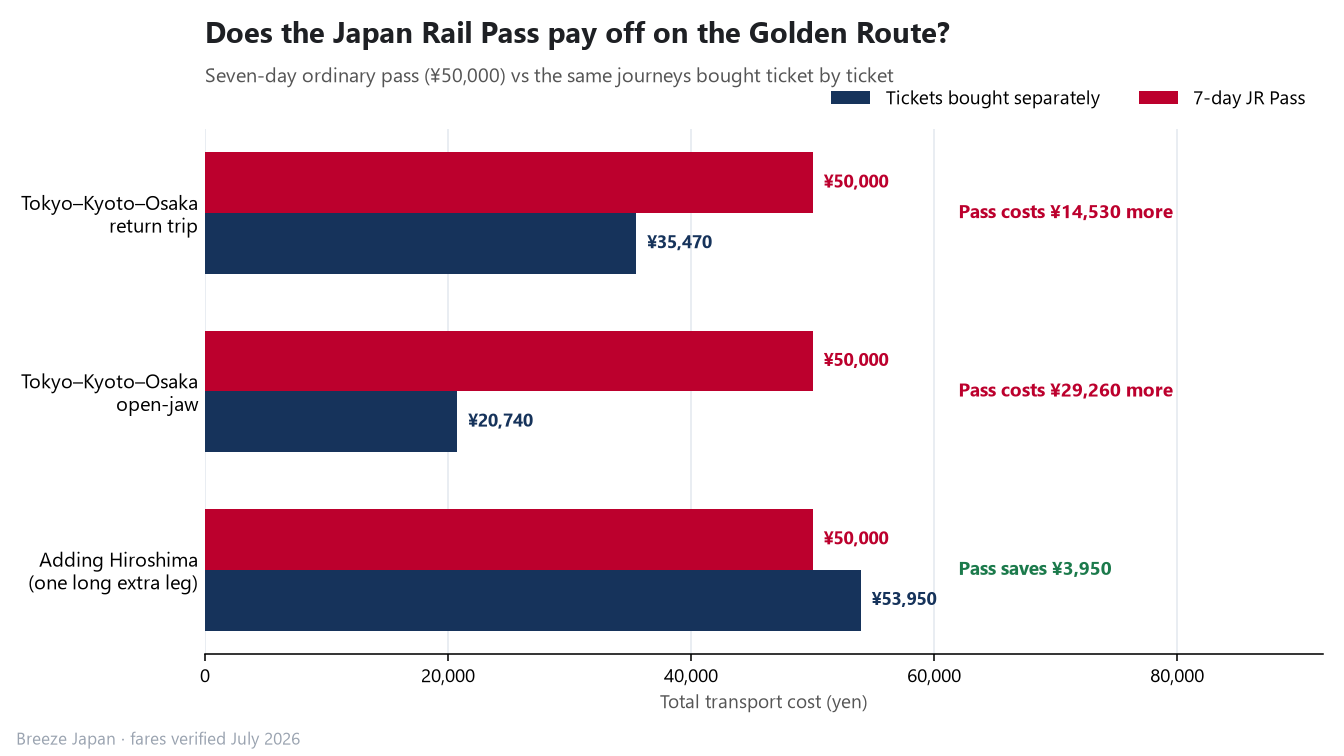
| Rail pass | the nationwide JR Pass loses money here. A seven-day pass is ¥50,000; the same journeys bought ticket by ticket run about ¥35,470 return, or ¥20,740 open-jaw. |
| Price rise | from 1 October 2026 the seven-day ordinary pass goes from ¥50,000 to ¥53,000 at overseas agents. The official reservation website is holding the old price for now. |
| What to buy | an IC card for city trains, two shinkansen tickets, and one day-trip pass. Nothing more complicated than that. |
| Budget | roughly ¥95,000 to ¥163,000 per person for seven days excluding flights, with accommodation the swing factor. |
1. What the Golden Route is, and whether it is right for you
2. How much of your week the route actually eats
3. Fly open-jaw: the biggest upgrade you can make
4. The Japan Rail Pass question: run the numbers before you buy
5. What to buy instead
6. The seven-day itinerary at a glance
7. Days 1 and 2: Tokyo
8. Day 3: choose exactly one day trip
9. Day 4: Tokyo to Kyoto
10. Day 5: Kyoto, east side
11. Day 6: Arashiyama or Nara, then move to Osaka
12. Day 7: Osaka, then Kansai Airport
13. Where to sleep: the three-base rule
14. Only four or five days? Cut a city, not the days
15. Ten days? This is where a rail pass finally makes sense
16. What a Golden Route week actually costs
17. When to go, and the three periods to avoid
18. Booking timeline: what to reserve and when
19. Six mistakes that wreck the route
20. Before you fly: the short checklist
1. What the Golden Route is, and whether it is right for you
The Golden Route is the Tokyo to Kyoto to Osaka corridor, and it earns its popularity honestly: it is the highest concentration of things worth seeing in Japan, connected by the best train line in the world. Roughly two thirds of first-time visitors follow some version of it.
The name comes from the Japanese travel trade, which has sold this exact corridor to inbound groups for decades. What it describes is simple geography. Tokyo and Osaka sit at either end of the Tokaido, the old highway along Japan’s Pacific coast, with Kyoto and Nagoya in between, and the Tokaido Shinkansen now runs that same line at 285 km/h.
Who it suits
| You are | Verdict |
|---|---|
| First time in Japan, one week or more | Yes. This is the route. Everything else is a variation on it. |
| First time, four or five days | Partly. Do Tokyo or Kansai, not both. See our compression plan below. |
| Travelling with young children or older parents | Yes, but slower. Two bases instead of three, and skip the day trip. |
| Second or third visit | No. Go to Kyushu, Hokkaido, Tohoku or the Setouchi islands instead. |
| Chasing cherry blossom or autumn colour | Yes, with warnings. The route is at its most beautiful and its most crowded at exactly the same time. |
The corridor is also the reason Japan feels easy for a first trip. English signage, luggage forwarding, 24-hour convenience stores and clockwork trains are all at their densest here. If you have never travelled in Asia before, this is the gentlest possible introduction.
If you are still deciding when to come at all, start with the best time to visit Japan, then come back here for the route.
2. How much of your week the route actually eats
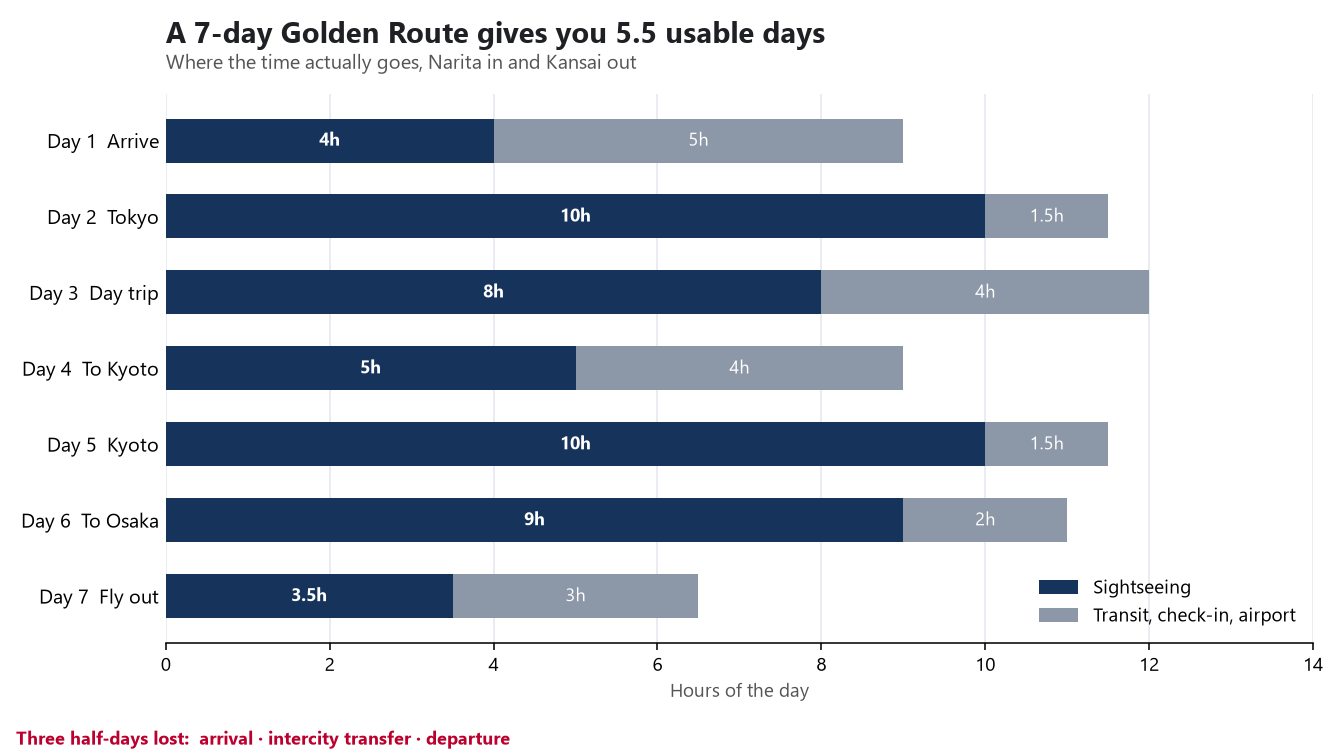
A seven-day Golden Route trip gives you about five and a half usable days, not seven. Arrival day, departure day and the two intercity transfers between them take the rest, and planning as though they do not is the single most common way people end up exhausted.
Here is where the time really goes on a standard Narita-in, Kansai-out week.
| Day | Lost to transit | Usable sightseeing |
|---|---|---|
| Day 1 — land at Narita | 3 to 5 hours (immigration, N’EX, check-in) | Half day at best, often an evening only |
| Day 2 — Tokyo | 1 to 2 hours of city trains | Full day |
| Day 3 — day trip | 3 to 4 hours return | Full day, but a tiring one |
| Day 4 — Tokyo to Kyoto | 4 hours door to door | Half day |
| Day 5 — Kyoto | 1 to 2 hours of buses | Full day |
| Day 6 — Kyoto to Osaka, via Nara | 2 hours | Full day |
| Day 7 — Osaka, fly out | 2 to 3 hours to Kansai Airport | Half day, or none on an early flight |
The half-day trap. Days 1, 4 and 7 are each about half a day of real sightseeing. Three half days is a day and a half gone. Build your must-see list around five full days and treat anything beyond that as a bonus.
Two things claw time back, and both are decisions you make before you leave home. Flying open-jaw removes the Osaka to Tokyo return leg. Sending your luggage ahead by takkyubin removes the suitcase from the Tokyo to Kyoto transfer, which is what turns that four-hour day into a three-hour one.
Everything else — earlier alarms, tighter schedules, skipping lunch — buys you far less than those two.
3. Fly open-jaw: the biggest upgrade you can make
Book your flights into Tokyo and out of Osaka, not a return to the same airport. On this route an open-jaw ticket usually costs the same or only slightly more, and it removes a ¥14,400 shinkansen ride plus roughly half a day of backtracking.
Airlines call this a multi-city or open-jaw booking: you fly into one city and out of another, with the gap covered on the ground. It is a standard fare construction, not a hack, and every major carrier and search engine supports it.
Which airports
| Airport | Serves | To city centre | Notes |
|---|---|---|---|
| Haneda (HND) | Tokyo | 25 to 45 min | Far closer than Narita. Worth paying a little more for. |
| Narita (NRT) | Tokyo | 60 to 90 min | Most long-haul and budget carriers. N’EX ¥3,070 to Tokyo Station. |
| Kansai (KIX) | Osaka, Kyoto, Nara | 50 min to Osaka, 75 min to Kyoto | Your departure airport. The foreign-visitor HARUKA one-way ticket is ¥1,800 to Shin-Osaka, ¥2,200 to Kyoto. |
| Itami (ITM) | Osaka | 30 min | Domestic only. Not an option for international departure. |
The direction matters. Fly into Tokyo and out of Kansai, not the reverse. Tokyo is the harder city to navigate jet-lagged, and it is better done at the start when your energy is highest and your legs are fresh. Kansai at the end also means your last day is in Osaka, which has the easiest airport run of the three cities.
If open-jaw is not available or not cheaper on your route, the fallback is to fly return into Tokyo and take the shinkansen back from Osaka on your final morning. Budget ¥14,400 and three hours, and stay near Shin-Osaka Station your last night.
Full airport transfer detail is in our guides to getting from Narita and Haneda into Tokyo and Kansai Airport to Kyoto and Osaka.
4. The Japan Rail Pass question: run the numbers before you buy
For a standard Golden Route week, the nationwide Japan Rail Pass loses you money. Not marginally — by roughly ¥15,000 on a return trip and nearly ¥29,000 on an open-jaw one. It is the most confidently repeated bad advice in Japan travel planning.
The pass was excellent value before October 2023, when a seven-day ordinary pass cost ¥29,650. That price rose 65% to ¥50,000, and the arithmetic of short, concentrated trips changed with it. Most guides never updated.
What the pass costs now
| Pass | Now (to 30 Sep 2026) | From 1 Oct 2026, overseas agents |
|---|---|---|
| 7-day ordinary | ¥50,000 | ¥53,000 |
| 14-day ordinary | ¥80,000 | ¥84,000 |
| 21-day ordinary | ¥100,000 | ¥105,000 |
| 7-day green car | ¥70,000 | ¥74,000 |
| 14-day green car | ¥110,000 | ¥116,000 |
| 21-day green car | ¥140,000 | ¥147,000 |
The increase was announced by the JR Group on 9 April 2026 and applies from 1 October 2026, local time at the point of purchase. Children aged 6 to 11 pay about half.
A quirk worth knowing. The October increase applies to overseas sales agents. The official JAPAN RAIL PASS reservation website is holding the current prices for a promotional period, with no end date announced at the time of writing. If you are travelling after October, check the official site against your agent before buying.
The actual arithmetic
Here is the same seven-day trip costed both ways. All shinkansen figures are Hikari reserved seats, because the pass does not cover Nozomi.
| Leg | Return trip | Open-jaw |
|---|---|---|
| Narita to Tokyo (N’EX round-trip ticket / one way) | ¥5,200 | ¥3,070 |
| Tokyo to Kyoto, Hikari reserved | ¥13,850 | ¥13,850 |
| Kyoto to Nara and back | ¥1,440 | ¥1,440 |
| Kyoto to Osaka, special rapid | ¥580 | ¥580 |
| Shin-Osaka to Tokyo, Hikari reserved | ¥14,400 | — |
| Shin-Osaka to Kansai Airport, HARUKA discounted one-way | — | ¥1,800 |
| Total paid per journey | ¥35,470 | ¥20,740 |
| Seven-day pass | ¥50,000 | ¥50,000 |
| The pass costs you | ¥14,530 more | ¥29,260 more |
Where the pass does win
Add one long leg beyond the three cities and the maths flips. Swap Nara for Hiroshima and you get:
| Leg | Fare |
|---|---|
| Narita to Tokyo, round trip | ¥5,200 |
| Tokyo to Kyoto | ¥13,850 |
| Kyoto to Hiroshima | about ¥10,500 |
| Hiroshima to Shin-Osaka | about ¥10,000 |
| Shin-Osaka to Tokyo | ¥14,400 |
| Total | about ¥53,950 |
| Pass saves you | about ¥3,950 |
The rule to remember. On Tokyo, Kyoto and Osaka alone, the nationwide pass never pays for itself. It breaks even only when you add at least one long return leg outside the three cities — Hiroshima, Kanazawa, Hakata or similar. Put another way, you need roughly ¥50,000 of JR travel, which is about four long shinkansen legs.
Two more things the pass does not do
It does not cover Nozomi or Mizuho. You can pay a supplement to ride them — ¥4,960 Tokyo to Kyoto, ¥4,180 Tokyo to Nagoya — but that makes the pass worse value, not better. On the pass you ride Hikari, which takes 2 hours 40 minutes to Kyoto against Nozomi’s 2 hours 13.
It does not cover private railways or subways. Tokyo Metro, Osaka Metro, Hankyu, Keihan, Kintetsu and Odakyu are all outside it, and those are the lines you will use most inside each city. Hakone is entirely private. So is the last stretch to Lake Kawaguchiko.
Our full JR Pass and shinkansen guide goes deeper on validity rules, seat reservations and the regional passes.
5. What to buy instead
For a Golden Route week you need three things: an IC card, two point-to-point shinkansen tickets, and one day-trip pass. That is the whole transport plan.
1. An IC card, for everything inside cities
Suica, Pasmo or ICOCA all work nationwide on trains, subways, buses and in convenience stores. Load ¥3,000 to ¥5,000 to start. City transport is where most of your daily travel actually happens, and no rail pass covers it well.
Since 2023 the physical cards have had supply problems, but the mobile versions on iPhone and Apple Watch work for foreign visitors and can be topped up with an overseas card. Set it up before you fly. Details in our Suica and ICOCA guide.
2. Two shinkansen tickets
Tokyo to Kyoto and, if you are not flying open-jaw, Osaka to Tokyo. Buy them at a station machine, at a JR ticket office, or online through SmartEX. Reserved seats cost a few hundred yen more than unreserved and are worth it with luggage.
| Leg | Nozomi reserved | Hikari reserved | Unreserved | Fastest |
|---|---|---|---|---|
| Tokyo to Kyoto | ¥14,170 | ¥13,850 | ¥13,320 | 2h13 |
| Tokyo to Shin-Osaka | ¥14,720 | ¥14,400 | ¥13,870 | 2h27 |
| Kyoto to Osaka | ¥580 on the JR special rapid | 28 min | ||
| Kyoto to Nara | ¥720 on the Miyakoji rapid | 45 min | ||
Without a pass, take the Nozomi. It is the fastest train, the price gap is about ¥320, and it runs several times an hour.
3. One day-trip pass, if the day trip needs it
| Day trip | What to buy | Price |
|---|---|---|
| Hakone | Hakone Freepass, 2 days from Shinjuku | ¥7,100 |
| Mount Fuji / Kawaguchiko | Fuji Excursion limited express, Shinjuku to Kawaguchiko | ¥4,200 each way |
| Nikko or Kamakura | Nothing special. Point-to-point or IC card. | — |
| Kansai-heavy trip instead of Tokyo | JR Kansai Wide Area Pass, 5 days | ¥12,000 |
Watch the Fuji Excursion split. A nationwide JR Pass covers Shinjuku to Otsuki only. The final stretch to Kawaguchiko runs on the private Fujikyu Railway and costs an extra ¥1,570 to ¥1,770, paid to the conductor or at the gate.
What about cash and cards
Cards are widely accepted in all three cities, but small restaurants, temple admissions, market stalls and some buses are still cash only. Carry ¥10,000 to ¥20,000 and top up at a 7-Eleven ATM, which reliably accepts foreign cards. See our guide to money, cash and cards in Japan.
6. The seven-day itinerary at a glance
Three nights Tokyo, two nights Kyoto, one night Osaka, with one day trip out of Tokyo. That distribution reflects how the cities actually work: Tokyo is enormous and needs time, Kyoto is compact but dense, and Osaka is best as a short, loud finish.
| Day | Base | Plan | Moving |
|---|---|---|---|
| 1 | Tokyo | Arrive, settle, easy evening in your neighbourhood | Airport to hotel |
| 2 | Tokyo | Old Tokyo: Asakusa, Ueno, riverside, evening in Shinjuku | City trains |
| 3 | Tokyo | Day trip: Hakone, Fuji, Nikko or Kamakura | 2 to 4 hours return |
| 4 | Tokyo to Kyoto | Morning in Shibuya or Harajuku, afternoon shinkansen, Kyoto evening | Shinkansen 2h13 |
| 5 | Kyoto | East Kyoto: Fushimi Inari at dawn, Higashiyama, Gion | Buses and short trains |
| 6 | Kyoto to Osaka | Arashiyama or Nara, then move to Osaka for the evening | 30 to 60 min |
| 7 | Osaka | Castle or market morning, then Kansai Airport | 50 min to KIX |
Why not two nights in Osaka
Osaka rewards a night and a morning, not two full days. Its pleasures are concentrated — eating in Dotonbori, the castle, Kuromon market, Umeda at night — and most of its famous day trips (Nara, Kobe, Himeji) are equally reachable from Kyoto.
If Universal Studios Japan is on your list, that changes everything: it is a full day, and you need a second Osaka night. Our Universal Studios Japan guide covers ticket timing and Express Pass strategy.
Reverse it if you land at Kansai. The route works identically backwards: Osaka, Kyoto, then Tokyo, flying out of Haneda or Narita. Everything below applies in reverse order.
7. Days 1 and 2: Tokyo
Give day one almost nothing to do, then use day two for the eastern, older half of the city. Jet lag from a long-haul flight is real, and the most common first-trip mistake is scheduling a full day of sightseeing for the afternoon you land.
Day 1 — arrival
Immigration and baggage at Narita takes 45 to 90 minutes, and the N’EX another hour. If you land at 15:00 you are realistically at your hotel by 18:00.
Plan an evening within walking distance of where you sleep: a convenience store haul, a bowl of ramen, a first walk through a lit-up shopping street. Do not book anything with a time on it.
Do these three things on arrival. Buy or activate your IC card, pick up cash from an airport ATM, and confirm your Tokyo to Kyoto shinkansen seats if you have not already. All three take ten minutes at the airport and save you an hour later.
Day 2 — old Tokyo
Start at Senso-ji in Asakusa early, ideally before 08:30, when the approach street is quiet. Then walk or take a short train to Ueno for the park and museums, or cross the river for the Tokyo Skytree. Senso-ji Temple, Asakusa, TokyoMap
Afternoon options that pair well: Akihabara for electronics and anime, Yanaka for a low-rise old neighbourhood almost no first-timer sees, or the Imperial Palace East Gardens if the weather is good.
Finish in Shinjuku after dark. Omoide Yokocho and Golden Gai give you the narrow-alley, red-lantern Tokyo that photographs well and tastes better than it looks.
Our neighbourhood deep dives cover this ground properly: Asakusa, Shinjuku and Shibuya, and the full Tokyo travel guide covers everything these two days leave out.
How to move around Tokyo
The subway, not JR. Tokyo Metro and Toei between them cover almost everything you want, and the JR Yamanote line handles the big loop. Tap your IC card and stop thinking about it.
Budget ¥800 to ¥1,200 a day on city transport. A Tokyo Metro 24-hour ticket (¥800) pays off only if you make five or more subway trips in a day, which is more moving than a good day involves.
8. Day 3: choose exactly one day trip
Pick one of Hakone, Mount Fuji, Nikko or Kamakura, and accept that you cannot do two. Each is a full day out of Tokyo, and the choice comes down to what you want the day to feel like rather than which is objectively best.
| Day trip | Why go | Time out | Cost | Weather risk |
|---|---|---|---|---|
| Hakone | Hot springs, lake, ropeway, volcanic valley, art museums. The most varied day. | 2h each way | ¥7,100 Freepass | Moderate — the ropeway closes in high wind |
| Mount Fuji / Kawaguchiko | The mountain itself, close up, from a lakeside town. | 2h each way | ¥4,200 each way | High — the mountain hides behind cloud most summer days |
| Nikko | The most ornate shrine complex in Japan, in cedar forest and mountains. | 2h each way | about ¥6,000 return | Low |
| Kamakura | Great Buddha, coastal temples, a beach town an hour from the city. | 1h each way | about ¥2,000 return | Low |
How to choose
Short on time or energy? Kamakura. It is an hour each way, needs no special pass, and you can be back in Tokyo for dinner without rushing.
Want the classic Japan postcard? Nikko, for Tosho-gu and the mountain scenery, which is reliable in a way Fuji is not.
Want variety in a single day? Hakone. The Freepass loop uses a mountain railway, a cable car, a ropeway, a pirate ship on the lake and a bus, and each leg looks different.
Must see Fuji? Go, but go in winter if you have the choice. From December to February the mountain is visible on most clear mornings. In June to August it is often hidden all day, and people come home with photographs of grey cloud.
Do not attempt Fuji and Hakone on the same day trip. Both are day-long commitments, they connect awkwardly, and the combined route means five hours on transport. It is a well-worn tourist mistake.
Each has its own full guide: Hakone, Mount Fuji and Kawaguchiko, Nikko and Kamakura.
The Tokyo Disney alternative
If you are travelling with children, day three is also where Tokyo Disneyland or DisneySea fits. It is a full, exhausting, expensive day, and it replaces the day trip rather than adding to it. See Tokyo Disneyland versus DisneySea.
9. Day 4: Tokyo to Kyoto
Take a mid-afternoon shinkansen, not a morning one. You get a final half day in Tokyo, you arrive in Kyoto in time for dinner, and you avoid paying for a Kyoto hotel night you spend on a train.
The move, step by step
| Time | What |
|---|---|
| Morning | Shibuya crossing, Meiji Shrine, Harajuku, or Tsukiji Outer Market for an early lunch |
| By 13:00 | Collect luggage from the hotel, or have it already forwarded |
| 14:00 to 15:00 | Nozomi from Tokyo or Shinagawa Station, 2h13 to Kyoto |
| 17:00 to 18:00 | Check in, then walk out into Kyoto in the evening |
Forward your luggage
Hotel-to-hotel takkyubin costs ¥2,000 to ¥3,000 per large suitcase and takes one night. Hand it in at your Tokyo hotel front desk before about 10:00 and it reaches Kyoto the following afternoon.
The catch is timing: your bag arrives the day after you do. Pack an overnight bag with one change of clothes and your toiletries and travel with only that. Shinkansen luggage racks are limited and oversized bags now require a reserved space, so this is genuinely easier as well as lighter.
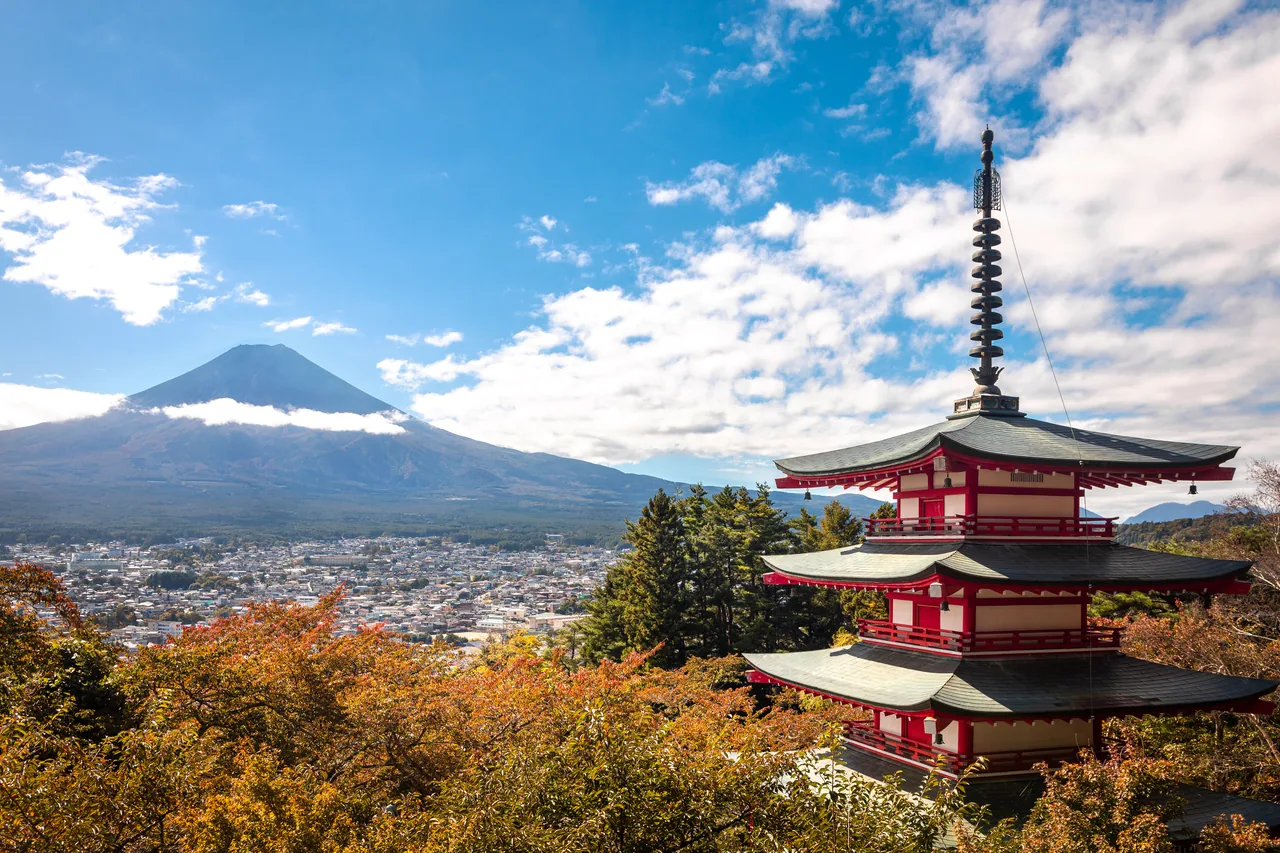
Which side for Fuji? Sit on the right-hand side travelling Tokyo to Kyoto, which is seat E in an ordinary car. On a clear day Mount Fuji appears about 40 minutes out, between Shin-Fuji and Shizuoka, and is visible for roughly five minutes.
First evening in Kyoto
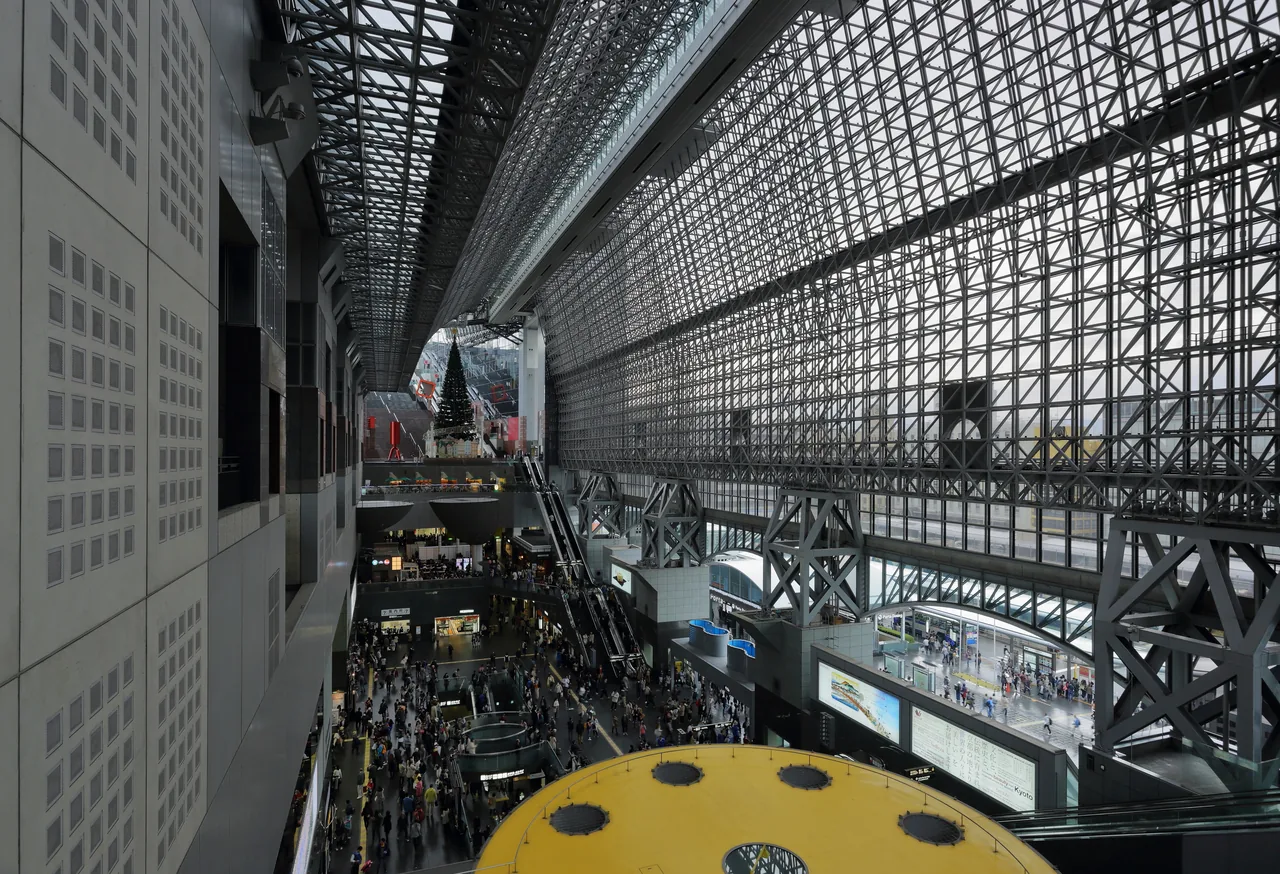
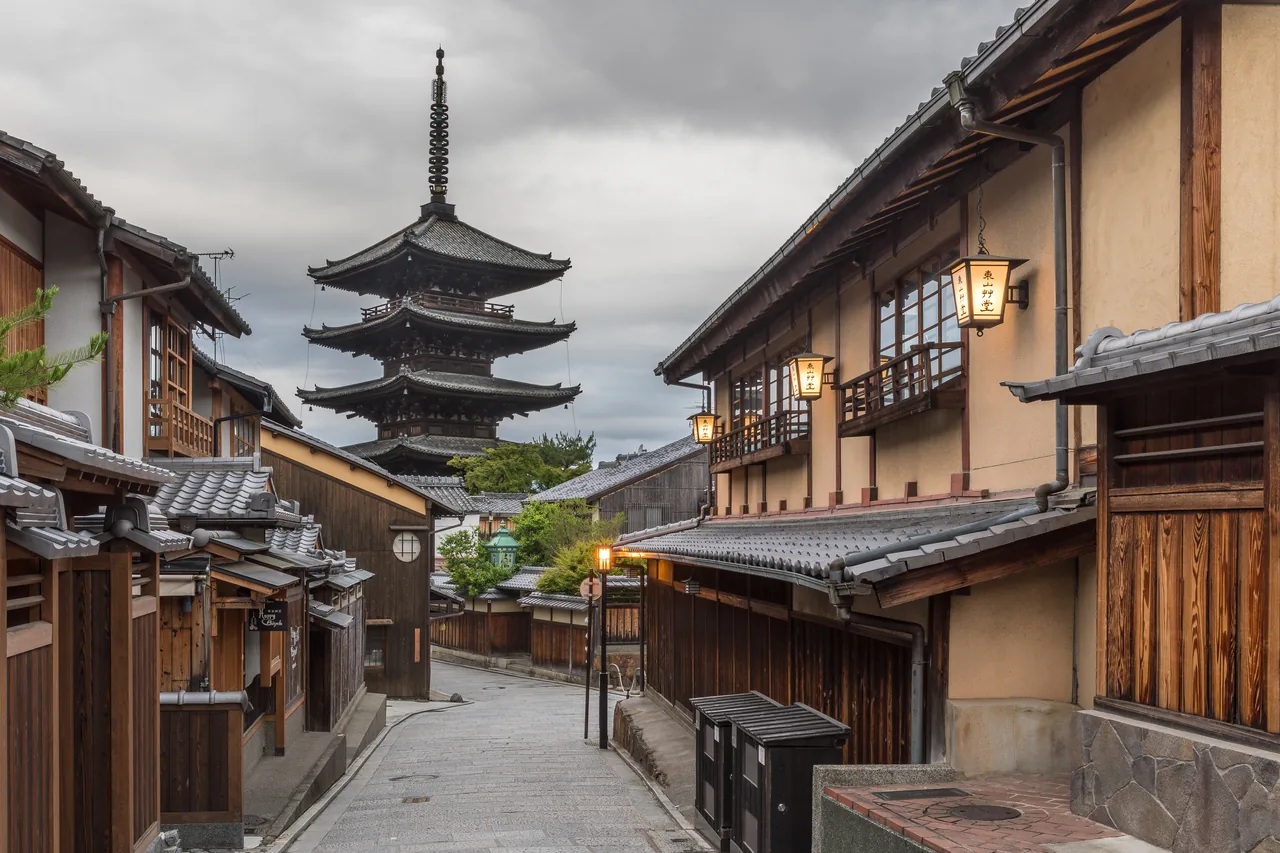
Do not start temple-hunting at 18:00. Instead walk the Gion and Pontocho district while the lanterns come on, or eat your way along Nishiki Market’s evening end and the covered arcades around Shijo.
Kyoto’s major sites close between 16:00 and 17:00, which surprises people. Your evenings here are for streets, food and the odd illuminated temple, not sightseeing proper.
10. Day 5: Kyoto, east side
Start at Fushimi Inari before 07:00, then work north through Higashiyama on foot. Kyoto’s eastern hills hold most of what you came for, and they connect in a single walkable line — but only if you beat the crowds to the first stop.
The dawn start is not optional
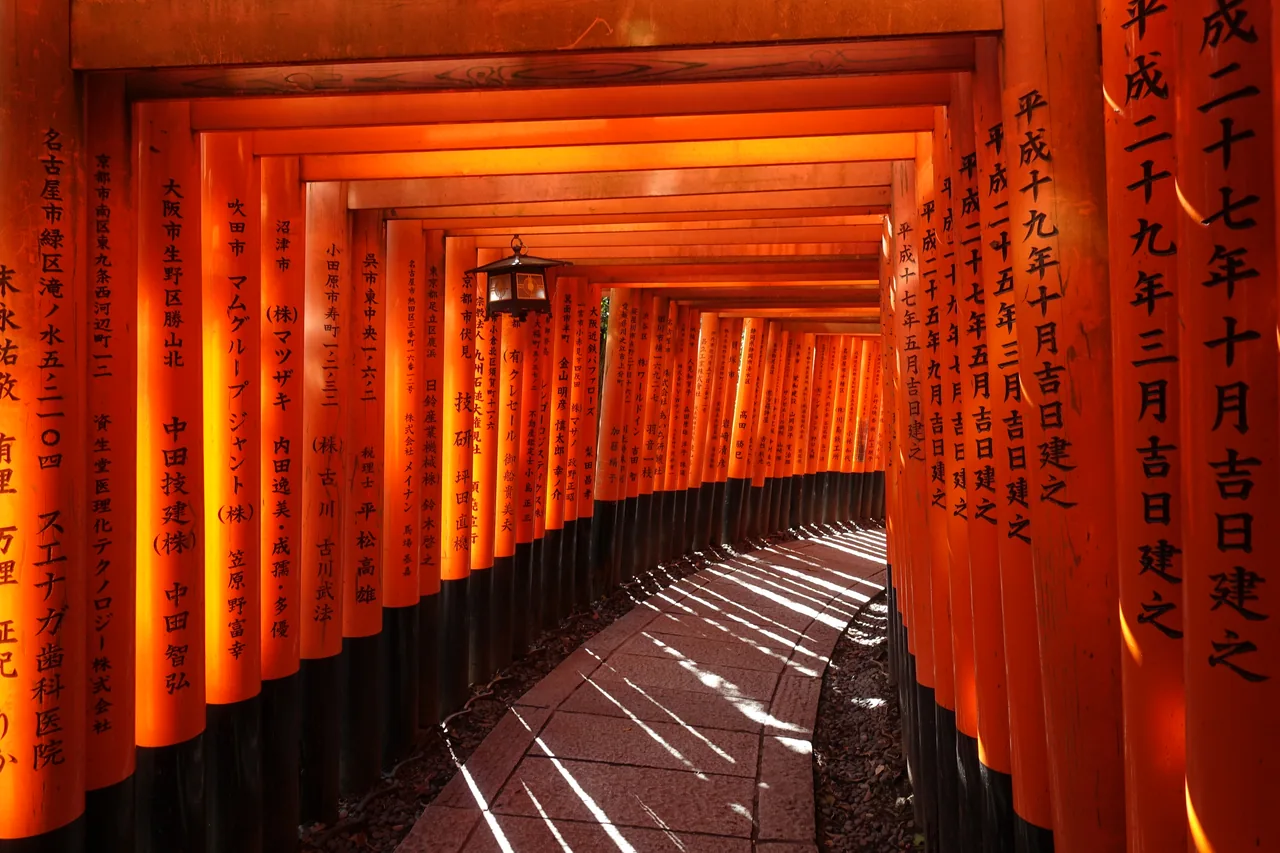
Fushimi Inari Taisha is free and open 24 hours. By 09:30 the lower torii tunnels are a slow-moving queue of people photographing each other. At 06:30 they are close to empty, and the light through the vermilion gates is at its best. Fushimi Inari Taisha, KyotoMap
Walk up to the Yotsutsuji viewpoint, about 30 to 45 minutes, for the city view. The full summit loop takes 2 to 3 hours and, honestly, the gates thin out above Yotsutsuji.
The rest of the day
| Time | Stop | Note |
|---|---|---|
| 06:30 to 08:30 | Fushimi Inari | Free. Two stops from Kyoto Station on the JR Nara line. |
| 09:30 to 11:00 | Kiyomizu-dera | ¥500. The approach lanes, Sannenzaka and Ninenzaka, are half the pleasure. |
| 11:00 to 13:00 | Walk north through Higashiyama | Kodai-ji, Yasaka Shrine, Maruyama Park. Lunch anywhere along here. |
| 14:00 to 16:00 | Ginkaku-ji and the Philosopher’s Path | ¥1,000. A 2 km canal walk, best in cherry blossom or autumn. |
| 17:00 onward | Gion, dinner | Quiet lanes, wooden machiya, the occasional geiko hurrying to an appointment. |
Photography rules in Gion. Private alleys in the Gion Shirakawa and Hanamikoji area ban photography, with fines of up to ¥10,000, after years of tourists harassing geiko and maiko. Photograph the public streets, never the people, and never follow anyone.
Getting around Kyoto
Kyoto’s subway is small and the city runs on buses, which are slow and crowded in peak season. Two practical fixes: use the JR and Keihan lines where they happen to go your way, and walk more than you would in Tokyo.
Taxis are reasonable for two or more people over short hops, typically ¥1,000 to ¥2,000 across the centre, and they save real time between eastern temples.
The full Kyoto travel guide covers the western and northern districts this day leaves out.
11. Day 6: Arashiyama or Nara, then move to Osaka
Spend the morning on one more Kansai highlight, then move to Osaka in the late afternoon — the hop takes under 30 minutes and costs ¥580. This is the easiest transfer of the whole trip, which is why it belongs on a sightseeing day rather than getting a day of its own.
Pick one: Arashiyama or Nara
| Arashiyama | Nara | |
|---|---|---|
| From Kyoto | 20 min, ¥240 | 45 min, ¥720 |
| The draw | Bamboo grove, Togetsukyo bridge, Tenryu-ji, monkey park, riverside | Todai-ji’s Great Buddha, 1,200 free-roaming deer, Kasuga Taisha |
| Time needed | Half day | Most of a day |
| Crowds | Severe. The bamboo path is shoulder to shoulder by 09:00. | Spread over a large park, so it absorbs people better. |
| Best for | Wanting more Kyoto | Wanting something Kyoto does not have |
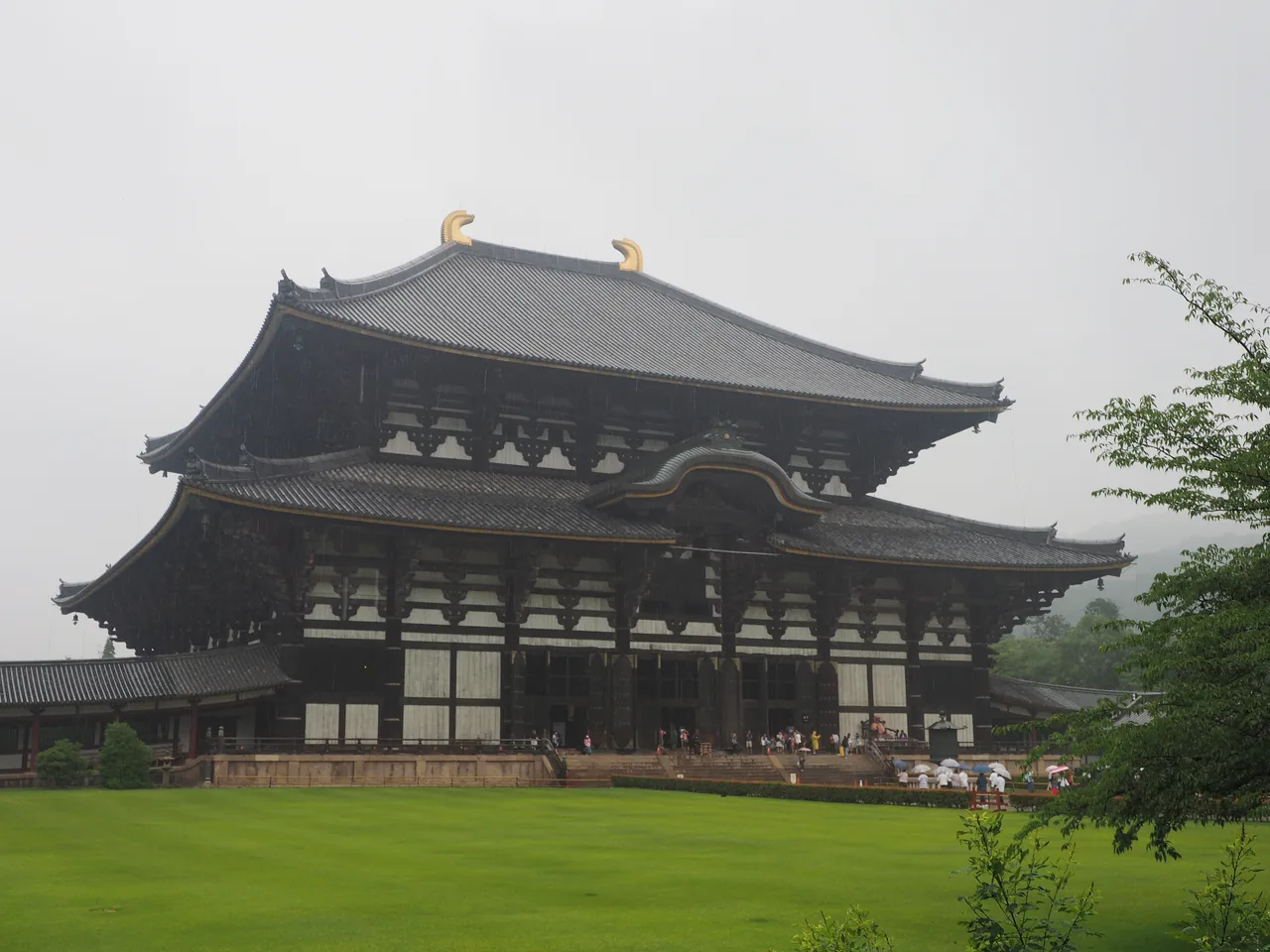
Our pick is Nara, if you only do one. Todai-ji’s Great Buddha Hall is the largest wooden building most people will ever stand inside, the deer are genuinely charming, and the scale of the park makes it the least crowded major site in Kansai. Todai-ji, NaraMap
Arashiyama wins if you are travelling in autumn, when the hills behind Tenryu-ji turn, or if you simply do not want a second long day. Go at 07:30 and the bamboo grove is almost yours.
Full detail in our Nara day trip guide.
The move to Osaka
Kyoto to Osaka is 28 minutes on the JR special rapid for ¥580, running several times an hour. Nara to Osaka is about 45 minutes on the Kintetsu or JR line, so you can go straight there without doubling back to Kyoto.
Check which Osaka station you want. JR arrives at Osaka Station in Umeda, in the north. The Dotonbori and Namba nightlife district is 10 minutes further south by subway. Book your hotel knowing which one you are near.
The first Osaka evening
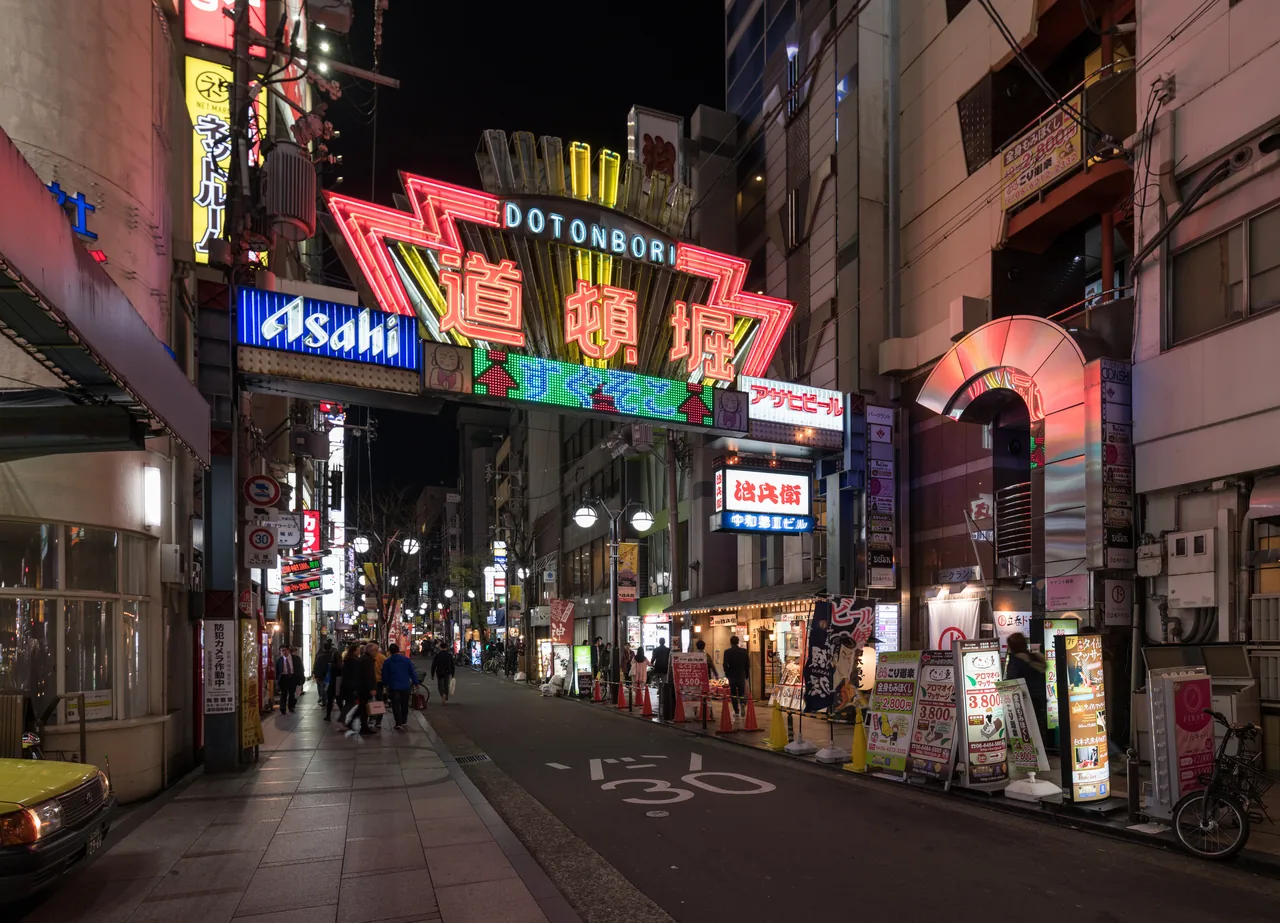
Go straight to Dotonbori after dark. The canal, the neon, the running Glico man sign and the street food stalls are the reason Osaka exists on most itineraries, and it is at its best between 19:00 and 22:00.
Eat standing up and eat several things: takoyaki, okonomiyaki, kushikatsu, and a late bowl of ramen. Osaka’s nickname is tenka no daidokoro, the nation’s kitchen, and one sit-down dinner wastes the opportunity. Dotonbori, OsakaMap
The full Osaka travel guide covers the districts and day trips a single night cannot reach.
12. Day 7: Osaka, then Kansai Airport
How much of day seven you get depends entirely on your flight time, so work backwards from it before planning anything. Kansai Airport is 50 to 75 minutes from central Osaka, and you want to be there two to three hours before an international departure.
| Your flight | Leave the city by | What you can fit in |
|---|---|---|
| Before 11:00 | 07:00 | Nothing. Sleep, eat breakfast, go. |
| 13:00 to 15:00 | 09:30 | Kuromon Market breakfast, or a quick castle exterior |
| 16:00 to 18:00 | 12:30 | Osaka Castle properly, or Umeda Sky Building, plus lunch |
| After 19:00 | 15:30 | A full half day. Castle, market and a last shopping run. |
The best short morning in Osaka
Kuromon Ichiba Market opens around 09:00 and is a ten-minute walk from Namba. Grilled scallops, uni, wagyu skewers and fruit, eaten standing between the stalls. It is touristy and it is still good.
Osaka Castle takes about two hours including the park. The keep is a 1931 concrete reconstruction with a museum inside, so the grounds and the outer moat walls are the real attraction. Osaka CastleMap
Getting to Kansai Airport
| From | Service | Time | Fare |
|---|---|---|---|
| Shin-Osaka | JR HARUKA limited express | 50 min | ¥1,800 foreign-visitor ticket (¥2,910 reserved / ¥2,380 non-reserved at the regular fare) |
| Namba | Nankai Rapi:t | 38 min | about ¥1,500 |
| Namba | Nankai airport express | 45 min | about ¥970 |
| Kyoto | JR HARUKA | 75 min | ¥2,200 foreign-visitor ticket (about ¥3,050 non-reserved at the regular fare) |
Leave earlier than feels necessary. Kansai Airport has long security and immigration queues at peak departure banks, typically late morning and early evening. Add a Japan tax-free refund check and a last souvenir run and three hours disappears. See our tax-free shopping guide for what has to be sealed and unopened.
Buy the HARUKA discounted one-way ticket. If you hold a foreign passport and entered on Temporary Visitor status, JR West sells a discounted one-way HARUKA ticket at ¥1,800 to Shin-Osaka and ¥2,200 to Kyoto, against a regular fare of ¥2,910 and about ¥3,580. Seats in the dedicated cars can be reserved free up to 30 days ahead through the WEST-QR site.
There is also an international tourist tax built into your ticket price. It tripled from ¥1,000 to ¥3,000 on 1 July 2026, though tickets issued on or before 30 June 2026 still pay the old ¥1,000. It is explained in our departure tax guide.
13. Where to sleep: the three-base rule
Book three hotels, not six, and put each of them next to a major station. On a route this compressed, minutes spent dragging luggage to and from stations are the difference between a relaxed week and a tiring one.
Tokyo — three nights
Stay near a Yamanote line station. Shinjuku and Tokyo Station give you the best onward access, Shibuya the best nightlife, Ueno and Asakusa the best value and the easiest Narita run.
If you are flying open-jaw and moving on to Kyoto, a hotel near Tokyo or Shinagawa Station makes day four painless.
Kyoto — two nights
Kyoto Station is the practical choice: every bus starts there, the shinkansen leaves from there, and it is the easiest arrival with luggage. Downtown Kawaramachi and Gion cost more and put you inside the evening scene.
Kyoto has the tightest hotel supply of the three cities and prices roughly double in cherry blossom and autumn foliage season. Book Kyoto first, before the other two.
Osaka — one night
Namba if you want to walk to Dotonbori and have an easy Nankai run to the airport. Umeda if you arrive by JR and want the Haruka from Shin-Osaka. Shin-Osaka only if you have a very early departure.
A note on Japanese hotel rooms. Standard business hotel rooms run 12 to 18 square metres and beds are narrow. If two of you want space, filter for rooms above 20 square metres or book an apartment-style hotel, which are common in Osaka and Kyoto.
Our neighbourhood-by-neighbourhood breakdowns: where to stay in Tokyo, where to stay in Kyoto and where to stay in Osaka.
14. Only four or five days? Cut a city, not the days
With four or five days, do Tokyo or Kansai, not both. Squeezing the full route into five days means two of them are spent moving, and you end up with a blurred sense of three cities instead of a real sense of one.
This is the most useful thing in this guide for anyone flying from within Asia, where short trips are the norm and flights are cheap enough to come back.
| You have | Do this | Not this |
|---|---|---|
| 4 days | Tokyo only, with one day trip | Tokyo plus Kyoto |
| 5 days | Kyoto 2 nights, Osaka 2 nights, Nara day trip. Fly in and out of Kansai. | Tokyo, Kyoto and Osaka |
| 6 days | The full route, but drop the day trip on day three | The full route plus a day trip |
| 7 days | The full route as written above | Adding Hiroshima |
The five-day Kansai plan
Kansai is the better choice for a short first trip. Kyoto, Osaka and Nara sit within 45 minutes of each other, so you get three distinct places with almost no transit cost.
| Day | Plan |
|---|---|
| 1 | Land at Kansai, Haruka to Kyoto, evening in Gion |
| 2 | Fushimi Inari at dawn, Higashiyama walk, Kiyomizu-dera |
| 3 | Arashiyama morning, Kinkaku-ji, move to Osaka |
| 4 | Nara day trip, Dotonbori at night |
| 5 | Osaka Castle or Kuromon Market, fly home |
Transport for the whole five days: an ICOCA card and about ¥3,000 of point-to-point tickets. No pass of any kind is worth buying.
The four-day Tokyo plan is simpler still. Three days in the city across Asakusa, Shibuya, Shinjuku and Akihabara, plus one day trip to Kamakura or Hakone. Fly in and out of Haneda if you can.
15. Ten days? This is where a rail pass finally makes sense
Add Hiroshima, Kanazawa or the Japan Alps and the seven-day rail pass stops being a bad deal. Ten days is also the point at which the Golden Route stops feeling like a checklist and starts feeling like a trip.
| Extension | Add | Where it slots in | Why |
|---|---|---|---|
| Hiroshima and Miyajima | 2 nights | After Kyoto, before Osaka | Peace Memorial Park and the floating torii. The most affecting stop on any Japan itinerary. |
| Kanazawa | 2 nights | Between Tokyo and Kyoto | Kenroku-en garden, a surviving samurai district and the best seafood market outside Tokyo. |
| Takayama and Shirakawa-go | 2 nights | Via Nagoya | Preserved Edo streets in the Japan Alps and thatched farmhouses. See our Takayama guide. |
| Hakone plus Fuji | 2 nights | Between Tokyo and Kyoto | Turns the rushed day trip into a proper onsen stay. |
| Nagoya | 1 to 2 nights | Between Tokyo and Kyoto | Ghibli Park, castle, and the easiest base for the Alps. See our Nagoya guide. |
The pass maths at ten days
A Tokyo, Kanazawa, Kyoto, Hiroshima, Osaka route racks up four long shinkansen legs plus airport transfers, which lands somewhere between ¥55,000 and ¥70,000 in point-to-point tickets. A seven-day pass at ¥50,000 now wins, and a 14-day pass at ¥80,000 is worth checking.
Time your pass, do not just buy it. The pass runs on consecutive calendar days from activation, so activate it on the morning of your first long journey, not when you land. On a ten-day trip with three city-stay days at the start, a seven-day pass covering days four to ten beats a 14-day pass covering days one to fourteen.
Note that Kanazawa is reached on the Hokuriku Shinkansen, whose base fares rose with the JR East revision of 14 March 2026. The Tokaido Shinkansen between Tokyo, Kyoto and Osaka was unaffected.
16. What a Golden Route week actually costs
Budget ¥95,000 to ¥150,000 per person for seven days excluding international flights, or roughly ¥14,000 to ¥21,000 a day. Accommodation is the variable that moves the total most; transport, once you skip the rail pass, is a surprisingly small share.
| Category | Lean | Comfortable | Generous |
|---|---|---|---|
| Accommodation, 6 nights | ¥42,000 hostels, budget business hotels | ¥78,000 mid business hotels, ¥13,000/night | ¥150,000+ 4-star, ryokan night |
| Intercity transport | ¥16,000 | ¥21,000 | ¥26,000 green car |
| City transport, 7 days | ¥5,000 | ¥7,000 | ¥12,000 some taxis |
| Food, 7 days | ¥21,000 ¥3,000/day, convenience stores and chains | ¥42,000 ¥6,000/day | ¥84,000+ ¥12,000/day, one kaiseki dinner |
| Admissions and one day trip | ¥11,000 | ¥15,000 | ¥25,000 |
| Total | about ¥95,000 | about ¥163,000 | ¥300,000+ |
Where the money actually goes
Two costs dominate and both are booked before you leave: hotels and the two shinkansen tickets. Everything else is elastic.
Food in Japan is the pleasant surprise. A genuinely good bowl of ramen is ¥900 to ¥1,300, a convenience store breakfast is ¥500, and a set lunch at a decent restaurant is ¥1,000 to ¥1,800. You have to try to spend a lot.
Tax-free shopping applies from ¥5,000 in a single store on the same day, at stores displaying the tax-free logo, with your passport. Since 2026 the rules changed to a refund-at-departure model for some categories, so keep receipts and allow airport time. Details in our tax-free guide.
17. When to go, and the three periods to avoid
Late October to early December and late March to April are the best windows, and Golden Week, Obon and New Year are the three to avoid outright. On a route this popular, timing changes the experience more than anything else in this guide.
| Period | Weather | Crowds | Verdict |
|---|---|---|---|
| Mar–Apr, cherry blossom | 10 to 18°C, changeable | Extreme | Beautiful, expensive, book 6 months out |
| Late Apr–early May, Golden Week | Pleasant | Avoid | Domestic holiday. Trains and hotels sell out. |
| Jun–mid Jul, rainy season | Humid, wet | Low | Cheap and quiet. Fuji rarely visible. |
| Mid Jul–Aug | 32 to 36°C, humid | High | Genuinely hard walking weather. Typhoon risk from August. |
| Mid Aug, Obon | Hot | Avoid | The other domestic travel peak. |
| Sep–Oct | 22 to 28°C, easing | Moderate | Strong choice. Typhoon season runs to October. |
| Nov–early Dec, autumn colour | 10 to 18°C, clear | High in Kyoto | The best all-round window |
| Late Dec–early Jan, New Year | Cold, clear | Avoid 29 Dec to 3 Jan | Much of the country closes |
| Jan–Feb | 2 to 10°C, dry | Lowest | Cheapest, clearest Fuji views, coldest mornings |
Our pick is the second half of November. Kyoto’s maples peak, the air is clear, Fuji is usually visible, and it is comfortable walking weather. Kyoto hotel prices reflect this, so book early.
If you are travelling between August and October, read our Japan typhoon season guide — trains suspend pre-emptively and a single storm can cost you a day. Our month-by-month breakdowns cover September, October and November in detail.
18. Booking timeline: what to reserve and when
Almost nothing on the Golden Route needs booking months ahead — except hotels in peak season, and the handful of attractions that sell out instantly. Knowing which is which saves both money and anxiety.
| When | Book |
|---|---|
| 4 to 6 months out | Flights (open-jaw). Kyoto hotels if travelling in cherry blossom or autumn season. |
| 2 to 3 months out | All hotels for any other season. Ghibli Museum tickets, which release on the 10th of the previous month and sell out in minutes. |
| 1 month out | Universal Studios Japan tickets and Express Passes. teamLab. Tokyo Disney if travelling on a weekend. |
| 1 month out | Shinkansen reserved seats open exactly 1 month ahead. Only necessary in peak season or with oversized luggage. |
| 1 to 2 weeks out | An eSIM. Any guided tours or cooking classes. |
| On the day | Almost every temple, shrine, museum and restaurant. Japan is not a reservations culture for ordinary sightseeing. |
Oversized luggage now needs a reservation. On the Tokaido, Sanyo and Kyushu shinkansen, bags whose combined dimensions exceed 160 cm require a free reserved seat with luggage space. Turning up without one risks a ¥1,000 penalty. Most check-in suitcases are fine; only the largest cases cross the line.
What you genuinely do not need
You do not need a rail pass, as covered above. You do not need to pre-book city transport, restaurant reservations for ordinary meals, or airport transfers. You do not need a pocket wifi if you have an eSIM.
You also do not need to pre-plan every hour. The route’s density means the difference between a good day and a great one is usually leaving room in it.
19. Six mistakes that wreck the route
Almost every disappointing Golden Route trip goes wrong in one of the same six ways. None of them are about choosing the wrong sights.
1. Buying the rail pass by reflex
Covered at length above. On this route it costs you ¥15,000 to ¥29,000 for nothing. Run the arithmetic against your actual legs before you buy.
2. Booking a return flight into one airport
Flying open-jaw is usually the same price and gives back half a day plus ¥14,400. Search multi-city before you search return.
3. Treating day one as a sightseeing day
Between immigration, the airport train and check-in, arrival day gives you an evening. Schedule accordingly and you start the trip rested instead of behind.
4. Adding a fourth city
Hiroshima, Kanazawa or Takayama inside seven days means another two travel half-days out of a week that already has three. Either extend to ten days or leave it for next time.
5. Arriving at famous sites at 10:00
Fushimi Inari, Kiyomizu-dera, the Arashiyama bamboo grove and Nara’s deer park are all transformed by an early start. The difference between 07:00 and 10:00 at Fushimi Inari is the difference between the photograph you imagined and a queue.
6. Underestimating Tokyo’s scale
Tokyo is not a city you walk between districts in. Shibuya to Asakusa is 40 minutes on the subway. Group each day by area rather than by attraction and you will halve your transit time.
The recoverable version of all six: fly open-jaw, skip the pass, wake early, and do fewer places properly. That is the whole guide in one line.
20. Before you fly: the short checklist
Six things to sort before you leave, none of which take more than fifteen minutes.
| Do this | Why |
|---|---|
| Check your visa status | Most Western passports get 90 days visa-free, Taiwan and Hong Kong likewise. Mainland Chinese passports need a visa. See our Japan visa guide. |
| Register on Visit Japan Web | Pre-fills immigration and customs. Saves 15 to 30 minutes at Narita. |
| Set up a mobile IC card | Suica or ICOCA in Apple Wallet, topped up with an overseas card before you land. |
| Buy an eSIM | Data from the moment you land, no counter queue, no pocket wifi to return. |
| Download offline maps | Google Maps offline for Tokyo, Kyoto and Osaka. Transit directions in Japan are excellent. |
| Bring cash and one backup card | ¥20,000 to start. 7-Eleven ATMs accept foreign cards reliably; many bank ATMs do not. |
Two cultural notes that save awkwardness: tipping does not exist and is refused if offered, and eating while walking is frowned on outside festival streets and market stalls. Our Japan etiquette guide covers the rest without making it complicated.
And when you get back and start planning trip two, our complete Japan travel guide covers the regions this route deliberately leaves out.