
Where to Stay in Hiroshima: Station, Downtown, Peace Park or Miyajima
Every tram ride in the city costs the same 240 yen, so the area you pick barely changes what you spend getting around. What it changes is your mornings and your evenings.
| Getting around | Hiroden trams charge a flat 240 yen for adults across the whole network, city lines and the Miyajima line alike. |
|---|---|
| Hiroshima Station | the tram platform moved up to the second floor of the station building in August 2025, so luggage never meets a staircase. |
| Lodging tax | Hiroshima Prefecture charges 200 yen per person per night on check-ins from 1 April 2026, with nothing due below 6,000 yen before tax. |
| Miyajima | the island adds a 100 yen visitor tax, charged once on the way in no matter how many nights you stay. |
| Last ferry | 22:14 from the island and 22:42 from Miyajimaguchi, so staying on Miyajima still leaves room for an evening in the city. |
1. The four areas, side by side
2. How the city is laid out, before you pick
3. Hiroshima Station: luggage never meets a staircase
4. Downtown: Kamiyacho through to Hatchobori
5. Peace Memorial Park and Otemachi: the mornings are different
6. Miyajima: what is left after the last boat
7. The mainland side at Miyajimaguchi, and Miyahama Onsen
8. Motoujina: a pier at the front door
9. Time and money between the areas
10. Two taxes that never appear at checkout
11. How many nights changes the answer
12. Who you are travelling with changes it too
13. What actually creates the price gap
14. The dates that are fixed, and when to book early
15. Island or city, decided properly
16. What older guides still get wrong
17. What to check on the booking page
18. Where Hiroshima sits in the wider trip
1. The four areas, side by side
There are four places in Hiroshima where it makes sense to book a room: around Hiroshima Station, the downtown stretch running from Kamiyacho through to Hatchobori, Otemachi beside the Peace Memorial Park, and the island of Miyajima itself, which you reach by boat.
| Area | Nearest tram stop | What only this area gives you | Price band |
|---|---|---|---|
| Hiroshima Station | Hiroshima, on the second floor of the station building | Wheeling a suitcase to the Shinkansen without stepping outside | Mid |
| Downtown: Kamiyacho, Hondori, Hatchobori | Hondori, Hatchobori | The densest run of places still open in the evening | Mid to high |
| Peace Memorial Park and Otemachi | Genbaku Dome-mae, Chuden-mae | Walking into the park before anyone else arrives | Mid |
| Miyajima island | None, the ferry instead | Being on the island after the last boat has gone | High |
Those four places feel quite different from one another, and yet the cost of moving between them is almost identical. Hiroden trams went to a flat adult fare of 240 yen across the whole network in February 2025, which erased the old split between the city lines and the Miyajima line. The usual reasoning about staying near a station to save on transport does not really apply here.
What does change is what your mornings and evenings look like. The Peace Memorial Park is quietest at first light, downtown comes alive after dark, and Miyajima becomes a different place once the last ferry has taken the day visitors home. One trip will not give you all three, so the choice is which one you want.
Three more places worth knowing about
The table above covers the areas that suit most visitors. Three others come into play once your circumstances are a little more specific.
| Area | When it fits |
|---|---|
| The mainland side at Miyajimaguchi | You want the first ferry of the day but the island rates are steep |
| Miyahama Onsen | You have a car and want a hot spring night after the island |
| Motoujina | You want to board a boat to Miyajima from your own hotel’s pier |
What to see and eat in Hiroshima, and how the trams work once you are on one, sits in the Hiroshima travel guide.
2. How the city is laid out, before you pick
Central Hiroshima is small enough to walk. You can go from the Peace Memorial Park through the Hondori arcade and out the far end at Hatchobori without it feeling like a trek. It does not divide into distinct neighbourhoods the way Tokyo or Osaka do, where the district you sleep in shapes the whole day.
The one exception is Hiroshima Station, which sits apart from everything else. How many times a day you cross that gap is the real difference between staying by the station and staying in the middle.
Two of the three city areas are within a short walk of each other
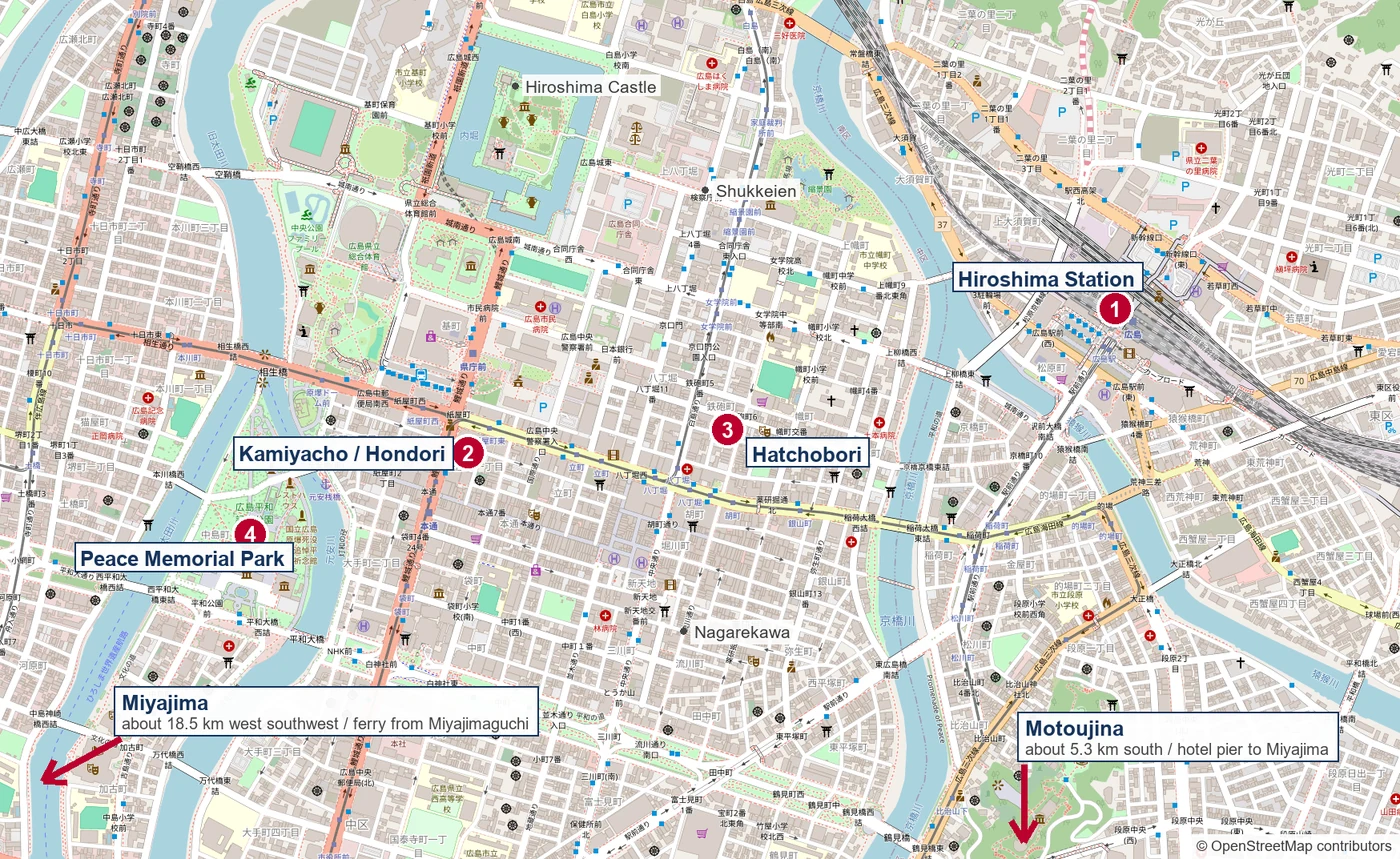
Put actual distances on the map and the idea of four separate areas starts to look overstated.
| Between | Straight-line distance |
|---|---|
| Kamiyacho and Peace Memorial Park | about 570 m |
| Hondori and Peace Memorial Park | about 620 m |
| Hondori and Hatchobori | about 600 m |
| Hatchobori and Nagarekawa | about 510 m |
| Hiroshima Station and Hatchobori | about 1 km |
| Hiroshima Station and Peace Memorial Park | about 2.2 km |
Kamiyacho to the Peace Memorial Park is 570 metres, a walk of a few minutes. Agonising over which of those two is closer to the sights is not a good use of your time. The thing that actually differs is what you find when you step out of the front door: an arcade of shops on one side, a riverbank on the other.
Hiroshima Station is the outlier. At 2.2 km from the park it is too far to walk comfortably with a day of sightseeing ahead, so you take the tram. Count how often you expect to make that trip and you will know whether the station area suits you.
Six rivers do the dividing
The centre sits on a delta, so the rivers act as the boundaries between areas. The Peace Memorial Park occupies a narrow strip between the Motoyasu and the Hon rivers, and downtown begins on the far bank to the east. When you look at a map, whether a route crosses a bridge is a reasonable proxy for whether it crosses between areas.
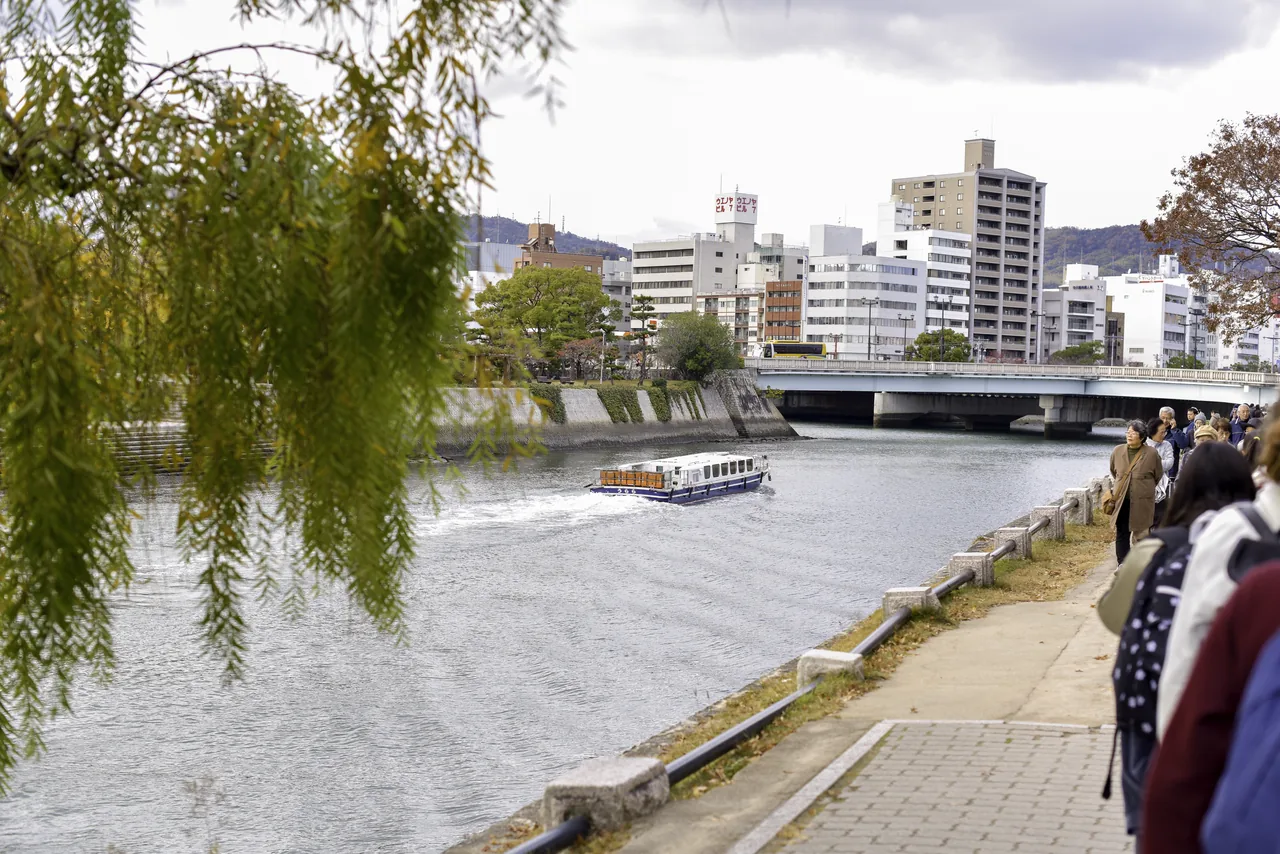
All that water also means there is a walkable riverside almost everywhere. An evening stroll near your hotel is possible whichever area you choose, and the paths on the Otemachi side link up particularly well.
Tram lines go to different places
Lines 1, 2, 5 and 6 serve Hiroshima Station. Of those, only line 2 continues out to Miyajimaguchi. If you expect to make the island trip more than once, it is worth checking whether line 2 stops near where you are booking.
A loop line opened on 28 March 2026, running clockwise and anticlockwise during the daytime hours when visitors are out. It circles the centre, so most trips will touch it somewhere.
3. Hiroshima Station: luggage never meets a staircase
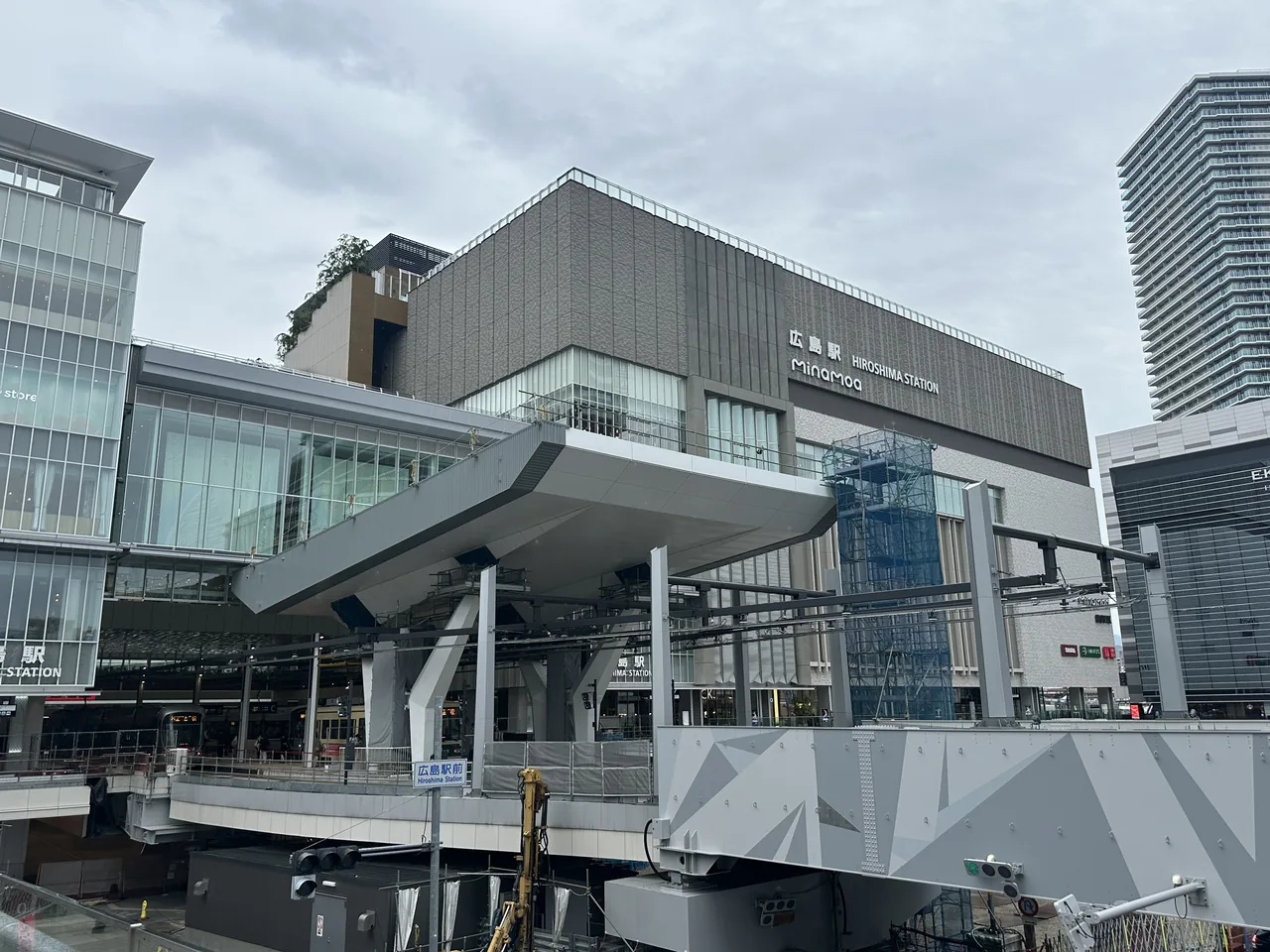
The area around Hiroshima StationMap changed twice in 2025. A new station building called minamoa opened on the south side in March, and in August the tram platform moved up onto the second floor of that building.
The second floor part matters when you are choosing a hotel. The JR ticket gates for both the local lines and the Shinkansen sit on that level, and the tram platform is directly in front of them. You do not carry a suitcase up or down stairs, and you do not get rained on. The old routine of walking out to a street-level stop in front of the station is gone.
The south side, around minamoa
This is where the new station building stands. Roughly 200 shops and restaurants are inside, which means dinner and a morning coffee can both happen without leaving the building. The tram platform is on this side too.
| Hotel | From the station | Price band |
|---|---|---|
| HOTEL GRANVIA HIROSHIMA SOUTH GATE 📷 Photos & rates | about 50 m | Mid to high |
| Hiroshima Ekimae Green Hotel 📷 Photos & rates | about 270 m | Mid |
| Sotetsu Fresa Inn Hiroshima 📷 Photos & rates | about 310 m | Mid |
| Nest Hotel Hiroshima Ekimae 📷 Photos & rates | about 410 m | Mid |
| Koko Hotel Hiroshima Ekimae 📷 Photos & rates | about 480 m | Lower mid |
| Guesthouse Akicafe Inn 📷 Photos & rates | about 290 m | Low |
The north side, the Shinkansen exit
The Shinkansen gates are on this side, along with the older shopping complex ekie. The airport limousine bus also stops at the Shinkansen exit. Hiroshima Airport is 1,500 yen and about 50 minutes away, so if you are flying out, the short walk to the bus on your last morning is what this side is worth.
| Hotel | From the station | Price band |
|---|---|---|
| Hotel Granvia Hiroshima 📷 Photos & rates | about 160 m | High |
| Sheraton Grand Hiroshima Hotel 📷 Photos & rates | about 240 m | High |
| VIA INN PRIME HIROSHIMA SHINKANSENGUCHI JR-West 📷 Photos & rates | about 250 m | Mid |
| Daiwa Roynet Hotel Hiroshima-Ekimae 📷 Photos & rates | about 320 m | Mid |
| Toyoko Inn Hiroshima-Eki Shinkansen-Guchi No.2 📷 Photos & rates | about 400 m | Lower mid |
The case for this area is easy to state. It suits a single night before a Shinkansen out, heavy luggage, and anyone using the airport bus. What it does not suit is an evening spent wandering, because the station surroundings go quiet after dark compared with downtown.
If several Shinkansen legs are in your plan, work out the JR Pass maths before you commit to anything.
4. Downtown: Kamiyacho through to Hatchobori
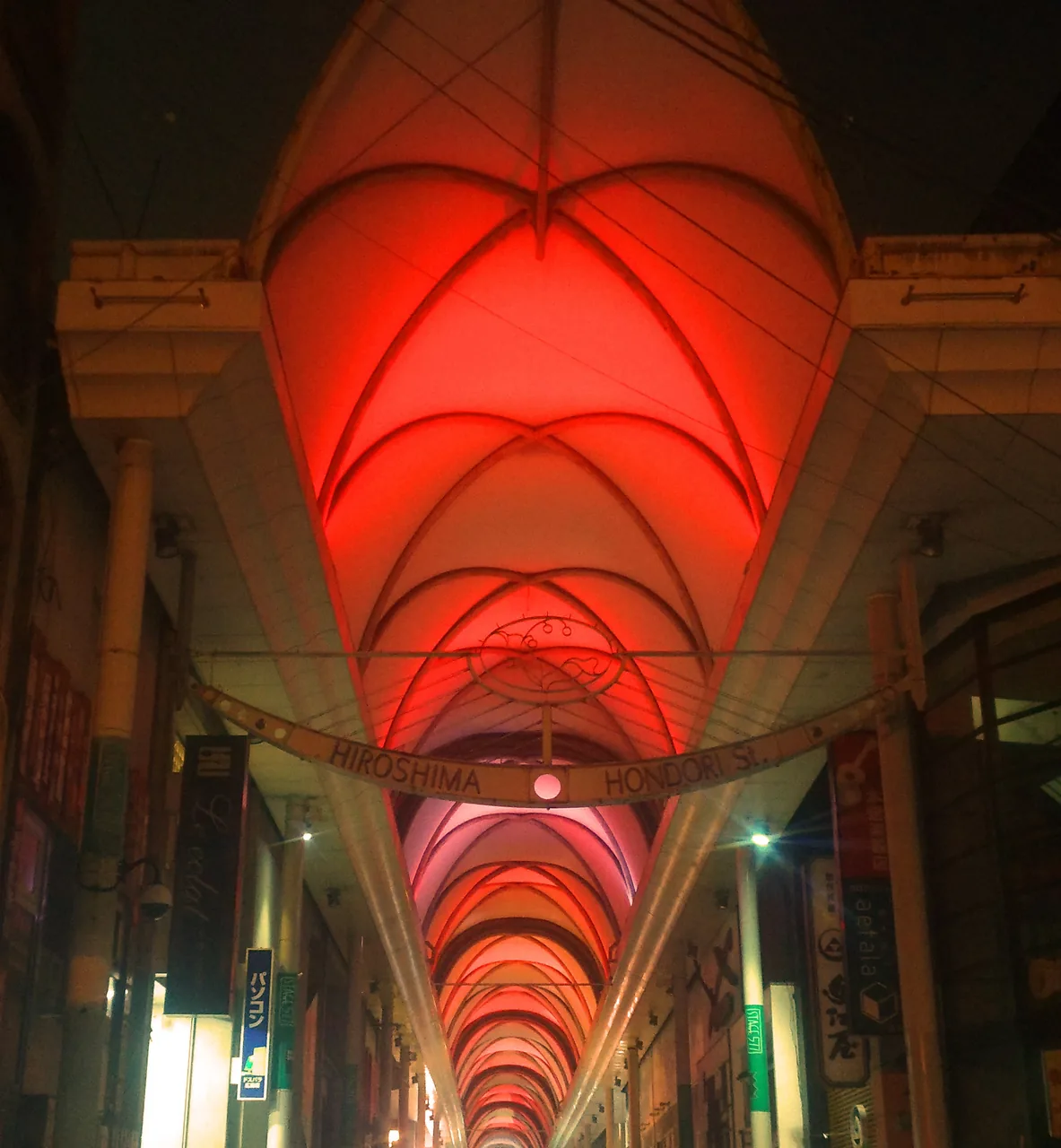
This is where the most places are still open in the evening. The arcade along HondoriMap runs east to west, and its eastern end is HatchoboriMap. One block south of there you are in Nagarekawa and Yagenbori.
It is also the area that holds up best in the rain. The arcade is roofed, so you can move through the shopping street without an umbrella.
Kamiyacho and Hondori, the daytime half
Department stores and the covered shopping streets are concentrated here, and tram stops come one after another. Hiroshima Castle and Shukkeien are both within walking distance.
| Hotel | From Kamiyacho | Price band |
|---|---|---|
| RIHGA Royal Hotel Hiroshima 📷 Photos & rates | about 330 m | High |
| ANA Crowne Plaza HIROSHIMA by IHG 📷 Photos & rates | about 460 m | High |
| Hotel Hokke Club Hiroshima 📷 Photos & rates | about 450 m | Mid |
| Chidori Inn Fukuromachi Hiroshima 📷 Photos & rates | about 240 m | Mid |
| Hondori Inn 📷 Photos & rates | about 280 m | Mid |
| Urbain Hiroshima Central 📷 Photos & rates | about 640 m | Lower mid |
| Small Hotel – Hostel 📷 Photos & rates | about 260 m | Low |
Hatchobori and Nagarekawa, the evening half
NagarekawaMap and Yagenbori together form the largest nightlife quarter in the Chugoku and Shikoku regions, with bars and restaurants running late. Put the other way round, a street-facing room here will not necessarily be quiet on a Saturday night.
| Hotel | From Hatchobori | Price band |
|---|---|---|
| Hilton Hiroshima 📷 Photos & rates | about 510 m | High |
| Tokyu Stay Mercure Hiroshima 📷 Photos & rates | about 480 m | Mid to high |
| Hotel Intergate Hiroshima 📷 Photos & rates | about 630 m | Mid to high |
| Mitsui Garden Hotel Hiroshima 📷 Photos & rates | about 430 m | Mid |
| Candeo Hotels Hiroshima Hatchobori 📷 Photos & rates | about 500 m | Mid |
| Nest Hotel Hiroshima Hatchobori 📷 Photos & rates | about 370 m | Mid |
| Hiroshima Washington Hotel 📷 Photos & rates | about 180 m | Mid |
| WeBase Hiroshima 📷 Photos & rates | about 420 m | Low |
| Capsule Hotel Cube Hiroshima 📷 Photos & rates | about 450 m | Low |
A washing machine in the room is more useful than it sounds when Hiroshima is a waypoint. On a longer loop through western Japan this becomes the place where you do laundry before moving on.
How the two halves differ in practice
Kamiyacho and Hondori work in daylight and go fairly quiet in the evening. Hatchobori and Nagarekawa do the opposite. They are 500 to 600 metres apart, so you are never far from either, and the decision comes down to which one you want directly outside the door rather than a short walk away.
If you are travelling alone and plan to eat out properly, the Hatchobori end is the more convenient of the two. If you are with family, the Hondori end keeps the nightlife at arm’s length while still leaving the arcade at your feet.
5. Peace Memorial Park and Otemachi: the mornings are different
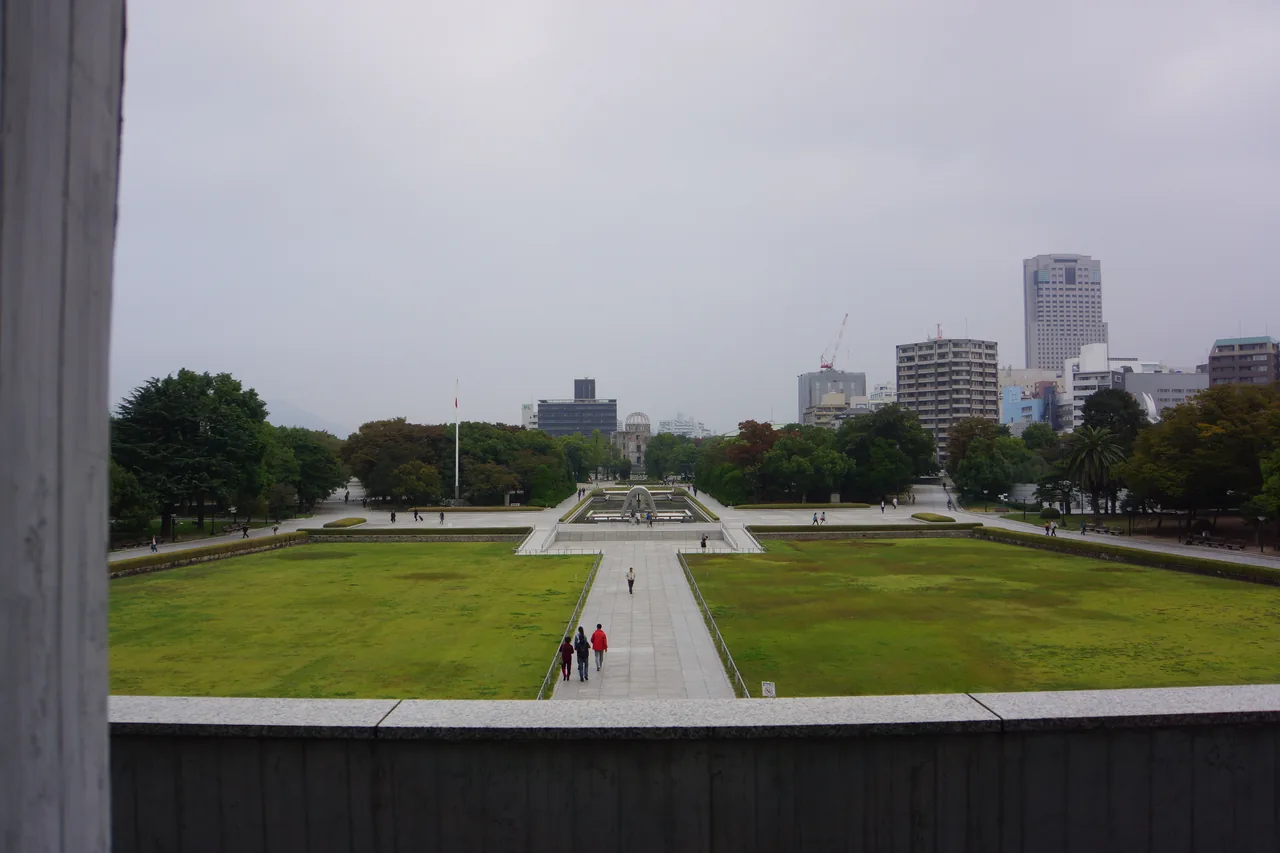
This covers the streets west and south of Peace Memorial ParkMap, mostly in Otemachi. The reason to choose it comes down to one thing: you can walk into the park before the tour buses arrive.
Neither the park nor the Atomic Bomb Dome is fenced, so early morning is not a problem. The museum keeps opening hours, but the grounds do not. When the walk from your hotel is five minutes, you end up going once before breakfast and again after dinner, and that is a different experience from stopping by once in the middle of a day.
| Hotel | From the park | Price band |
|---|---|---|
| THE KNOT HIROSHIMA 📷 Photos & rates | about 460 m | Mid to high |
| Dormy Inn Hiroshima 📷 Photos & rates | about 580 m | Mid |
| Daiwa Roynet Hotel Hiroshima 📷 Photos & rates | about 640 m | Mid |
| HOTEL MYSTAYS Hiroshima Peace Park 📷 Photos & rates | about 380 m | Mid |
| Hotel S-Plus Hiroshima Peace Park 📷 Photos & rates | about 560 m | Mid |
| Comfort Hotel Hiroshima Otemachi 📷 Photos & rates | about 600 m | Lower mid |
| HOTEL LiVEMAX Hiroshima Heiwa Koen-Mae 📷 Photos & rates | about 300 m | Lower mid |
| Grand Base Hiroshima Peace Memorial Park 📷 Photos & rates | about 340 m | Mid |
| J-Hoppers Hiroshima Guesthouse 📷 Photos & rates | about 460 m | Low |
What separates it from downtown
The Hondori arcade is only a little over 600 metres away, so going out for dinner is no hardship. The difference is what happens outside the door afterwards. It is quiet, and you are less likely to be woken by noise than you would be a few streets east.
For families this is the area to look at first. The riverside paths connect, which makes an evening walk easy, and you never have to route yourself through the nightlife district to get home.
When to rule it out
A single night followed by an early Shinkansen does not sit well here. The station is 2.2 km away, which means luggage and a tram on a morning when you are already watching the clock.
It also falls down if your evening involves moving between several places. Otemachi has restaurants, but not at downtown density. One dinner and back is fine; a circuit of two or three adds up in walking.
Does crossing the river count as leaving the area
Because the park occupies a narrow strip between two rivers, almost every hotel here is technically across the water in Otemachi or Nakajima, with a bridge in between. There are enough bridges that it never feels like a detour, so the distance a listing quotes to the park is the distance you will actually walk.
What there is to see inside the park, what the museum costs and how long it takes, is covered in the Hiroshima travel guide.
6. Miyajima: what is left after the last boat
MiyajimaMap is administratively part of Hatsukaichi, not Hiroshima City. You get there by boat, and that single fact turns staying there into a different sort of decision.
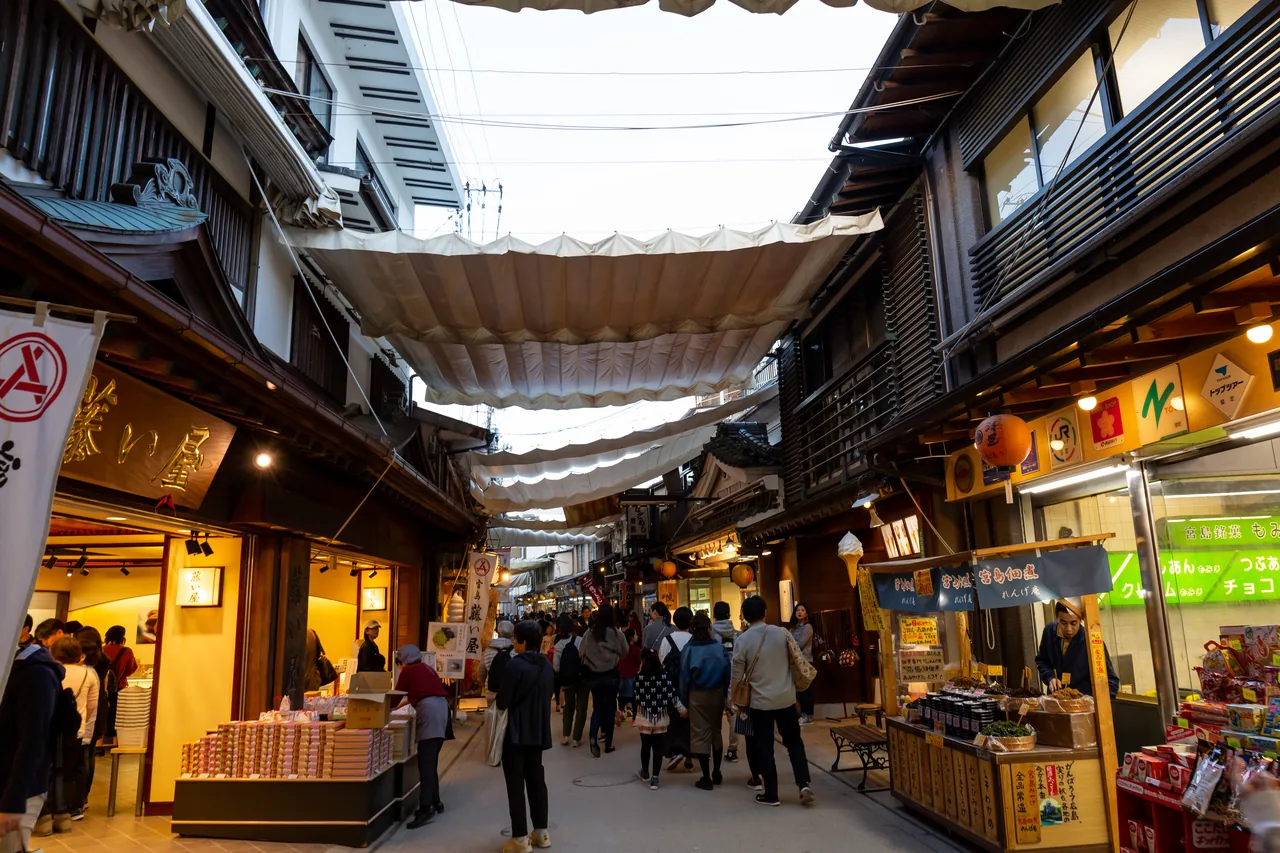
The reason to do it is that the island in the evening is not the island in the afternoon. Day visitors leave on the late boats, the shopping street empties out, and what remains is the deer and the lights. The same is true the other way round in the morning, before the first arrivals come across.
The ferry timetable sets the shape of your day
| Direction | First | Last | One way |
|---|---|---|---|
| Miyajimaguchi to the island | 05:00 | 22:42 | 200 yen |
| Island to Miyajimaguchi | 05:45 | 22:14 | 200 yen |
Through the day the boats run every fifteen minutes, so waiting is rarely an issue. The last services are late enough that staying on the island and going into the city for the evening still works. Miss the last one, though, and there is no fallback. There is no bridge.
Where the island accommodation sits
Almost all of it lines the walk from the pier towards the shrine. Ryokan dominate, and most sell dinner and breakfast as part of the rate, which is why the numbers sit clearly above the city.
| Accommodation | From the pier | Price band |
|---|---|---|
| Iwaso 📷 Photos & rates | about 500 m | High |
| Kinsuikan 📷 Photos & rates | about 120 m | High |
| Itsukushima Iroha 📷 Photos & rates | about 30 m | High |
| Hotel Miya Rikyu 📷 Photos & rates | about 90 m | High |
| Miyajima Grand Hotel Arimoto 📷 Photos & rates | about 410 m | High |
| Jukeiso 📷 Photos & rates | about 730 m | Mid to high |
| Sakuraya 📷 Photos & rates | about 110 m | Mid |
| Miyajima Machiya Hotel Shiomachi-An 📷 Photos & rates | about 640 m | Mid |
| Miyajima Guest House Mikuniya 📷 Photos & rates | about 550 m | Low |
Because the tax is per visit rather than per night, a three night stay is still 100 yen in total. The reverse also holds: base yourself in the city and cross on two consecutive days and you pay it twice. There is an annual pass at 500 yen for anyone crossing repeatedly.
Position on the island matters too
Everything is on the same walk, but the character shifts along it. Places right by the pier are easy with luggage and easy to time against the boats. Further round, past the shrine, it is quieter but the walk grows and picks up some gradient.
Iwaso sits about 500 metres in, up towards the valley. It has been operating since 1753, and the building and setting are the point rather than the convenience. At the other end of the scale, Itsukushima Iroha and Kinsuikan are a minute or two from the pier and sell access instead.
Work backwards from the dinner service
Ryokan serve dinner at a set time, and arriving after it can mean missing a meal you have already paid for. From Hiroshima Station the tram takes about 70 minutes, the ferry ten, and then there is the walk, so allow at least an hour and a half door to door.
Taking JR instead cuts that by more than half. If the dinner slot is tight, plan around the train rather than the tram.
7. The mainland side at Miyajimaguchi, and Miyahama Onsen
If the island rates look steep but you still want to be on the first boat, there is a middle option: the mainland at MiyajimaguchiMap, where the ferries leave from.
Staying here means the first crossing is easy to make. Boats start at 05:00, so being on the island at sunrise is genuinely achievable. Rates sit below the island ryokan, and since the visitor tax is charged once on entry, that part of the cost is identical either way.
| Hotel | From the pier | Price band |
|---|---|---|
| Miyajima Coral Hotel 📷 Photos & rates | about 150 m | Mid |
| Simple Stay Miyajima 📷 Photos & rates | about 60 m | Lower mid |
| Bar & Hotel Colors Miyajima 📷 Photos & rates | about 170 m | Lower mid |
| Grandvrio Hotel Miyajima Wakura 📷 Photos & rates | about 850 m | Mid |
| Aki Grand Hotel & Spa 📷 Photos & rates | about 1 km | Mid to high |
The trade on the mainland side
The evening island. You still have to be on a boat before the last one, which puts you in the same position as a day visitor. The morning is what the mainland side hands back, and for a lot of people the morning is the better half anyway: the tide is often more photogenic and the light comes from behind the torii rather than into it.
Dinner needs checking in advance. The choice around Miyajimaguchi is nothing like Hiroshima downtown, and places geared to daytime visitors close in the evening. Confirming whether your hotel serves dinner is the safe move.
Going a little further for a hot spring
Miyahama OnsenMap is the closest hot spring village to Miyajima. It is about 5 km from JR Miyajimaguchi, roughly ten minutes by car, and about 2 km from JR Ōnoura, which is closer again.
That is not a distance you cover on foot or by tram, so it needs a car or a hotel shuttle. It fits an itinerary where the island is the daytime and the hot spring is the night. How ryokan pricing is put together is covered in the Japan onsen and ryokan guide.
8. Motoujina: a pier at the front door
About 5 km south of the centre, MotoujinaMap has effectively one hotel. What it also has is something nowhere else offers: a boat pier of its own.
Setonaikai Kisen high-speed boats connect Hiroshima Port, the Prince Hotel pier and Miyajima. From the Prince Hotel pier the island is about 26 minutes away.
| Route | Adult | Child | Time |
|---|---|---|---|
| Prince Hotel pier to Miyajima | 2,300 yen | 1,150 yen | about 26 min |
| Hiroshima Port to Prince Hotel pier | 1,450 yen | 730 yen | about 26 min |
| Hiroshima Port to Miyajima | 2,300 yen | 1,150 yen | about 32 min |
At 2,300 yen this is far more expensive than the ordinary route. Hiroshima Station to Miyajimaguchi is 240 yen on the tram and the ferry is 200 yen, so the conventional way costs 440 yen. What the boat buys is the absence of a change. With luggage or with children, that can be worth the difference.
Because the frequency is low, this only works if a boat trip to Miyajima is a fixed part of the plan. If your days are mostly in the city, you will be heading out to catch a tram anyway, and the pier stops being an advantage.
Getting into town
Five kilometres out means an evening downtown involves a journey. It is not a walk, and the tram network out here is not as dense as it is in the centre. Treat it as a place where dinner happens on site.
The sea view and the distance from city noise are what you are paying for. If your idea of an evening is deciding where to eat once you are already outside, this is the wrong choice.
9. Time and money between the areas
Because the tram fare is flat, there is very little arithmetic to do. Any journey, anywhere on the network, is 240 yen for adults and 120 yen for children.
| Route | Mode | Fare | Time |
|---|---|---|---|
| Hiroshima Station to Hatchobori or Kamiyacho | Hiroden | 240 yen | about four minutes quicker since the platform moved |
| Hiroshima Station to Miyajimaguchi | Hiroden line 2 | 240 yen | about 70 min |
| Hiroshima Station to Miyajimaguchi | JR Sanyo Line | separate fare | about 28 min |
| Miyajimaguchi to the island | Ferry | 200 yen | about 10 min |
| Hiroshima Airport to the Shinkansen exit | Limousine bus | 1,500 yen | about 50 min |
Choosing between the tram and JR out to Miyajimaguchi is a question of time rather than money. Seventy minutes against twenty-eight is a gap of more than forty minutes each way. Once in a trip, the tram is fine. Twice or more and the train starts to matter.
How many tram rides a day, by area
| Where you stay | A city day | A Miyajima day |
|---|---|---|
| Hiroshima Station | 480 yen return | 480 yen return plus 400 yen of ferry |
| Downtown | mostly on foot | 480 yen return plus 400 yen of ferry |
| Peace Memorial Park | mostly on foot | 480 yen return plus 400 yen of ferry |
The flat fare means the island trip costs the same from every area. Only the city days differ, and downtown and the park are both walkable enough that some days involve no tram at all.
So the spread in daily transport is a few hundred yen. Room rates move by more than that, which is why picking an area to save on fares does not really work in Hiroshima.
If you are using the airport
Staying near the station keeps the airport simple, because the limousine stops at the Shinkansen exit. From anywhere else you take a tram to the station first and then transfer, which is one extra move with bags.
That said, the constraint only touches your arrival and departure days. On a stay of three nights or more, the other days should probably decide it. What IC cards will and will not cover is set out in the IC card guide.
10. Two taxes that never appear at checkout
Hiroshima adds two separate charges, and they are counted differently. One is per night, the other is per visit.
The Hiroshima prefectural lodging tax
| Item | Detail |
|---|---|
| Amount | 200 yen per person per night |
| Threshold | nothing is due if the nightly rate is under 6,000 yen before tax |
| What counts as the rate | service charges are included; meals and consumption tax are excluded |
| In force | check-ins from 1 April 2026 |
| Coverage | the whole prefecture, so Miyajima and Miyahama Onsen included |
| Collection | not part of the booking total, collected by the property |
The 6,000 yen threshold is where this gets interesting in practice. Guesthouses and capsule hotels often sit below it and are simply not taxed. Ryokan with meals included are assessed on the rate after the food is stripped out, so the headline figure tells you very little.
The Miyajima visitor tax
One hundred yen per person, charged when you cross to the island and not when you leave. Preschool children and holders of a disability certificate are exempt, as are school groups and their supervisors, though university students are not.
Worked through, by party size
| Scenario | Lodging tax | Visitor tax | Due at the desk |
|---|---|---|---|
| One person, one night in the city | 200 yen | none | 200 yen |
| Two people, two nights in the city | 800 yen | none | 800 yen |
| Two people, one night on the island | 400 yen | 200 yen | 600 yen |
| Four people, two city nights and one island day | 1,600 yen | 400 yen | 2,000 yen |
| Four people, two nights on the island | 1,600 yen | 400 yen | 2,000 yen |
Notice that the last two lines match. Basing yourself in the city and crossing once costs the same in tax as sleeping on the island twice, because the visitor tax counts crossings.
Where it stops matching is two consecutive island days from a city base, which means paying the visitor tax twice. At that point moving one of the nights onto the island is the cheaper arrangement.
Lodging taxes elsewhere in Japan are collected by region in the Japan lodging tax guide.
11. How many nights changes the answer
Central Hiroshima concentrates its sights around the Peace Memorial Park, and half a day covers most of it. That makes the length of your stay the strongest single influence on which area suits you.
| Length | Area that fits | Why |
|---|---|---|
| One night | Hiroshima Station | Short walk to the Shinkansen the next morning |
| Two nights | Downtown or Peace Memorial Park | One day for the city, one for Miyajima |
| Two nights including the island | City first, Miyajima second | One hotel change buys the island evening |
| Three nights or more | Downtown, and stay put | Days out to Kure or Iwakuni start appearing |
One night leaves you few options
Arriving in the afternoon and leaving the next morning is the most common shape. That gives you two usable blocks: the evening you arrive and the following morning. See the Peace Memorial Park, have dinner, and the day is full.
Booking near the station removes the luggage move from the second morning. Booking downtown shortens the evening instead but puts a tram in your way at the start of the day. It is a question of which one you would rather delete, and with heavy bags the station usually wins.
Two nights means giving a day to Miyajima
The natural shape is to spend the whole second day on the island: cross in the morning, come back late in the afternoon, and still be in the city for dinner. In that version you never move hotels.
Swap to sleeping on the island and you trade one luggage move for the evening and the early morning. There are coin lockers at Miyajimaguchi station and near the pier, so the large bags can stay behind while you take an overnight bag across.
Three nights or more, and moving stops paying
From the third day, trips out to Kure or Iwakuni start to make sense. Both are structured as day returns from Hiroshima, so there is no reason to shift base. Downtown works best as the fixed point.
At this length laundry becomes a real consideration. Either pick somewhere with a washer dryer in the room or check where the nearest coin laundry is, and you can travel with less.
If Hiroshima is being added to an Osaka or Kyoto trip, the golden route itinerary sets out how many days go where.
12. Who you are travelling with changes it too
The same area can feel quite different depending on the group.
| Travelling | Suits | Think twice about |
|---|---|---|
| Solo | Downtown, Hiroshima Station | Miyahama Onsen, which needs a car |
| As a couple | Peace Memorial Park, Miyajima | Nothing in particular |
| With children | Peace Memorial Park and Otemachi | Immediately beside Nagarekawa |
| With older parents | Hiroshima Station | Island properties up the slope |
| With a lot of luggage | Hiroshima Station | Miyajima island |
With children
The riverside paths on the Otemachi side link up, which makes an evening walk easy, and you can get home without passing through the nightlife streets. Children travel for 120 yen on the tram, so moving around is cheap.
Family rooms are not common in the city business hotels. In practice that means two rooms or an extra bed, and because the lodging tax is per person, the headcount on the booking needs to be right.
With older parents
The second floor tram platform improved this area considerably. There are no stairs between the ticket gates and the tram, and nothing outdoors in between. The airport bus uses the same side, which keeps the arrival and departure days short on walking.
On the island, check the terrain before booking. The walk from the pier towards the shrine picks up gradient, and some of the lanes are too narrow for a car. Listings quote the distance from the pier, and that number is the one to read.
With a lot of luggage
Hiroshima Station is close to the correct answer. The route from the gates to the tram is indoors, and the hotels are within a few hundred metres of the concourse.
The island is the opposite. There is a boat to get on and off, and the lanes through the old town are narrow. Unless you leave the bags on the mainland, it is hard work.
13. What actually creates the price gap
Search Hiroshima and the spread of rates looks wide. Much of it is not about location. The four city areas are minutes apart by tram, so position alone does not add much. The gap comes from what is bundled into the rate.
Business hotels sell a bed
This is the dominant format in the city. You get a room and often breakfast, and dinner is your own problem. Hiroshima happens to concentrate its okonomiyaki places and izakaya downtown, so eating out is an easy assumption to build on. Keep the room cheap, spend the money on dinner.
Rooms in this category are generally small. Open a large suitcase and the walking space goes. If you are carrying a lot or staying several nights, the floor area in the listing is worth a look.
Ryokan sell dinner and breakfast as well
Most of the Miyajima accommodation works this way. Dinner and breakfast are inside the rate, which is exactly why putting those numbers next to a city business hotel produces a misleading comparison. You are looking at two meals and a bath as well as a room.
The island has fewer places open for dinner than the city does, so bundling meals is closer to a convenience than an upsell. Book a room without meals there and finding dinner becomes a genuine task with a short list of options.
Guesthouses and capsule hotels
There are several downtown and near the station. Plenty sit under 6,000 yen before tax, which means no lodging tax at all. For a short solo stay they work well.
Check the luggage policy though. Whether they hold bags after checkout, and until when, varies from place to place. If your plan is half a day in Hiroshima and an evening Shinkansen out, that detail shapes the whole day.
Whether to add breakfast
City hotels usually treat breakfast as an option. Near the station you can eat inside minamoa or ekie, and downtown has places open in the morning. Declining the hotel breakfast is a workable choice here.
On the island it is not. Few places open early, so breakfast included is effectively the default.
14. The dates that are fixed, and when to book early
Hiroshima has a handful of dates that do not move. How far ahead rooms disappear varies from year to year, but which days belong on the list does not.
| When | Why | Areas affected |
|---|---|---|
| Around 6 August | The Peace Memorial Ceremony is held in the park | The whole city, the park area most of all |
| Mid to late November | Autumn colour in Momijidani on Miyajima | The island and Miyajimaguchi |
| Late March into early April | Cherry blossom | City and island alike |
| Late April into early May | Golden Week | Everywhere |
| Mid August | Obon | Everywhere |
| New Year | Family travel and shrine visits | The island fills earliest |
The sixth of August is a different kind of busy
This date does not behave like a tourist peak. The ceremony takes place early in the morning, so people arrive the night before and stay in the city. Parts of the area around the Peace Memorial Park are closed to through traffic on the morning itself, which can interrupt a route you had planned to walk.
If your trip includes these dates, booking early is only half of it. The other half is deciding in advance whether your morning belongs near the park or somewhere else entirely.
Miyajima’s autumn runs on its own schedule
During the colour season the island fills before the city does, even when the city still has plenty of availability. That is simply a function of how few places there are to stay: about twenty within walking distance of the pier. When that happens, the mainland side at Miyajimaguchi is the fallback.
Where the colour and the blossom reach, and when, is mapped by region in the Japan autumn foliage guide and the cherry blossom guide.
Baseball nights
Mazda Zoom-Zoom Stadium is within walking distance south east of Hiroshima Station. On evenings with a home game, the area around the station and downtown both get busier. Checking your dates against the fixture list before you book is a small thing that occasionally saves trouble.
15. Island or city, decided properly
This is the question people go back and forth on most. Staying on Miyajima has a clear upside, and a clear price attached to it.
| Consideration | Island | City |
|---|---|---|
| Evening and early morning on Miyajima | Yes | No |
| Choice for dinner | Narrow | Wide |
| Price band | High | Mid |
| Movement | Tied to the last boat | Unconstrained |
| Onward travel | Boat, then tram or train | Straight out |
| Taxes | Lodging plus visitor tax | Lodging tax only |
When the island is the better call
Two nights or more in Hiroshima, with Miyajima accounting for a large share of what you came to see. Photography pushes it further in that direction. Through the day there is almost always someone standing in front of the torii. Go at first light or after dark and the frame is empty.
The tide belongs in this calculation as well. The hours when you can walk out to the gate and the hours when it appears to float both occur within a single day, and staying over means catching both. On a day trip you get whichever one the ferry timetable hands you.
When the city is the better call
One night, or Hiroshima as a waypoint in a western Japan itinerary. No boat with luggage, and a Shinkansen available first thing.
Dinner also argues for the city. Okonomiyaki and oyster places cluster downtown, and if you were hoping to try more than one in an evening, the island cannot support that.
The hybrid has one catch. Crossing again in the evening means paying the 100 yen visitor tax a second time if you already went over earlier the same day. Worth folding into the sums if you plan two crossings.
Why the island costs more
It is not only position. Most properties include two meals, and the supply is genuinely small: around twenty places within a walk of the pier, against a city with many times that.
Which is why the island sells out first when dates get tight. A situation where the city has rooms and Miyajima has none is common rather than unusual. If you have decided on the island, book it earlier than you would book the city.
16. What older guides still get wrong
A lot changed in Hiroshima inside the last eighteen months, and a good share of what turns up in search still describes the previous arrangement. Several of those details feed directly into choosing where to stay.
| Still written as | Now |
|---|---|
| Change to the tram at a street-level stop in front of the station | Trams board on the second floor of the station building, since August 2025 |
| City trams 220 yen, the Miyajima line charged separately | A flat 240 yen across the network, since February 2025 |
| Hiroshima has no lodging tax | 200 yen per person per night on check-ins from 1 April 2026 |
| Miyajima needs only the ferry fare | A 100 yen visitor tax is charged on the way in |
Why each of these moves the decision
The first affects what you do with luggage. Assume a street-level transfer and you conclude that anything away from the station is inconvenient; connect straight through on one level and that inconvenience shrinks.
The second overturns the arithmetic for Miyajima trips. Under the old zonal fares the cost of reaching Miyajimaguchi depended on where you started. Now it is 240 yen from anywhere.
The third and fourth are money that never shows up in the booking total. Both are collected in person, so building a budget from the card charge alone leaves you short, and the gap widens with the size of the party.
Mapping apps are behind as well
Even after the platform moved upstairs, routing sometimes still walks you out to the street in front of the station. At Hiroshima Station, follow the signage from the second floor gates instead.
There is a related problem when checking locations. Search Miyajima on some booking sites and a golf course of the same name inside Hiroshima City comes back alongside the island. The reliable test is the distance quoted from the pier.
17. What to check on the booking page
Once the area is settled, these are the fields worth reading. They are the ones that go wrong most often in Hiroshima specifically.
| Check | Reason |
|---|---|
| Whether the lodging tax is in the rate | Usually it is not, and 200 yen per person per night is collected on site |
| Whether meals are included | Island ryokan are typically half board, so a direct comparison with city rates misleads |
| Which side of the station | The south side and the Shinkansen exit are two different places |
| The tram stop name | Only line 2 continues to Miyajimaguchi |
| Check-in time | On the island this has to line up with the boats |
| Room size | City business hotel rooms run small |
Extra checks for the island
Decide how much luggage is actually coming across. There will be a stretch of narrow lane with a suitcase, so leaving the large bags in a locker at Miyajimaguchi and carrying an overnight bag is the comfortable version.
Confirm the dinner service time as well. Ryokan serve at a fixed hour, and arriving after it can mean going without. Work backwards from that hour to the ferry you need.
Extra checks for longer stays
Beyond two nights, look at the housekeeping schedule. Daily cleaning during a stay has become less standard in Japan, and some properties change towels only. It is stated on the booking page.
Laundry follows from that. Few rooms have a washer dryer, so where they do not, the number of shared machines is what determines whether it is workable.
Before you confirm
Make sure the number of guests is correct. The lodging tax is per person, so it scales with the party: four people for two nights is 1,600 yen in tax alone. Leaving a child off the booking changes what you are asked for at the desk.
Cancellation terms also behave differently by area. Island ryokan are preparing meals, so their free cancellation window tends to close earlier than a city business hotel’s. If your plans could still move, read that deadline first.
If you need data from the moment you land, the Japan eSIM guide compares plans by the network each one runs on.
18. Where Hiroshima sits in the wider trip
Most people staying in Hiroshima did not come only for Hiroshima. What comes before and after it therefore has a lot to say about which area works.
| Shape of the trip | Area that fits |
|---|---|
| Flying in direct and staying put | Downtown or Peace Memorial Park |
| One night attached to an Osaka or Kyoto trip | Hiroshima Station |
| A day on the way north from Fukuoka | Hiroshima Station |
| Miyajima is the point and Hiroshima is incidental | The island or the mainland at Miyajimaguchi |
| Three nights or more, taking in Kure and Iwakuni | Downtown, staying put |
Coming west by Shinkansen
This is the most common approach for English-speaking visitors, and the station area is the simplest answer to it. Drop the bags on arrival, take a tram straight into the centre, and leave from the station the following morning without carrying anything across town twice.
It is also the version where a JR Pass does the most work, because the same pass covers the Sanyo Line out to Miyajimaguchi and the JR ferry to the island. That removes the tram from the equation entirely and cuts the journey to the island to under forty minutes.
Flying in
Hiroshima Airport handles a modest international schedule, and the limousine bus into the city takes about fifty minutes. Because that lands you at the Shinkansen exit, a late arrival is easiest absorbed near the station, while an afternoon arrival leaves enough of the day to justify being downtown.
Taking in Kure and Iwakuni
Past three days, do not move hotels. Kure and Iwakuni are both structured as returns from Hiroshima, so there is nothing to gain from relocating. Downtown as a fixed base, going out and coming back, is the least effort.
Which of them to pick, and what each one costs in time, is worked through in the Hiroshima travel guide. Broader planning for the country sits in the Japan travel guide.