
Kanazawa Travel Guide: Kenrokuen, the Castle, the Chaya Districts and Myoryuji
Kanazawa is a castle town that came through the war intact. The temples sit across the rivers, the teahouse streets were licensed east and west, and the samurai lanes are beside the keep. What to see in what order, with prices, opening hours and closing days.
| The city | No firebombing, so the domain’s streets are still standing. |
|---|---|
| Layout | The sights spread across two rivers around the castle. |
| Garden | Kenrokuen is free in the early morning hours. |
| Winter | Yukitsuri is up from 1 November to mid March. |
| Booking | Myoryuji is reservation-only and bars preschool children. |
| Tickets | The 1,000 yen Odekake Pass covers sixteen sites. |
1. The castle town survived the war intact
2. Two rivers divide the city around the castle
3. The name Kenrokuen is a list of six qualities
4. Yukitsuri goes up on 1 November, starting with one pine
5. Seisonkaku was built by a lord for his mother
6. The castle roofs are white because the tiles are lead
7. The castle grounds were a university campus until 1995
8. The shrine gate above the city was once a lighthouse
9. Higashi Chaya exists because the domain gathered the teahouses
10. Kazuemachi is the narrow one down by the river
11. There are old streets on the Utatsuyama slope too
12. Nishi Chaya is the western half of the same decision
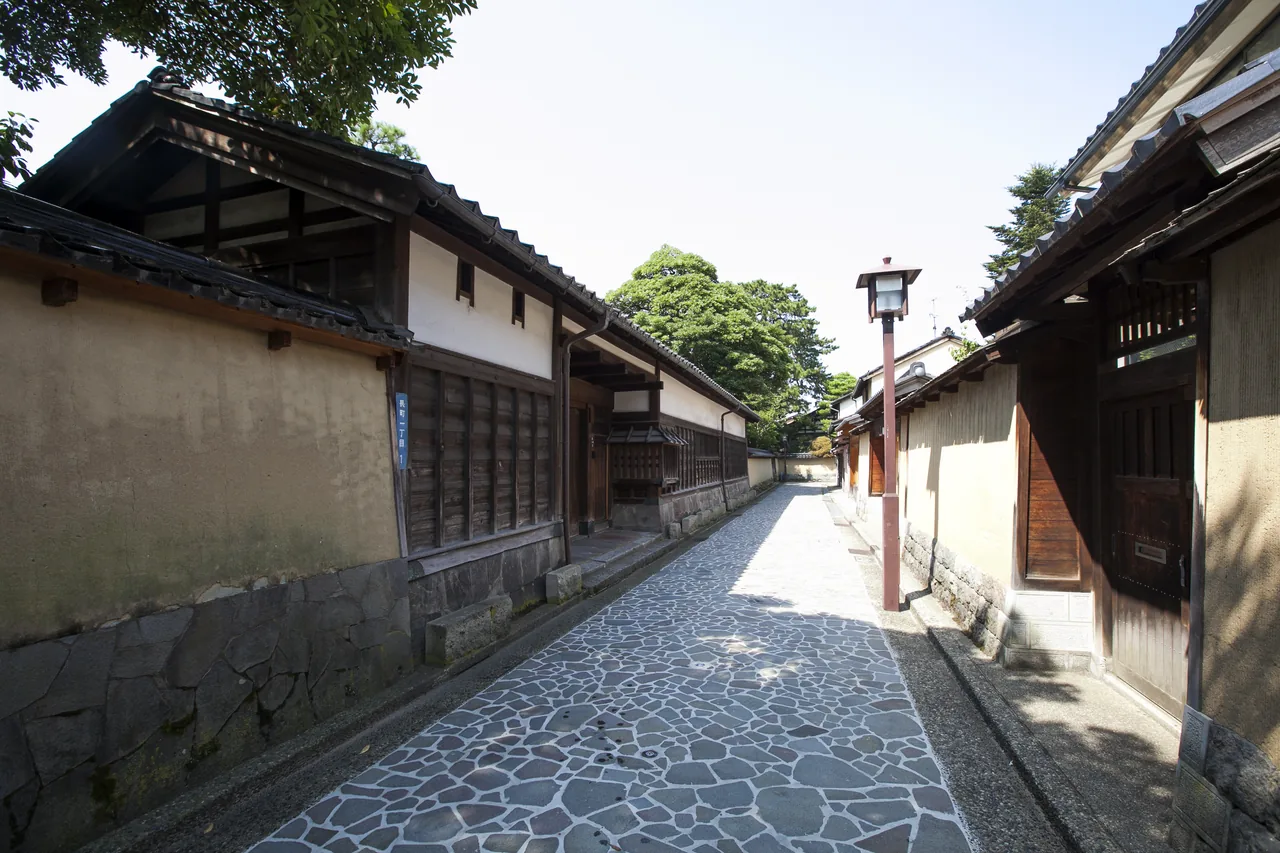
13. Nagamachi wraps its earthen walls in straw for the winter
14. The temples were gathered across the river to defend the town
15. Myoryuji is a fortress with a temple on the outside
16. The 21st Century Museum was built without a front
17. The museums are stacked on one hill beside Kenrokuen
18. Almost all of Japan’s gold leaf is beaten here
19. Kutani ware and Kaga Yuzen were built by the domain
20. You can make some of it yourself in an afternoon
21. Noh was part of ordinary life in this city
22. Omicho Market was the castle kitchen
23. Crab season starts on 6 November
24. Jibuni and Kanazawa oden are local to here
25. There is somewhere to sit with tea in every district
26. Forget your lunch, but do not forget your umbrella
27. What you see depends heavily on when you come
28. With children, the choices narrow usefully
29. What to do when it rains
30. The evening loop bus runs on Saturdays and selected dates
31. Different places close on different days
32. You get around the city by bus
33. The combined ticket usually wins
34. From Tokyo there is no change of train
35. The gate outside the station is a drum
36. Book the Shirakawa-go bus before anything else
37. Kaga Onsen and Noto are two different situations
38. The station handles the souvenir problem
39. Choose between the station and Korinbo
40. Two days split like this
1. The castle town survived the war intact
Kanazawa was never firebombed. While most Japanese cities lost their wooden centres between 1944 and 1945 and rebuilt in concrete, the streets the Kaga domain laid out here are still where they were. Four separate districts in this one city are protected at national level as Important Preservation Districts for Groups of Traditional Buildings. Ishikawa Prefecture has eight of them; half sit inside Kanazawa. Map
That is the difference you feel on the ground. In most cities the old quarter is one restored block you walk down in ten minutes. Here there are four of them, in four different moods, spread across the city, and each one is a working neighbourhood rather than an exhibit.
The layout is the domain’s, not a planner’s
The Kaga domain built this town to be defended. Temples were pushed across the rivers and clustered together so their high walls formed a screen on the approaches. Teahouses were licensed into two districts well away from the keep. Samurai housing was placed immediately west of the castle so the men could reach it quickly. The merchants’ market sat at the castle gates.
Four hundred years later that plan is still the reason your day works the way it does. If you want temples you cross a river. If you want teahouses you cross the other one. Nothing about Kanazawa’s spread is accidental, and once you see the logic the map stops feeling random.
Preservation districts mean four walks, not one
A preservation district covers a whole streetscape rather than a single building. Owners cannot rebuild freely and repairs have to keep the original form, which is why these four areas will look much the same in twenty years as they do now.
For a visitor that translates into four distinct walks. Higashiyama and Kazuemachi are teahouse streets. The Utatsuyama foothills are temples and merchant houses tangled together on a slope. Teramachi is a long avenue of temple gates. They do not feel alike, and doing all four in one day flattens them.
So do not try to loop the whole city on foot
The plan most first-time visitors arrive with is to leave the bags at the station and walk a circuit. It does not work here. The station sits twenty to forty-five minutes’ walk from the main sights, while the sights themselves are five to ten minutes apart from each other.
Walk one district at a time and use a bus or a taxi only when you change district. Done that way you will board a bus about twice a day. If Kanazawa is one stop on a longer trip, the Japan golden route itinerary shows where it fits.
2. Two rivers divide the city around the castle
Kanazawa Castle and Kenrokuen sit in the middle, with the Asanogawa to the north east and the Saigawa to the south west. Everything else is positioned relative to those two rivers, which makes route planning simple once you know which bank you are heading for. Map
| Area | From the castle | What is there |
|---|---|---|
| Castle and Kenrokuen | The centre | Castle park, the garden, Seisonkaku |
| Hill of Culture | South, uphill | 21st Century Museum, National Crafts Museum, prefectural museums |
| Higashi Chaya and Kazuemachi | Across the Asanogawa, east | Two teahouse streets, the gold leaf museum |
| Teramachi and Nishi Chaya | Across the Saigawa, south | Around seventy temples, Myoryuji, a teahouse street |
| Nagamachi | Immediately west | Earthen-walled samurai lanes, the Nomura house |
| Omicho Market | Just north | The market and its restaurants |
Keep east and south on separate days
Higashi Chaya and Teramachi are on opposite sides of the castle. Linking them means crossing both rivers and spending the difference in bus time. Give one day to the east bank and one to the south and you never double back.
With only one day, take the castle, Kenrokuen and the eastern teahouse streets and leave the rest. That version needs one bus ride.
Omicho fits into any day
The market sits at the foot of the castle, so you pass it whichever direction you are heading. Eat there before you start, or come down off the castle hill for lunch. Either way you add no extra travel.
3. The name Kenrokuen is a list of six qualities
The garden was named in 1822 by Matsudaira Sadanobu, the lord of Shirakawa. He took the name from a Song dynasty text, Li Gefei’s record of the famous gardens of Luoyang, which praised one garden there for combining six qualities: spaciousness, seclusion, artifice, antiquity, water, and a broad view. Map
The point of the original passage is that those six qualities fight each other. Open a garden up and you lose its seclusion. Work it heavily by hand and you lose its age. Fill it with ponds and waterfalls and you can no longer see out. To claim all six is to claim the argument has been solved.
You can check the six as you walk
It is worth walking the garden with that list in your head, because it turns a pretty park into something you are reading. The wide lawn and the pond give you the spaciousness and the water. Step into the wooded paths behind and the noise drops away. The pruned pines are the artifice, the mossy stone lanterns the antiquity, and the ridge at the far end opens onto the city and the hills beyond it.
Kenrokuen is grouped with Kairakuen in Mito and Korakuen in Okayama as one of the three great gardens of Japan. All three were built by daimyo in the Edo period, all three are stroll gardens meant to be walked rather than viewed from one seat, and all three sit next to a castle.
The lantern everyone photographs
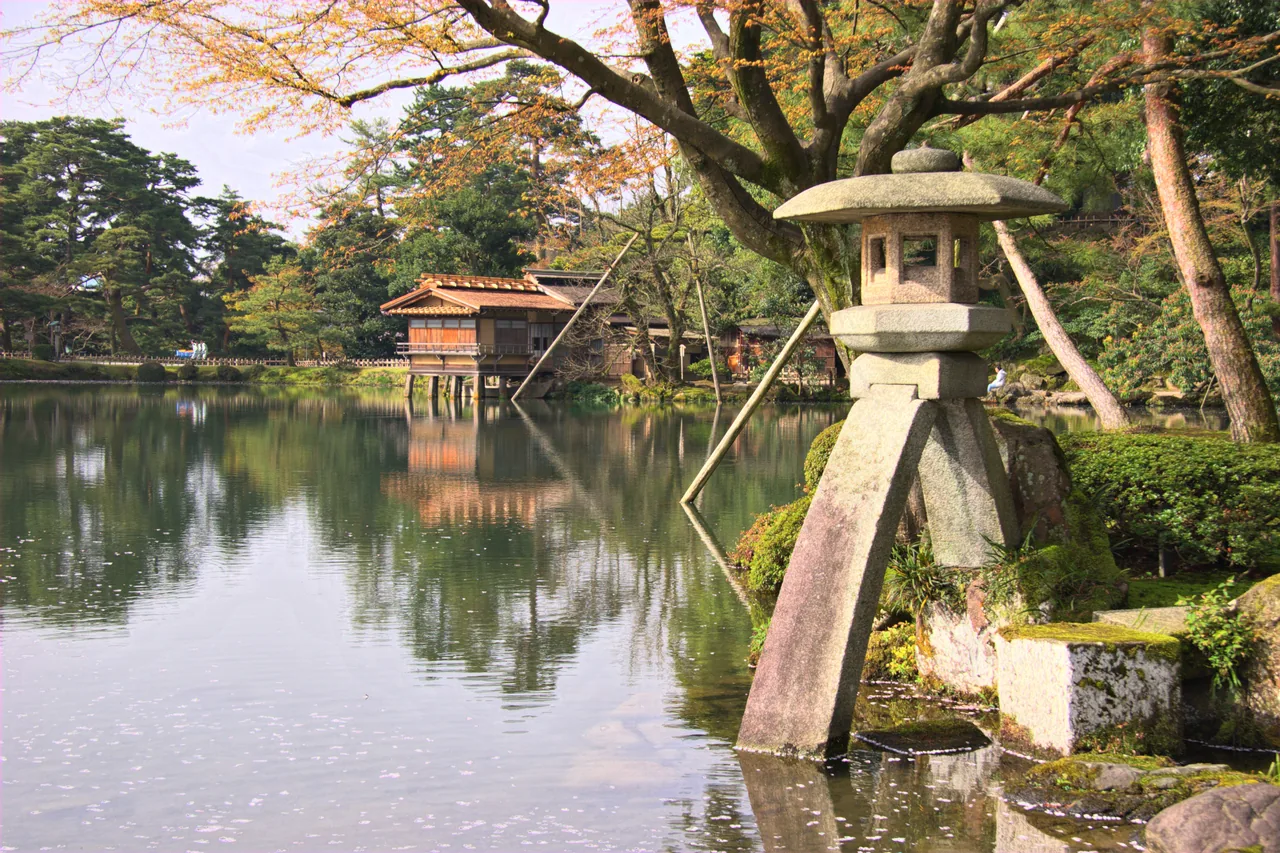
The Kotoji lantern stands at the edge of Kasumigaike pond on two legs of different lengths, one in the water and one on the bank. It is the single most photographed object in the city and it is usually surrounded. Arrive in the free early morning hours and you will have it to yourself.
| Item | Detail |
|---|---|
| Admission | Adults 320 yen, ages 6 to under 18 100 yen |
| Free | Under 6, and 65 and over on proof of age |
| Hours | 1 March to 15 October 07:00 to 18:00, otherwise 08:00 to 17:00 |
| Closed | Open every day |
| Early opening | Free. From 04:00 April to August, 05:00 in March and from September through October, 06:00 from November to the end of February |
4. Yukitsuri goes up on 1 November, starting with one pine
The ropes that hold up the branches through winter go on every year from 1 November, and the first tree is always the Karasaki pine. Work continues to the middle of December. Taking them down starts in mid March and runs about a week, and the Karasaki pine is the last one stripped.
That tree has the widest branch spread in the garden. Five poles go up around it and close to eight hundred ropes are tied out to the limbs. It is the shape you have seen in every winter photograph of the city.
The snow here is wet
This is not the dry powder of Hokkaido. Snow off the Sea of Japan arrives heavy with water, packs onto branches and snaps them. Yukitsuri spreads that weight across ropes instead of leaving it on the wood.
So it is both a winter sight and a piece of necessary maintenance. Come in early November and you can watch the gardeners actually tying the ropes, which is a better thing to see than the finished cones.
Spring brings free opening days
The garden opens free during the cherry blossom, during the Hyakumangoku festival, on Culture Day and over the new year. The blossom dates are set once the trees are actually opening, so check close to your trip. National timing is in our Japan cherry blossom guide.
Inside the garden grounds is Seisonkaku, a residence built in 1863, which closes on Wednesdays and moves to Thursday when a public holiday falls on the Wednesday. Kenrokuen itself never closes, so the only trap is turning up on the wrong day for the house.
5. Seisonkaku was built by a lord for his mother
Seisonkaku sits against the southern edge of Kenrokuen and was built in 1863 by the thirteenth Kaga lord, Maeda Nariyasu, as a retirement residence for his mother. The building is an Important Cultural Property and the garden around it is a nationally designated place of scenic beauty.
The two floors were built to different rules. The ground floor is formal shoin architecture, the sort of space where you receive people. The upper floor is sukiya, the lighter style used for tea rooms, where the household actually lived. Walking up the stairs you can feel the formality drop away.
There is a room painted deep blue
The upstairs room called Gunjo no Ma has its ceiling and walls finished in a strong ultramarine ground from mineral pigment. Using a colour that saturated across a whole room was unusual in the late Edo period and it is the thing most visitors remember.
Some windows hold Dutch coloured glass, imported at the same period as the glass in the Oyama Shrine gate a few streets away. Seeing where the ruling family chose to spend imported material tells you something the label cards do not.
It closes on Wednesdays
Kenrokuen never closes but Seisonkaku does, on Wednesdays, shifting to Thursday if a holiday intervenes. Plenty of people walk the garden and find the house shut. If you want both, keep Wednesday off the plan.
The house is included in the Hill of Culture pass, so if you are already carrying that ticket there is nothing more to pay.
6. The castle roofs are white because the tiles are lead
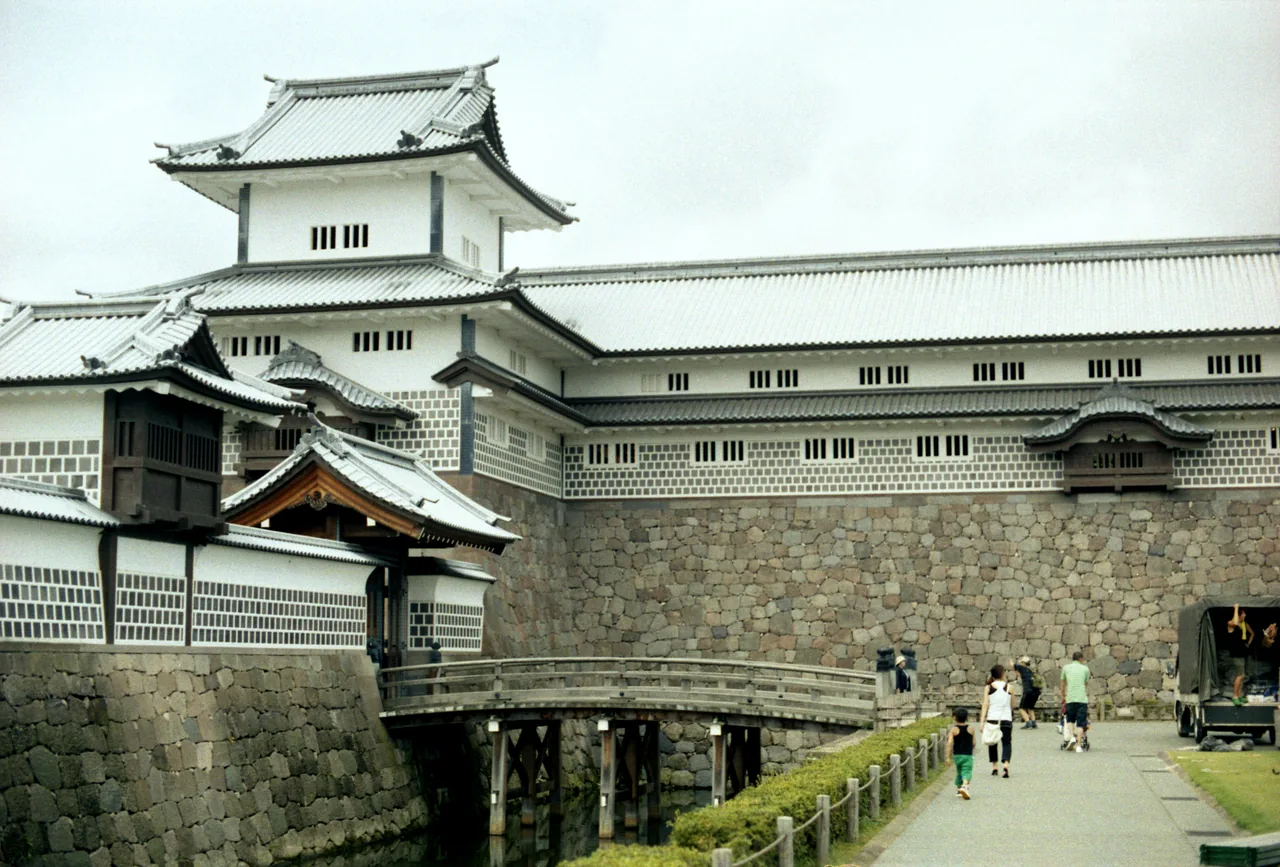
From a distance Kanazawa Castle reads as a white building, and the reason is that its roof tiles are made of lead. Edo period records say lead was chosen to make the castle look magnificent. Two other explanations travel with it: lead is light, so the roof carries a winter snow load better, and in an emergency the tiles could be melted down into shot. Map
The walls are namako kabe, plaster laid in raised half-round ribs over a grid, a finish that keeps rain and snow off the wall face. White roof over white lattice is why this castle looks brighter than most.
The park is free and only the interiors are ticketed
The whole castle site is a public park and walking it costs nothing. You pay only to go inside the Hishi Yagura turret, the Gojukken Nagaya storehouse and the Hashizumemon Tsuzuki Yagura. Those three were rebuilt in timber in 2001 using Edo period joinery, so once inside you are looking at posts and beams fitted without nails.
| Item | Detail |
|---|---|
| Park | Free. 1 March to 15 October 07:00 to 18:00, otherwise 08:00 to 17:00 |
| The three buildings | Adults 320 yen, children 100 yen. 09:00 to 16:30, last entry 16:00 |
| Free | Under 6, and 65 and over with proof |
| Gyokusen’inmaru garden | Free. 09:00 to 16:30. Closed 29 December to 3 January |
The buildings shut long before the park does
The park stays open into the evening but the last entry to the interiors is at four. Arrive late in the afternoon and you will walk the grounds without seeing inside anything. Be on the hill by three if the buildings matter to you.
Inside the walls there is a second garden, Gyokusen’inmaru, restored on the site of the lords’ private garden and free to enter. Where Kenrokuen is broad and open, this one is small, terraced and enclosed, and the contrast between them is worth the ten minutes.
7. The castle grounds were a university campus until 1995
From 1949 to 1995 Kanazawa University occupied the castle site. Lecture halls and laboratories stood inside the walls and students walked in through the Ishikawamon gate. Only after the university moved out to a new campus at Kakuma did the site go back to being a castle.
The move ran in stages from 1989 and finished in 1995. Ishikawa Prefecture bought the site from the state in 1996, began restoration, and opened it to the public as Kanazawa Castle Park in September 2001.
That is why the buildings look new
The big structures inside the walls are pale and sharp-edged because they were rebuilt in 2001, not weathered for four centuries. Anyone who has been to Himeji or Matsumoto notices the difference immediately. They were built to the surviving drawings and to excavation evidence using period technique, which is why the interiors are worth entering.
The Ishikawamon gate itself is original Edo work and still standing. Having the new and the old inside one park is useful: you can see exactly what lead tiles look like new and what four hundred years does to them.
Work is still going on
Restoration has not finished. Sections are excavated and rebuilt in turn, so on any given visit part of the site is likely to be fenced. Boards around the park explain what is currently being built.
The park itself is free and opens early. A path cuts across it towards Kenrokuen, and people walk through it on the way to work, which keeps it feeling like part of the city rather than a monument.
8. The shrine gate above the city was once a lighthouse
The gate at Oyama Shrine was built in 1875 and its top storey holds coloured glass on all four sides. A lamp was once lit up there and the gate worked as a navigation light for ships offshore. A shrine gate doubling as a lighthouse is not something you see twice. Map
Three architectural traditions are stacked in one building. The lowest level is a triple arch framed entirely in timber, faced with Tomuro stone, the stone the Kaga domain used for its own works. Above it the storeys turn Chinese, then Western. The lightning rod on the roof is thought to be the oldest surviving one in Japan.
It stands on the way up to the castle
The shrine is dedicated to Maeda Toshiie, who founded the Kaga domain, and to his wife Matsu. It sits immediately below the castle on the western side, so if you are walking up from Nagamachi you pass it without making a detour.
A gate at the back of the precinct leads through to the Gyokusen’inmaru garden and on into the castle. Walk Nagamachi, then the shrine, then the garden, then the castle, and you never retrace a step.
The grounds are free and quick
There is a small pond garden inside the precinct and no admission charge anywhere on the site. Fifteen minutes is enough unless you want to sit.
Late afternoon light hits the glass in the gate from the west, which is when it actually reads as coloured rather than dark. If you are photographing it, come up at the end of the day rather than the start.
9. Higashi Chaya exists because the domain gathered the teahouses
In 1820 the Kaga domain took the teahouses that were scattered around the castle town and licensed them into two districts, one east and one west. The eastern one is Higashi Chaya. The western one is Nishi Chaya. They are the same age for the same reason. Map
A chaya was a house where geigi entertained guests with dance and music. Some of these buildings still work that way, and on an evening you occasionally hear a drum or a shamisen from behind a door. Walking the street costs nothing.
The lattice is the point
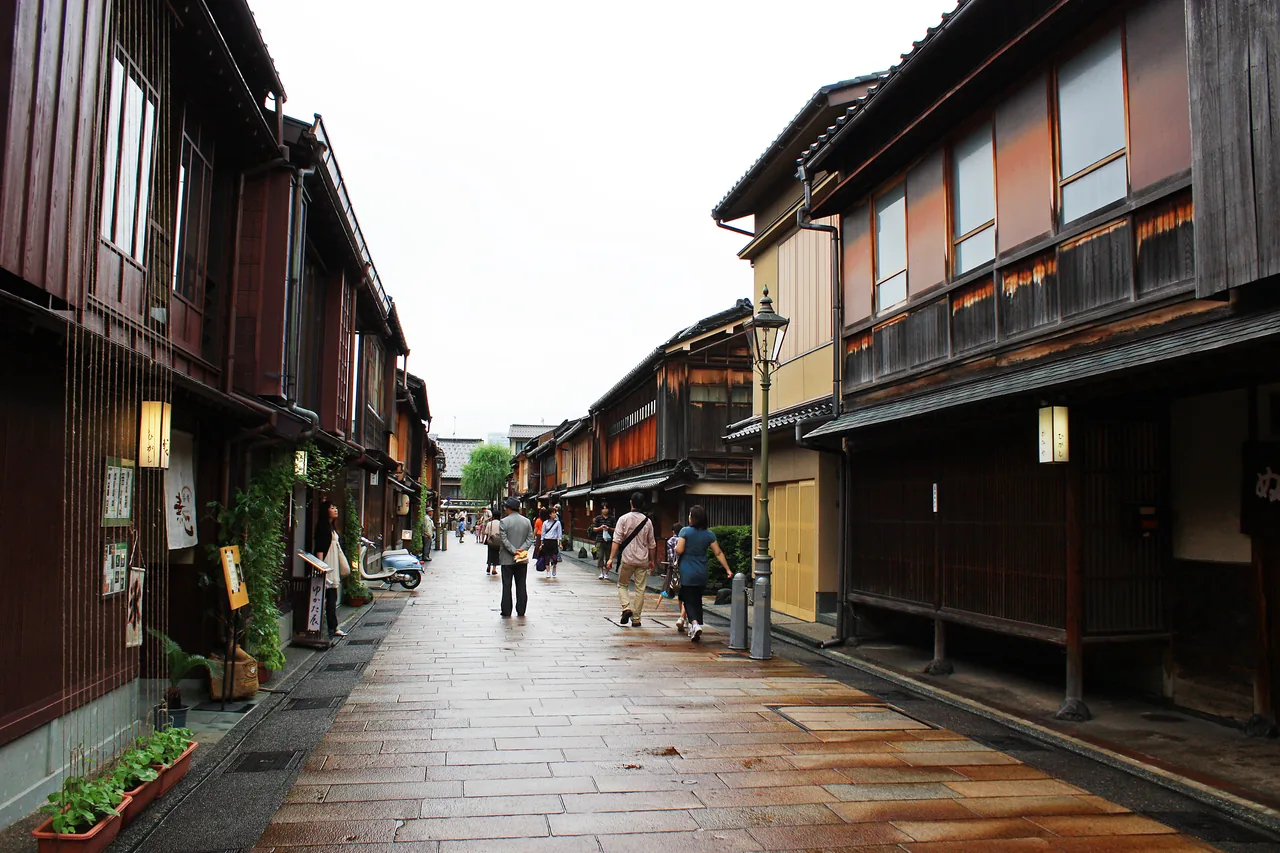
The fronts are covered in kimusuko, wooden lattice with the slats set close together so that people inside can see out while people outside cannot see in. It was privacy for the customers. Repeated down a whole street it is the image the city sells itself on.
Higashiyama Higashi became a national preservation district in 2001, the second teahouse district in the country to be listed after Gion in Kyoto.
Two houses let you inside
| House | Admission | Hours |
|---|---|---|
| Shima | Adults 500 yen, junior high and under 300 yen | 09:30 to 17:30, to 17:00 December to February. Open daily |
| Kaikaro | General 750 yen, students 500 yen | 10:00 to 17:00. Irregular closures |
Shima is an Important Cultural Property, built in 1820 and never remodelled. Upstairs you see the guest rooms and the small room where the performers waited, and the relationship between stage and audience becomes obvious in a way no diagram manages.
Kaikaro has an interior finished in gold leaf and still trades in the evening, which is why it only admits visitors during the day.
10. Kazuemachi is the narrow one down by the river
Kazuemachi runs along the Asanogawa, less than ten minutes on foot from Higashi Chaya across the bridge. Most people see the two together. Map
Where Higashi Chaya is a broad street with buildings facing each other, Kazuemachi is a lane barely wide enough for two people, squeezed between the water and a row of wooden houses that turn their backs to the river.
It is still a working street
Nothing here has been dressed up for visitors. Lanterns come on in the evening and customers arrive. During the day it is quiet and almost empty, which is when it is easiest to photograph.
Two named alleys climb from the riverbank to the main road above: Kuragarizaka, the dark slope, and Akarizaka, the light one. Both are shortcuts and both are steep. In the rain, watch your feet on the stone.
Come at dusk if you can
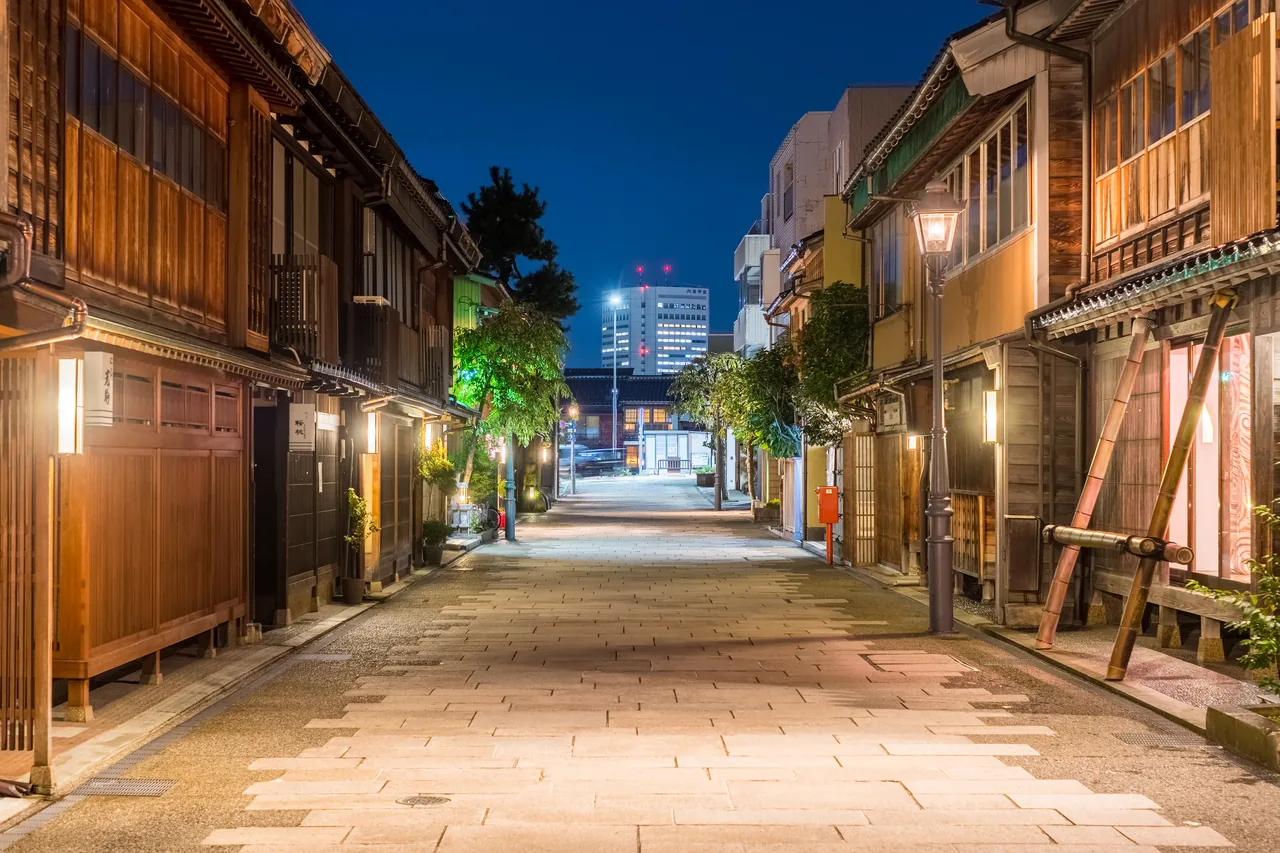
Once the lamps are lit the light sits on the water. The natural order is Higashi Chaya first, then over the bridge as the sun goes. Dinner options are thicker back on the Higashiyama side, so plan to cross back.
11. There are old streets on the Utatsuyama slope too
The hill behind Higashi Chaya is Utatsuyama, and its lower slopes hold thirty-seven temples and two shrines. This area is a national preservation district as well. Map
If Teramachi guards the southern approach across the Saigawa, this cluster guards the eastern one across the Asanogawa. The Kaga domain gathered temples into three groups when it built the castle town and this is one of them. Most arrived here during the seventeenth century.
Temples and houses are mixed together
Teramachi lines its temples along a main road. Here the lanes bend with the slope and temples sit among ordinary merchant houses, so a gabled Edo period hall appears at the end of an alley with no warning.
Almost nobody comes up here. On a day when Higashi Chaya is shoulder to shoulder, five minutes uphill puts you somewhere with nobody in it. The lanes are narrow and steep, so wear something sensible on your feet.
The top gives you the whole city
There is a park and a viewpoint at the summit. From there you can see the city and the mountains behind it, and the way the castle and Kenrokuen sit dead centre makes immediate sense.
It is a continuous climb from the bottom. A city bus goes up if you would rather not walk. In cherry blossom season the hill fills up like everywhere else.
12. Nishi Chaya is the western half of the same decision
Nishi Chaya was licensed in the same year as Higashi Chaya, 1820, on the far side of the castle across the Saigawa. It is smaller and far quieter. Map
The surviving stretch is about one block long, so this is a ten minute stop rather than an afternoon. What you get in exchange is space. When the eastern district is packed, there is somewhere to sit here.
It pairs with Myoryuji
Myoryuji is five minutes away on foot and the Teramachi temples are in the same direction, so the three go together. Since you are crossing the river anyway, do them in one run.
There is a small free museum on the street, Nishi Chaya Shiryokan, with a reconstructed teahouse upper room. If you are not going to make it to Shima, this covers some of the same ground at no cost.
Only one of the two loop buses comes here
The sightseeing loop runs clockwise and anticlockwise, and the two directions do not serve the same stops. Nishi Chaya is on the anticlockwise route only. Board the clockwise bus and it will not bring you here. Check the direction on the stop before you get on.
13. Nagamachi wraps its earthen walls in straw for the winter
Nagamachi is where the samurai lived, immediately west of the castle. Earth walls topped with tile run down both sides of the lanes and the ground is laid with fitted stone. Walking it is free. Map
Putting retainers next to the castle meant they could reach it in a hurry. The lanes bend repeatedly rather than running straight so that an attacking force could not drive through, which is also why it is so easy to lose your bearings in here.
The straw goes on in early December
Kanazawa’s wet snow sticks to the earth walls and takes the surface off them. So on the first weekend of December the walls are wrapped in straw mats, and they stay wrapped until the middle of March. Come in that window and the whole quarter is lined with straw.
The Nomura house opens earlier than everything else
| Item | Detail |
|---|---|
| Admission | Adults 550 yen, high school 400 yen, elementary and junior high 250 yen |
| Hours | April to September 08:30 to 17:30, October to March 08:30 to 16:30 |
| Last entry | 30 minutes before closing |
| Closed | 26 and 27 December, 1 and 2 January |
The Nomura house is the one place in the quarter you can go inside. It belonged to a family that served the domain for generations, and its small garden is built to be seen from within the rooms, with a water channel running under the floorboards.
Most Kanazawa attractions open at nine. This one opens at half past eight, which makes it a useful first stop if you are an early starter.
14. The temples were gathered across the river to defend the town
South of the Saigawa there are close to seventy temples in one district, and the name Teramachi means exactly that. The third Kaga lord, Maeda Toshitsune, moved temples out of the area around the castle and concentrated them here. It was a defensive measure. Map
Temples have high walls and open ground. Line enough of them up beyond a river and you have a screen across the southern approach to the castle. Kanazawa has three such clusters and this is the largest.
On Saturday evenings the bells ring
The temples here ring their bells together on Saturday evenings, and the sound was selected as one of the hundred soundscapes of Japan worth preserving. Walk the district then and it comes at you from several directions at once.
Individual temples are not set up as attractions. Most leave the gate open and let you into the forecourt, but there are no ticket desks and few explanation boards. You walk, and you go through whichever gate appeals.
Three clusters, not one
The domain did not put all the temples in one place. Teramachi covers the south, the Utatsuyama foothills cover the east, and a third group sits on the Kodatsuno slope south east of the castle. From any direction, a temple wall was the first thing an attacker met.
Visitors mostly walk the first two, which are the ones with preserved streetscapes. Kodatsuno is quiet residential ground and few people seek it out.
The cherry tree at Shogetsuji leans over the wall
Shogetsuji, in Teramachi, has an old cherry tree in its grounds that is a designated natural monument. Its branches reach out over the wall and across the road, so in spring you get it from the street without going in.
15. Myoryuji is a fortress with a temple on the outside
Myoryuji was moved to this site and rebuilt in 1643 by Maeda Toshitsune, at a time when relations with the shogunate were tense, and it was given the role of an outlying fort. The outside is a temple. The inside was built for a fight. Map
From the street it reads as two storeys. Inside there are four levels divided into seven layers, twenty-three rooms and twenty-nine staircases, and which staircase you take determines where you come out. A watch platform at the end of the main roof let sentries see out across the Kaga plain.
You go round in a group, for about forty minutes
You cannot wander. A guide leads a set route past the offering box built as a pit trap, the staircase hidden under floorboards, the treads with paper panels so a defender underneath could see feet crossing above, and a well that legend says connects to the castle.
Toshitsune spent his career avoiding a fight he could not win. He married into the Tokugawa family, sent his mother to Edo as a hostage, and by tradition made himself look like a fool in public. This building belongs to that story.
It has nothing to do with ninja
The nickname Ninja Temple came later and stuck because of the mechanisms. No ninja were based here and the temple itself says so. Photography inside is not permitted, so come for the building rather than for pictures of it.
16. The 21st Century Museum was built without a front
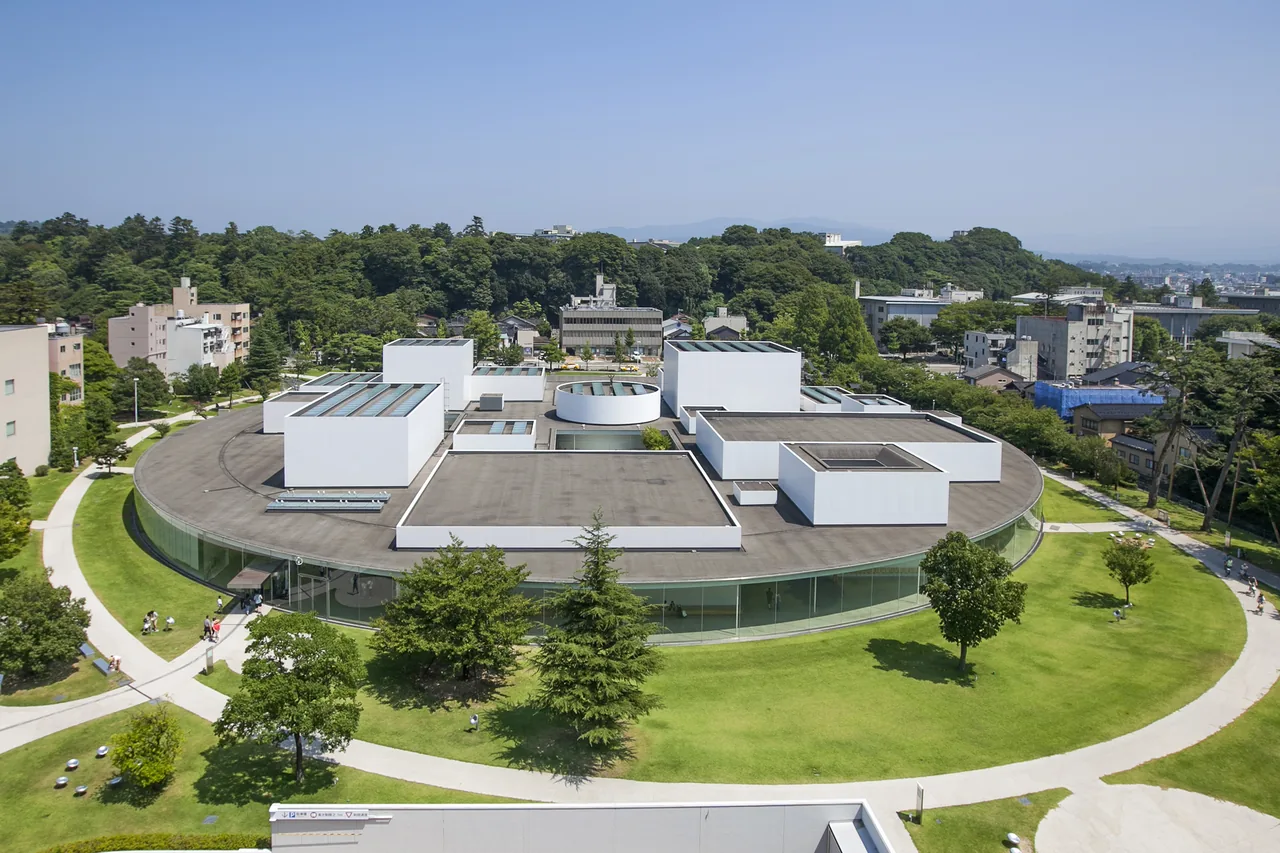
Kanazawa’s 21st Century Museum of Contemporary Art is a circle of glass with no front and no back. The site has streets on three sides, and the architects made it round so that anyone arriving from any direction walks straight in. It was designed by SANAA, the practice of Kazuyo Sejima and Ryue Nishizawa, and opened in 2004. Map
Most museums have a facade, a flight of steps and a decision about which way you approach. This one refuses all three. Entrances are spaced around the glass wall and every one of them lands you in the same place. The intention was to make the building part of the street rather than an object on it.
The glass lets you see other people
Much of the internal walling is glass as well as the outside. People in the galleries and people in the free zone are aware of each other, which is deliberate: the practice is known for dismantling the assumed divisions between front and back, private and public. Rectangular galleries of different sizes float inside the circle and you move between them.
| Item | Detail |
|---|---|
| Public zone | Free. 09:00 to 22:00 |
| Gallery zone | 10:00 to 18:00, to 20:00 on Friday and Saturday |
| Collection exhibition | Adults 450 yen, university students 310 yen, school age free, 65 and over 360 yen |
| Closed | Gallery zone Mondays, or the next weekday after a holiday, plus new year |
A lot of it costs nothing
The works in the free zone, the library and the pieces out on the lawn are all open without a ticket. Several of them are meant to be climbed into, spoken through or sat under, so families tend to stay a while. The free zone runs until ten at night.
The pool basement is same-day booking only
The view down through the water is free from the courtyard, and that is the image most people know. Going underneath and looking up is the part that needs the booking. If you want it, make the museum your first stop of the day.
The basement closes for maintenance for a stretch at a time. This year it is scheduled to shut from 19 to 30 October, and during that period you can only look down from above.
17. The museums are stacked on one hill beside Kenrokuen
Walk south out of Kenrokuen and you are on a slope with a museum every few minutes. The area is called the Hill of Culture, and because the buildings are so close together you can reasonably see three or four in a day. That is also why the combined ticket exists. Map
The National Crafts Museum used to be in Tokyo. It was the crafts wing of the National Museum of Modern Art in Chiyoda, and it moved here and reopened in October 2020, the first national art museum on the Sea of Japan side of the country.
The building was moved here as well
Its home is two Meiji era army buildings, the former Ninth Division headquarters and the former officers’ club, dismantled and rebuilt on this site. Red roofs, white walls, western timber construction. Inside are more than four thousand works of modern and contemporary craft and design.
Next door is the Ishikawa Prefectural Museum of Art, which holds Kutani ware, Kaga Yuzen and lacquer, including a National Treasure incense burner on permanent display. Beyond it the prefectural history museum, the Noh museum, the Nakamura Memorial Museum and the D.T. Suzuki Museum follow one after another.
The red brick sheds were an arsenal
The prefectural history museum occupies three red brick buildings put up as an army arsenal in the early twentieth century. After the war an art college used them as classrooms, and in 1986 they became a museum. The buildings themselves are an Important Cultural Property.
The same thing happened here as at the castle: the army left, an institution moved in, and that is why the fabric survived. Inside you can see the brickwork and the timber roof structure.
The Suzuki museum is a place to sit
The D.T. Suzuki Museum commemorates the Buddhist philosopher born in this city. There is very little on display. There is a square of standing water, a corridor around it, and at the end an empty room where you sit and look at the water. People either find it the best thing in Kanazawa or wonder what they paid for.
With this many institutions in walking distance, single tickets add up quickly. The pass is usually the cheaper way.
18. Almost all of Japan’s gold leaf is beaten here
Effectively every sheet of gold leaf used in Japan is made in Kanazawa. Production elsewhere is negligible. The leaf on temple altars, on lacquerware, on folding screens and on the gold lines of porcelain all leaves this city. Map
One reason is historical and the other is meteorological, and both of them are local to this city.
The domain kept beating leaf after it was banned
In the Edo period the shogunate prohibited the domains from beating gold leaf, wanting the metal under central control. The Kaga domain carried on quietly through its own craft workshops. Working with restricted material while still needing volume and quality pushed the technique forward, and the skill compounded across generations.
A sheet today is about a ten thousandth of a millimetre thick. It cannot be picked up by hand without disintegrating, so it is lifted with bamboo tools. That thinness is the accumulated result.
Damp air suits the work
Static electricity ruins gold leaf, because the sheet clings and tears. Static builds in dry air and struggles in humid air. Kanazawa sits where moist wind comes in off the Sea of Japan, so it rains often and the humidity stays high all year. Good water is usually cited as the third condition.
The rain gets talked about as the city’s drawback. It is also the reason one of its industries is here at all.
You can see it, wear it and eat it
The Yasue Gold Leaf Museum, near Higashi Chaya, shows how the leaf is made and what the tools look like. Workshops around the city run short sessions where you apply leaf to chopsticks or a small dish, usually about thirty minutes, and you take the result away.
Several shops sell soft serve ice cream with a whole sheet laid over it. It does not change the taste. It is, however, the closest you will get to the material.
19. Kutani ware and Kaga Yuzen were built by the domain
The Kaga domain ran craft workshops inside the castle and recruited artisans into them. Ceramics, dyeing, lacquer and metalwork all came out of that system, and most of what is sold in Kanazawa today traces back to it. The city is registered with the UNESCO Creative Cities Network in the field of crafts. Map
Kutani is the one with five colours
Kutani ware puts thick overglaze in navy, red, purple, green and yellow onto white porcelain. The set is called Kutani gosai. Because the pigment is laid on heavily you can feel the brushwork with a fingertip, which makes it easy to tell apart from other Japanese porcelain.
The lord sent Goto Saijiro to Hizen Arita to learn the technique, and he opened a kiln at Kutani village around 1655. Work from that first period is known separately as Ko-Kutani.
Kaga Yuzen paints insect damage on purpose
Kaga Yuzen came from Kyoto with the dyer Miyazaki Yuzensai. The motifs are grasses and flowers, the palette is warm, and colours are graded from one into another with a technique called bokashi.
The detail people remember is mushikui, literally insect-eaten. Holes and brown blotches are painted into the leaves deliberately, because a leaf that has been chewed is closer to a real plant than a perfect one. If you get the chance to look at a length of cloth, look at the leaves.
Where to see it and where to buy it
The Ishikawa Prefectural Museum of Art has Kutani, Kaga Yuzen and lacquer together. The Ishikawa Prefectural Museum for Traditional Products and Crafts groups the prefecture’s crafts by type, which is the quickest way to work out what you actually like.
For buying, look around Higashi Chaya and Nagamachi, or inside Kanazawa Station. Kaga Yuzen by the bolt is not a realistic souvenir, so most visitors end up with a handkerchief or a small textile piece.
20. You can make some of it yourself in an afternoon
Kanazawa is set up so that crafts are something you do for an hour, not only something you look at. Gold leaf work runs near Higashi Chaya and around the city, Kaga Yuzen at the Nagamachi Yuzen centre, Kutani painting at workshops in town. Most sessions take thirty minutes to an hour and you carry the result out with you.
Kimono rental counts as part of the same category here. Rental shops cluster around Higashi Chaya and Kenrokuen. All of this is indoors, which makes it the obvious plan on a wet day.
Gold leaf is the quickest
You lay a cut stencil over the object, apply the leaf, then brush the surplus away. Half an hour, and the item goes home with you. Most places do it on things you will actually use, like chopsticks or a card case.
Kaga Yuzen takes a little longer. At the Nagamachi centre you brush colour into a piece of cloth about handkerchief size. It is walkable from the Nomura house, so it slots into a Nagamachi morning.
Plenty of people walk the streets in kimono
The usual arrangement is to dress in the morning and return the outfit in the evening. Most people are doing it for photographs in front of the teahouse lattice.
Bear in mind that these streets are stone and geta are slippery. If rain is forecast, bring your own shoes to change into.
21. Noh was part of ordinary life in this city
There is a local saying that in Kanazawa the chanting falls out of the sky. It refers to carpenters on roofs and gardeners up trees humming Noh chant while they worked. The point is that Noh was not confined to a stage here. Map
The Kaga lords were patrons for generations. Toshiie and his successors favoured the Konparu school, and under the fifth lord, Tsunanori, the domain standardised on the Hosho school. The local tradition has been called Kaga Hosho ever since. Because the domain had merchants and artisans learn it too, it spread well beyond the samurai class.
The gate outside the station is a Noh drum
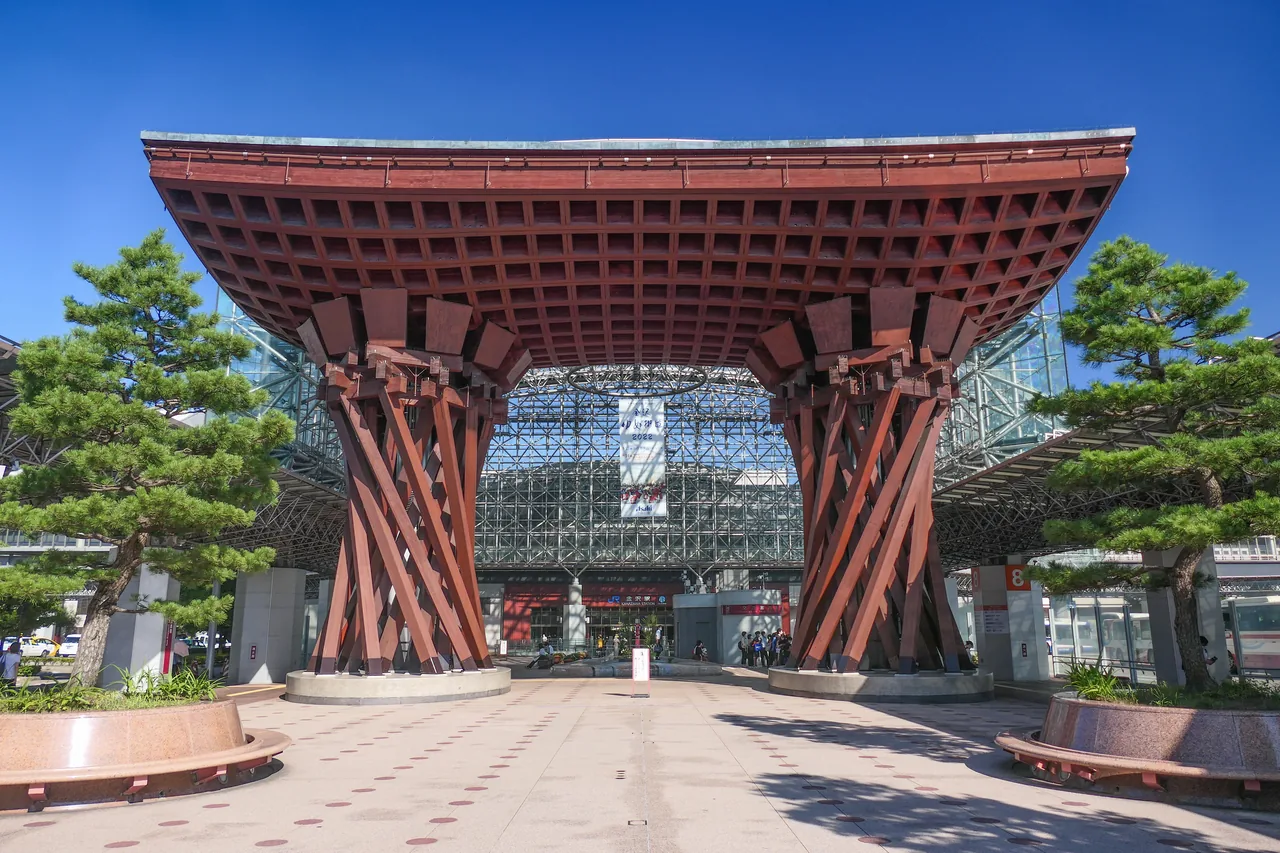
The timber gate at the east exit of Kanazawa Station, the Tsuzumi-mon, was built in 2005 in the shape of the hand drum used in Noh. The way the two columns splay outwards as they rise is the drum body stood on end.
At the Kanazawa Noh Museum you can look at masks and costumes and try a mask on. A Noh mask is expressionless head-on but changes as it tilts, and the museum is arranged so you can test that yourself.
Performances run on fixed dates
The Kanazawa Noh Theatre holds regular performances, but they are scheduled rather than continuous. If the dates line up, take it. If they do not, the museum covers the ground with video and objects.
If you have never seen Noh, a short performance with commentary is a much easier entry point than a full programme.
22. Omicho Market was the castle kitchen
Omicho has been on this spot for more than three hundred years. After a great fire in 1690 the fish market at the mouth of the Asanogawa relocated here, and in 1721 the market from the mouth of the Saigawa was merged in as well. Under the fifth lord it became the supplier to the castle kitchens. Map
It is still a market where residents shop rather than a food court with a market theme. There are close to a hundred and seventy businesses and fish dominates. Everything is laid out on ice at the front of each stall, so you learn what is in season simply by walking through.
Some of it is to eat now and some to take away
Kaisendon restaurants sit inside the arcade and upstairs, and there is a queue at lunchtime. Several stalls grill oysters or prawns to order and hand them over for you to eat on the spot, which for a lot of visitors replaces lunch entirely.
The season is obvious from the stalls
Winter is crab and yellowtail. Spring brings shellfish and sea bream, summer squid and sea urchin, autumn nodoguro and sweet shrimp. What comes out of this stretch of sea changes month by month, so the same stall looks different every time you come.
Prices are marked, so you do not have to ask. Larger items are prepared for you on request and some stalls will pack things cold for travel.
It is on the way up to the castle
From the southern exit of the market to Kanazawa Castle Park is a few minutes on foot. Eat here in the morning, go up to the castle, cross into Kenrokuen and you have barely travelled. It is also the closest of the main sights if you are walking in from the station.
23. Crab season starts on 6 November
The snow crab season off Ishikawa opens on 6 November every year. The date does not move. Fishing seasons are set nationally to protect the stock, and before that date the local crab is simply not available.
| Name | Season | What it is |
|---|---|---|
| Kano-gani | 6 November to 20 March | Male. Large, with the leg meat |
| Kobako-gani | 6 November to 29 December | Female. Small, full of roe |
Kano-gani takes its name from one character each of Kaga and Noto. It is the brand for male snow crab landed in Ishikawa, and a blue tag on the leg identifies where it came from.
The female crab is on sale for less than two months
Kobako-gani is under half the size of the male. The reason to order it is what is inside the shell: the internal roe is dense and creamy, the external roe pops between the teeth. Those two textures are the whole point.
Winter thunder means the yellowtail have arrived
From the middle of November into December this coast gets days of hard wind and thunder. In Ishikawa and Toyama that thunder is called buri-okoshi, the thunder that wakes the yellowtail, because the winter fish start being landed at the same time. Fishermen read the storms as a sign of a good catch.
Ishikawa has more days of thunder per year than any other prefecture in Japan, and unusually most of them are in winter. If you hear it at night in December, that is normal here.
24. Jibuni and Kanazawa oden are local to here
Jibuni comes down from the samurai cooking of the Kaga domain. Duck is dusted in flour, simmered in stock and served with wasabi on top. The flour thickens the broth, so the dish holds its heat, which matters in a winter this wet.
It is served with sudarefu, a wheat gluten product, along with taro, spinach and lily bulb. The name is variously explained as coming from the jibu-jibu sound of the pot or from the name of a person. You meet it at set-meal restaurants and on ryokan dinner trays.
Oden is eaten here all year
Elsewhere oden is winter food. Kanazawa keeps its oden shops open through the summer. The broth is clear and lightly seasoned. Two ingredients are local. The first is kurumafu, a ring of wheat gluten that soaks up an enormous amount of stock.
The other is kani-men, the shell of a female snow crab packed with its meat and roe and set in the broth. It is made only while the crab is landed, so November and December. It costs several times what a normal oden piece costs and it exists nowhere else.
People here take sweets when they visit
Kanazawa households spend more on wagashi than those of any other city in Japan. There is a local habit called omotase, of taking a favourite confection with you when you call on someone, which means people buy sweets constantly. That is why old confectioners survive on so many corners.
Tea comes with it. There are places to sit with matcha and a sweet inside Kenrokuen, in Higashi Chaya and in Nagamachi. Finishing a garden with twenty minutes sitting down is the local way to do it.
25. There is somewhere to sit with tea in every district
Matcha and a sweet, served sitting down, is built into the attractions here rather than being a separate errand. There is a tea house inside Kenrokuen, old chaya buildings serving in Higashi Chaya, and residences with gardens in Nagamachi. Expect somewhere between 500 and 1,000 yen.
The ruling family were tea people for generations, and that left a lot behind. Confectioners multiplied because tea needs something beside it. Kilns appeared because tea needs bowls.
Ohi ware was made for the tea bowl
Ohi ware is hand-formed rather than thrown, and it came to Kanazawa with a potter brought in alongside a tea master under the fifth lord. The surface glaze is a warm amber, so it looks nothing like the five-colour brilliance of Kutani.
Because it exists to be a tea bowl, weight and feel in the hand are what it is judged on. There is a place to see it near Kenrokuen and shops in town sell it.
The confectioners change with the month
Old wagashi shops are scattered across the city and they change the shapes and colours through the year, so the window display tells you roughly what month it is. They sell singly, so you can buy one and eat it walking.
If you are taking sweets home, the station concentrates the city’s confectioners in one place and saves you a special trip.
26. Forget your lunch, but do not forget your umbrella
There is a saying here: you can forget your lunchbox but not your umbrella. Mornings turn to rain by the afternoon often enough that locals treat it as a rule. Carry one whatever the season.
Kanazawa gets far more rain than Tokyo, and unlike most of the country its wettest month is in winter, not summer. Wind crossing the Sea of Japan picks up moisture and drops it against the mountains here. December is the peak and May the driest month.
That is the opposite pattern to Tokyo and Osaka. If you arrive in December expecting clear skies you have the wrong model. For snow conditions see our Japan in December guide.
Half of what you came to see exists because of the weather
The ropes in Kenrokuen, the straw on the Nagamachi walls and the lead roofs on the castle are all answers to wet snow. Gold leaf is beaten here because the air is damp. The glass canopy at the station was built because it rains and snows so much.
So the weather that inconveniences you produced most of the sights. On a wet day, shift the plan towards museums, the market and craft workshops. The Hill of Culture is almost entirely indoors and tightly packed.
Dress for stone and steps
The teahouse streets and Nagamachi are paved in stone, which turns slick when wet. Teramachi and Kazuemachi have steps. Flat soles with grip beat anything with a heel.
In winter the snow turns to slush underfoot. Waterproof shoes make a large difference to how the day goes. Snow in the city centre is usually cleared and rarely deep.
27. What you see depends heavily on when you come
Kanazawa changes more between seasons than most Japanese cities. Some of the best things here exist only in winter, and some of them are impossible then. Knowing which is which before you book saves disappointment.
Spring opens the garden for free
Kenrokuen is opened free during the cherry blossom, and because the castle grounds next door are also full of cherry trees the two run together into one continuous stretch. Some evenings are lit. It is also the busiest time of year.
The Hyakumangoku festival falls on the first weekend of June, marking Maeda Toshiie’s entry into the castle, with a procession through the city. The garden is free then too.
Summer belongs to the early morning
Midday is hot and humid. Since Kenrokuen opens free from four in the morning at that time of year, the sensible shape of a summer day is garden at dawn, museums and market in the heat.
Autumn brings colour to the garden, the castle grounds and Utatsuyama from the middle of November. Because the yukitsuri work begins on 1 November, there is a window when you can see autumn leaves and the winter ropes at the same time.
Winter has the most that is unique to here
Yukitsuri, straw on the walls, crab and winter yellowtail all belong to the cold months, and snow on Kenrokuen is the image the city is known for. The cost is frequent rain and snow and short daylight.
Build indoor blocks into a winter itinerary. The museums, the market and the craft workshops are what fill them.
28. With children, the choices narrow usefully
Kanazawa has places where children can run and one place that will not admit them at all. Sorting that out in advance makes the day much easier. With children, build around the castle park and the 21st Century Museum.
Kanazawa Castle Park has broad lawns, costs nothing and has paths a pushchair can handle. Kenrokuen mixes gravel and steps and there are sections a pushchair cannot manage.
The museum holds their attention
School-age children get into the collection exhibition free, though a ticket still has to be issued. The works out on the lawn are made to be touched and climbed into, and the free zone inside has a library and a children’s area.
For the pool basement, anyone aged about two and over needs their own booking, so a family needs several slots. Register early in the morning.
Myoryuji does not admit preschool children
The tour moves in a group through narrow stairs and passages, so preschool children cannot go in. Elementary school children pay 800 yen. It is forty minutes on your feet, which is worth mentioning to them beforehand.
If your children are small, leave that one out and keep everything else. Nishi Chaya and Teramachi are fine to walk with children.
The market and the workshops work well
Omicho is grazing food, and plenty of stalls grill or fry things to hand over. Gold leaf sessions finish in half an hour and produce something to take home, which suits shorter attention spans.
Utatsuyama park has playground equipment and a view over the city. On a wet day, chain the Hill of Culture museums together instead.
29. What to do when it rains
You have a good chance of meeting rain here, so it is worth deciding in advance where you would go. Conveniently, the indoor options are concentrated on one hill.
The museums and galleries on the Hill of Culture are around five minutes apart. Chain the National Crafts Museum, the prefectural art museum, the 21st Century Museum, the Noh museum and the Suzuki museum and the day is full without much time outdoors.
The market and the station are covered
Omicho is roofed, so you can walk it dry and eat inside. Kanazawa Station has its shopping arcades under the glass canopy, which makes it the natural place to buy things you have been putting off.
Craft sessions are all indoors and run about an hour, which is a good length for waiting out a shower.
The teahouse streets are better wet than you expect
Wet stone reflects the lattice and the lamps. If you are photographing, this is arguably the better weather. The trade is that it is slippery, so keep to flat shoes and take the Kazuemachi steps slowly.
Many hotels lend umbrellas, and every shopping street sells them.
30. The evening loop bus runs on Saturdays and selected dates
The Kanazawa Light-Up Bus leaves Kanazawa Station between 19:00 and 21:00 at twenty minute intervals, but not every day. It operates on Saturdays and selected dates, and does not run in January. The fare is 300 yen for adults and 150 yen for children, from stand 7 at the east exit of the station.
| Item | Detail |
|---|---|
| Single fare | Adults 300 yen, children 150 yen |
| Dedicated day pass | Adults 600 yen, children 300 yen |
| City one day pass | Not valid on this bus |
| Service | Saturdays and selected dates. Departures from Kanazawa Station 19:00 to 21:00, every 20 minutes |
The daytime city one day pass does not cover this service. There is a separate pass for it, worth buying if you plan to board more than once. That pass is not sold on board either, so pick it up at the station ticket centre or an information desk first.
Any other night, walk or take a taxi
The castle, Kenrokuen, Oyama Shrine and the teahouse streets are lit in the evening regardless of whether the bus is running. You can still see them. Moving between districts is the part that gets awkward.
Staying in Korinbo puts the castle and the garden within walking distance at night. Staying at the station means a bus or a taxi each way.
Kanazawa closes early
Shops and restaurants here shut earlier than you may be used to. Omicho is packed away by evening and most of the teahouse street businesses close too. Dinner happens in Korinbo, Katamachi or around the station.
Oden counters and bars stay open late, and Katamachi is where the night lasts longest. It is walkable from Kazuemachi once you have seen the lanterns.
31. Different places close on different days
The main sights here do not share a closing day. The 21st Century Museum’s gallery zone shuts on Mondays and Seisonkaku shuts on Wednesdays, while a good share of Omicho’s stalls take Wednesday off.
| Place | Closed |
|---|---|
| Kenrokuen | Never |
| Kanazawa Castle Park | Never |
| Shima | Never |
| Nomura house | 26 and 27 December, 1 and 2 January |
| 21st Century Museum gallery zone | Mondays |
| Seisonkaku | Wednesdays |
| Omicho Market | Many stalls closed Wednesday |
Monday shuts the galleries and nothing else
On a Monday the museum’s ticketed zone is shut. The free zone stays open, so you can still walk the building and see the outdoor works. Kenrokuen, the castle and the teahouse streets are unaffected. If the Monday is a public holiday the museum opens and closes the next weekday instead.
Wednesday is the awkward one
Seisonkaku closes and part of the market is shut. If your plan was lunch at Omicho followed by the garden and the house, move it to another day.
Even so, Kenrokuen, the castle, the 21st Century Museum, the Nomura house and Shima are all open on a Wednesday. It does not empty out the day.
32. You get around the city by bus
There is no subway in Kanazawa. Two Hokuriku Railroad lines cross the city and neither goes anywhere useful for sightseeing. Moving between districts means a bus or a taxi. Within a district you walk.
The one most visitors use is the sightseeing loop around the castle. It runs in two directions and the two directions do not stop in the same places. They are not the same route reversed.
| Item | Detail |
|---|---|
| Loop bus | 220 yen a ride. Clockwise and anticlockwise stop at different places |
| One day pass | 800 yen. Worth it from about the fourth ride |
| Where to buy | Station information desks and app. Not sold on board |
| Payment | Depends on the operator, see below |
Clockwise is faster for Kenrokuen
For Kenrokuen and Higashi Chaya the clockwise loop is considerably quicker. The anticlockwise one takes a long way round. Nishi Chaya, on the other hand, is only on the anticlockwise route.
The direction is written at each stop. Check it before boarding, because getting it wrong can nearly double the journey.
Bicycles and taxis fill the gaps
The city runs a public bicycle share called Machi-nori, with docks at the sights and around the station, and you can return to a different dock from the one you took. Districts are about ten minutes apart by bicycle, which on a dry day beats the bus. Given the rainfall, decide on the morning.
Taxis wait at the station and the main sights. With three people the fare is not far off three bus fares. One common approach is a taxi on arrival day and departure day, with everything else on foot.
Suica and ICOCA do not work on every bus
National IC cards work on the loop bus, the JR buses and the Furatto community buses. They do not work on Hokuriku Railroad’s ordinary service buses, which take the local ICa card or contactless credit card, introduced in March 2025.
If you end up on an ordinary route bus, have cash or a contactless card ready. Our Japan IC card guide covers the cards themselves.
33. The combined ticket usually wins
Paid separately, Kenrokuen, the castle interiors, the museum collection exhibition and the Nomura house come to 1,640 yen. The Hill of Culture Odekake Pass is 1,000 yen and covers sixteen places including all four. Two more sites and it is clearly the cheaper route.
| Ticket | Price | Valid | Covers |
|---|---|---|---|
| Hill of Culture Odekake Pass | 1,000 yen | 2 days | Sixteen sites: Kenrokuen, the castle, the 21st Century Museum collection, the National Crafts Museum, the prefectural art museum, the Nomura house and more |
| Kenrokuen plus one | 500 yen | 2 days | Kenrokuen and one listed site |
| City cultural facilities pass | From 520 yen | 1 day to 1 year | Seventeen municipal facilities |
The Odekake pass admits you once per site, has no child rate, cannot be combined with other discounts, and special exhibitions are either excluded or discounted only. It is sold at convenience stores, online and at the station tourist information desks.
Over 65 changes the arithmetic
Kenrokuen and the castle interiors are free for anyone aged 65 and over, and the 21st Century Museum has its own senior rate. If you qualify, the pass can easily work out dearer than paying as you go.
To claim it you need to be able to show your age, so foreign visitors should carry a passport. Japan has no single senior age, and other places set their own thresholds, so it has to be checked site by site.
You could fill a day paying nothing
Kanazawa Castle Park, the Gyokusen’inmaru garden, all three teahouse streets, the Nagamachi lanes, the Teramachi temples, Oyama Shrine and the 21st Century Museum’s public zone are free. Kenrokuen is free in the early morning.
Unless you specifically want the interiors, the free list is a full day on its own, because in this city the streets are the attraction.
34. From Tokyo there is no change of train
The Hokuriku Shinkansen runs straight through from Tokyo, with the fastest Kagayaki service taking 2 hours 24 minutes. From Osaka and Kyoto you have to change on the way.
| From | How | Time | Standard fare |
|---|---|---|---|
| Tokyo | Kagayaki, all seats reserved | From 2h 24m | 14,600 yen |
| Tokyo | Hakutaka, has unreserved seats | From 2h 41m | From 14,070 yen |
| Osaka | Thunderbird to Tsuruga, then shinkansen | From 2h 15m | 9,410 yen |
| Kyoto | Same | From 1h 45m | 7,720 yen |
Kagayaki has no unreserved carriages
Every seat on a Kagayaki is reserved, so you cannot simply buy a ticket and board. It stops at few stations, which is why it is fast, but if the reservations are gone you wait for the next service. Hakutaka carries unreserved seats and stops more often.
The Hokuriku Shinkansen is covered by the nationwide rail pass, Kagayaki included, unlike the Nozomi and Mizuho services on the Tokaido and Sanyo lines. Whether a pass beats point-to-point tickets is worked through in our JR Pass guide.
Coming from Kansai now means changing at Tsuruga
The Thunderbird used to run through from Osaka to Kanazawa. In March 2024 the shinkansen was extended to Tsuruga, that through service ended, and you now change there. The transfer is built as a cross-platform connection, so it is short.
The journey got slightly faster and noticeably more expensive: the same trip was 7,790 yen before the extension and is 9,410 yen now. Worth knowing before you compare it with flying.
Coming via Nagoya or Takayama
Plenty of visitors reach Kanazawa overland from Nagoya through Takayama and Shirakawa-go, arriving by bus rather than by train. That route is set out in our Takayama and Shirakawa-go guide, and it works well in the other direction too.
35. The gate outside the station is a drum
Come out of the east exit of Kanazawa Station and two timber columns hold up a curved beam over your head. That is the Tsuzumi-mon, shaped after the hand drum used in Noh. Behind it a large canopy of glass and aluminium covers the forecourt. Map
The canopy is called the Motenashi Dome, built on the idea of holding out an umbrella to arriving visitors in a city where it rains and snows this much. In practice it means you get from the platform to the bus stand without opening one.
The two exits do different jobs
The east exit has the gate, the bus stands and the tourist information desk. Every bus that matters for sightseeing leaves from this side. The west exit is quieter, with hotels and offices. If it is your first time, come out east.
The building itself is worth ten minutes. Shops on the ground floor and below sell the region’s crafts and confectionery, which makes it a single stop for everything you meant to buy.
Leave the bags here
There are coin lockers in the station and the information desk will hold luggage. If you arrive before check-in, drop the bags and start at the castle. Dragging a suitcase over the stone lanes of the teahouse districts is not a good time.
The American magazine Travel + Leisure picked it in 2011 as one of the fourteen most beautiful stations in the world, the only one in Japan on that list, which is why so many people photograph the gate before they have left the forecourt.
36. Book the Shirakawa-go bus before anything else
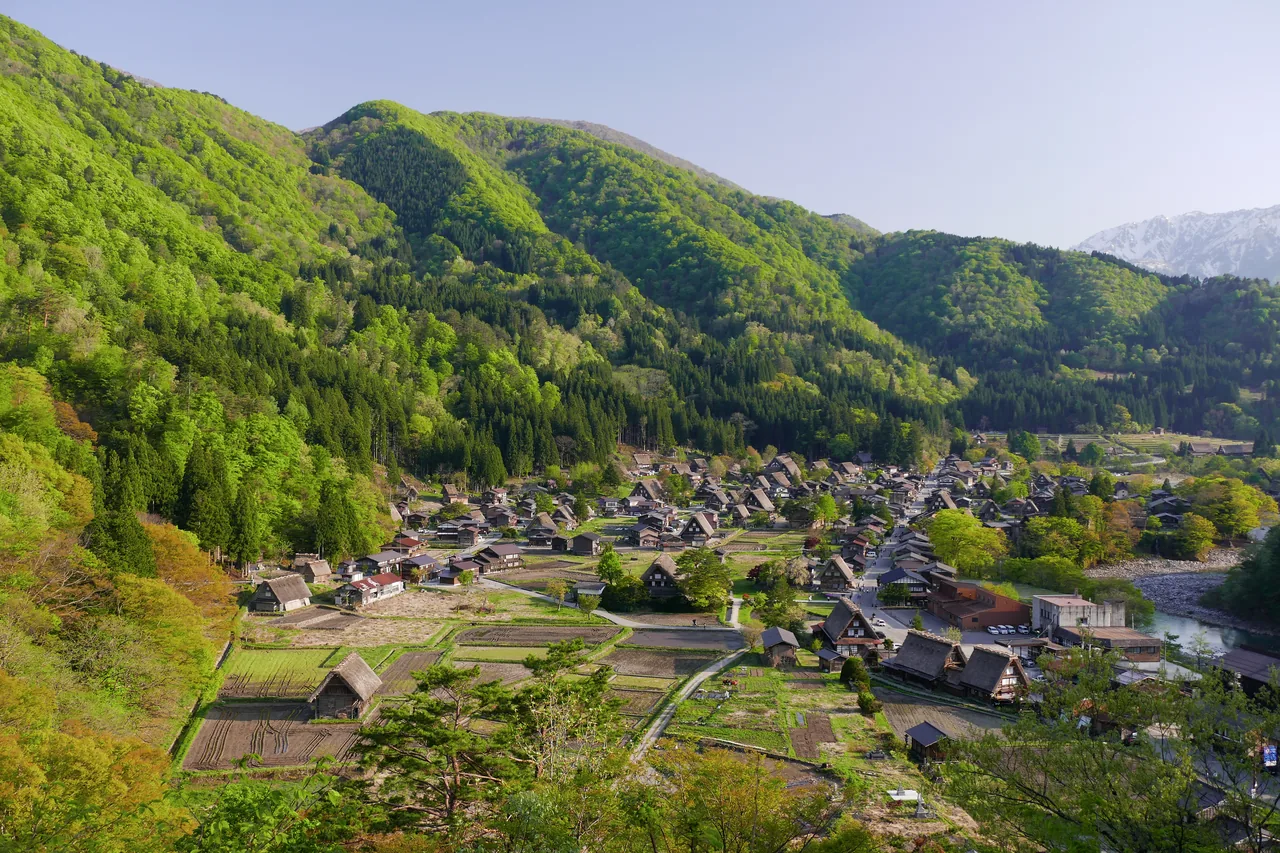
The express bus from Kanazawa to Shirakawa-go takes 1 hour 15 minutes and every seat is reserved, so without a booking you are not travelling. One way is 2,800 yen for adults, and reservations open a month ahead by phone or online. Map
It works as a day trip. Go out in the morning, walk the village, come back in the afternoon and have dinner in Kanazawa. There are around fourteen departures a day from Kanazawa and fewer coming back, so fix your return first and build around it.
Turning up without a reservation does not work
This is not a service where you queue and take a spare seat. In peak season it sells out days in advance. Book it on the evening you arrive in Kanazawa.
Many people come the other way, from Takayama through Shirakawa-go and on to Kanazawa. That routing is covered in our Takayama and Shirakawa-go guide.
37. Kaga Onsen and Noto are two different situations
Kaga Onsen is 16 minutes from Kanazawa by shinkansen. The 2024 extension added a station there, and the hot spring villages sit around it, reached by local bus.
Most people either day trip for a bath or spend their last night at a ryokan out there before flying home. How ryokan and onsen work is covered in our onsen and ryokan guide.
There are four villages, not one
Kaga Onsen is a collective name. Yamanaka, Yamashiro and Katayamazu are in Kaga City and Awazu is in Komatsu. They differ enough that you should choose before you go.
Yamanaka has a gorge walk, Yamashiro has a restored historic bathhouse at its centre, Katayamazu looks out over a lagoon and Awazu has the long-established inns. All four are a bus ride from Kaga Onsen Station.
Check before heading for Noto
Parts of the Noto Peninsula are still recovering from the January 2024 earthquake. Some accommodation and attractions have reopened, but sections of road and public transport remain out. If Noto is on your plan, confirm each item directly before you travel.
Kanazawa itself and everything south of it, including Hakusan, Komatsu and Kaga, is operating normally. A trip confined to Kanazawa is not affected.
38. The station handles the souvenir problem
Kanazawa Station gathers the region’s crafts and confectionery into one arcade. You can buy Kutani ware, gold leaf goods and wagashi without tracking down individual workshops, which is useful on a departure morning.
Full-size Kutani pieces are a commitment. Chopstick rests and small dishes carry the same five colours and travel better. Anything with the full palette is instantly identifiable as being from here.
Gold leaf turns up in several forms
Leaf-covered chopsticks and lacquerware, cosmetics and tea containing it, and sake with leaf suspended in the bottle. It is light to carry and unambiguously local.
With wagashi, ask about shelf life. Fresh sweets need eating within days, dried ones keep for weeks. Staff will tell you which is which if you ask.
Sake and cooking ingredients too
Ishikawa has good rice and good water and a number of breweries. The station shops carry the local labels, including small bottles. In winter someone will happily tell you which one goes with crab.
If you want to attempt jibuni at home, buy sudarefu. It is dried wheat gluten, light and stable, and Omicho sells it as well.
39. Choose between the station and Korinbo
Accommodation clusters in two places: around Kanazawa Station and in Korinbo. The station is easier on arrival and departure days, Korinbo puts you in the middle of the sights. Either way, nowhere in the city is more than about fifteen minutes by bus.
Station hotels are larger and the rooms tend to be bigger. You never drag a case far and a late arrival is no problem. The cost is that you commute out in the morning and back in the evening.
Korinbo suits walkers
Korinbo is the department store and shopping district at the centre of town. Kenrokuen, the 21st Century Museum and Nagamachi are all within walking distance from here, which matters a lot if you intend to be at the garden for the free early opening.
Katamachi sits just south of it, where the restaurants and bars are. Good if you eat late, less good if you want quiet. For quiet, look at the teahouse districts or the west side of the station.
Machiya conversions are an option
Around the teahouse streets there are guesthouses converted from machiya townhouses, with the lattice windows, steep stairs and small internal gardens intact. Some let by the whole house, which works for a group.
They are old buildings, so sound carries and the stairs are close to ladders. If you have heavy luggage or difficulty with steps, look at the photographs carefully before booking.
There is a lodging tax
Kanazawa levies its own accommodation tax: 200 yen per person per night where the room rate is under 20,000 yen and 500 yen at or above that. Rooms under 5,000 yen per person per night before tax are exempt. Ishikawa Prefecture has no separate tax of its own.
Some properties collect it in cash at check-in. National coverage is in our Japan accommodation tax guide.
40. Two days split like this
Day one around the castle, day two across the rivers. Not crossing the water repeatedly is the single biggest time saving available in Kanazawa.
Day one, the centre
Eat at Omicho in the morning and walk up into the castle park. Take Oyama Shrine and the Gyokusen’inmaru garden on the way through, see the three castle interiors, then cross into Kenrokuen. Add Seisonkaku and it is early afternoon.
Give the rest of the day to the Hill of Culture. The 21st Century Museum stays open late, so it works as the last stop. If you want the pool basement, go to the museum first thing in the morning to register, then come back.
Day two, across the rivers
Walk Nagamachi in the morning, cross the Saigawa for Nishi Chaya, Myoryuji and Teramachi. Your Myoryuji reservation time fixes the shape of this day, so book it before you plan anything else. In the afternoon cross the Asanogawa to Higashi Chaya and Kazuemachi.
Finish at dusk in Kazuemachi as the lanterns come on, then eat. With only one day, take day one and add Higashi Chaya late in the afternoon.
A third day goes outside the city
With three days, use the extra one for Shirakawa-go or Kaga Onsen. Shirakawa-go is about two and a half hours of bus travel plus two or three hours in the village. Kaga Onsen is a short shinkansen hop and can also be an overnight.
If you would rather stay in town, the Utatsuyama slope, the Kodatsuno lanes and whatever you missed on the Hill of Culture will fill it, and this is where a craft workshop fits.
What has to be booked ahead
Myoryuji, the Shirakawa-go bus and your Kagayaki seat. None of the three can be sorted out on the day. Everything else can be decided once you are here.
The 21st Century Museum pool basement is the exception in the other direction: it cannot be booked in advance at all, only from nine on the morning itself. Keep those two rules straight and the itinerary holds together.
🎡Things to Do8
🏨Where to Stay2
🚇Getting Around1
🗾Japan trip essentials23
Kanazawa travel questions
One day covers the castle, Kenrokuen and the eastern teahouse streets. The problem is that the sights are spread across two rivers around the castle, so cramming everything into a day turns it into travelling rather than looking. Two days lets you take the centre on the first day and the far banks on the second without doubling back.
Early morning, when it is free and nearly empty. Enter up to fifteen minutes before the paid opening and there is no charge. That means from 04:00 between April and August, 05:00 in March and from September through October, and 06:00 from November to the end of February. The teahouse and shops inside are not open at that hour.
The ropes go up from 1 November, starting with the Karasaki pine, and work continues into mid December. They come down over about a week from the middle of March. So any time from early November to mid March. The straw wrapping on the Nagamachi earth walls runs on a similar schedule, so you can see both in one day.
Book if you can. It runs on reservations taken by telephone from three months ahead, and each slot has a capacity. You can still get in on the day if a slot has room, but a full slot is closed. It takes cash only, and preschool children are not admitted at all, which catches families out. Admission is 1,200 yen for adults and students and 800 yen for elementary school children, and the tour lasts about forty minutes.
No. Registration for the basement of Leandro’s Pool opens at 09:00 on the day itself, online or at the machine by the Hondori entrance, and there is no telephone booking. You need an exhibition ticket to register and your slot lasts five minutes. If you want it, make the museum your first stop of the day.
Both were licensed in 1820, when the domain gathered the teahouses into an eastern and a western district. Higashi Chaya is larger and has two houses you can go inside. Nishi Chaya is small and quiet and sits next to Myoryuji. With one day, take Higashi Chaya.
From about the fourth ride, yes, at 800 yen. If you walk within each district and only ride when changing district you will board twice a day, which is cheaper paid singly. Note that the pass is not sold on board, so buy it at a station information desk before you start.
It depends on the operator. National IC cards work on the sightseeing loop, the JR buses and the Furatto community buses. They do not work on Hokuriku Railroad’s ordinary route buses, which take the local ICa card or contactless credit card. Carry cash or a contactless card if you might use a route bus.
The season opens on 6 November. Male kano-gani runs to 20 March and female kobako-gani only to 29 December. If you want the roe-filled female crab, come in November or December. Kani-men, the oden made from a packed female crab shell, is only on the menu during the same window.
Thunderbird limited express to Tsuruga, then the shinkansen. About 2 hours 15 minutes and 9,410 yen fully reserved. The through service ended when the shinkansen was extended to Tsuruga in March 2024, so the change is now unavoidable. The trip got slightly faster and about 1,600 yen more expensive.