
Japan’s Accommodation Tax: What Every City Charges and How It Is Calculated
It is charged per person per night, and your prepaid booking total usually does not cover it. Rates differ by city, Kyoto and Osaka have already changed theirs and Hokkaido has just started charging, so here is every rate straight from the municipal notices.
| What sets the rate | The room price divided by the number of guests, not the room price itself. |
|---|---|
| Highest in Japan | Kyoto charges ¥10,000 a night once one guest’s share reaches ¥100,000. |
| Newly charging | Hokkaido added a prefectural tax in April 2026, and cities stack their own on top. |
| Changing next | Tokyo moves to a flat 3 percent in April 2027, with nothing charged below ¥13,000. |
| How you pay | The property collects it, so it often appears only at check-in or check-out. |
1. The tax your booking total probably does not include
2. Where the number comes from: per person, per night, room only
3. The flat-rate cities and what they charge
4. Kyoto sits alone at the top
5. The shift to percentage rates
6. Hokkaido, where two taxes stack
7. Osaka and Fukuoka
8. Onsen stays add a bathing tax
9. What a real trip actually costs
10. Paying it, and what to check before you book
1. The tax your booking total probably does not include
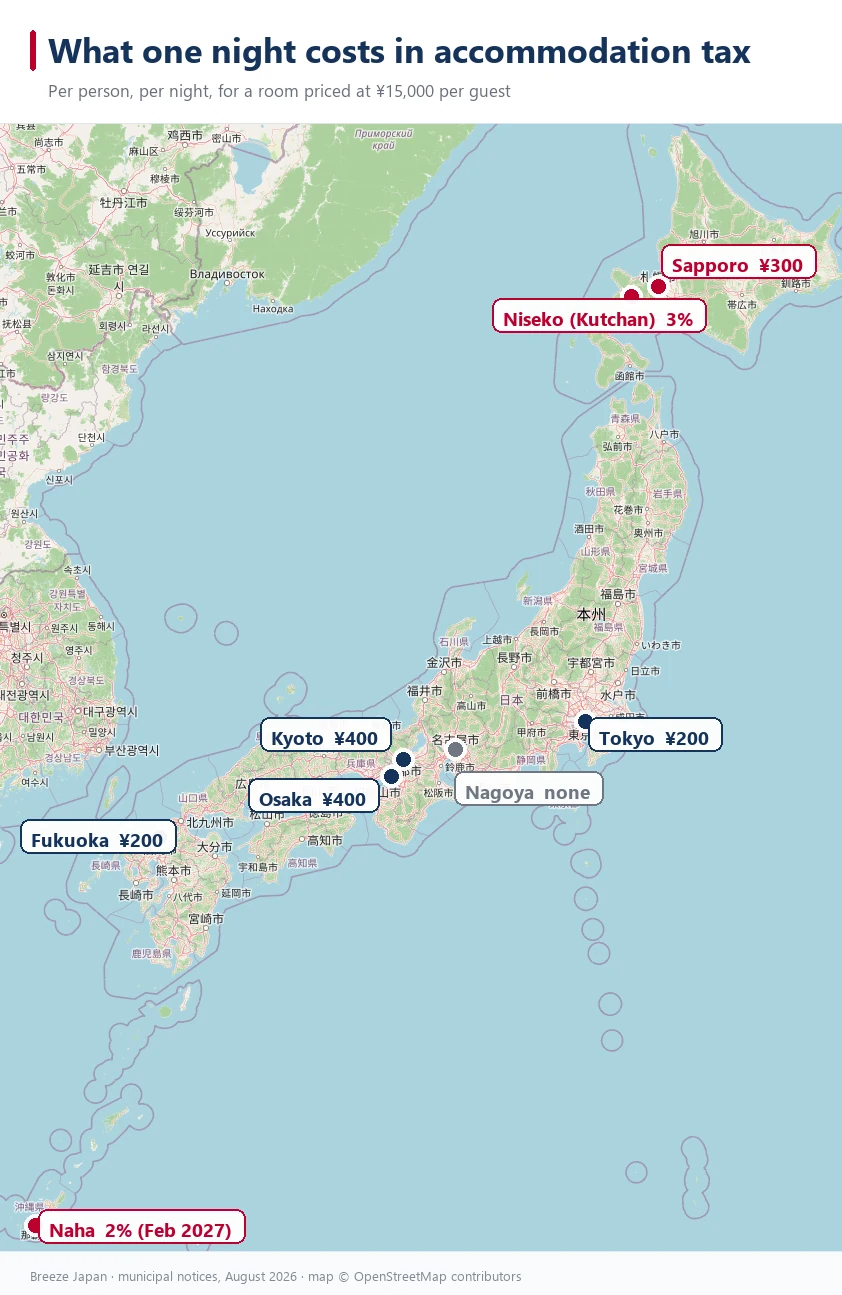
Japan’s accommodation tax is a local tax charged per guest per night, and depending on the city it runs from ¥200 to ¥10,000. Booking sites collect the room rate; the property collects this tax separately, which is why most visitors meet it for the first time at the front desk.
It is not a national tax. Each prefecture or city writes its own ordinance, gets the Minister for Internal Affairs and Communications to sign off, and then starts charging. Tokyo has one. Nagoya does not. The same room at the same price can carry nothing in one city and ¥1,000 in another.
| City | One guest paying ¥15,000 a night | Status |
|---|---|---|
| Tokyo | ¥200 | Charging now |
| Osaka | ¥400 | Charging now |
| Kyoto | ¥400 | Charging now |
| Sapporo | ¥300 (¥100 prefectural + ¥200 city) | From April 2026 |
| Fukuoka | ¥200 | Charging now |
| Naha | ¥300 (2 percent) | From February 2027 |
| Nagoya | None | Not adopted |
| Nara | None | Not adopted |
If you have paid a city tax in Rome, Amsterdam or Lisbon, the mechanism will be familiar: a per-night charge collected by the property rather than the booking platform. The difference in Japan is how uneven the map is. A two week trip through Tokyo, Takayama, Kyoto and Hiroshima passes through two taxing authorities and two that charge nothing at all.
2. Where the number comes from: per person, per night, room only
The band is decided by one guest’s share of the room rate, calculated as the room price divided by the number of people sleeping in it. Kyoto City and the Tokyo Metropolitan Government both spell this out. A twin room at ¥20,000 shared by two people counts as ¥10,000 per person per night.
Because the bands are steps rather than a smooth curve, adding people to a room does not always raise the total. A ¥60,000 room in Kyoto works out like this.
| Guests | Per person per night | Band | Each | Total for the room |
|---|---|---|---|---|
| 1 | ¥60,000 | ¥50,000 and above | ¥4,000 | ¥4,000 |
| 2 | ¥30,000 | ¥20,000 and above | ¥1,000 | ¥2,000 |
| 3 | ¥20,000 | ¥20,000 and above | ¥1,000 | ¥3,000 |
| 4 | ¥15,000 | ¥6,000 and above | ¥400 | ¥1,600 |
Same room, same night: one guest pays ¥2,400 more than four guests would pay between them. Solo travellers booking well appointed ryokan rooms are the group most affected by this, because a room priced for two lands entirely in one person’s band.
What is stripped out before the calculation
| Item | Counted? |
|---|---|
| Room charge | Yes |
| Service charge | Kyoto City states that it is included |
| Breakfast, dinner and other meals | No |
| Consumption tax of 10 percent | No |
This matters most at ryokan, where the standard rate is quoted with dinner and breakfast built in. The taxable figure is the room-only portion, so a ¥35,000 half-board rate that contains ¥12,000 of food is assessed at ¥23,000. The property does the arithmetic, and a receipt that does not match your own estimate is usually explained by this split.
3. The flat-rate cities and what they charge
Most of Japan still uses fixed amounts arranged in bands, and only a handful of places charge a percentage. Here is the full picture as it stands in 2026.
| Authority | Method | Rate by guest’s nightly share | Threshold |
|---|---|---|---|
| Tokyo Metropolis | Fixed | Under ¥10,000 nil / ¥10,000 to under ¥15,000 ¥100 / ¥15,000 and above ¥200 | Under ¥10,000 |
| Tokyo (from April 2027) | Percentage | 3 percent | Under ¥13,000 |
| Osaka Prefecture | Fixed | Under ¥5,000 nil / ¥5,000 to under ¥15,000 ¥200 / ¥15,000 to under ¥20,000 ¥400 / ¥20,000 and above ¥500 | Under ¥5,000 |
| Kyoto City | Fixed | Under ¥6,000 ¥200 / ¥6,000 to under ¥20,000 ¥400 / ¥20,000 to under ¥50,000 ¥1,000 / ¥50,000 to under ¥100,000 ¥4,000 / ¥100,000 and above ¥10,000 | None |
| Hokkaido (prefectural) | Fixed | Under ¥20,000 ¥100 / ¥20,000 to under ¥50,000 ¥200 / ¥50,000 and above ¥500 | None |
| Sapporo City | Fixed | Under ¥50,000 ¥200 / ¥50,000 and above ¥500 | None |
| Fukuoka City | Fixed | Under ¥20,000 ¥200 / ¥20,000 and above ¥500 | None |
| Okinawa Prefecture (from February 2027) | Percentage | 2 percent, capped at ¥2,000 a night | Not stated |
| Kutchan Town | Percentage | 3 percent (2 percent for stays up to March 2026) | None |
The same room rate across five cities
| Guest’s nightly share | Tokyo | Osaka | Kyoto | Sapporo | Fukuoka |
|---|---|---|---|---|---|
| ¥4,000 | nil | nil | ¥200 | ¥300 | ¥200 |
| ¥9,000 | nil | ¥200 | ¥400 | ¥300 | ¥200 |
| ¥18,000 | ¥200 | ¥400 | ¥400 | ¥300 | ¥200 |
| ¥35,000 | ¥200 | ¥500 | ¥1,000 | ¥400 | ¥500 |
| ¥80,000 | ¥200 | ¥500 | ¥4,000 | ¥1,000 | ¥500 |
Two patterns come out of that table. At hostel and guesthouse prices, Kyoto and Sapporo charge while Tokyo and Osaka charge nothing, because neither of the first two sets a threshold. At the top end the four flat-rate cities barely move while Kyoto climbs to twenty times what Tokyo asks. Budget travellers and luxury travellers therefore meet completely different versions of this tax.
4. Kyoto sits alone at the top
From stays on 1 March 2026, Kyoto City moved to five bands and raised the top two sharply. A band for guests paying ¥100,000 or more per night was added, and it carries ¥10,000. The same stay was taxed ¥1,000 before the change.
| Guest’s nightly share | Until February 2026 | From March 2026 | Multiple |
|---|---|---|---|
| Under ¥6,000 | ¥200 | ¥200 | unchanged |
| ¥6,000 to under ¥20,000 | ¥400 | ¥400 | unchanged |
| ¥20,000 to under ¥50,000 | ¥500 | ¥1,000 | 2x |
| ¥50,000 to under ¥100,000 | ¥1,000 | ¥4,000 | 4x |
| ¥100,000 and above | ¥1,000 | ¥10,000 | 10x |
The size of the increase follows from the revenue target. Kyoto City collected about ¥5.2 billion from this tax in the 2023 financial year, its highest ever, and projects roughly ¥12.6 billion under the new bands. That is 2.4 times as much, and the city has named bus service improvements and crowd management around Kyoto Station as the things the money is for. The design routes money from visitors into the parts of daily life that visitor numbers have strained.
Kyoto has no exemption threshold
Tokyo and Osaka both set a floor below which nothing is charged. Kyoto does not. A ¥4,000 dormitory bed still carries ¥200. Anyone spending a week in cheap accommodation accumulates more tax in Kyoto than in Tokyo or Osaka, which reverses the usual assumption that the expensive city is the expensive one to be taxed in.
Coverage is broad: hotels, ryokan, simple lodgings and private lodging businesses are all included. Students and teachers on a school-run educational trip are exempt, and there is no general exemption for independent travellers.
5. The shift to percentage rates
Three authorities have now moved away from fixed amounts, and all three changes land within about a year of each other. Tokyo goes to 3 percent, Okinawa starts at 2 percent, and Kutchan raises its existing percentage to 3.
Tokyo, from 1 April 2027
| Item | Now | From April 2027 |
|---|---|---|
| Method | Two fixed amounts | 3 percent of the room rate |
| Threshold | Under ¥10,000 per person per night | Under ¥13,000 per person per night |
| Properties covered | Hotels and ryokan | Hotels, ryokan, simple lodgings and private lodgings |
The Tokyo Metropolitan Assembly passed the amendment on 27 March 2026 and the national government gave its consent on 30 June 2026. What makes this change worth planning around is that it pushes in opposite directions depending on your budget.
| Guest’s nightly share | Now | From April 2027 | Difference |
|---|---|---|---|
| ¥8,000 | nil | nil | no change |
| ¥12,000 | ¥100 | nil | disappears |
| ¥13,000 | ¥100 | ¥390 | ¥290 more |
| ¥20,000 | ¥200 | ¥600 | ¥400 more |
| ¥60,000 | ¥200 | ¥1,800 | ¥1,600 more |
Raising the threshold from ¥10,000 to ¥13,000 removes the charge entirely from the mid-range business hotels that most visitors use, while a ¥60,000 room goes from ¥200 to ¥1,800. Under the fixed system the maximum was ¥200 no matter how expensive the room, so the effective rate on a luxury stay was a fraction of a percent, and Tokyo has chosen to level that at 3 percent across the board.
The other half of the Tokyo change is coverage. Private lodgings registered under the national minpaku law and the special-zone scheme are currently outside the tax, so an apartment rental in Tokyo carries none today. From April 2027 it will carry 3 percent like everything else. Families booking apartments for four or five people should re-check totals for stays after that date.
Okinawa, from 1 February 2027
| Item | Detail |
|---|---|
| Rate | 2 percent of the room charge |
| Cap | ¥2,000 per person per night |
| Adopted by | Okinawa Prefecture plus five municipalities |
| The five | Motobu, Onna, Chatan, Miyakojima and Ishigaki |
| Naha | Prefectural tax only |
| Outside the tax | School club activities and educational trips for pupils under 18 |
The cap bites at ¥100,000 per person per night, above which the charge stops rising. Okinawa Prefecture expects about ¥7.78 billion a year from it. The practical point for visitors is the split between Naha and the resort municipalities: a night in Naha carries the prefectural tax alone, while Onna, Chatan, Miyakojima and Ishigaki add their own on top. A ¥30,000 beachfront room therefore carries ¥600 in prefectural tax before the municipal share is counted.
6. Hokkaido, where two taxes stack
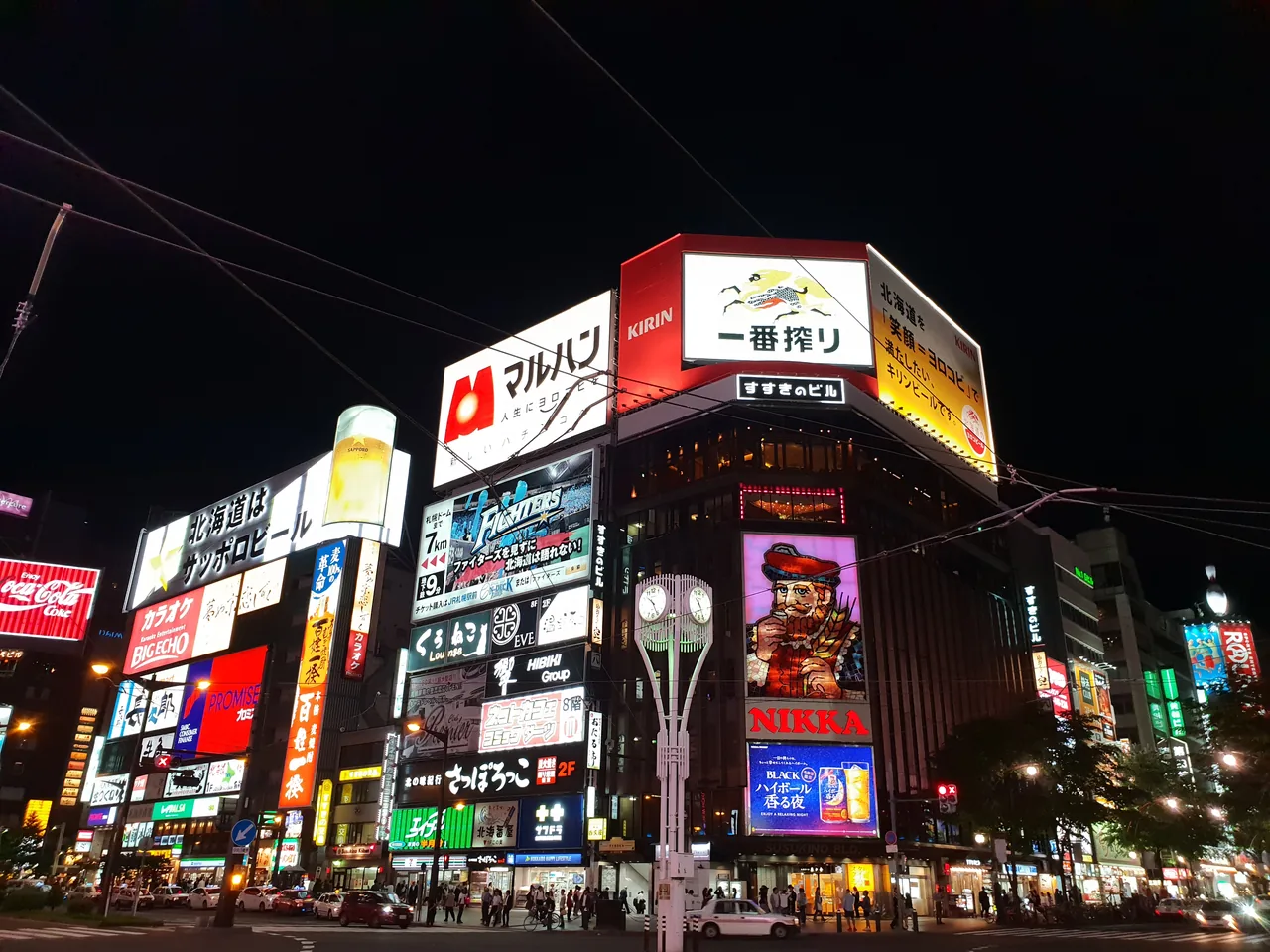
From stays on 1 April 2026, every property in Hokkaido collects a prefectural tax, and fifteen municipalities add a second layer of their own. Sapporo is one of them, so a night there carries both.
| Guest’s nightly share | Hokkaido | Sapporo City | Total in Sapporo |
|---|---|---|---|
| Under ¥20,000 | ¥100 | ¥200 | ¥300 |
| ¥20,000 to under ¥50,000 | ¥200 | ¥200 | ¥400 |
| ¥50,000 and above | ¥500 | ¥500 | ¥1,000 |
Sapporo’s own ordinance has only two steps, ¥200 below ¥50,000 and ¥500 at or above it. The table shows three rows because the prefectural tax splits again at ¥20,000. Neither layer has a threshold, so a ¥5,000 hostel bunk in Sapporo carries ¥300, which is more than the same bunk would carry anywhere else in Japan.
| Charging since | Municipalities |
|---|---|
| November 2019 | Kutchan (percentage based) |
| November 2024 | Niseko Town |
| November 2025 | Akaigawa |
| April 2026 | Sapporo, Otaru, Hakodate, Asahikawa, Furano, Shimukappu, Kitami, Abashiri, Obihiro, Otofuke, Kushiro, Rusutsu, Toyako, Koshimizu and Shintoku |
Ski season in Kutchan
Most of the Niseko accommodation that foreign visitors book, Hirafu included, sits inside Kutchan Town. Kutchan has charged a percentage since 2019 rather than a fixed amount, and it raised that percentage from 2 to 3 for stays from 1 April 2026, with the prefectural share deducted within the calculation. Stays up to 31 March 2026 remain at 2 percent.
A percentage rate behaves very differently in a resort town where January rates are several times the summer ones. A ¥60,000 condo shared by two people works out at ¥30,000 each, so ¥900 per person and ¥1,800 for the room for one night. In a flat-rate city the same room would carry ¥400 or ¥500. Kutchan collected ¥568 million from this tax in the 2024 financial year, a third consecutive record, which is what a percentage rate applied to peak ski pricing produces.
7. Osaka and Fukuoka
Osaka Prefecture
From stays on 1 September 2025, Osaka lowered its threshold from ¥7,000 to ¥5,000 and raised every band. Rooms that used to fall below the line are now taxed at ¥200.
| Guest’s nightly share | Until August 2025 | From September 2025 |
|---|---|---|
| Under ¥5,000 | nil | nil |
| ¥5,000 to under ¥7,000 | nil | ¥200 |
| ¥7,000 to under ¥15,000 | ¥100 | ¥200 |
| ¥15,000 to under ¥20,000 | ¥200 | ¥400 |
| ¥20,000 and above | ¥300 | ¥500 |
A ¥12,000 twin near Namba or Umeda shared by two people gives each guest a ¥6,000 share, which used to be untaxed and is now ¥200 each. Over three nights that is ¥1,200 for the pair.
No municipality inside Osaka Prefecture levies its own accommodation tax, so unlike Hokkaido there is only ever one layer to calculate, whether you stay in Osaka City or Sakai. School trip exemptions granted during the Expo period continue to apply.
Fukuoka City
| Guest’s nightly share | Charge | Composition |
|---|---|---|
| Under ¥20,000 | ¥200 | ¥150 city plus ¥50 prefecture |
| ¥20,000 and above | ¥500 | ¥450 city plus ¥50 prefecture |
Fukuoka has run the same two bands since 1 April 2020 without adjustment, which makes it the most stable rate on this page. The prefectural component is folded in and collected by the city, so no visitor pays twice. Coverage includes hotels, ryokan and registered private lodgings.
8. Onsen stays add a bathing tax
Properties with hot spring facilities charge a bathing tax on top of any accommodation tax, and the standard rate set in national law is ¥150 per person per day. One overnight stay counts as one day. Articles 701 to 701-29 of the Local Tax Act provide the basis, and each municipality fixes the actual amount by ordinance.
| Visit type | Standard rate | Hakone Town |
|---|---|---|
| Overnight | ¥150 per person per day | ¥150 |
| Day bathing only | Set locally | ¥50 |
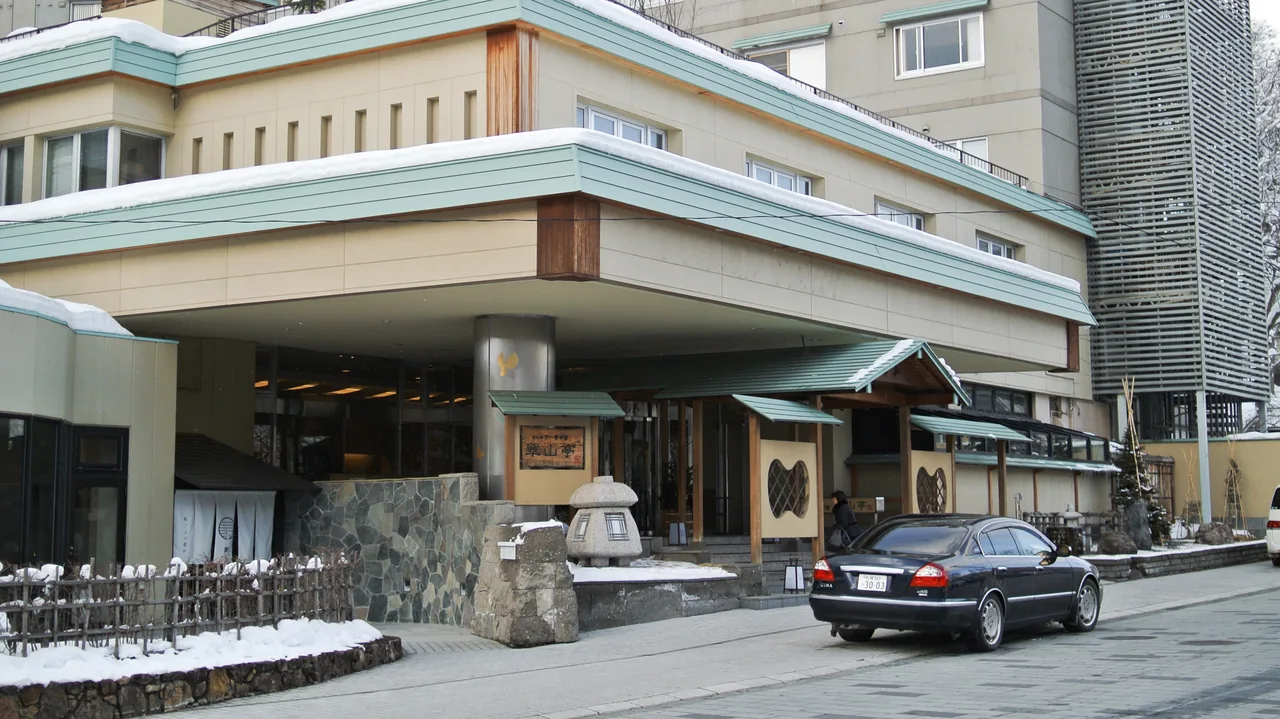
The amount is small, but it lands alongside the accommodation tax rather than instead of it. A ryokan night in Jozankei outside Sapporo, or in Beppu or Yufuin, carries both. The same is true of the higher-end Kyoto ryokan that have hot spring baths.
Bathing tax is easy to miss because practice varies: some properties fold it into the quoted rate and some list it separately at checkout. When a final bill runs slightly above what you calculated, this is usually the line responsible.
Hiroshima Prefecture
Hiroshima introduced a prefectural lodging tax for stays from 1 April 2026. Nothing is charged below ¥6,000 per person per night before tax, and ¥200 applies at or above that. Because it is prefectural rather than municipal, it also applies on Miyajima.
9. What a real trip actually costs
Four itineraries, with the room rate divided by headcount before the band is read.
| Itinerary | Per person per night | Calculation | Total tax |
|---|---|---|---|
| Tokyo 3 nights, twin room | ¥14,000 | ¥100 × 2 people × 3 nights | ¥600 |
| Golden Route: Tokyo 3, Kyoto 3, Osaka 2, twin | ¥14,000 | (¥100 × 3) + (¥400 × 3) + (¥200 × 2) per person, doubled | ¥3,800 |
| Sapporo 4 nights in February, twin | ¥22,000 | ¥400 × 2 people × 4 nights | ¥3,200 |
| Kyoto ryokan, 1 night, two guests | ¥60,000 | ¥4,000 × 2 people plus ¥150 bathing tax × 2 | ¥8,300 |
The first three are rounding errors against the cost of the trip. The fourth is the case worth knowing about in advance: a ¥120,000 room split between two people puts each guest at ¥60,000, which sits in Kyoto’s ¥50,000 band at ¥4,000 each. The identical booking in February 2026 would have carried ¥1,000 each, so the same night now costs ¥6,000 more in tax alone.
Multi-city trips pass through several regimes
On a rail-pass itinerary the ordinance changes every time you change city. Three nights in Tokyo, three in Kyoto and two in Osaka at ¥14,000 per person produce ¥300, ¥1,200 and ¥400 respectively, so ¥1,900 per person. Nights spent in Takayama, Kanazawa, Hiroshima or Nagoya add nothing at all, because those places have not adopted the tax.
Yokohama, the second largest city in Japan, charges no lodging tax at all, and neither does Kanagawa Prefecture. What that means for a Tokyo base is covered in the Yokohama travel guide.
10. Paying it, and what to check before you book
Some properties collect the tax inside the prepaid booking total and some collect it only on arrival. Kyoto City’s guidance is that it is paid to the property, while noting that it is sometimes already included in what a booking site or travel agent has charged. Which of the two applies is stated on your booking confirmation and in the property’s own information page.
| What to check | Where it appears |
|---|---|
| Whether the tax is included | The taxes and fees line on your booking confirmation |
| What is due on arrival | The “payable at the property” section |
| Accepted payment | Varies; some properties take cash only for this line |
| Changes to headcount | Fewer or more guests changes each share and therefore the band |
Keep some coins and small notes for the properties that still take cash only. Our guide to money and payments in Japan covers where cards work and where they do not.
This is separate from the departure tax
The International Tourist Tax charged when you leave Japan is a national tax, already built into your airline ticket, and unrelated to where you slept. It rose from ¥1,000 to ¥3,000 for departures from 1 July 2026, and tickets issued on or before 30 June 2026 keep the old ¥1,000 rate. Our departure tax guide explains how it appears on a fare breakdown.
Keep the receipt if you are claiming expenses
Business travellers should note that the accommodation tax is itemised separately from consumption tax on a Japanese receipt, and that consumption tax is not charged on it. If you are reclaiming costs, the two lines are not interchangeable.