
Akihabara Guide: Which Building, Which Floor and What Time It Opens
Akihabara is not a district you walk through; it is a district you go up and down. The shop you want is usually on the fourth floor of a building whose ground floor sells something else entirely, and each building opens at its own hour. Here is the floor-by-floor version, from official sources.
| Exit | Use the Electric Town exit, not the Showa-dori side. |
|---|---|
| Floors | Mandarake sells something different on each of eight floors. |
| Opening | Mandarake does not open until noon. |
| Maid cafes | The cover charge is set by your age bracket. |
| Sunday | Chuo-dori closes to cars from 13:00. |
| Touts | Street soliciting is banned here by ward ordinance. |
1. In Akihabara the address you need is a floor, not a street
2. Leave the station by the Electric Town exit
3. Radio Kaikan puts ten different kinds of shop on ten floors
4. Mandarake Complex sells something different on each of eight floors
5. The component arcades have been here since 1950
6. Super Potato separates the floors you buy on from the floor you play on
7. The biggest game centre changed hands
8. Animate is two buildings, not one
9. Maid cafe pricing is set by age bracket
10. Do not follow anyone who approaches you on the street
11. Don Quijote runs around the clock and has a theatre upstairs
12. Yodobashi is on the other side of the station
13. On Sunday afternoons Chuo-dori closes to traffic
14. Gachapon Kaikan closes an hour early on Sundays
15. The UDX shopping floors are currently closed
16. Kanda Myojin and the arches under the tracks
17. What half a day covers, and what a full day covers
18. Is Akihabara a good place to stay?
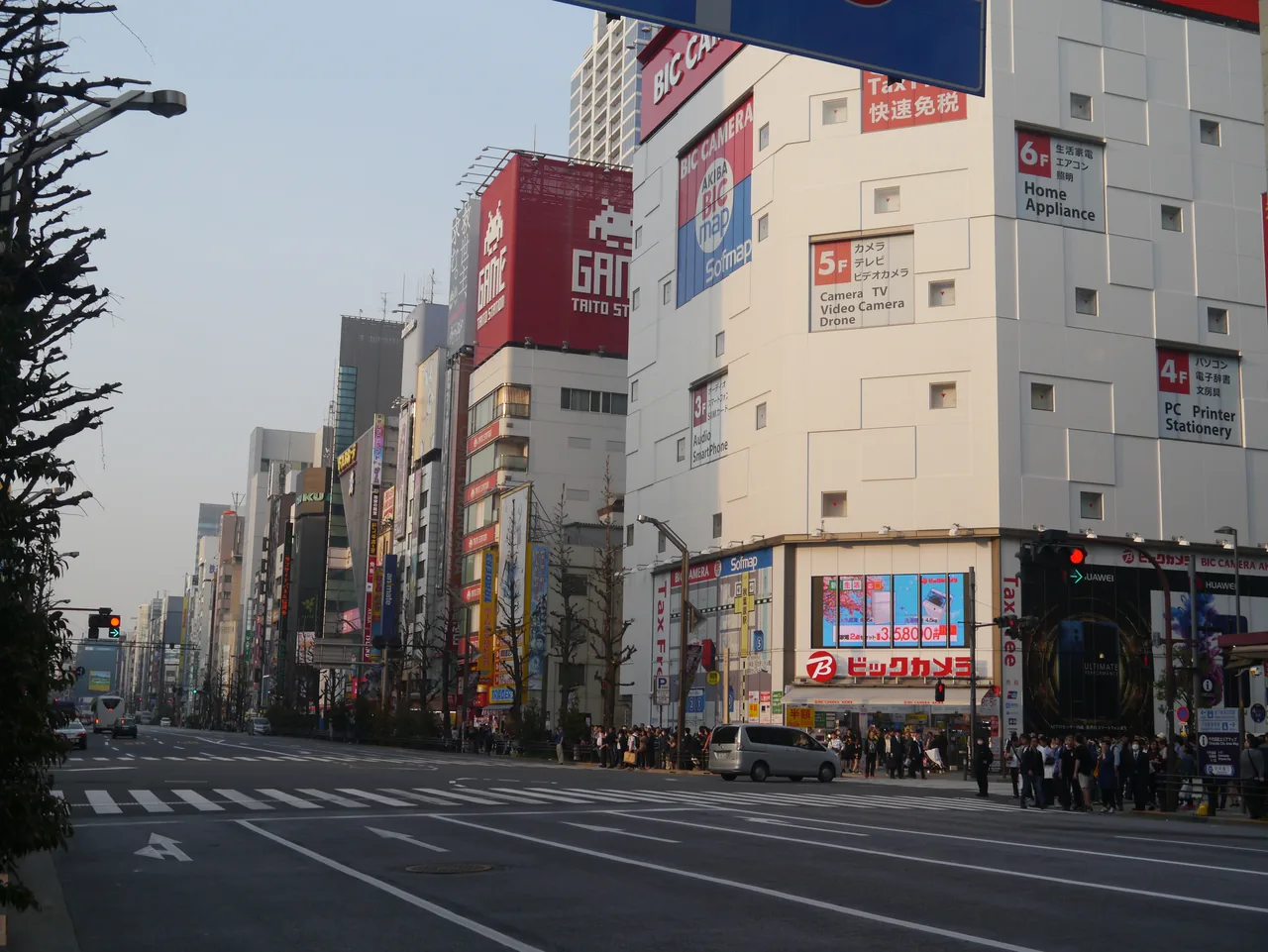
1. In Akihabara the address you need is a floor, not a street
Most Tokyo neighbourhoods give you a list of sights to walk between. Akihabara gives you a list of buildings to go up. The thing you came for is rarely visible from the pavement. Second-hand manga sits on the third floor of a building whose ground floor is a buy-back counter, and figures are spread across three floors above that. Arrive without a building and a floor in mind and you will spend the afternoon on staircases.
Chuo-dori is the wide avenue that starts at the Electric Town exit of Akihabara station and runs north, and it organises everything else. The large buildings sit on it. One block back on either side, the streets narrow and fill with component shops and small specialists. Map
These are the buildings whose floor plans are published on their own official pages. Each one gets its own section below.
| Building | Floors | What is inside |
|---|---|---|
| Akihabara Radio Kaikan | B1-10 | Dolls, figures, audio, cards and books |
| Mandarake Complex | 1-8 | Second-hand manga, doujinshi, toys |
| Tokyo Radio Department | B1-3 | About 36 electronic component shops |
| Animate main building | 1-6 | Character goods |
| Animate annex | B1-7 | Capsule toys, game goods, pop-up events |
| Super Potato | 3-5 | Retro game sales, plus an arcade floor |
| Don Quijote Akihabara | B1-8 | Discount goods, maid cafe, theatre |
| Silk Hat Akihabara | B1-8 | Game centre |
Half a day covers two or three buildings
Working a single building from top to bottom takes about an hour, and longer where the floors change character as much as they do in Radio Kaikan. With only an afternoon, pick two or three buildings and treat the rest of the district as something you look at from the street and do not go into.
Write down shop names before you go, not just categories. Several chains run more than one branch inside Akihabara alone, so searching the brand name can send you to the wrong door. One maid cafe brand operates three separate premises in this district.
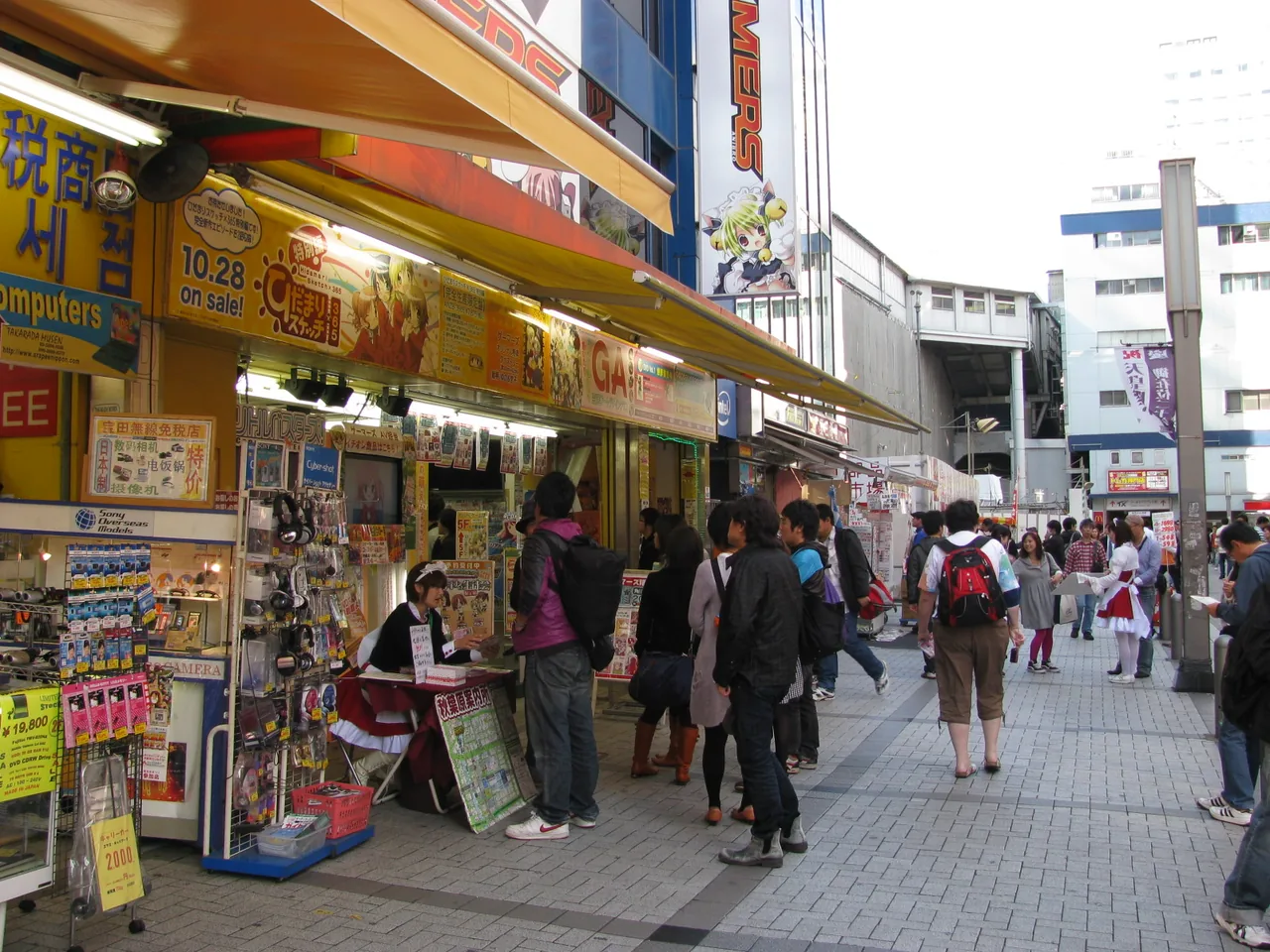
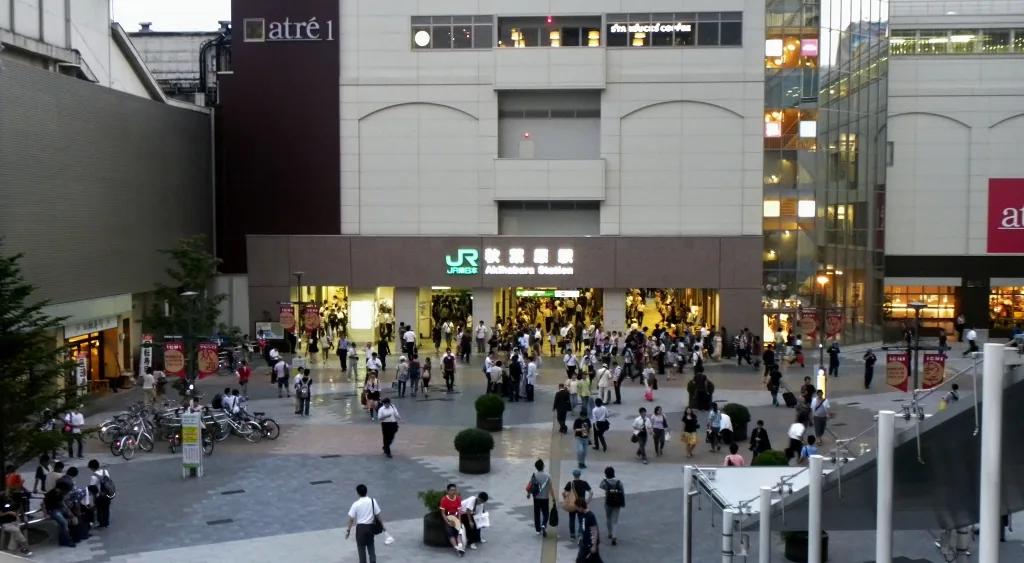
2. Leave the station by the Electric Town exit
Akihabara station has exits on both sides, and only one of them opens onto the district people come for. The Electric Town exit puts you on Chuo-dori among the signs. The Showa-dori side faces a wide road and office blocks, and looks like an ordinary business district. This is the most common wrong turn here. Map
The station carries the JR Yamanote, Keihin-Tohoku and Sobu lines, the Tokyo Metro Hibiya line, and the Tsukuba Express. The Tsukuba Express platforms sit well below the others, so allow real walking time if you are changing to or from it.
| Coming from | Line | Get off at |
|---|---|---|
| Shinjuku, Shibuya, Ikebukuro | JR Yamanote | Akihabara |
| Ueno | JR Yamanote or Keihin-Tohoku | Akihabara, two stops |
| Ginza, Roppongi | Tokyo Metro Hibiya | Akihabara |
| Asakusa | Tokyo Metro Ginza | Suehirocho |
| Southern Shinjuku | Toei Shinjuku | Iwamotocho |
The northern end is closer to Suehirocho
The shopping strip runs north along Chuo-dori, and its far end is genuinely closer to Suehirocho station on the Ginza line than to Akihabara station. Gachapon Kaikan, near the top of the strip, is a two-minute walk from Suehirocho but seven minutes from the Electric Town exit. Map
If your list is weighted towards the northern shops, get off at Suehirocho and walk south. If you are starting with the big buildings by the station, do it the other way round. Either way you only walk the strip once.
Put your luggage down first
This is a district of stairs, lifts and narrow aisles, and a suitcase turns every floor change into a negotiation. There are coin lockers in and around the station. Some of them open with a card and not a coin, so having an IC card such as Suica or ICOCA loaded makes them easier to use.
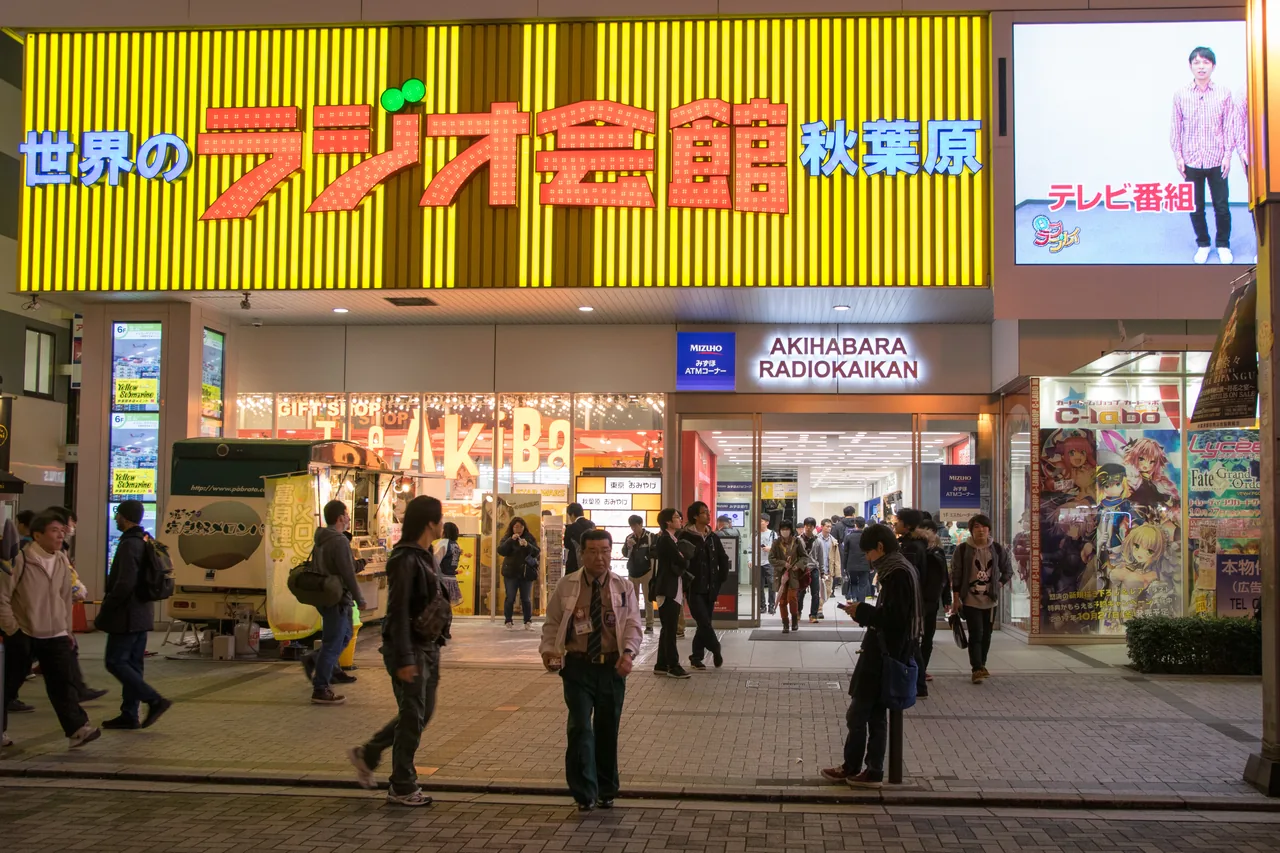
3. Radio Kaikan puts ten different kinds of shop on ten floors
Akihabara Radio Kaikan is the building you see when you cross the road from the Electric Town exit. It runs from a basement level to the tenth floor, and the official floor guide sorts its tenants into dolls, hobby and figures, electrical and audio, cards and books, and a catch-all category. The building’s stated hours are 10:00 to 20:00. Map
The ground floor alone tells you what kind of building this is: several trading-card shops, a card buy-back centre, an optician, a gift shop and a convenience store, all on the same level. Go up and the mix shifts towards dolls, figures and model kits.
The building’s hours are not the shop’s hours
The official site carries a continuous stream of notices about individual tenants closing for the day or changing their hours, several every month. Going for one particular shop means checking that shop’s own notice. The building’s opening time will not tell you.
The basement restaurants keep a different schedule entirely. They open at 12:00 Monday to Friday and at 11:30 on Saturdays, Sundays and public holidays. They close at 22:30 on weekdays and Saturdays, and at 21:30 on Sundays and public holidays.
Starting here keeps the walking short
It is the closest large building to the station, which makes it a sensible first stop. Come out, turn north along Chuo-dori, and the rest of the buildings arrive in order. Leave it until last and you will be carrying everything you have bought up and down ten floors.
4. Mandarake Complex sells something different on each of eight floors
Mandarake Complex is a single second-hand shop occupying an eight-storey building. The floors are not variations on a theme; they are separate departments, and the distance between the third and the sixth is the distance between a bookshop and a toy shop. Map
| Floor | What is sold there |
|---|---|
| 1 | Buy-back counter, cosplay costumes |
| 2 | Disney material |
| 3 | Shonen manga, vintage |
| 4 | Men’s doujinshi |
| 5 | BL and shojo manga, male idols, women’s doujinshi, magical girl, dolls |
| 6 | Toys: overseas toys, plastic models, prize figures, Lego |
| 7 | Toys: tokusatsu, chogokin die-cast |
| 8 | Toys: bishoujo lines, robot lines |
If you came for figures, your destination is floors six to eight. For books it is three and five. Doing both is easier from the top down, because the toy floors are where people most often lose track of time.
It does not open until noon
Mandarake Complex trades from 12:00 to 20:00 and does not close for holidays. That single fact reorders a morning in Akihabara, because this building cannot go first. Spend the morning in Radio Kaikan or Animate, both of which open at 10:00, and come here after lunch.
Tokyo has two large Mandarake locations, this one and Nakano. Nakano is structured differently, with separate Mandarake units scattered across the floors of a shopping arcade instead of one shop filling one building. The comparison, and the rest of the second-hand scene, is in our guide to second-hand shopping in Japan.
5. The component arcades have been here since 1950
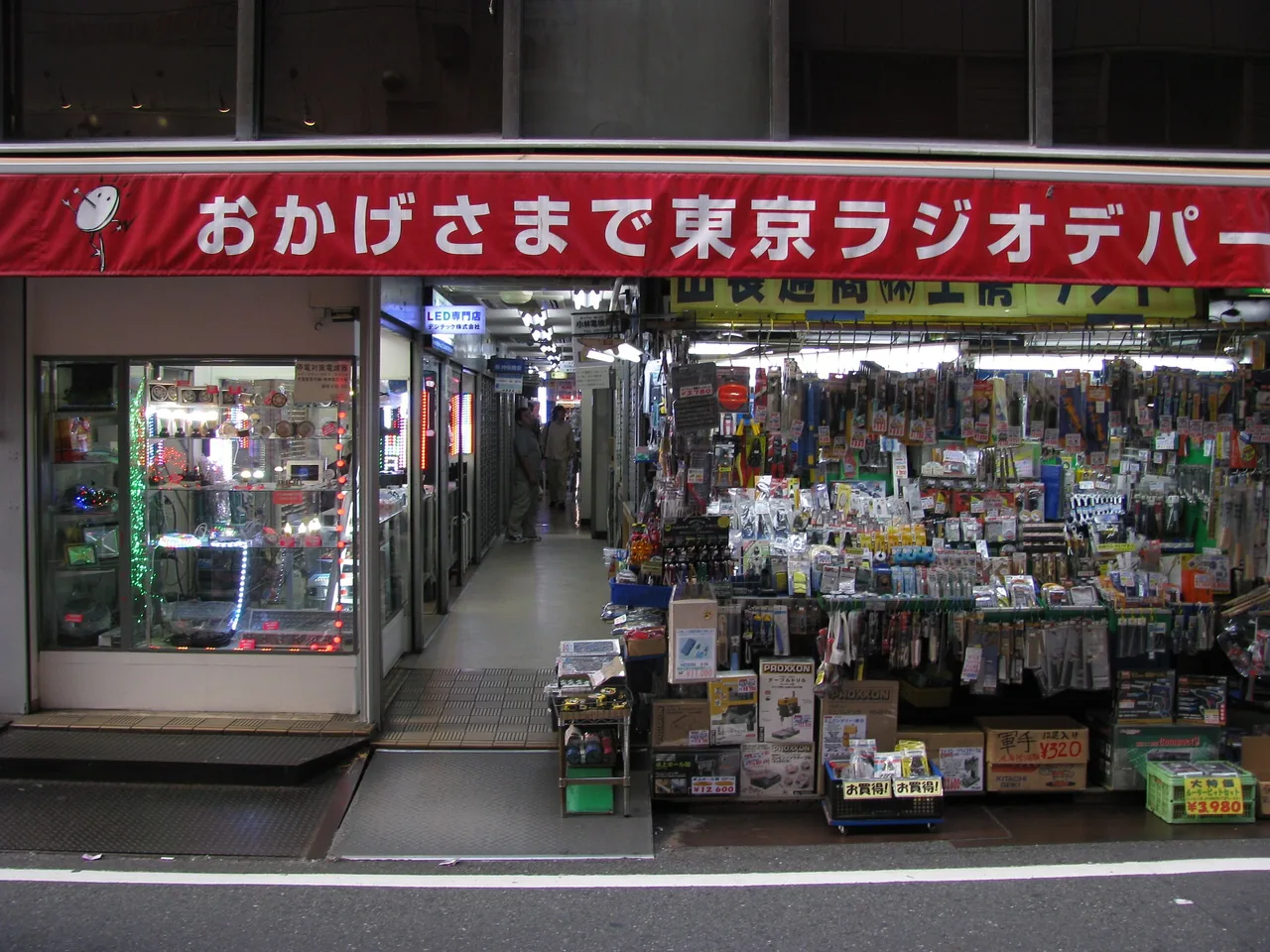
The name Electric Town comes from the component trade, and that trade is still here. Tokyo Radio Department was founded in February 1950 and still houses roughly 36 component shops across its basement and three floors above it, two minutes from the station on foot. Map
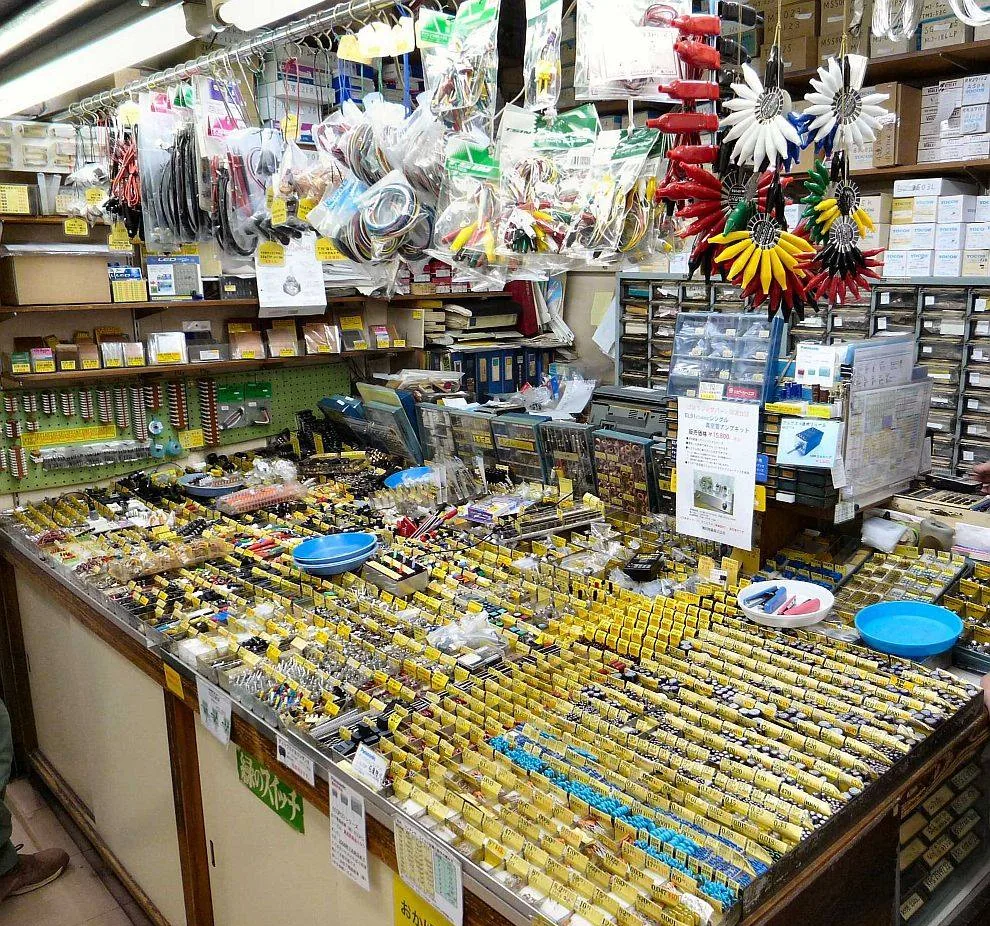
Inside, the aisles are narrow and the stock lives in drawers, trays and cardboard boxes: resistors, connectors, valves, wire, toggles sold one at a time. Even with no intention of buying anything, it is the part of Akihabara that looks least like anywhere else. The stated hours are 10:00 to 19:00, though individual shops vary.
The trade is shrinking
Component shops that had been trading for fifty years or more have been closing one after another. The buildings and the arcades remain, but the tenant count is not what it was. Going specifically for one shop means confirming that it is still open before you make the trip.
Put the other way round: what survives in these aisles is the oldest version of Akihabara still standing. Visitors who only walk the anime shops leave without seeing where the district’s name came from.
Large electronics are bought elsewhere
For cameras, laptops and appliances rather than parts, the component arcades are the wrong place. The large store on the other side of the station carries the stock, posts the prices and handles tax-free paperwork at a dedicated counter. That building gets its own section below.
6. Super Potato separates the floors you buy on from the floor you play on
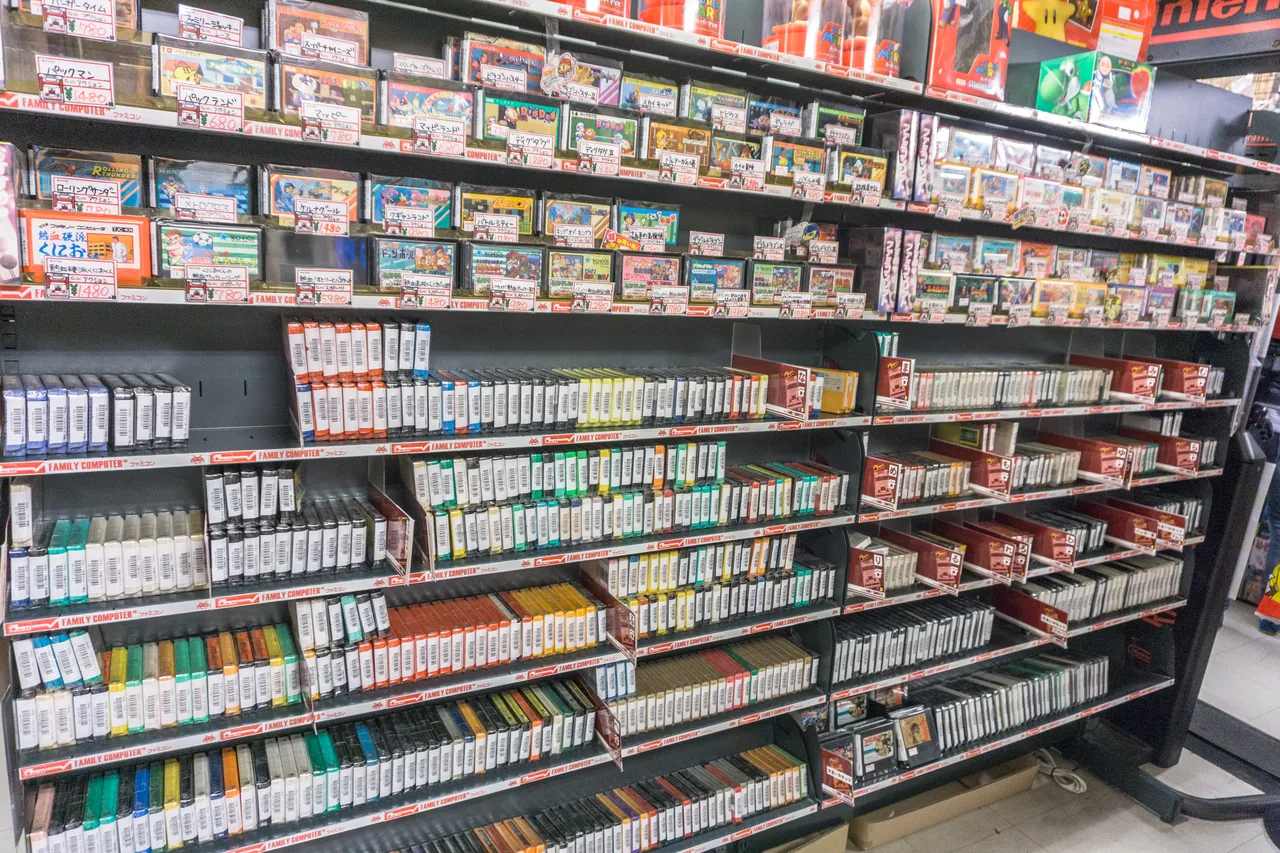
Super Potato sells retro consoles and cartridges across three floors of the Kitabayashi building. Floors three and four are the shop: software, hardware, merchandise and old-fashioned sweets. The fifth floor is something else, an arcade of older cabinets with somewhere to sit down. Map
Hours are 11:00 to 20:00, the same on weekdays as at weekends, with no closing day. That is an hour earlier than Mandarake, which matters when you are trying to build a morning that works.
The fifth floor does not require you to buy anything
The arcade floor takes coins per game and has seating, so it is a reasonable place to stop when your legs have had enough of staircases. It is usually quieter than the retail floors below it.
Anyone seriously considering buying a console to take home should check the power supply and the region locking first. Japanese domestic hardware runs on a different mains standard and, on older systems, a different video standard, so it may not simply work when you get it home.
7. The biggest game centre changed hands
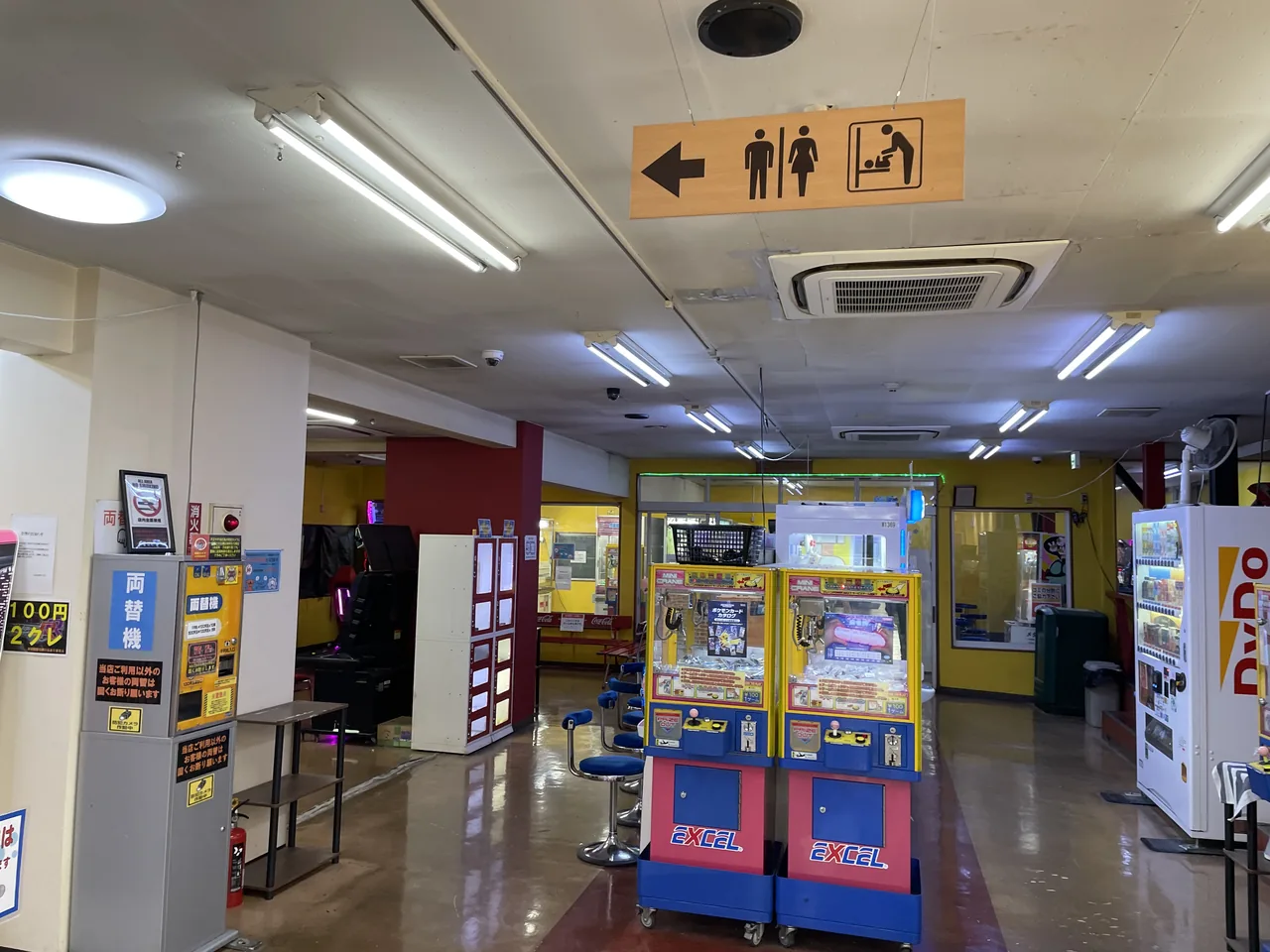
The large arcade three minutes from the Electric Town exit is no longer the one in your guidebook. The Sega-branded building that stood here for over thirty years closed when its lease ran out, and Silk Hat Akihabara moved into the same premises. It occupies a basement level and eight floors above, and trades from 10:00 to 24:00. Map
Older write-ups and photo sets still show the previous name on the red frontage, so expect the signage to look wrong when you arrive. The Sega-lineage arcades have not left Akihabara, though: the second, third and fifth branches are all still trading under the GiGO name.
This is what stays open in the evening
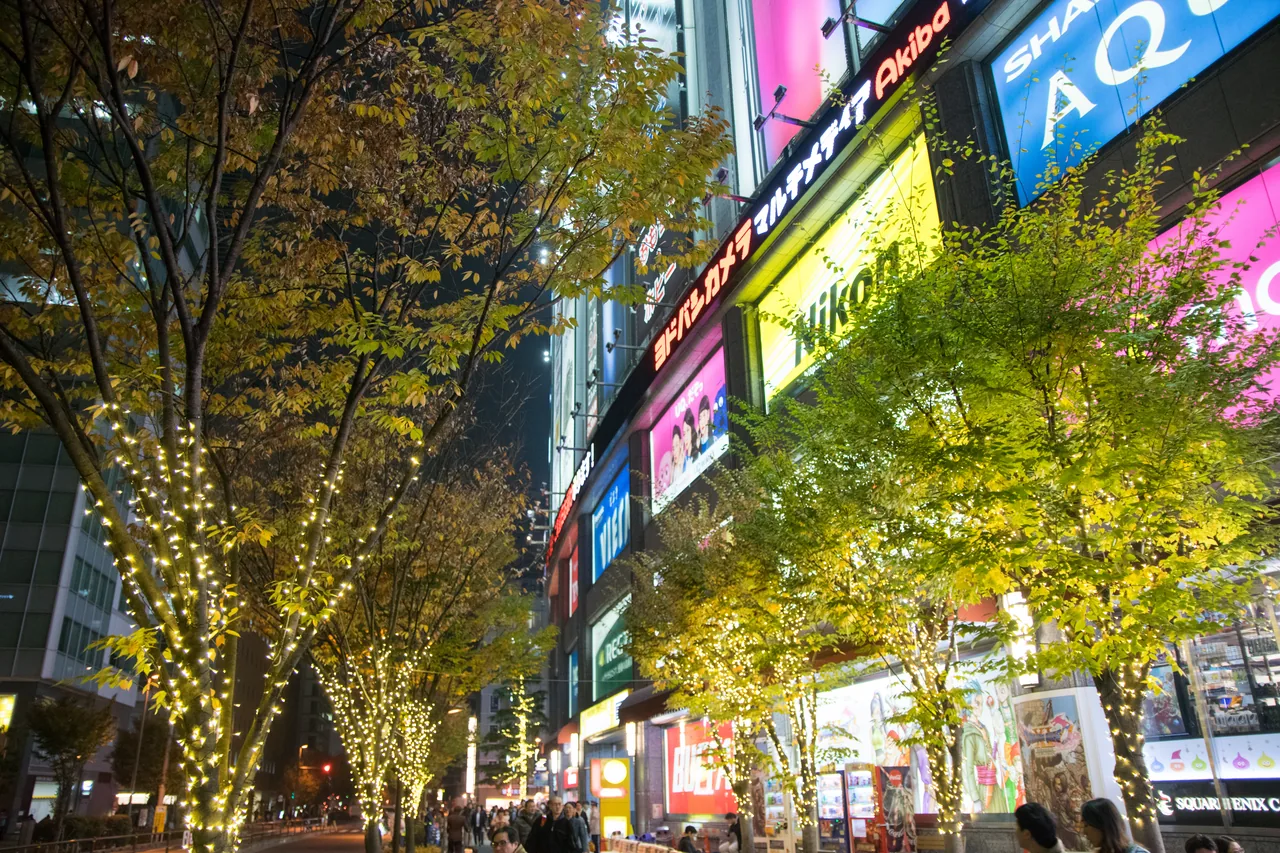
Most of Akihabara shuts around 20:00. Once dinner is over the district thins out quickly, and the arcade is one of the few things that carries on. Together with the 24-hour discount store, it is what an Akihabara evening consists of.
The basement is weighted towards competitive fighting and mech cabinets; the upper floors move towards rhythm games and crane machines. Crane machines dispense prizes, so the cost per attempt and the number of attempts a prize realistically takes both vary by machine, and neither is posted in a way that is easy to compare.
8. Animate is two buildings, not one
Animate Akihabara occupies a main building and a separate annex. The main building holds character goods on floors one to six. The annex runs from a basement level up to the seventh floor and stocks different things. Treating them as one shop is how people end up spending an hour in the wrong building. Map
| Building | Floors | What is there |
|---|---|---|
| Main | 1-6 | Character goods throughout |
| Annex | B1-1 | Capsule toy floor |
| Annex | 2-3 | Goods from game titles |
| Annex | 4-7 | Official shops and limited-run events |
Both buildings reopened recently after a full refit. The annex gained a dedicated capsule toy floor across its basement and ground level, and its upper floors now rotate limited-run events tied to individual titles. Those change every few weeks, so what is running during your visit is something to check on the day.
The annex closes an hour earlier at weekends
The main building runs 10:00 to 21:00 every day of the week. The annex matches that on weekdays but closes at 20:00 on Saturdays, Sundays and public holidays. If a weekend evening visit to an event floor is the plan, that hour is the one that catches people out.
Limited-run events draw queues, and the first weekend of a popular title is the worst of them. If the merchandise is all you want, avoid the opening days and go on a weekday afternoon.
9. Maid cafe pricing is set by age bracket
A maid cafe bill is the price of what you order plus a cover charge, and the cover charge depends on how old you are. At the brand with three premises in Akihabara, the published cover runs across six age bands. On top of that, every guest must order at least one drink. The stated starting point for an adult is 1,570 yen. Map
| Band | Age | Cover charge |
|---|---|---|
| Adult | 23-59 | 850 yen |
| Young adult | 19-22 | 600 yen |
| Teenager | 13-18 | 400 yen |
| Child | 7-12 | Free |
| Infant | 0-6 | Free |
| Senior | 60 and over | 600 yen |
The band is applied automatically from the date of birth you register on arrival. Note that the senior band starts at 60 here; senior thresholds in Japan are set venue by venue, so do not carry that number to the next place you visit.
A seating slot is one hour
The standard stay is one hour. The official wording is explicit that going over the hour because of crowding or any other reason does not attract an extra charge. Leaving early is fine.
Cash, credit cards, QR payment apps and electronic money are all accepted, but electronic money is being withdrawn from October. If you were planning to pay with a transport IC card, bring cash or a credit card instead.
These are one brand’s prices
Akihabara has many maid cafes and concept cafes, and they price differently from one another. The table above is one operator’s published tariff, not a district standard. Read the board at the door of whichever place you choose before you sit down.
10. Do not follow anyone who approaches you on the street
Chiyoda ward bans soliciting customers in public places by ordinance, and Akihabara is one of two areas singled out for enforcement. The ordinance applies across the whole ward; the designated priority zones are the area around Kanda station and the area around Akihabara station.
The ward is specific about the problem it is addressing: premises whose style of business may fall foul of the entertainment business law have been operating alongside legitimate shops, and street soliciting in elaborate costume has increased. The ward designated the Sotokanda area a priority zone and now patrols it jointly with local associations and the Manseibashi police station.
The rule of thumb is simple
Do not walk anywhere with someone who approached you on the street. Because the approach itself is prohibited, a business that recruits customers that way is also unlikely to be posting its prices properly at the door. If a particular place appeals to you, look it up and go there yourself.
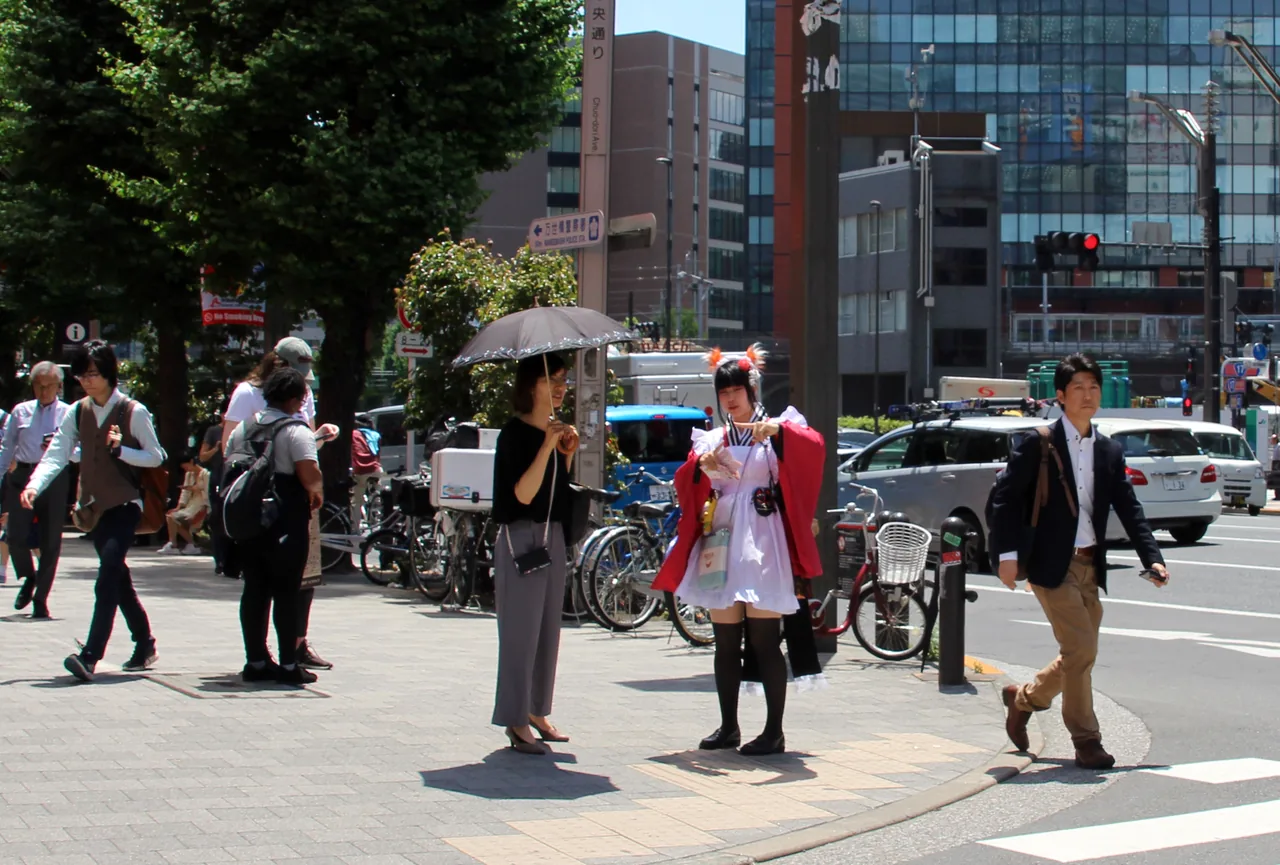
People in maid costume handing out flyers are an ordinary sight and not in themselves the problem. Taking a flyer and following someone are different acts. Confirm prices and conditions at the door or on the official site, not from the flyer.
Photography has limits too
Close-up photographs of people working on the street may be refused. Inside venues, photography rules are set individually, and a photograph with a member of staff is usually a separate paid item, not part of what you already ordered. Ask before you raise a camera.
11. Don Quijote runs around the clock and has a theatre upstairs
The Don Quijote branch here is open 24 hours. It fills a basement level and eight floors, and it is not all discount shopping: the lower levels include a pachinko and slot parlour, the fifth floor is a maid cafe, and the eighth floor is the AKB48 Theater. Map
The theatre runs to a fixed performance schedule and admission is by application, not by turning up. It is not somewhere you wander into while shopping, so anyone hoping to see a show needs to read the official guidance in advance.
What is left late at night
With most of the district closed by 20:00, the 24-hour store and the arcade that runs to midnight are what remains. If you are staying nearby, this is where a late shopping run happens.
Driving here, the car park holds 36 vehicles and the multi-storey section operates from 10:00 to 21:00. The maximum charge is 1,200 yen for 24 hours of parking. There is a size limit: vehicles wider than 1,710 mm or taller than 1,550 mm will not fit.
12. Yodobashi is on the other side of the station
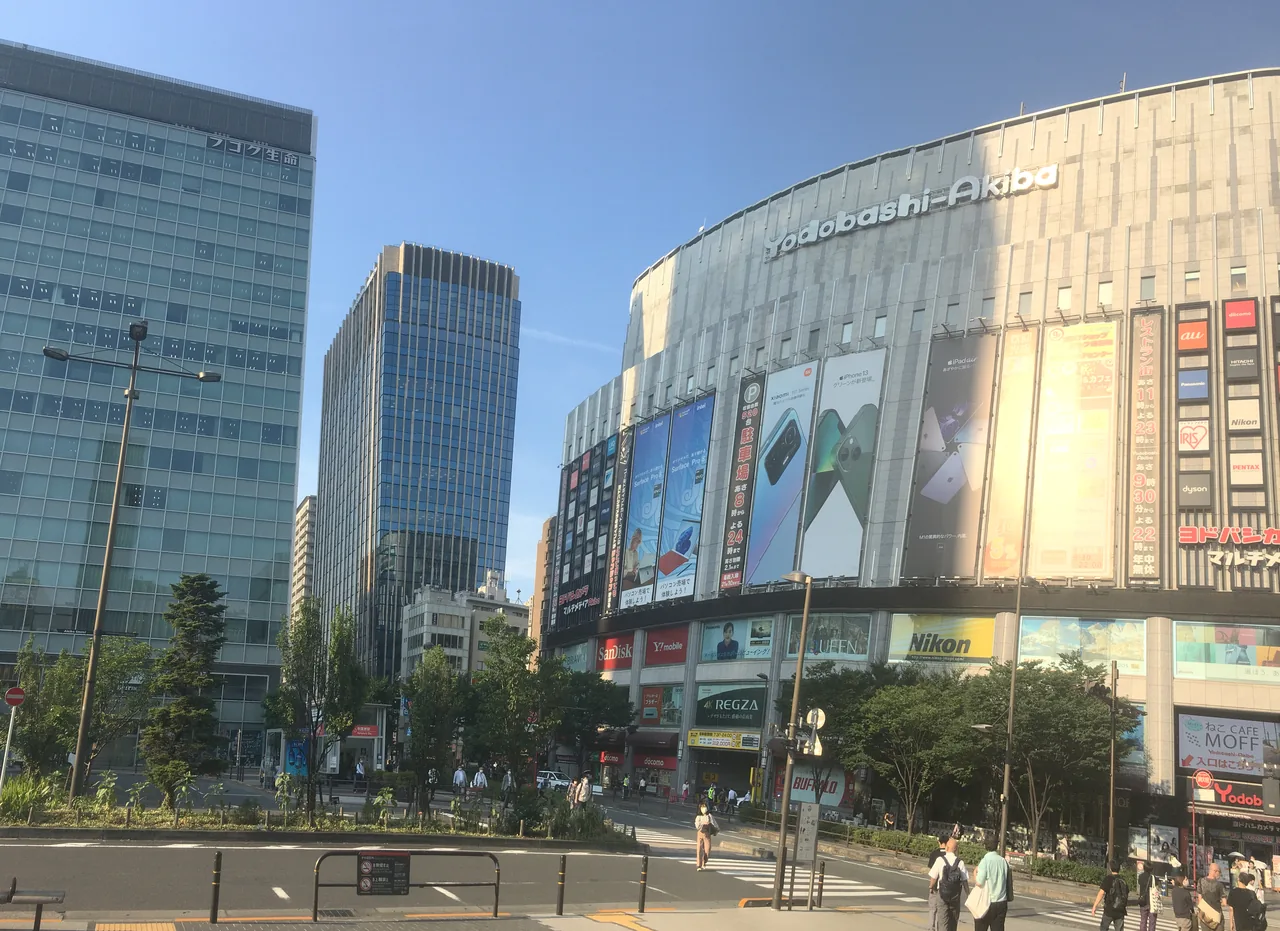
Yodobashi Akiba sits on the opposite side of the tracks from the Electric Town exit. It is a minute from the station, but from the shopping strip you have to cross back under or over the railway. For cameras, appliances and computer parts under one roof, this is where the stock is. Map
Arriving by car, the car park runs from 07:30 to 24:00 with last admission at 22:30, and charges 400 yen per 30 minutes. Bicycle parking runs 09:20 to 22:00 and motorcycle parking 09:30 to 22:00.
Tax-free processing changes on 1 November
Until now, electronics stores and discount chains have deducted consumption tax at a dedicated till, so you paid the lower price on the spot. From 1 November the purchase is rung up at the full tax-inclusive price, and the tax is refunded after customs confirms the goods leaving the country at your departure airport.
What that changes in Akihabara is the amount you have to be able to pay on the day. A camera or a laptop is exactly the kind of purchase where the difference is large enough to matter, so leave headroom on your card. The full mechanics, including what happens at the airport, are in our guide to tax-free shopping in Japan.
13. On Sunday afternoons Chuo-dori closes to traffic
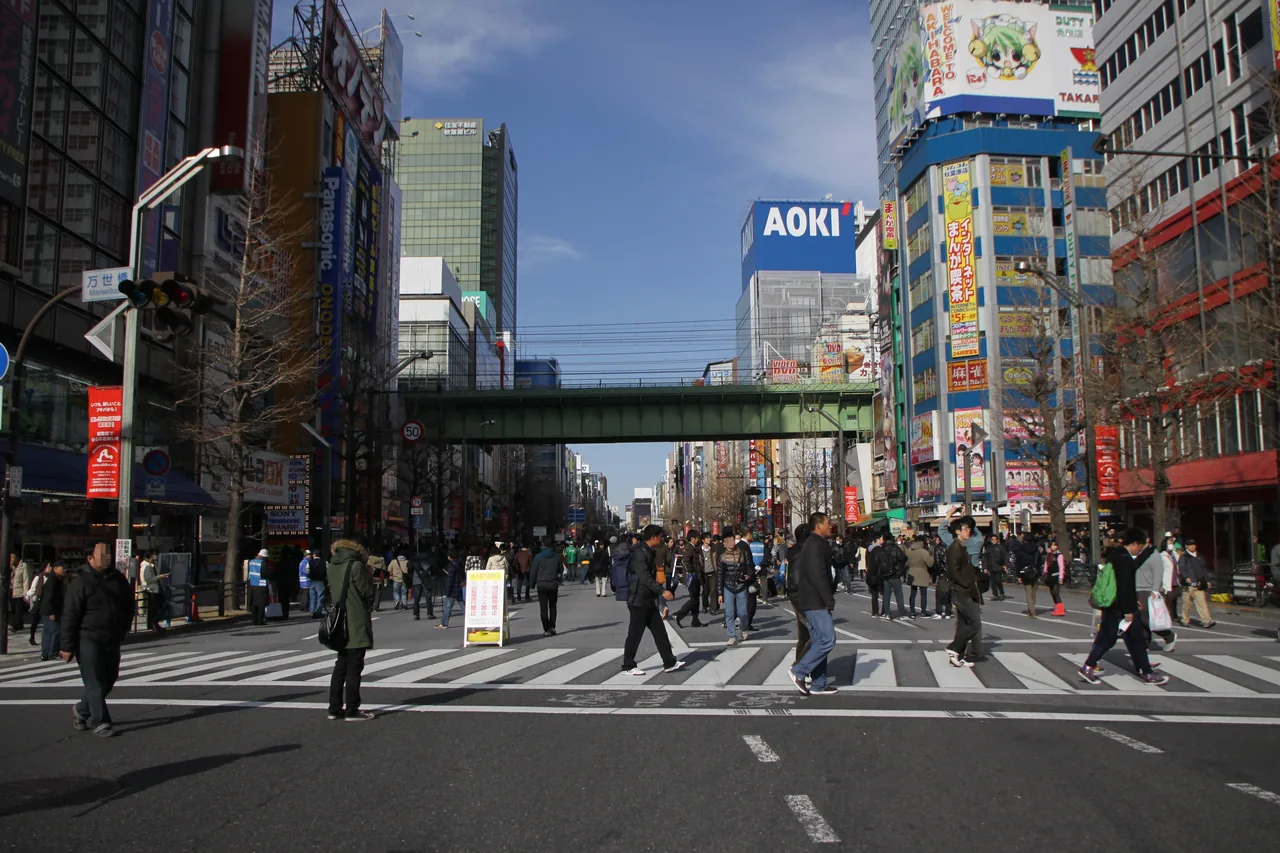
Every Sunday the avenue is given over to pedestrians. The closure runs from the Sotokanda 5-chome crossing to the Manseibashi crossing, about 570 metres, and it starts at 13:00. It finishes at 18:00 from April to September and at 17:00 from October to March. Rain, storms or strong winds cancel it. Map
Tokyo runs several of these closures and Akihabara’s is the most restricted of them. Ginza closes a stretch of about 1,100 metres on Saturdays, Sundays and public holidays, starting at midday. Shinjuku also starts at midday. Akihabara gets one day, an hour later, over roughly half the distance.
| District | Days | Hours | Length |
|---|---|---|---|
| Akihabara | Sunday | 13:00-18:00 (17:00 Oct-Mar) | About 570 m |
| Ginza | Sat, Sun, public holidays | 12:00-18:00 (17:00 Oct-Mar) | About 1,100 m |
| Shinjuku | Sun, public holidays | 12:00-18:00 (17:00 Oct-Mar) | Part of 3-chome |
It is not a street performance event
Selling goods, performing, busking and cycling are all prohibited inside the closure, and the shopping association states this plainly on its official page. If you have seen photographs of costumed performances filling the road, those are from an earlier era and that is not what happens now.
What it actually offers is the chance to stand in the middle of a six-lane avenue and look up. The building fronts here are covered in signage from the second floor to the roofline, and you cannot frame that from the pavement. For photography, this is the hour to be here.
Smoking on the street is prohibited
Chiyoda ward’s living environment ordinance bans smoking on the street, and that applies at all times, closure or no closure. Use the designated smoking areas.
14. Gachapon Kaikan closes an hour early on Sundays
Gachapon Kaikan is a shop that consists entirely of capsule toy machines. It occupies the ground floor of the MN building in Sotokanda 3-chome, two minutes from Suehirocho station on the Ginza line and seven minutes from the Electric Town exit at Akihabara. It sits near the northern end of the strip. Map
Its hours change with the day. Weekdays are 11:00 to 20:00; Sundays and public holidays are 11:00 to 19:00. Since the Sunday street closure is what brings most visitors up this end of Chuo-dori in the afternoon, it is worth knowing that this particular shop shuts earlier on exactly that day.
Break a note before you arrive
Most of the machines take coins. Some accept notes, but not all of them, so arriving with a handful of 100 yen coins saves you hunting for a change machine between attempts.
What comes out of any given machine is random. If there is one specific item you want, a second-hand shop that sells capsule toy contents individually is often faster. Mandarake and several tenants inside Radio Kaikan trade in exactly that.
15. The UDX shopping floors are currently closed
The shops and restaurants inside Akihabara UDX have shut for a full refurbishment. It is the first large-scale rework since the complex opened twenty years ago, and the operator has said it expects to reopen in winter, with details to be announced in the autumn. Map
Older articles about where to eat in Akihabara routinely put UDX first. Following that advice now walks you to a closed shutter, which is worth knowing before you build a lunch plan around it.
| Floor | Still trading |
|---|---|
| 1 | Fukushimaya, Kanekoya, a mobile phone shop, a bank ATM area, the post office |
| 2 | Akiba Square, Akiba Info |
| 4 | UDX Gallery, Gallery Next, UDX Theater, the shared office |
| 5 | A florist, a convenience store |
| 6 | UDX Conference, the clinic mall |
The Tokyo Anime Center is not here either
The Tokyo Anime Center left Akihabara some years ago. It now occupies the second floor of Shibuya MODI and opens 11:00 to 19:00, with no regular closing day. Looking for it in Akihabara will not find it.
Its exhibitions rotate every few weeks and some of them run in other cities altogether. If there is a particular title you want to see, check which venue is hosting it before you travel across town.
16. Kanda Myojin and the arches under the tracks
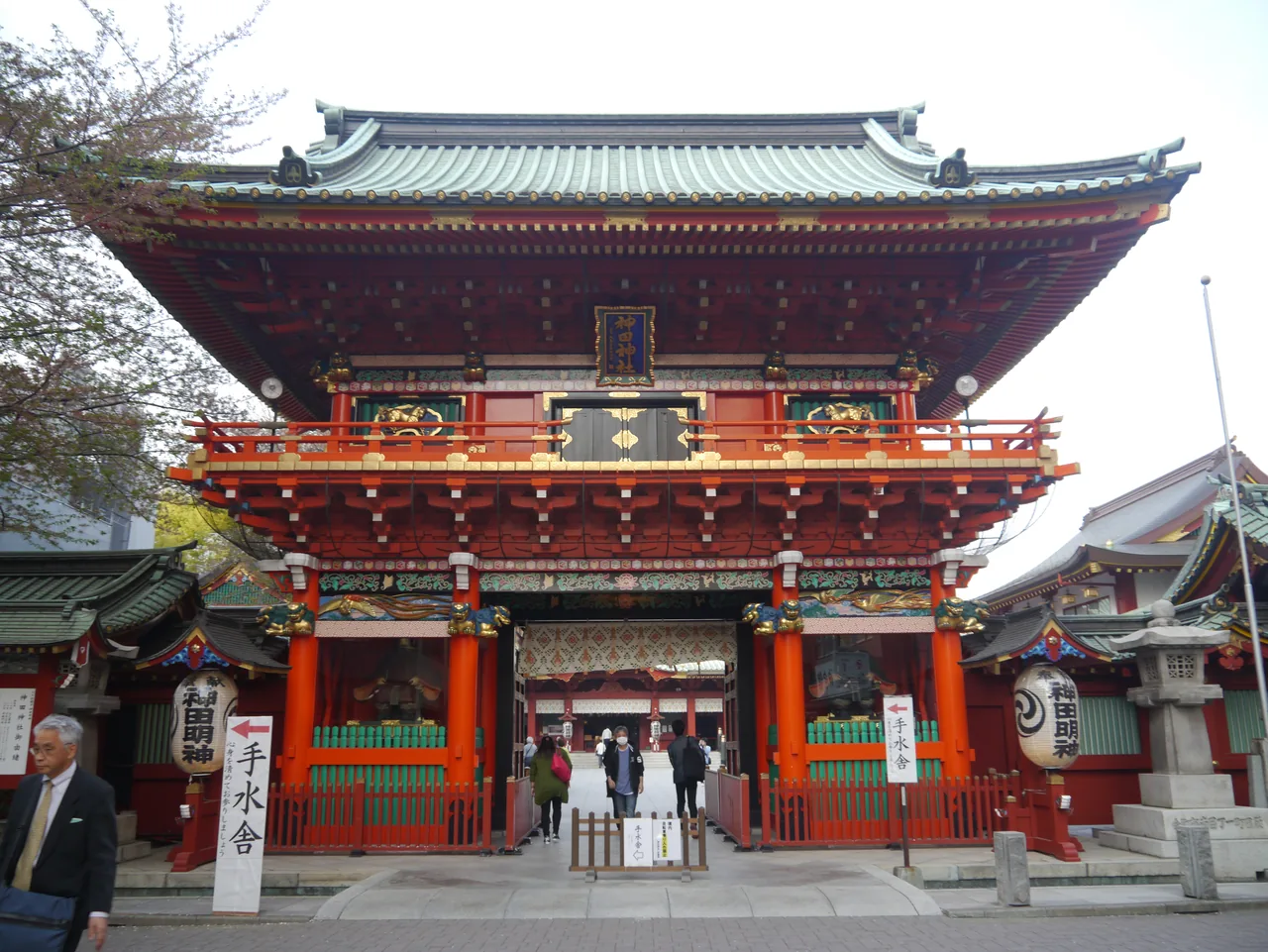
Kanda Myojin is a seven-minute walk from the Electric Town exit. From Ochanomizu station’s Hijiribashi exit it is five minutes, and from Suehirocho on the Ginza line it is also five. Walk uphill out of the shopping streets and the vermilion gate appears. The shrine’s Kanda Matsuri is held every second year. Map
It is the nearest place to the district where you are outdoors and not in a shop, and that makes it a natural end to a half day of staircases.
The arcade under the viaduct closes on Wednesdays
Between Akihabara and Okachimachi stations, the space under the railway viaduct houses 2k540 AKI-OKA ARTISAN, a row of workshops and shops selling leather, metalwork and woodwork. It has nothing in common with the rest of the district. Hours are 11:00 to 19:00 and it closes on Wednesdays. Map
A Wednesday closing day is unusual around here, where most of the larger shops trade every day of the year. Plan a Wednesday visit that includes this arcade and you will arrive at shuttered units.
Manseibashi has a closing day that moves each month
By the Manseibashi crossing, the brick arches of a former railway station have been converted into mAAch ecute Kanda Manseibashi, with shops under the arches and a deck along the river where you watch trains pass at eye level. Map
Hours differ by area within it. The stair and platform areas run 11:00 to 22:00 on weekdays and Saturdays, and 11:00 to 20:30 on Sundays and public holidays. The open deck runs an extra half hour on weekdays and Saturdays.
There is one closing day a month, and the date moves. Most of them fall on a Monday, but at least one falls on a Thursday. Check the date for the month you are visiting; the weekday is not reliable.
17. What half a day covers, and what a full day covers
Budget an hour per building and the day plans itself. Because the shops are stacked instead of spread out, you stay in one place longer here than in a district built around sights. The order below follows opening times, not the map.
| Time | Half day | Full day |
|---|---|---|
| 10:00 | Radio Kaikan | Radio Kaikan |
| 11:00 | Component arcades, street | Component arcades, Super Potato |
| 12:00 | Mandarake | Lunch, then Mandarake |
| 14:00 | Animate or the arcade | Animate main building and annex |
| 16:00 | Finish | Kanda Myojin, the arcades under the viaduct |
| 18:00 onwards | Game centre, Don Quijote |
On a Sunday, put 13:00 to 17:00 or 18:00 on Chuo-dori itself so it overlaps the street closure. That same day, though, Gachapon Kaikan shuts at 19:00 and the Animate annex at 20:00.
Pairing it with Ueno fills a day
Ueno is two stops away on the JR lines, and it is about as different as two adjacent districts get: a park, a cluster of national museums, and a market street. Doing Ueno Park in the morning and Akihabara in the afternoon also happens to line up with Mandarake’s noon opening. The detail is in our Ueno guide.
For Asakusa, the Ginza line from Suehirocho runs there without a change. The temple and the shopping street are covered in the Asakusa guide.
Work out whether a pass pays
For a day spent only in Akihabara there is no reason to buy a transport pass. Once you are linking three or more districts in a day, the subway tickets start to make sense. Which ones exist and where the break-even sits is in Tokyo transport passes.
18. Is Akihabara a good place to stay?
Akihabara sits on the Yamanote line, which makes it a practical base. Shinjuku, Shibuya, Ikebukuro, Ueno and Tokyo station are all reachable without changing trains, and the Hibiya line and Tsukuba Express use the same station.
This is a shopping district rather than a residential one, so the choice of places to eat after 20:00 is thin. If evenings out matter to you, Ueno or Shinjuku will serve you better.
Getting here from the airports
From Narita, the Keisei Skyliner to Nippori and then two stops on the JR is the straightforward route. From Haneda, either the monorail and the Keihin-Tohoku line, or the Toei Asakusa line. Comparing the airport routes alongside the neighbourhoods themselves is easier in our guide to where to stay in Tokyo.
The wider question of which Tokyo district suits which kind of trip is covered neighbourhood by neighbourhood in the Tokyo travel guide. Akihabara lands in the well-connected but quiet-at-night column.
Accommodation tax is set at prefecture level
Tokyo levies an accommodation tax based on the room rate. The rates and the exemption threshold are set for the whole prefecture, so staying in Akihabara makes no difference to what you pay. The calculation is in our note on Japan’s accommodation tax.
🎡Things to Do22
🏨Where to Stay2
🚇Getting Around3
🗾Japan trip essentials22
Akihabara: frequently asked questions
The Electric Town exit. It opens directly onto Chuo-dori, where the large buildings are. The Showa-dori side faces offices and a main road. Yodobashi Akiba is the one major destination on that side.
Radio Kaikan and Animate open at 10:00. Super Potato and Gachapon Kaikan open at 11:00. Mandarake does not open until 12:00. Don Quijote is open 24 hours. If you arrive in the morning, start with the buildings that open at 10:00.
Sundays only, starting at 13:00. It runs to 18:00 from April to September and to 17:00 from October to March, over about 570 metres between the Sotokanda 5-chome and Manseibashi crossings. Rain or strong wind cancels it.
No. The shopping association’s official page prohibits selling goods, performing, busking and cycling inside the closure. It is an opportunity to walk in the road and photograph the buildings, not an event.
The menu price plus a cover charge. At the brand with three premises in Akihabara the cover is 850 yen for ages 23 to 59, 600 yen for 19 to 22, 400 yen for 13 to 18, free for 12 and under, and 600 yen for 60 and over. One drink per person is required, and the stated adult starting point is 1,570 yen. Other operators price differently.
One hour is the standard slot. The official wording states that exceeding the hour, for crowding or any other reason, carries no additional charge. Leaving early is fine.
No. Chiyoda ward prohibits soliciting customers in public places, and the area around Akihabara station is one of the two designated priority zones. If a venue interests you, look it up and go there directly.
The UDX shopping floors are closed for refurbishment, so older recommendations lead to a shutter. What remains is the basement restaurant level of Radio Kaikan, the street-level restaurants along and behind Chuo-dori, and mAAch ecute by Manseibashi. The Radio Kaikan basement opens at 12:00 on weekdays and 11:30 at weekends and on holidays.
No. It is on the second floor of Shibuya MODI and opens 11:00 to 19:00.
From 1 November, stores charge the full tax-inclusive price and the consumption tax is refunded after customs confirms the goods leaving Japan at your departure airport. For a camera or a laptop that is a large sum to front, so leave headroom on your card.
It covers two or three buildings. Radio Kaikan and Mandarake each take about an hour on their own. Adding Kanda Myojin or the arcades under the viaduct pushes it towards a full day.
The main shopping buildings trade every day, so yes. The exception is 2k540 AKI-OKA ARTISAN under the viaduct, which closes on Wednesdays. Move that to another day.