
Renting a Car in Okinawa: Permits, Booking Windows and What You Pay at the Desk
Okinawa runs out of cars long before it runs out of cheap ones, so peak dates need three to four months of lead time. Japan also accepts only one kind of international permit, and it is not the one every country issues.
| Permit | An International Driving Permit issued under the 1949 Geneva Convention. The 1968 Vienna version is refused. Carry it with your home licence and passport. |
|---|---|
| When to book | Three to four months ahead for New Year, Golden Week, Obon and the summer holidays. One to two months the rest of the year. |
| Daily cost | Roughly 5,000 to 10,000 yen for the car, and peak dates run close to double the quiet season. |
| The charge people miss | Paying for CDW does not cancel NOC. That is 20,000 yen if the car still drives and 50,000 yen if it does not. |
| Most common fine | Bus lanes on weekday mornings and evenings. 6,000 yen and a point on your record. |
1. Okinawa has one rail line, and it does not leave the capital
2. Japan accepts only the 1949 Geneva permit
3. The island runs out of cars, not cheap cars
4. Peak dates cost about double the quiet season
5. Collecting the car at Naha Airport takes longer than you think
6. Three things to settle at the booking stage
7. CDW does not cover NOC, and that surprises everyone
8. There is exactly one expressway
9. Allow two hours each way to the aquarium
10. Bus lanes catch more visitors than anything else
11. Driving on the left goes wrong in predictable places
12. Okinawa enforces drink driving harder than anywhere in Japan
13. Parking is free almost everywhere except Naha
14. Fuel stations thin out as you go north
15. Fuel and drop-off both run on a full-to-full rule
16. Miyako and Ishigaki sell out earlier than the main island
17. Doing Okinawa without a car is possible, within limits
18. A checklist to run before you fly
1. Okinawa has one rail line, and it does not leave the capital
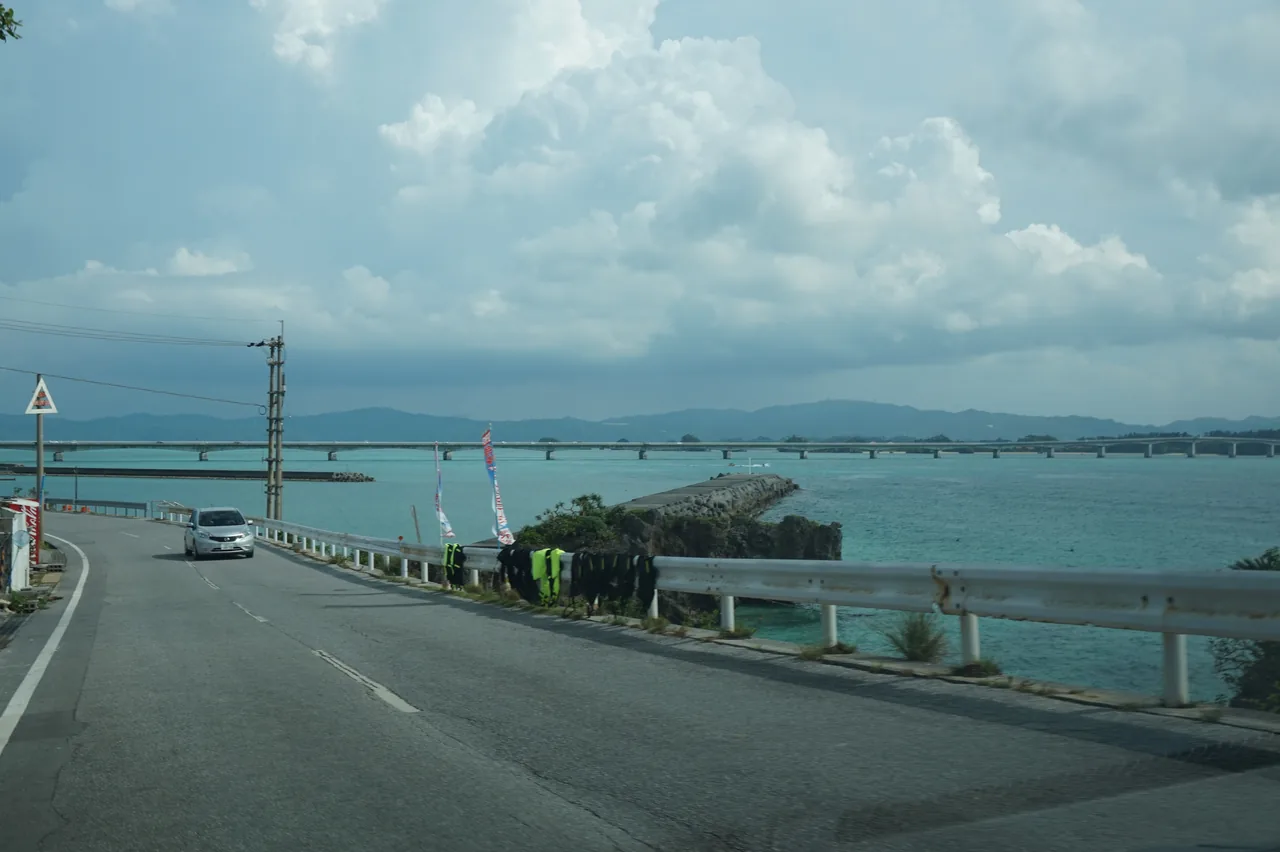
Mainland Japan spoils you. Trains go everywhere, they are on time, and a rental car is usually the worse choice. Okinawa is the exception. The only rail on the island is the Naha monorail, and it never leaves the capital. Everything north of the city runs on roads.
So the question is not whether you like driving. It is how far north you plan to go.
| Your plan | Car? | Why |
|---|---|---|
| North: Churaumi AquariumMap, Kouri BridgeMap, Yanbaru | Yes | Buses run a handful of times a day, so one stop eats the whole day |
| Central beaches plus American Village in one day | Yes | Routes do not connect, and waiting beats driving on time spent |
| One resort, pool and beach, not moving much | No | An airport transfer costs less than three days of rental |
| Naha only: Shuri Castle, Kokusai Street, food | No | The monorail covers it and you would only pay to park |
| A day of snorkelling at the Blue Cave | Maybe | Most operators include hotel pickup, so you can skip the car that day |
Mixed itineraries have a middle option that few people consider: rent only the days you need it. Walk Naha on your first and last day, take the car for the two days in between. You drop the daily rate and the parking problem at once. The cost is doing pickup and return twice, so add that time back in.
2. Japan accepts only the 1949 Geneva permit
This is the part that strands people at the rental desk. Japan recognises the International Driving Permit issued under the 1949 Geneva Convention, and nothing else. The 1968 Vienna Convention permit, which several countries now issue by default, is not valid here. Neither is your home licence on its own, however international it looks.
You hand over three documents at the counter and all three are checked against each other.
| What you need | Notes |
|---|---|
| IDP, 1949 Geneva Convention | Booklet format. Valid one year from issue |
| Your home driving licence | The original. The IDP is worthless without it |
| Passport | They check the entry stamp against the permit dates |
Where to get one depends on where you live. In the United States it is AAA or AATA, and you must apply before you leave, since no one can issue you an American IDP once you are abroad. In the UK it is the Post Office, in Canada the CAA, in Australia and New Zealand the state and national motoring clubs. Allow a couple of weeks if you are applying by post.
Everyone driving needs their own set. If two of you plan to share the wheel, register both names when you book, and understand that an accident with an unregistered driver at the wheel voids the insurance.
3. The island runs out of cars, not cheap cars
Okinawa does not behave like the rest of Japan on this. Demand has grown faster than the rental fleet, and staffing has not kept up either, so in peak season the constraint is physical. One branch in Tomigusuku was running a waiting list of more than a hundred parties.
| When you are travelling | Book by |
|---|---|
| New Year, Golden Week, Obon, summer holidays | Three to four months ahead |
| Everything else | One to two months ahead |
The popular combinations go first: Naha Airport pickup, morning collection. Book the car the same day you book the flight. Most rates cancel free until a few days out, so holding a car costs you nothing and waiting for a better price usually ends with no car at all.
Read the cancellation terms once while you are there. Past the free window most companies charge a day’s rate, and peak bookings have longer windows. Note also that a cancelled flight does not cancel your car. If a typhoon grounds you, someone has to call.
4. Peak dates cost about double the quiet season
Budget 5,000 to 10,000 yen a day for the car itself. Kei cars and compacts sit at the bottom of that, minivans and convertibles at the top. Insurance, the NOC waiver and a child seat go on top of that number, so the amount you actually pay is higher than the headline rate.
Timing moves it more than anything else. The dearest weeks run close to twice the cheapest ones, and the four spikes are New Year, Golden Week, the Marine Day weekend in July, and Obon. Same car, same branch, three days apart, different bill.
| Line item | Typical |
|---|---|
| Car | 5,000 to 10,000 yen a day |
| Collision damage waiver (CDW) | Around 1,000 to 2,000 yen a day |
| NOC waiver | 400 to 1,080 yen a day |
| ETC card rental | 330 yen up to seven days |
| Child seat | About 1,100 yen each |
If your dates can move, shifting a few days either side of a peak brings the flights and the hotel down with the car. Our month guides to July in Japan and August in Japan show where the crowds and the weather sit.
Compare on the final total, not the headline rate. Whether CDW is bundled varies by company, and the cheapest-looking option frequently is not once insurance is added. Some operators also price their airport branch differently from their city branches.
One-way drop-offs vary as well. Within the main island some companies charge nothing and others do. If you are thinking of collecting in Naha and returning in the north, confirm that before you book rather than at the counter.
5. Collecting the car at Naha Airport takes longer than you think
There are no rental desks inside the terminal at Naha AirportMap. You collect your bags, walk out of arrivals, cross the road to the rental shuttle stops, ride to the company’s branch, and do the paperwork there. First-timers routinely plan as though the keys are handed over airside.
| Stage | Normal | Peak or heavy traffic |
|---|---|---|
| Waiting for the shuttle | 5 to 15 minutes | 20 minutes or more |
| Airport to branch | About 15 minutes | 30 to 40 minutes, up to an hour |
| Paperwork and vehicle check | 15 to 20 minutes | Longer once a queue forms |
Add it up and you want a full hour from landing to driving away, or an hour and a half on a summer morning. If your first day sends you straight north from the airport, this is the hour that gets left out of the plan.
Stop numbers differ by company and are scattered across bays 10, 11-A, 11-B and 14, with staff holding branded flags. Screenshot the bay number from your confirmation email before you fly. At least one company moved its stop in January 2026, so trust the email over an older blog post.
Return runs the same sequence backwards. You check the car in at the branch and shuttle back to the terminal, which takes the same time again.
6. Three things to settle at the booking stage
Leave these to the counter and you lose time, or in one case the car.
Child seats
Japanese law requires a child seat for anyone under six. It is not a recommendation. Turn up with a child you did not declare and no seat of your own, and the company can refuse to rent to you. Around 1,100 yen each, and they will ask the child’s weight and age in months to pick between infant and junior seats. Stock is finite, and in peak season the seats sometimes run out before the cars do.
The ETC card
Almost every car on the main island has an ETC transponder fitted, but the card is a separate rental. It runs 330 yen for up to seven days and around 1,100 yen for longer. Worth it if you touch the expressway even once: the toll itself drops and you skip the manned booth. Whatever you spend is settled when you return the car.
Car class
A kei car is cheap and easy to park, and it will not swallow four people plus luggage. Two large cases and up, go a class higher. Convertibles are popular here, though in reality the roof stays up through the middle of a summer day, so choose one expecting to enjoy it in the morning and evening. Some companies still split smoking and non-smoking vehicles, which is worth checking if you care.
7. CDW does not cover NOC, and that surprises everyone
Two similarly named charges sit in every Japanese rental contract, and buying one does not remove the other.
| Charge | What it covers | Amount |
|---|---|---|
| Collision damage waiver (CDW) | The excess you would owe toward repairs after an incident | Around 1,000 to 2,000 yen a day |
| Non-operation charge (NOC) | The company’s lost rental income while the car is off the road | 20,000 yen if it still drives, 50,000 yen if it does not |
| NOC waiver | Cancels the charge above | From 400 yen a day, typically 500 to 1,080 for a passenger car |
In plain terms: buy CDW only, scrape the car, and you owe nothing for the repair but the 20,000 yen NOC still lands. Damage it badly enough that it cannot be driven back and it is 50,000. Which is why most people add the NOC waiver at roughly 500 yen a day. Three days of that is 1,500 yen against a single 20,000 yen scrape.
Be aware that some companies do not offer a NOC waiver at all, which is common among the budget brands. If you cannot find it on the booking page, it does not exist there. Given how narrow the roads get in the north, that is a reason to pick a company that offers it.
Book through a comparison site such as DiscoverCars and you will also be offered its own Full Coverage at checkout. It works differently from the rental company’s CDW. If something happens, you pay the rental company first, excess and NOC included, then claim the money back with the receipts within 90 days of returning the car, up to €5,000 in total. The rental company cannot see that policy, so the counter will still offer you CDW and the NOC waiver, and taking both means paying twice for the same scrape. Decide before you book: the rental company’s cover if you would rather not pay anything on the spot, or Full Coverage alone if you would rather keep the daily rate down.
8. There is exactly one expressway
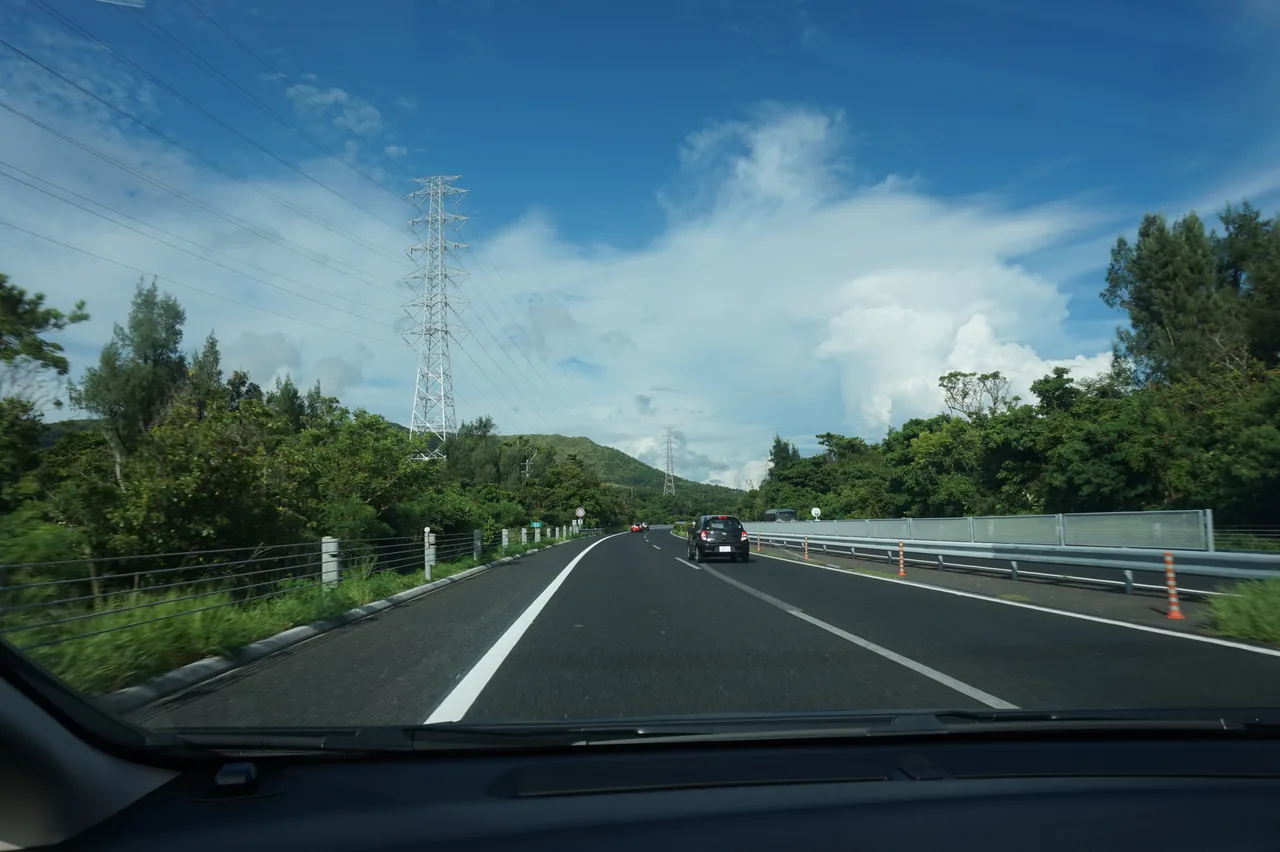
The whole island has a single expressway, the Okinawa Expressway, running from Naha in the south to Kyoda interchangeMap in the north. Going north, you take it. There is no wrong turn to make.
| Vehicle | Cash | ETC | Late night 0 to 4 |
|---|---|---|---|
| Standard car | 1,610 yen | 1,040 yen | 730 yen |
| Kei car | 1,320 yen | 850 yen | 600 yen |
Naha IC to Kyoda IC is about 57 km and 37 to 43 minutes. In a standard car one full run saves 570 yen on ETC against cash, so a return trip saves 1,140. The card rental is 330 yen, which means a single return journey already pays for it. In a kei car the toll drops a band again.
Booths are staffed and cash is fine, but the manned lanes back up on peak mornings while the ETC lane stays clear. Take a ticket on entry and pay on the way out.
Two places to stop: Nakagusuku PA and Igei SA, both with toilets, a convenience store and fuel, and Igei has a viewpoint. The full run is only forty-odd minutes, so you can skip both, but they are useful with children on board.
9. Allow two hours each way to the aquarium
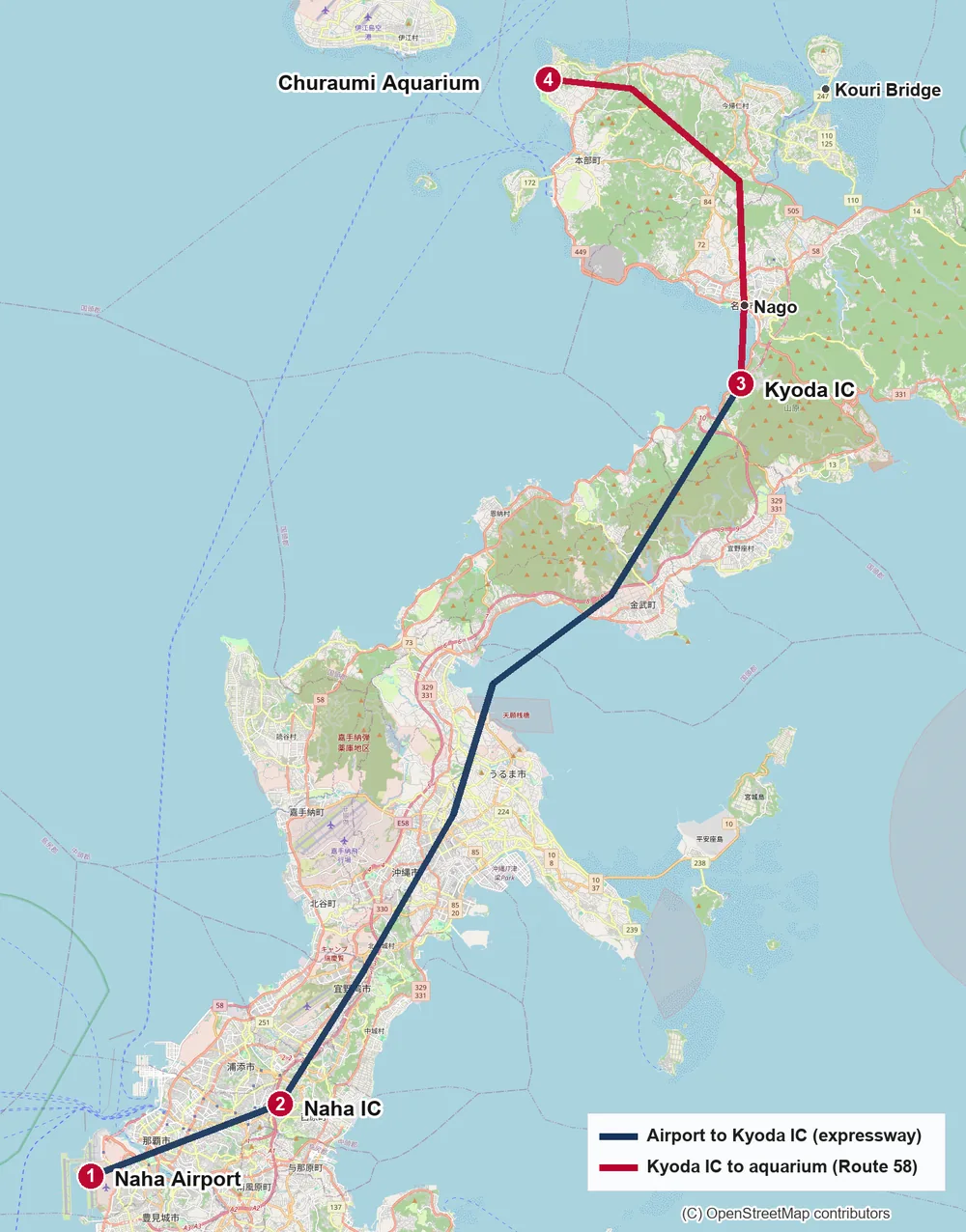
This is the distance that quietly breaks first-day itineraries. Naha Airport to Churaumi Aquarium is about 100 km, which is further than most people picture when they look at a map of a small island.
| Route | Distance | Time | Toll |
|---|---|---|---|
| Via the expressway | About 96 km | About 2 hours | 1,040 yen on ETC |
| Route 58 the whole way | About 90 km | 2 hours 50 to 3 hours | None |
The expressway ends at Kyoda, and from there you follow Route 58 north for the last forty minutes or so. That stretch runs along the coast and is genuinely pleasant, so a good compromise is the coast road going up and the expressway coming back.
Coming back is the problem. The aquarium closes at a set time, everyone leaves at once, and that traffic files south in one line. The return leg routinely takes half an hour longer than the outbound. Putting the aquarium on the same day you return the car is how people end up racing a check-in deadline.
A night in the north removes the round trip entirely. Stay around Motobu or Nago, go in at opening time the next morning, and the crowds are thinner too. Our Churaumi guide covers what to see inside and when to arrive.
10. Bus lanes catch more visitors than anything else
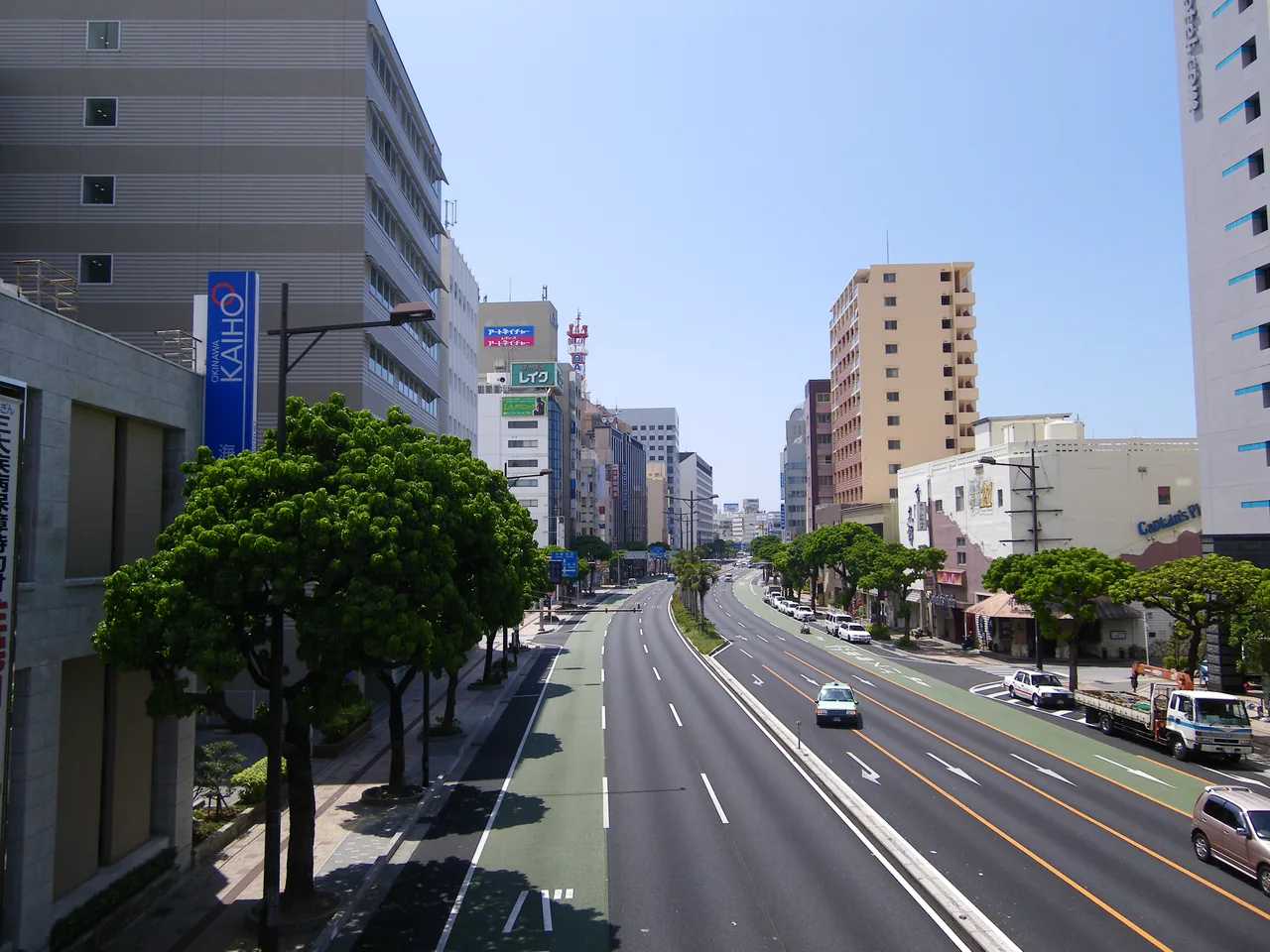
If you remember one rule for driving here, make it this one. Route 58 and other main roads between Naha and Urasoe become bus lanes during weekday rush hours.
| Detail | Rule |
|---|---|
| Hours | Weekdays 07:00 to 09:00 and 17:30 to 19:30 |
| Not in force | Saturdays, Sundays, public holidays, 2 and 3 January, days buses do not run |
| Bus lane violation | 6,000 yen and one point |
| Bus-only road violation | 7,000 yen and two points |
The signs are there, on posts and painted on the road, with the hours written in kanji, and they are easy to miss the first time. Some stretches are painted blue. When in doubt, stay in a middle lane. Slower, but nothing goes wrong.
The area around Kokusai StreetMap has its own timed restrictions. If your plan has you crossing Naha at rush hour, move it. You would only be sitting in traffic anyway.
11. Driving on the left goes wrong in predictable places
Japan drives on the left with the wheel on the right. If you have only ever driven on the right, the straight bits take about five minutes to absorb. The moments that catch people are always the same ones.
| Situation | What changes |
|---|---|
| Turning right | You cross oncoming traffic. Treat it with the caution you would give a left turn at home |
| Turning left | Stay tight. Swinging wide puts you in the oncoming lane |
| Pulling out of a car park | The single most common mistake. Muscle memory sends you into the right-hand lane |
| Indicators | They are where your wipers were. Expect a few days of wiping instead of signalling |
| Unsignalled junctions | Stop signs are frequent and a rolling stop counts as a violation |
The roads themselves are wide and well signed. What makes Okinawa harder than it looks is that Naha jams up daily and there are very few routes connecting south to north, so one accident leaves no sensible detour. The best defence is an itinerary with slack in it.
Use the car’s built-in navigation. Japanese units let you search by phone number or by MAPCODE, so noting down the phone number of each place you want to reach saves you fighting with kanji input. If you would rather use your phone, check the car has a mount, because holding it is a ticketable offence.
12. Okinawa enforces drink driving harder than anywhere in Japan
The numbers are stark. Of 2,809 injury collisions in Okinawa in 2025, 83 involved alcohol. That is 2.95 per cent, the worst rate in Japan for the fifth year running. There were 1,097 arrests, which works out at 0.74 per thousand residents against a national average of 0.16, so about 4.6 times the national rate. Alcohol featured in 12.5 per cent of fatal crashes, more than double the national figure.
Enforcement matches. Evening checkpoints on Naha streets and the national routes are routine.
Mornings deserve the same caution. Awamori is strong, and a late night still registers at breakfast. Okinawan drinking sessions are famously unhurried, so if you have an early start the following day, the sensible move is to go easy the night before.
There is also no equivalent of a ride-home service you can summon in minutes. On any evening you plan to drink, leave the car at the hotel from the start. That is the only version of this that reliably works.
13. Parking is free almost everywhere except Naha
Parking only becomes a problem inside the capital. Most attractions on the island have their own free car parks.
| Where | Parking |
|---|---|
| Churaumi Aquarium (Ocean Expo Park) | All nine car parks are free |
| Northern and central beaches, roadside viewpoints | Mostly free |
| Around Kokusai Street | 220 yen per 30 min on weekdays, 330 at weekends, 1,600 yen for 12 hours |
| Outer Naha | Day rates as low as around 600 yen |
| Naha city hotels | Often 1,000 to 1,500 yen a night on top of the room |
Which is why a lot of visitors leave the car at the hotel on their Naha day and take the monorail. Half a day around Kokusai Street already passes 800 yen in parking, and once you count circling for a space, walking is faster.
When you book a hotel, check whether parking is free, charged, and whether the number of spaces is capped. Naha hotel car parks are small and can be full by the time you get back in the evening. Northern resorts are usually free and rarely short of space.
14. Fuel stations thin out as you go north
Naha and the central belt are well served. Past Kyoda, heading into Yanbaru, the picture changes: the gaps between stations widen and the ones that exist close early. Okinawan stations keep more regular days off and shorter hours than the national norm, so an evening or early morning fill-up is not something to count on up there.
The standing habit is to top up around Nago before heading further north. Treat half a tank as your refuel point rather than a quarter. If you have taken an EV, plan charger locations with more care than you would on the mainland.
| Area | What to expect |
|---|---|
| Naha and central Okinawa | Stations and convenience stores everywhere |
| Around Nago | The last comfortable place to fill before the north |
| Motobu and the aquarium | Present, but fewer and closing earlier |
| Kunigami and deep Yanbaru | Sparse. Arrive with more than half a tank |
The roads narrow too. You will meet single-track sections between sugarcane fields where one car has to give way. Worth knowing before you upgrade to something large.
15. Fuel and drop-off both run on a full-to-full rule
Japanese rentals are full to full. Bring it back short and the company refuels it at their own rate, which is above pump price. Fill up near the branch before you drop off and keep the receipt, because some companies ask for it.
Ask for regular at the pump. Almost every passenger car you will rent in Okinawa runs on petrol. Self-service stations are common and some machines offer English. At a staffed station, “regular, full” is understood.
Do a lap of the cabin before you hand over the keys. Chargers left in the socket and things slid under the back seat are the usual casualties, and the branch is far enough from the terminal that you will not be going back for them.
16. Miyako and Ishigaki sell out earlier than the main island
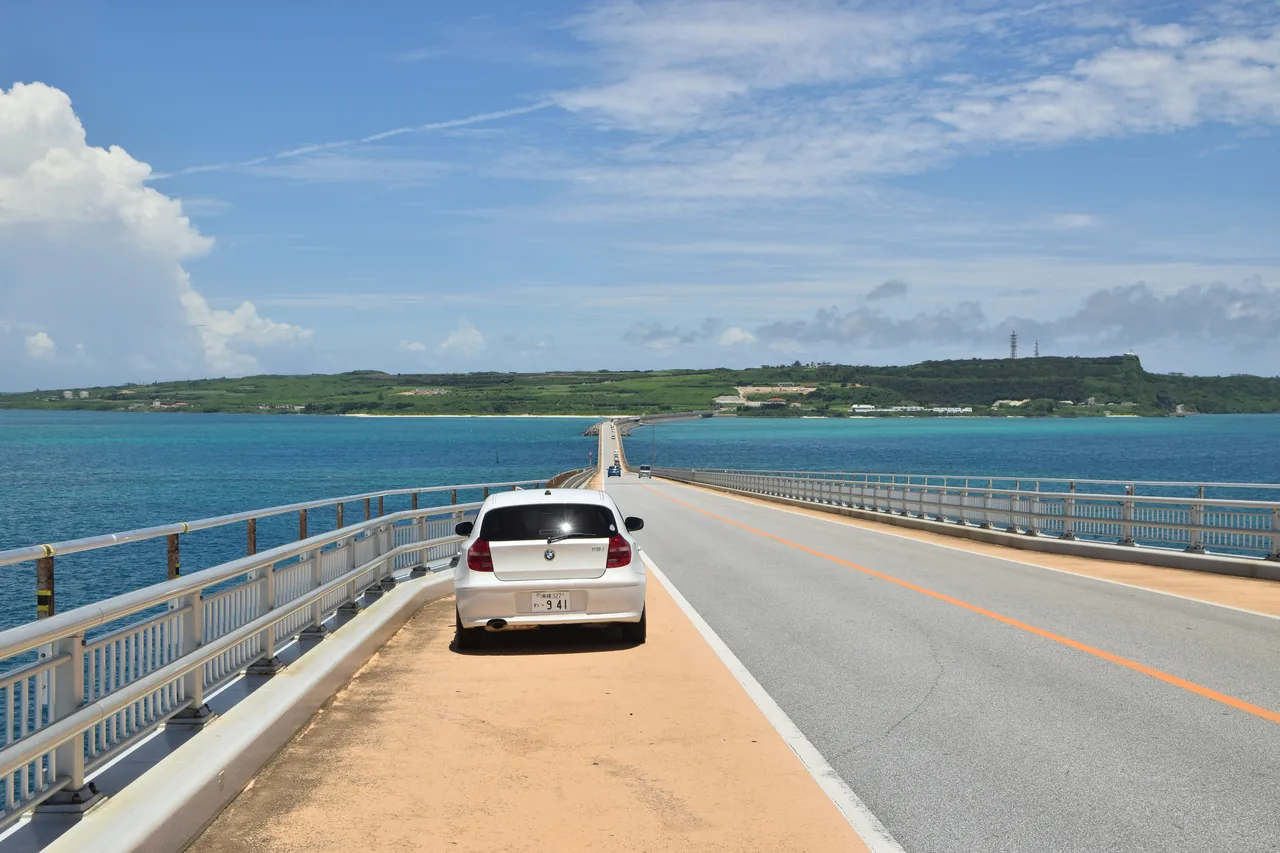
Miyako IslandMap works differently. There is effectively no public transport, so without a car you cannot move, and yet the fleet is capped. As of March 2024 the island had 349 operators running 6,754 vehicles, and that remains the most recent published figure.
Outside peak season there is room. Golden Week and the summer holidays are the problem: booked out more than two months ahead, with kei cars and compacts going first. This is an island where the car goes in the basket at the same time as the flight.
Ishigaki has the same structure with a slightly larger town, so you can survive a day or two on buses and taxis there. On Miyako you cannot, and even the airport to your hotel is a taxi or a rental.
You also cannot take a main-island rental across on the ferry. Contracts almost always forbid leaving the island, so each island means a separate rental. Our Miyako guide covers what is worth the drive once you are there.
17. Doing Okinawa without a car is possible, within limits
For anyone without a licence, anyone who found everything booked out, and anyone who simply would rather not drive. Okinawa is not a kind island to carless travellers, but there are workable options.
| Option | Where it works | Notes |
|---|---|---|
| Yanbaru Express Bus | Naha Airport to the aquarium in about 2 hours 17 minutes | Runs via Nago, Motobu Port, the aquarium and on to Unten Port |
| Sightseeing bus tours | The aquarium, Kouri Island and the northern highlights | Some itineraries give you 180 minutes inside the aquarium |
| Monorail | Naha and the airport | Enough on its own for Shuri Castle and Kokusai Street |
| Taxis and private charter | Half days with two or more people | With four sharing, some routes land close to rental costs |
The honest summary: if you want the north in a single day, a bus tour is the realistic choice. If you want to stop in several places across several days, that is what a car is for. Trying to do the north on scheduled buses gets you one or two stops a day.
For a Naha-only trip you are better off without a car anyway. The monorail reaches Shuri Castle and Kokusai Street, and most of what survives of the Ryukyu Kingdom sits inside that radius. It reads very differently once you know the history, so our piece on the Ryukyu Kingdom is worth ten minutes before you go. For the practical side, getting around Naha without driving has the monorail fares, the day pass and the two places that need a bus instead.
18. A checklist to run before you fly
Everything above, reduced to the points where something actually has to be done.
| When | What |
|---|---|
| The day you book flights | Book the car. Three to four months out for peak dates |
| Two weeks out | Apply for the IDP, or check the expiry on the one you have |
| On the booking page | Declare child seats, add the ETC card and NOC waiver, register every driver |
| The night before | Screenshot the shuttle bay number from your confirmation |
| Packing | IDP, home licence and passport in the same pocket |
| Landing day | Leave a clear hour between touchdown and driving away |
| On the road | Bus lanes at weekday rush hour, and nothing to drink |
| Last day | Refuel, then return two hours before departure |
Pay with a credit card if you can. Some companies place a hold, and the budget operators that take only cash tend to want a large deposit. Our guide to money and cards in Japan covers what actually works at Japanese terminals.
If you are travelling between summer and early autumn, read the cancellation terms alongside the storm season. A grounded flight does not release your rental booking, and nobody cancels it for you. Our typhoon season guide has the timing and what to do when one is forecast.