Don Quijote Japan: The Free Discount Coupon, Tax-Free and Opening Hours
The Don Quijote discount coupon costs nothing. It takes 5% off from 10,000 yen before tax and 7% from 30,000, on top of the tax exemption. It only works on a tax-free purchase, though, and alcohol and tobacco do not count towards the total. Here is how to use it, and which branch to go to.
| Coupon | free, but only on a tax-free purchase. |
|---|---|
| Bands | 5% from 10,000 yen, 7% from 30,000, before tax. |
| Excluded | alcohol, tobacco and consoles do not count. |
| Rules | no screenshots, and it will not stack with majica. |
| 24 hours | 44 of 552 stores, in nine prefectures only. |
| Medicine | sold at one store in three. |
1. The discount coupon is free
2. Six categories that do not count
3. What happens at the register
4. You cannot combine it with majica
5. What you need at the tax-free counter
6. Sixteen branches cannot do tax-free
7. Only 44 stores are open 24 hours
8. The 26 Tokyo branches that never close
9. Osaka has three, Kyoto has none
10. Opening times are just as uneven
11. Nine different shop signs, one company
12. Medicine is sold at one store in three
13. Airport, station and motorway branches
14. IC cards work at the register
15. When the bags get heavy
16. Which branch to use, by city
1. The discount coupon is free
Nobody needs to pay for the Don Quijote discount coupon. The company’s own portal hands it out at no cost, with pages in English, Korean, Thai and both forms of Chinese. Travel booking sites distribute the same thing, also free.
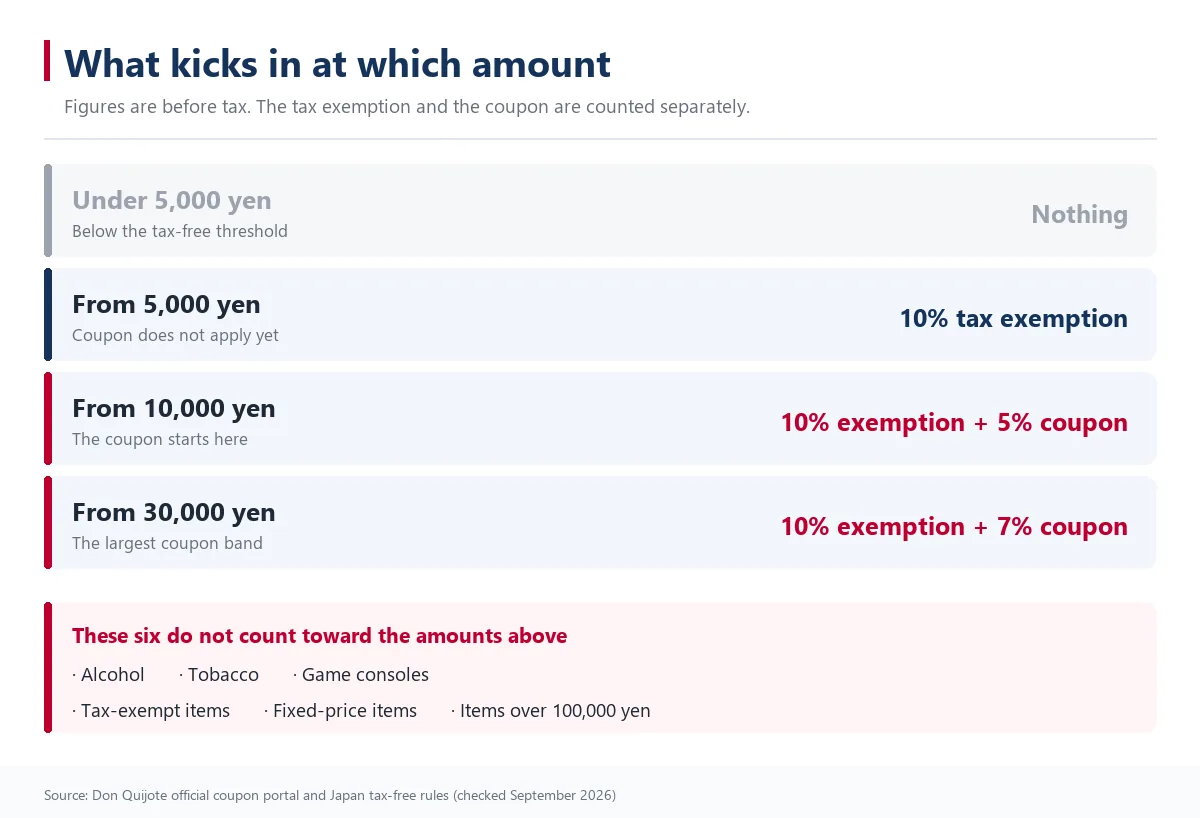
There are two bands. 5% off once the before-tax total reaches 10,000 yen, and 7% from 30,000 yen. That sits on top of the 10% consumption tax you are already not paying, because the two are calculated separately.
It only works on a tax-free purchase. Pay the normal way and the coupon does nothing. Tax-free needs your physical passport, and the threshold for tax-free itself is 5,000 yen before tax at one store on one day. So anything between 5,000 and 9,999 yen gets the tax exemption but not the coupon.
Japanese nationals visiting from abroad qualify too, as long as they meet the tax-free conditions. Diplomatic tax exemption, the kind embassies use, is excluded.
Where it works
Don Quijote stores in Japan, plus Apita and Piago, which belong to the same group. The 16 branches that cannot process tax-free cannot accept the coupon either, and those are listed further down.
There is no registration, no account and no minimum stay. You open the page, you get a banner, you show the banner. The friction is all at the register rather than beforehand.
Where to pick it up
Get it free from the KKday coupon page. Klook lists the same coupon at the same rates. Neither asks for payment, and the voucher appears on screen straight away.
There is no downside to holding one you never use. Mobile signal inside a basement sales floor is unreliable, so pick it up before you leave the hotel.
With the coupon sorted, the remaining question is which branch you go to. If you plan to shop at night, stay somewhere you can walk from. Hotels around the all-night branches, the Dotonbori one included, are listed on Trip.com.
2. Six categories that do not count
Certain goods are excluded from the discount, and the list is short enough to memorise. The official terms name six.
| Excluded | Notes |
|---|---|
| Alcohol | Sake, whisky, beer, all of it |
| Tobacco | Heated tobacco products included |
| Game consoles | The hardware itself |
| Non-taxable goods | Prepaid cards and similar |
| Fixed-price goods | Items the store may not discount |
| Single items over 100,000 yen | Before tax |
This is the part people get wrong. Those categories are not merely undiscounted. They do not count towards the 10,000 and 30,000 yen thresholds either. Put 8,000 yen of whisky and 3,000 yen of snacks in the basket and the receipt says 11,000, but the coupon sees 3,000.
If your shopping list leans heavily on alcohol and cigarettes, the coupon will do much less than the headline percentages suggest. It pays off on cosmetics, snacks, household goods and souvenirs, which is where most of the volume goes anyway.
The exclusion for single items over 100,000 yen mostly affects electronics and watches. A 120,000 yen camera is still tax-free; it simply gets no coupon discount and does not help you reach the next band.
3. What happens at the register
The coupon is shown on screen while you pay. The official instructions run to four steps.
1. Tap the banner
Open the coupon page and tap the banner to bring up the barcode screen.
2. Show the staff
Present the screen at the point of payment, not before and not after.
3. Work through it yourself
The screen runs from step one to step four, and the customer taps through it.
4. Close it
Press the close button at the end.
A screenshot is refused, so you need a live connection and the actual page. Showing the coupon after payment has been completed is also too late. And it is single use.
Open the page before you join the queue. Mobile signal inside a crowded basement floor is not reliable, and a page that will not load at the till is the one common way this goes wrong.
Tax-free registers are usually separate from the ordinary ones, and in the bigger branches they are on a different floor entirely. Ask where it is on the way in rather than after your basket is full.
Queues build between 9pm and midnight at the busier city branches. At an all-night store you can simply go later; at one that closes at 1am you cannot.
4. You cannot combine it with majica
Don Quijote runs its own payment system called majica. It is a prepaid electronic money product, used through an app or a physical card. Signing up costs nothing, spending earns points, and the app carries its own set of coupons.
The official terms are explicit: the tax-free discount coupon cannot be used together with a majica card, or with any other discount or promotion. It is one or the other.
Which one is worth it
For a short trip, the coupon wins on simplicity. majica means installing an app, registering an account and loading money you then have to spend before you leave. The coupon is a web page you open at the till, and 5% to 7% is a meaningful number on a large tax-free basket.
majica makes more sense for people who come to Japan often or stay for months, because points accumulate and app-only promotions appear regularly. Even then, the two cannot be stacked on the same transaction.
majica is accepted at 549 of the 552 stores, so availability is not the deciding factor. The deciding factor is that using it forfeits the coupon.
5. What you need at the tax-free counter
Tax-free needs the physical passport. A photo or a photocopy is not accepted. Leave it at the hotel and you lose both the exemption and the coupon for that day.
The threshold is 5,000 yen before tax, at one store, on one day. Purchases at different branches cannot be combined, and neither can purchases on different days. Consumption tax is 10% in general and 8% on food and drink.
Who qualifies
Short-term visitors who entered Japan less than six months ago. Residents do not qualify. Japanese nationals living abroad and visiting temporarily do, which is why the coupon terms mention them specifically.
The process is changing
At present the store deducts the tax at the register and you pay the lower amount. That is being replaced: you will pay the full tax-inclusive price in the shop and claim the consumption tax back at the airport on departure. The sealed-bag rule for consumables goes away with it. The passport requirement does not change.
The coupon applies to tax-free transactions, and the transaction still counts as tax-free after the change, so the sequence of processing the exemption and then showing the coupon should hold. The fine detail is worth re-checking close to your trip.
The full picture, including what you do at the airport and how long to allow for it, is in the Japan tax-free shopping guide.
If second-hand shops are more your thing than discount chains, our guide to Hard Off, Book Off and Mandarake covers those instead.
6. Sixteen branches cannot do tax-free
Tax-free works at 536 of the 552 stores. The 16 that cannot process it fall into clear groups.
| Type | Branches |
|---|---|
| Inside universities | Campus Donki, three of them |
| Mall tenants | LaLaport Tachihi, Seven Park Ario Kashiwa, two Cosme Donki, Kita-Ageo PAPA, the Outlet store |
| Motorway service area | Michi Donki NEOPASA Shimizu |
| Regional MEGA | Minokamo, Hamamatsu Mikatahara, Kanoya |
| Others | Osaka Tenma Station, Nagoya Midori, Ichinomiya |
Of those, the two a visitor might plausibly walk into are LaLaport Tachihi and the motorway branch. If you were planning to shop tax-free at a service area on a road trip, that plan does not work. The two airport branches, by contrast, do handle tax-free.
This matters more than it looks, because the discount coupon covered earlier only applies to a tax-free transaction. No tax-free means no coupon either.
7. Only 44 stores are open 24 hours
Don Quijote has 552 stores in Japan, and 44 of them are open 24 hours. That count comes from reading the opening hours of every branch in the company’s own store finder. The rest close at some point during the night.
Closing times vary a lot. Ninety-eight branches close at midnight, 77 at 1am, 114 at 2am and 105 at 3am. Fifty-one stay open until 4am or 5am. At the other end, 26 shut at 11pm and another 26 shut at 9pm. One store closes at 5pm.
So the chain does trade late. The problem is the assumption. If you turn up at 3am expecting the doors to be open, the odds are against you unless you picked one of the 44. Checking the closing time of the specific branch takes a few seconds and saves a wasted walk.
If you want the rules on the tax exemption itself rather than the stores, the Japan tax-free shopping explainer covers thresholds, paperwork and what changes at the airport.
Where the 44 are
All-night branches exist in nine prefectures. The other 38 prefectures have none at all.
| Prefecture | 24-hour stores | All stores there |
|---|---|---|
| Tokyo | 26 | 76 |
| Kanagawa | 6 | 35 |
| Osaka | 3 | 46 |
| Aichi | 3 | 45 |
| Fukuoka | 2 | 23 |
| Hokkaido | 1 | 20 |
| Miyagi | 1 | 10 |
| Chiba | 1 | 32 |
| Hyogo | 1 | 13 |
They cluster where visitors sleep, which is why the chain feels like it never closes if you only ever shop in central Tokyo or Osaka. Step outside those nine prefectures and the picture changes completely. Kyoto, Nara, Okinawa and Hiroshima have no all-night branch at all.
Store numbers by prefecture run Tokyo 76, Osaka 46, Aichi 45, Kanagawa 35, Chiba 32, Saitama 28, Fukuoka 23, Shizuoka 21 and Hokkaido 20. Every one of Japan’s 47 prefectures has at least one store.
8. The 26 Tokyo branches that never close
Tokyo has 76 stores and 26 of them run 24 hours. Most neighbourhoods a visitor is likely to stay in have one. This is the complete list.
Shinjuku area, six
Kabukicho, Shinjuku East-South Exit, Shinjuku Meiji-dori, Shinjuku, Shin-Okubo Station Front and Takadanobaba Station Front.
Shibuya and Meguro, four
MEGA Shibuya Main, MEGA Shibuya Annex, Nakameguro Main and Picasso Meguro Station Front.
Ikebukuro, three
Ikebukuro Station West, Ikebukuro East Exit Front and Kita-Ikebukuro.
Asakusa, Akihabara, Ginza
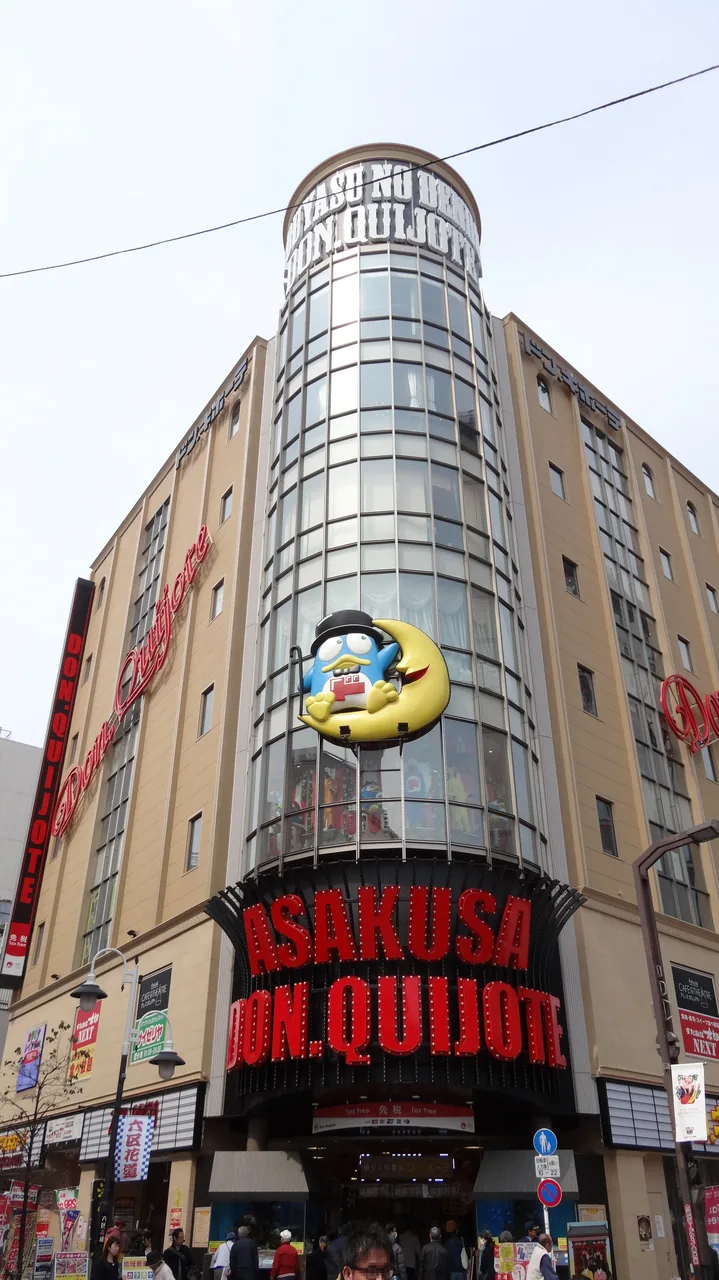
Asakusa, Akihabara and Ginza Main. All three sit inside major sightseeing areas.
Other central branches
Roppongi, Korakuen, Platinum Shirokanedai, Kamata Station Front and Akabane East Exit.
Outer Tokyo and Picasso
Hachioji Station Front, Machida Station Front, Picasso Shin-Koiwa, Picasso Koiwa Station Front and Picasso Otsuka Kitaguchi.
The Asakusa branch is open all night, but Don Quijote Asakusa EKIMISE closes at 8pm. They are two different shops with similar names, a few minutes apart. If you are going late, you want the Asakusa branch. Map
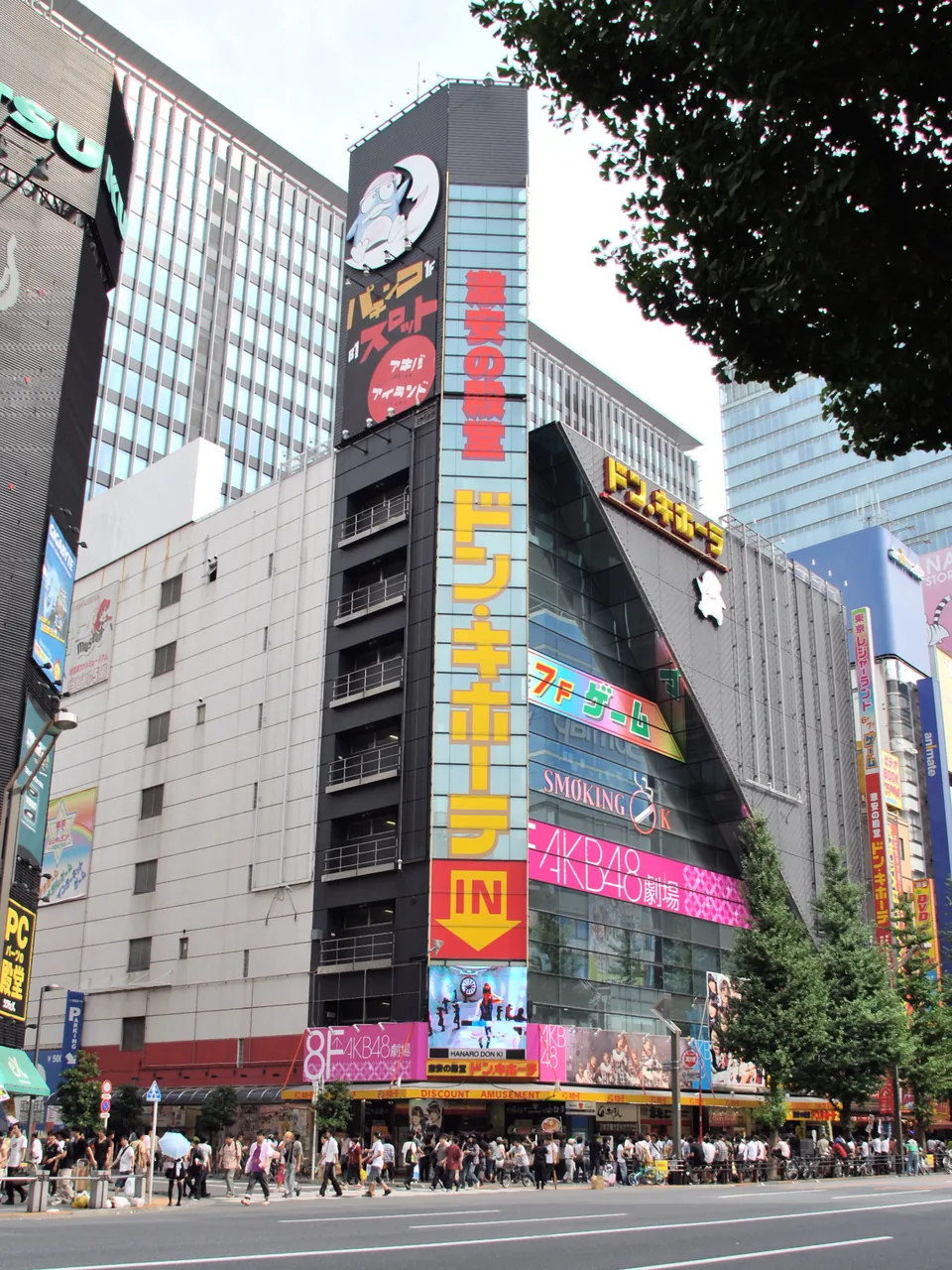
The Akihabara branch has a theatre upstairs and sits right on the electronics strip, which makes it an easy late stop after the shops close. If you are working through that district properly, our Akihabara guide breaks the buildings down floor by floor. Map
The Ueno branch is not in Ueno. Its registered address is Yushima in Bunkyo ward, not Ueno in Taito ward. It opens at 9am and closes at 4am. Check the map before you set off from Ueno Station on foot. Map
Where you sleep decides which branch is reachable at night. If the hotel is not booked yet, where to stay in Tokyo sets out the districts, and Trip.com shows what rooms in each of them go for.
9. Osaka has three, Kyoto has none
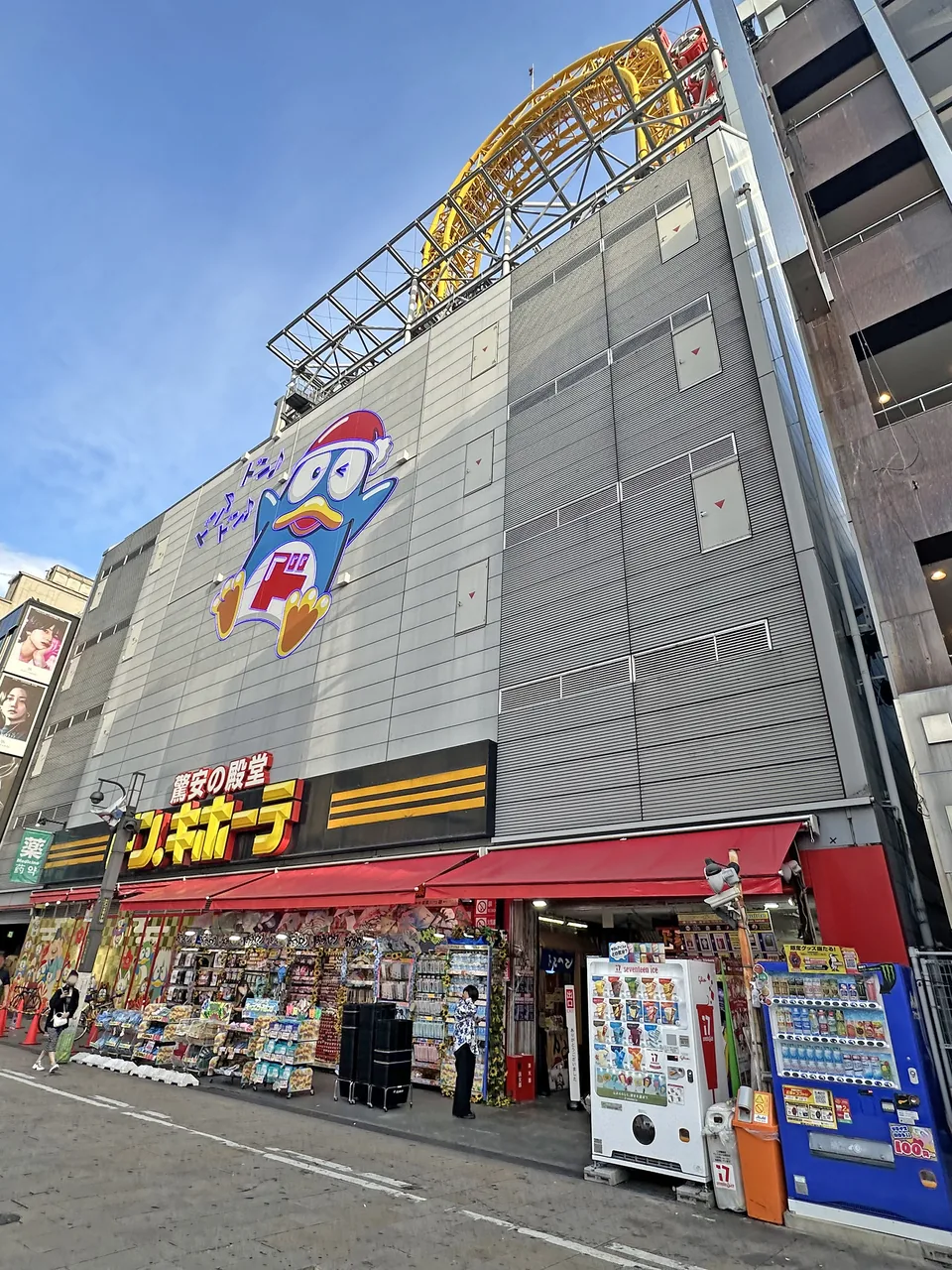
Three Osaka branches are open all night: Umeda Main, Dotonbori and Dotonbori Midosuji. That is three out of 46 stores in the prefecture, and all three sit where visitors already are.
The Dotonbori branch is the one on the canal with the Ferris wheel attached to the building. Midosuji is a few minutes west, towards Shinsaibashi. If one is packed, the other is a short walk. Map
Umeda Main sits north of Osaka Station, which makes it the practical choice if you are staying near the station rather than in Minami. Map
Walking the Dotonbori strip itself is a separate trip. our Namba and Dotonbori guide runs through the arcades, the bridges and the boat.
All twelve Kyoto stores close at night
Kyoto has 12 branches and none of them run 24 hours. The latest closing time in the prefecture is 1.30am.
| Branch | Hours |
|---|---|
| Shijo Kawaramachi | 10:00-1:00 |
| Shijo-dori | 10:00-1:00 |
| Kyoto Karasuma Shichijo | 9:00-1:00 |
| Uzumasa Tenjingawa | 9:00-1:00 |
| Kyoto Avanti | 9:00-0:00 |
| Kyoto Fushimi | 9:00-0:00 |
| MEGA Yamashina | 9:00-0:00 |
| Rakusai | 10:00-0:00 |
For a late run in central Kyoto, Shijo Kawaramachi and Shijo-dori are the two to know. Both are inside the main shopping area and both close at 1am. Map
Staying near Kyoto Station instead? Karasuma Shichijo or Avanti. Avanti sits inside the building on the south side of the station and closes at midnight. Map
If your itinerary has you in Osaka during the day and Kyoto at night, do the shopping while you are still in Osaka. It is the same chain and the Osaka branches are open when the Kyoto ones are not. Where to stay in Osaka covers which districts put you near one. If you want to walk there at night, Trip.com’s list of hotels around the Dotonbori branch is the quicker way to check.
10. Opening times are just as uneven
There is no standard opening time either. Some branches open at 7am, plenty open at 10am, and the difference matters if you were planning to shop before a train.
Six branches open at 7am. Eki Donki inside Osaka Station, Picasso Akasaka and Picasso Sakurajosui in Tokyo, Nishiarai Station Front, BIGFUN Heiwajima, and Fujisawa Station South Exit in Kanagawa. Map
A larger group opens at 8am, including Kokusai-dori Kumoji and Naha Tsubogawa in Okinawa, plus the Miyakojima and Ishigakijima branches. City-centre stores in the entertainment districts tend to open at 10am instead, because their trade is in the evening.
Thirty-three branches close before 9pm
Stores inside shopping malls follow the mall’s hours rather than their own, which is why a third of the early closers are mall tenants.
Sora Donki at New Chitose Airport closes at 5pm. It runs 9am to 5pm. If you are flying out of Hokkaido in the evening, the airport branch will be shut before you reach it. The Haneda Airport branch is better at 10.40pm, but a late-night arrival still misses it.
Okashi Donki and Osake Donki near Tokyo Station’s Yaesu side close at 9.30pm. Michi Donki, the branch inside a motorway service area, closes at 9pm.
The rule of thumb is simple. The more unusual the location, the shorter the hours, because airport, station, motorway and campus branches all trade on someone else’s schedule.
11. Nine different shop signs, one company
The same company trades under nine names in Japan. The store finder lists them separately because the size and the stock are genuinely different.
Don Quijote: 336
The standard format. Narrow aisles, goods stacked to the ceiling, the version most people picture.
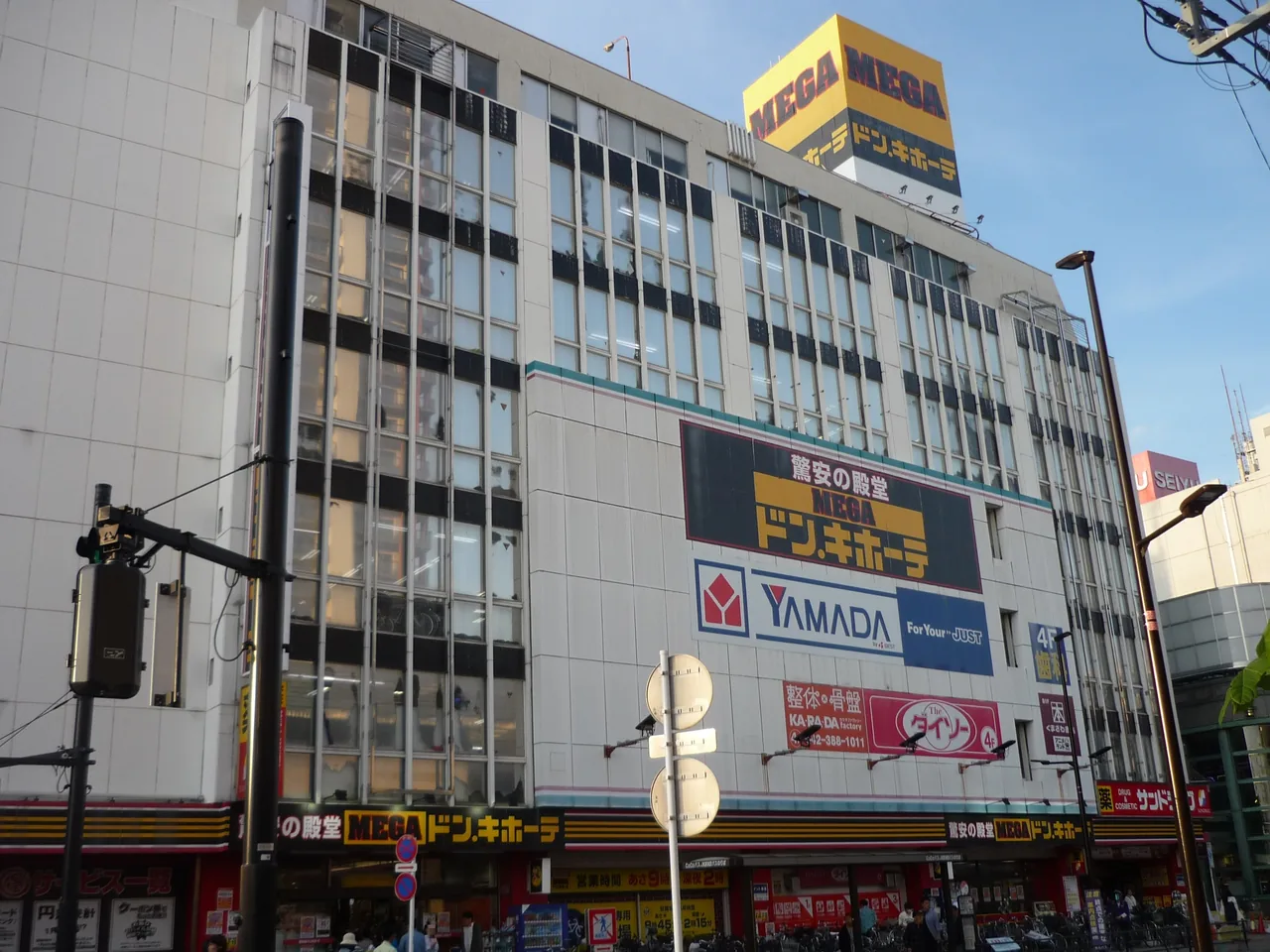
MEGA Don Quijote: 188
Much larger grocery floor. Usually suburban, usually with parking.
Picasso: 12
Small city-centre format. Concentrated in Tokyo and several run 24 hours.
Kirakira Donki: 8
Cosmetics and lifestyle goods. Mall tenants, so they close in the evening.
Sora Donki: 2
Airport branches, one at New Chitose and one at Haneda.
Four one-offs
Eki Donki in Osaka Station, Michi Donki in a service area, Campus Donki inside universities, and a single Essence store.
In practice visitors deal with the first three. MEGA branches are the ones to pick for food and household goods, because the grocery floor is laid out like a supermarket rather than a treasure hunt. Central branches lean towards cosmetics, snacks and souvenirs.
Kirakira Donki is worth flagging because the name says Donki but the shop does not feel like one. Wide aisles, bright lighting, cosmetics at the front. If you go expecting the usual crammed aisles you will wonder whether you are in the right place. Most close at 8pm.
Campus Donki branches sit inside university buildings and are not really open to passing shoppers in the way the others are. They also cannot process tax-free, which is covered further down.
12. Medicine is sold at one store in three
Buying medicine at Don Quijote is a standard piece of travel advice, and it only works at 176 of the 552 stores. That is the count of branches carrying the pharmaceutical marker in the official store finder.
Tokyo has it at 32 stores out of 76, Osaka at 15 out of 46, Kyoto at 5 out of 12. Okinawa is the outlier in the good direction, with 8 of its 10 stores selling medicine.
So walking into the nearest branch for cold medicine or pain patches is a coin flip. The store finder shows what each branch carries; checking before you go is quicker than checking two shelves and giving up.
Other services, same caveat
| Service | Stores | Reading |
|---|---|---|
| Tax-free | 536 | Nearly everywhere |
| Alcohol | 529 | Nearly everywhere |
| UnionPay | 542 | Nearly everywhere |
| Parking | 458 | Suburban branches |
| Tobacco | 394 | Five in seven |
| ATM | 189 | One in three |
| Medicine | 176 | One in three |
Forty branches run a concierge counter with foreign-language staff. They are the larger, more visited stores, so if you expect to need help with the tax-free process, those are the ones to aim for.
ATMs are the other one-in-three service. Convenience stores have far denser coverage, so sort cash out before you shop rather than counting on the store. Our guide to cash and cards in Japan covers which cards work in which machines.
13. Airport, station and motorway branches
Two branches sit inside airports and one inside a railway station. The signs differ but the company is the same, and the hours and tax-free status vary enough to be worth a table.
| Branch | Location | Hours | Tax-free |
|---|---|---|---|
| Sora Donki New Chitose | New Chitose Airport | 9:00-17:00 | Yes |
| Sora Donki Haneda | Haneda Airport | 9:00-22:40 | Yes |
| Eki Donki Ekimarche Osaka | Osaka Station | 7:00-23:00 | Yes |
| Michi Donki NEOPASA Shimizu | Shin-Tomei Expressway | 9:00-21:00 | No |
The 5pm close at New Chitose is the one to remember. Saving all the souvenir shopping for the airport on your last day in Hokkaido does not work if the flight is in the evening. Buy in Sapporo instead. Map
Haneda runs until 10.40pm, which covers most evening departures but not a late-night arrival. Map
Eki Donki opens at 7am, one of only six branches in the country to do so, which makes it genuinely useful before an early shinkansen.
You need a working connection to display the coupon at an airport till. Our eSIM guide covers activating data before you land.
14. IC cards work at the register
Suica and ICOCA are accepted as payment. Counting the electronic money markers in the store finder, transit cards work at roughly 530 of the 552 stores. Around twenty branches do not take them.
Nine transit cards are listed: Suica, PASMO, ICOCA, Kitaca, TOICA, manaca, SUGOCA, nimoca and Hayakaken. They are mutually interchangeable across Japan, so the region your card came from does not matter.
| Payment method | Stores accepting |
|---|---|
| majica | 549 |
| UnionPay | 542 |
| iD, QUICPay, Rakuten Edy | around 530 |
| Nine transit IC cards | 525–530 |
Tax-free purchases are a different matter
Transit cards are usually accepted at the tax-free register too, but the balance cap is the problem. IC cards hold a limited amount, and tax-free baskets are by definition at least 5,000 yen and often much more. Arriving with only an IC card is how people end up topping up at the counter with a queue behind them.
Bring a credit card or cash as well. If you have not sorted a transit card yet, our Suica and ICOCA guide covers where to buy one and what the deposit is.
No branch is cash-only. But with ATMs at only one store in three, withdrawing inside the shop is not something to count on.
15. When the bags get heavy
A serious Don Quijote run produces more luggage than you left the hotel with. Shinkansen rules on oversized bags are worth knowing before you plan the next leg.
Bags above a certain combined dimension need a reserved space on the train. The measurements and the booking method are in our shinkansen luggage guide.
Sending it ahead
Japan’s courier services will move a suitcase to your next hotel or to the airport. Convenience stores and hotel front desks both accept them. Sending the large bag ahead on a travel day is standard practice here and costs less than most visitors expect.
Tax-free goods need care. Once the refund system changes, there will be situations where tax-free purchases have to stay with you until customs sees them at departure. If you intend to courier tax-free shopping ahead, ask in the store whether that particular purchase allows it.
Liquids are capped in cabin baggage. Cosmetics and alcohol go in the hold. So do the knives and scissors that Don Quijote sells in quantity, which catches people out at security more often than it should.
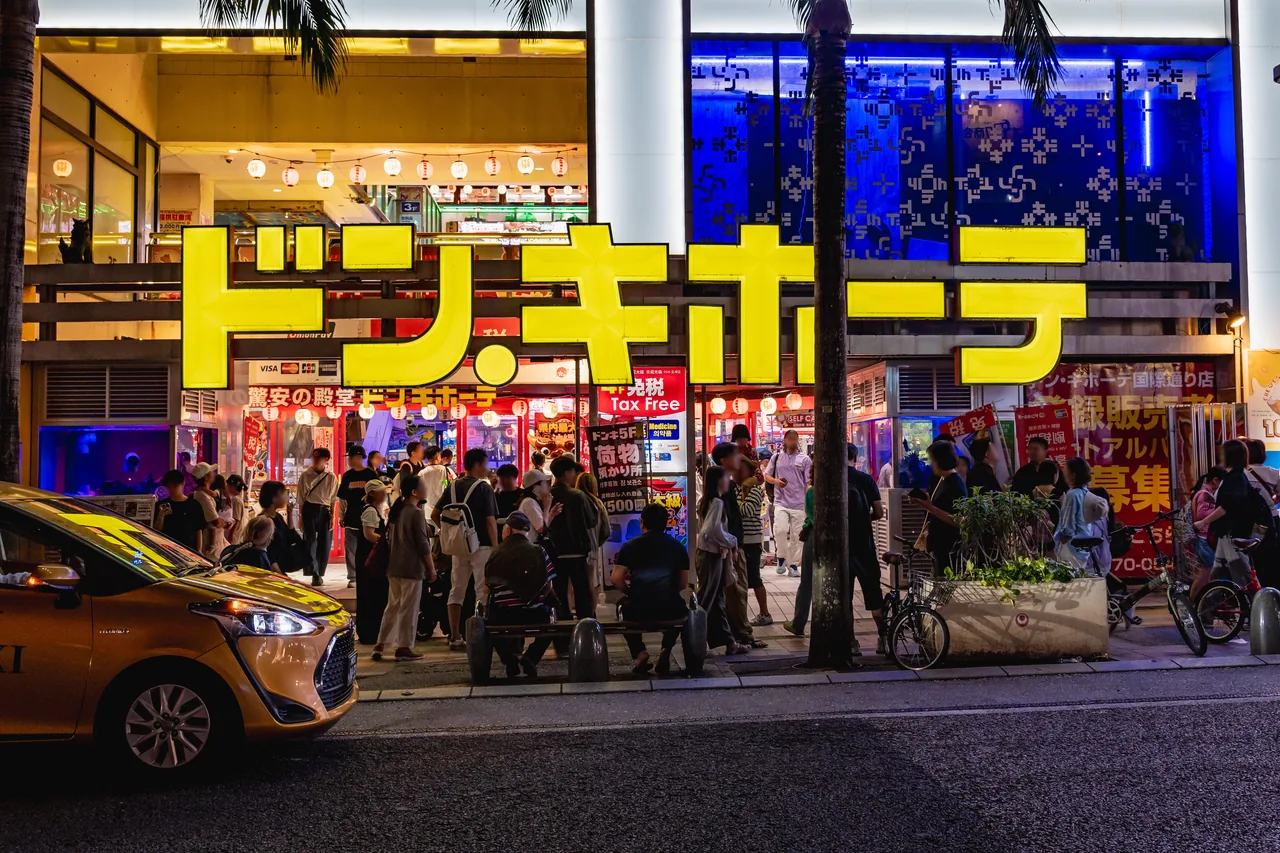
16. Which branch to use, by city
The city you sleep in narrows the choice more than anything else. Ask whether you can go at night, and whether the branch sells medicine.
| Area | Stores | Open 24h | Sell medicine |
|---|---|---|---|
| Tokyo | 76 | 26 | 32 |
| Osaka | 46 | 3 | 15 |
| Aichi (Nagoya) | 45 | 3 | 15 |
| Kanagawa (Yokohama) | 35 | 6 | 9 |
| Fukuoka | 23 | 2 | 8 |
| Hokkaido | 20 | 1 | 8 |
| Hyogo (Kobe) | 13 | 1 | 3 |
| Kyoto | 12 | 0 | 5 |
| Okinawa | 10 | 0 | 8 |
| Hiroshima | 6 | 0 | 2 |
Tokyo is the easy case. Wherever you are staying, something is open, and at night Shinjuku, Shibuya, Ikebukuro and Asakusa all have a branch.
In Osaka the late options narrow to Dotonbori and Umeda. In Kyoto they disappear entirely after 1.30am.
Fukuoka has two all-night branches, Tenjin Main and Nakasu, both inside the nightlife districts. Map
Okinawa has no 24-hour branch but several very late ones. Kokusai-dori runs to 5am and Naha Tsubogawa to 3am, which in practice covers anything you would want. Map
Sapporo’s single all-night branch is MEGA Tanukikoji Main, next to the Susukino nightlife area. Map
Planning the wider trip? Our Japan travel guide pulls together transport, budget and routing. If Kyoto is on the list, where to stay in Kyoto is the companion piece, and Trip.com has the rates once your dates are fixed.