
Matsuyama Travel Guide: Dogo Onsen Honkan, Matsuyama Castle, Botchan Train and Shimanami Kaido
Matsuyama puts a hilltop castle and the Dogo Onsen hot spring a short tram ride apart. This guide explains how the Dogo Onsen Honkan courses work, how to get up to the castle, what to eat and how to get around on the trams. It also covers day trips to Uchiko, Shimonada Station and the Shimanami Kaido, and how many nights to stay.
| How long | One night lets you bathe at Dogo in the evening and see the castle the next morning, and two nights leave room for a day trip. |
|---|---|
| Dogo Onsen Honkan | A plain soak in Kami-no-Yu costs ¥700, and the Tama-no-Yu courses add a rest room, a towel set and a look at the imperial bath. |
| Trams | Every ride costs ¥250 in cash or ¥230 by IC card, and neither the JR Pass nor the ALL SHIKOKU Rail Pass covers them. |
| Castle | The ropeway and chairlift share one ticket, the top station takes cash only, and the chairlift stops in rain. |
| Day trips | Uchiko, Ozu, Shimonada Station and Imabari for the Shimanami Kaido are each under an hour away by JR. |
1. How Matsuyama is laid out: the castle hill, Dogo Onsen and two stations
2. Dogo Onsen Honkan: the courses, the baths and the imperial bath
3. Asuka-no-Yu, Tsubaki-no-Yu and how to choose between the three baths
4. Walking around Dogo: the station, the clock, foot baths and the arcade
5. Dogo Park, Isaniwa Shrine, Ishiteji and the pilgrimage temples
6. Matsuyama Castle: ropeway or chairlift, tickets and the keep
7. Below the castle: Ninomaru Garden, Bansuiso and the Saka no Ue no Kumo Museum
8. Okaido, Gintengai and the city centre around Matsuyama-shi Station
9. The Botchan Train and Matsuyama’s street trams
10. Mitsuhama, Takahama and the islands off Matsuyama
11. What to eat in Matsuyama: tai-meshi, nabeyaki udon and citrus
12. Day trips from Matsuyama: Uchiko, Ozu, Shimonada Station and the Shimanami Kaido
13. When to go: Matsuyama’s weather, cherry blossoms and festivals
14. Getting to Matsuyama by plane, train, ferry or bus
15. Getting around Matsuyama: trams, fares, day tickets and luggage
16. Where to stay in Matsuyama: Dogo, the city centre or JR Matsuyama Station
17. Dogo Onsen for first-timers: what to bring, bath manners and tattoos
18. One-day and two-day Matsuyama itineraries
1. How Matsuyama is laid out: the castle hill, Dogo Onsen and two stations
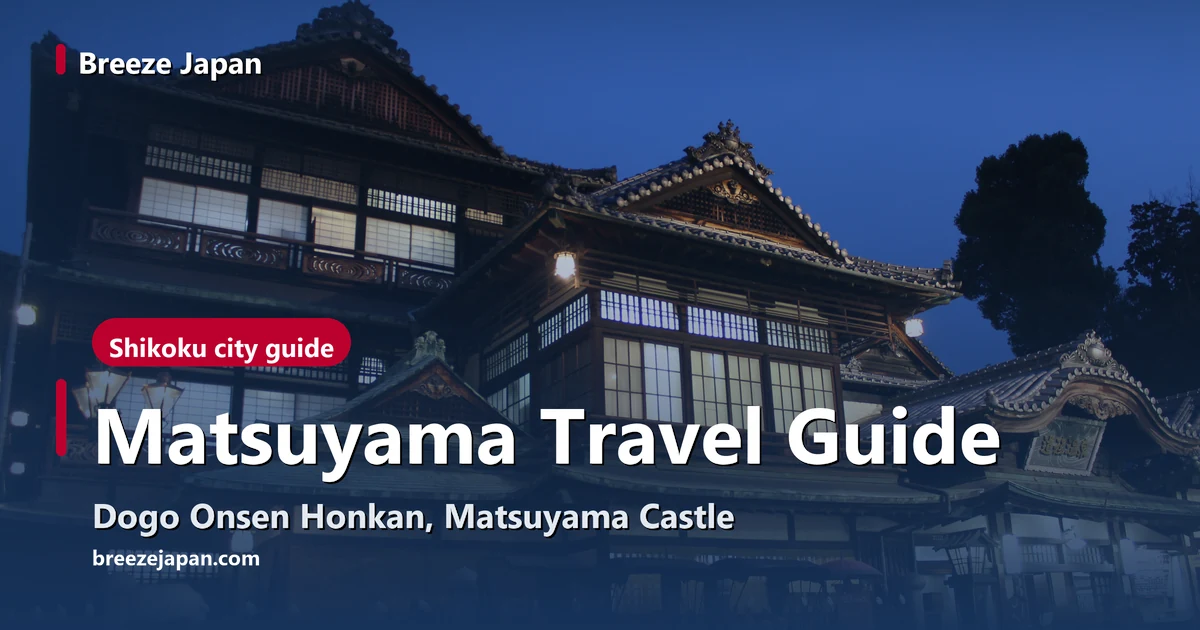
Step out of almost any tram in central Matsuyama and look up. A wooded hill rises right in the middle of town, and on top of it sits a castle keep on high stone walls. That hill is Katsuyama, 132 m high, and building started on Matsuyama Castle in 1602. Ride the tram east to the end of the line and you reach the other half of the city’s story, Dogo Onsen, a hot spring said to have about 3,000 years of history and to be the oldest in Japan.
Matsuyama is the main city of Ehime Prefecture, on the west side of Shikoku, and the transport hub for the middle of the prefecture. On Breeze Japan it is the second Shikoku city after our Takamatsu travel guide, and it slots easily into a wider trip planned with the Japan travel guide. People come for the castle and the baths, and stay for the trams rattling down the main streets, the citrus juice stands and the stories from Natsume Soseki’s novel “Botchan”.
The castle in the middle, the hot spring at the east end
The castle changed hands early. Kato Yoshiaki began building on Katsuyama in 1602 and was moved to Aizu in 1627 before it was finished. Gamo Tadachika completed it, and in 1635 Matsudaira Sadayuki took over. His family then held Matsuyama for generations, which is why the Matsudaira name keeps turning up around town, from the shrine on the Dogo hillside to the yuzu roll cake called taruto.
Dogo sits at the eastern tram terminus, Dogo Onsen, about 11 km from the airport. The hot spring quarter is small and walkable: the Honkan bathhouse, the two newer public baths, the station and the shopping arcade are all within a few minutes of each other on foot. The famous novel adds a layer to all of this. Soseki came to Matsuyama to teach English at the prefectural middle school, and the city’s own wording is that “Botchan” is said to be based on his time here.
Two stations with almost the same name
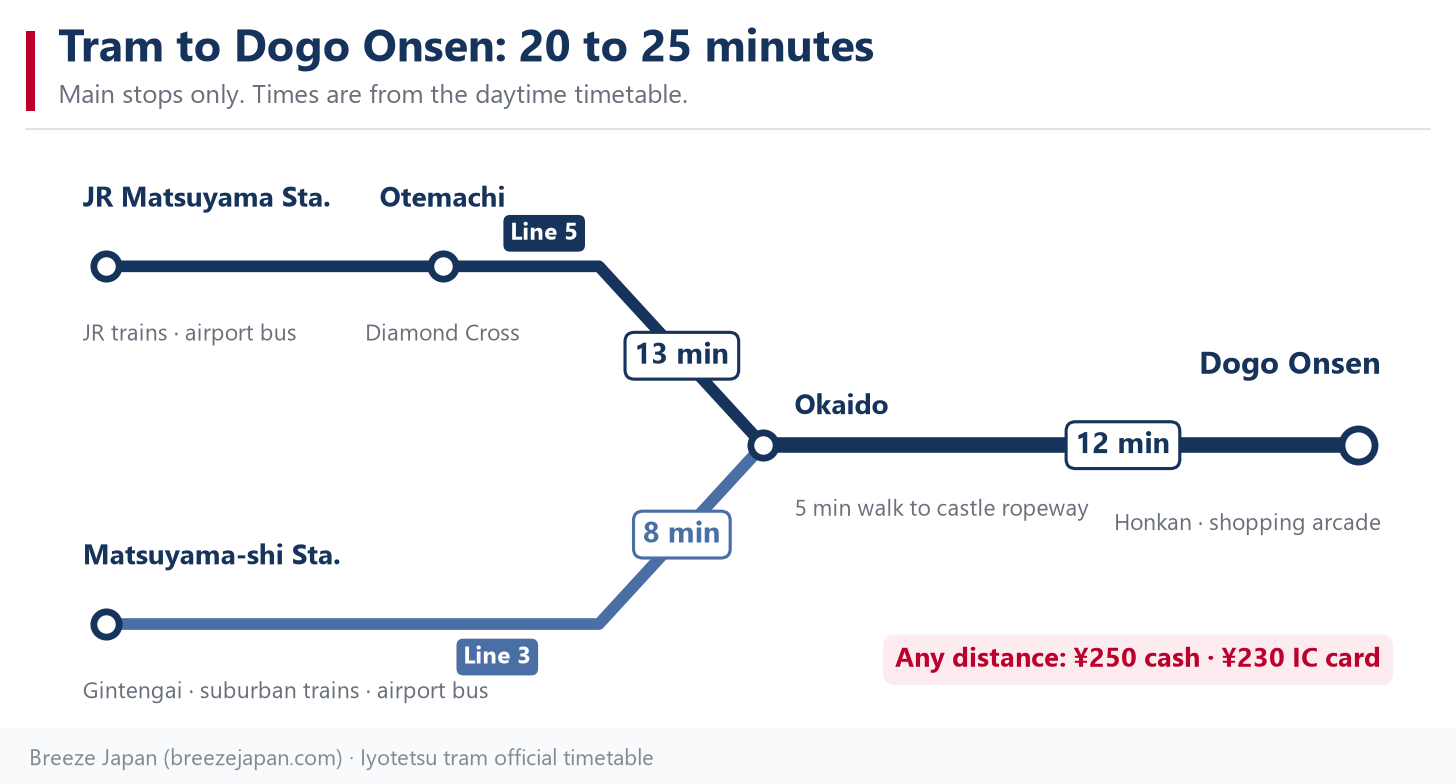
The first thing that confuses new arrivals is that Matsuyama has two main stations. JR Matsuyama Station is where JR trains arrive, including the Shiokaze limited express from Okayama and the Ishizuchi from Takamatsu. It was recently rebuilt as an elevated station with a row of shops underneath called JR Matsuyama Station Dandan-dori. Matsuyama-shi Station, which locals shorten to “Shieki”, is the hub of the private Iyotetsu railway. Suburban trains leave from here and the Iyotetsu Takashimaya department store sits on top. They are separate stations, 10 minutes apart by tram.
Between them and the castle lies Okaido, the main shopping street at the foot of the castle hill. From the Okaido tram stop it is about a 5-minute walk to the castle ropeway station. At its south end, Okaido meets the Gintengai arcade with just one street between them, and Gintengai ends at Matsuyama-shi Station. Cross that one street and you can walk from Okaido to the Iyotetsu hub under the arcade roofs. The airport is about 15 minutes by car from the city, according to Visit Ehime.
The tram times, worked out from the timetable, are easy to remember. Matsuyama-shi Station to Okaido takes 8 minutes and Okaido to Dogo Onsen 12 minutes, so 20 minutes end to end. From JR Matsuyama Station it is 13 minutes to Okaido and 25 minutes to Dogo Onsen. Every ride costs ¥250 in cash or ¥230 with an IC card, however far you go.
| Area | What’s there | How to get there |
|---|---|---|
| Dogo | Dogo Onsen Honkan, Asuka-no-Yu, Tsubaki-no-Yu, the shopping arcade, foot baths, Isaniwa Shrine, Dogo Park, Ishiteji | Tram to Dogo Onsen: 20 min from Matsuyama-shi Station, 25 min from JR Matsuyama Station |
| Around the castle | Matsuyama Castle, Ninomaru Historical Garden, Bansuiso, Saka no Ue no Kumo Museum, the prefectural art museum | Tram to Okaido, then 5 min on foot to the ropeway |
| City centre (Okaido, Gintengai) | Covered shopping arcades, Ropeway Street, Matsuyama-shi Station, Diamond Cross, nabeyaki udon shops | Tram to Okaido or Matsuyama-shi Station |
| Takahama and Mitsuhama | Old port streets, the free Mitsu ferry, Baishinji Station, Mikyan Park, the ferry to Gogoshima | Iyotetsu suburban train from Matsuyama-shi Station (Baishinji about 20 min) |
| Hojo | Kashima island, Hojo-style tai-meshi, the Fuwari roadside station | JR to Iyo-Hojo Station |
| Nearby towns | Uchiko, Ozu, Shimonada Station (Iyo City), Imabari for the Shimanami Kaido, Tobe | JR from JR Matsuyama Station, or by car |
What a day, one night or two nights gets you
With one day you can see the castle in the morning, eat lunch around Okaido and spend the afternoon and evening in Dogo, finishing with a bath at Honkan. It works, but you will be watching the clock. One night is the comfortable minimum: you get Dogo after dark, when the station is lit and people stroll the arcade in cotton yukata, and you can be back in the water when Honkan opens at 6:00. Two nights leave a full day for the coast at Mitsuhama or a trip out to Uchiko, Shimonada Station or the Shimanami Kaido.
2. Dogo Onsen Honkan: the courses, the baths and the imperial bath
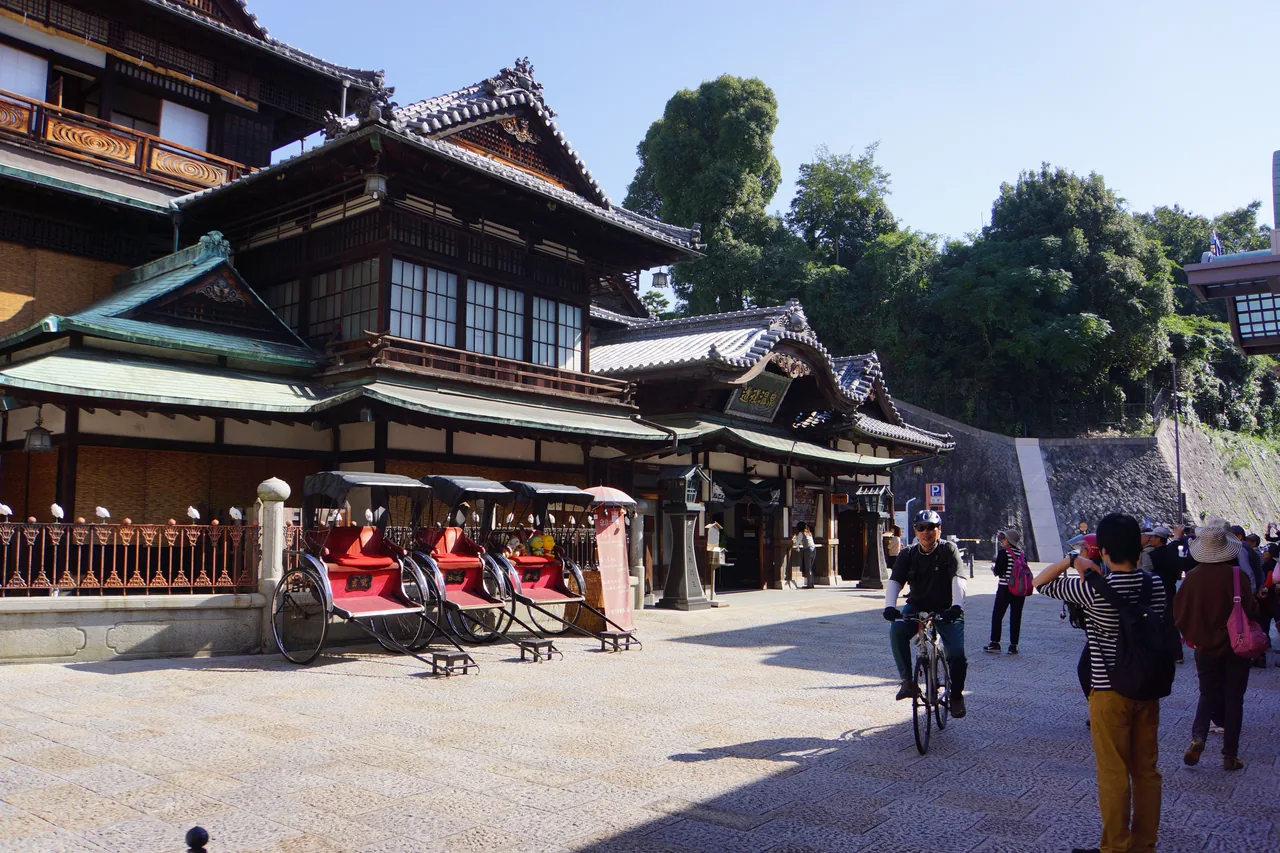
Walk up the arcade from the station and it ends at a three-storey wooden bathhouse with stacked tiled roofs, a little tower on top and a line of red rickshaws waiting out front. This is Dogo Onsen HonkanMap, rebuilt in 1894 and still a working public bath, about 5 minutes on foot from Dogo Onsen tram stop. In 1994 it became the first public bathhouse to be named a national Important Cultural Property, and the Michelin Green Guide gives it three stars.
A bathhouse that kept bathing through its restoration
Honkan recently came out of a long conservation project that took several years. The bath stayed open for most of that time, though the whole building did close for a short spell during the work. It is now fully open again. All the rest rooms are back in use, two new private rooms were added, and the entrance moved to the west side of the building, so an older map may send you to the wrong door.
Look up at the roof. The little tower is Shinrokaku, with red glass windows and a white heron on its tip. A drum called Toki-daiko has been beaten up there to mark the time since the 1894 rebuild, three times a day, and its sound was picked as one of the 100 Soundscapes of Japan. In early June staff hang bamboo blinds (sudare) on the building, a summer custom kept up since the Meiji era.
Kami-no-Yu or Tama-no-Yu: how the courses work
There are two baths inside. Every course includes Kami-no-Yu, while Tama-no-Yu is only open to people on the pricier courses. The courses build on each other. The cheapest is just a soak in Kami-no-Yu. The next adds time in the big second-floor hall, wearing a rented yukata, with tea and a snack. The next lets you into Tama-no-Yu as well, with its own rest room and a look at the imperial bath. Above that you get a private room on the third floor, with both baths and the imperial bath too.
| Course | Adult / child | Baths | Rest area and extras | Time limit | Hours (last entry) |
|---|---|---|---|---|---|
| Kami-no-Yu downstairs (Kaika) | ¥700 / ¥350 | Kami-no-Yu | None, bathing only | 60 min | 6:00 to 23:00 (22:30) |
| Kami-no-Yu second floor | ¥1,300 / ¥650 | Kami-no-Yu | Big second-floor hall, yukata rental, tea and a snack, bamboo blinds from June to September | 60 min | 6:00 to 22:00 (21:00) |
| Tama-no-Yu second floor | ¥2,000 / ¥1,000 | Kami-no-Yu and Tama-no-Yu | Tama-no-Yu rest room on the second floor, yukata, towel set, tea and a snack, free look at Yushinden | 60 min | 6:00 to 22:00 (21:00) |
| Tama-no-Yu third-floor private room | ¥2,500 / ¥1,250 | Kami-no-Yu and Tama-no-Yu | Your own room on the third floor (the “first class” of the novel), towel set, a look at Yushinden | 90 min | 6:00 to 22:00 (20:30) |
| Private room Shirasagi-no-Ma | ¥6,000 per group plus ¥1,300 per person (child ¥650) | Kami-no-Yu and Tama-no-Yu (the room itself has no bath) | A room for your group, entry at 6:30, 9:30, 12:30, 15:30 or 18:30, towel set, a look at Yushinden | 90 min | Five groups a day, booking required |
| Private room Hisho-no-Ma | ¥3,000 per group plus ¥1,300 per person (child ¥650) | Kami-no-Yu and Tama-no-Yu (the room itself has no bath) | A room for your group, entry at 8:00, 11:00, 14:00, 17:00 or 20:00, towel set, a look at Yushinden | 90 min | Five groups a day, booking required |
Adult prices apply from age 12, child prices from 2 to 11 (6 to 11 for the Yushinden tour). The regular first- and second-floor courses can’t be booked, you just turn up and pay. The things you do book are the two private rooms and a Yushinden tour on its own, without a bath. Book online until 22:00 the day before, or by phone on the day itself (089-921-5141).
If you only want to feel the water, the ¥700 downstairs course is enough. If you want to sit around afterwards in a yukata with tea, take the second floor. If you want to see the imperial bath and soak in both baths, take Tama-no-Yu second floor, and if you want a quiet room to yourselves, the third floor.
Yushinden, the Botchan Room and a line from Spirited Away
Yushinden is, in Dogo Onsen’s own words, Japan’s only bathroom built for the imperial family. You see it on a guided tour: ¥500 (child ¥250), 9:00 to 17:00 with last entry at 16:30, about 30 minutes. It is a room to look at, not a bath. The Tama-no-Yu courses include a visit, and if you only want the tour, book it ahead.
Up on the third floor, in the north-west corner, is the Botchan Room. Natsume Soseki is said to have used it with his friend Masaoka Shiki in 1895, and the writer Matsuoka Yuzuru gave it its name in 1966. In “Botchan” the young teacher boasts that he always went in first class. That first-class room is the one you get on the Tama-no-Yu third-floor course.
Many visitors arrive having heard a link to Studio Ghibli’s “Spirited Away”. The first-hand word comes from Studio Ghibli’s official diary. The writer asked director Hayao Miyazaki directly, and his answer was that lots of different hot springs went into the film and there is no particular one, but Dogo Onsen is definitely in there. The same entry mentions a big door in the storyboards marked with the characters 導後, and the diary writer guesses it may point to Honkan. That is the writer’s guess, not something the director said.
Queues, towels and the shop counter
On busy days Honkan switches to a call system. You take a numbered ticket, and when they ring your phone you have 15 minutes to get in, after which the ticket is cancelled automatically. The tickets can run out early, so on a busy day don’t leave Honkan until late in the evening.
Towels come with the Tama-no-Yu courses and private rooms. The two Kami-no-Yu courses don’t include one, so bring your own or rent at the counter: ¥110 for a towel, ¥320 for a bath towel. Shampoo, conditioner and body soap are provided in both baths. You can’t bring food in, and you can’t stay overnight. Dogo Onsen points anyone looking for a room to the local ryokan association.
The shop counter sells mikan juice for ¥180, Dogo Cider for ¥350, a box of five Botchan dango for ¥864, the bathhouse’s own stamp (goyuin) for ¥400 or ¥600, and special bathing wear for ¥500, which is covered in the manners section below. Honkan has no regular closing day. It shuts for one day of cleaning in December and opens as usual over New Year. Prices and the cleaning date are on Dogo Onsen’s English site, and our guide to Japan’s onsen and ryokan covers bathing in general.
3. Asuka-no-Yu, Tsubaki-no-Yu and how to choose between the three baths
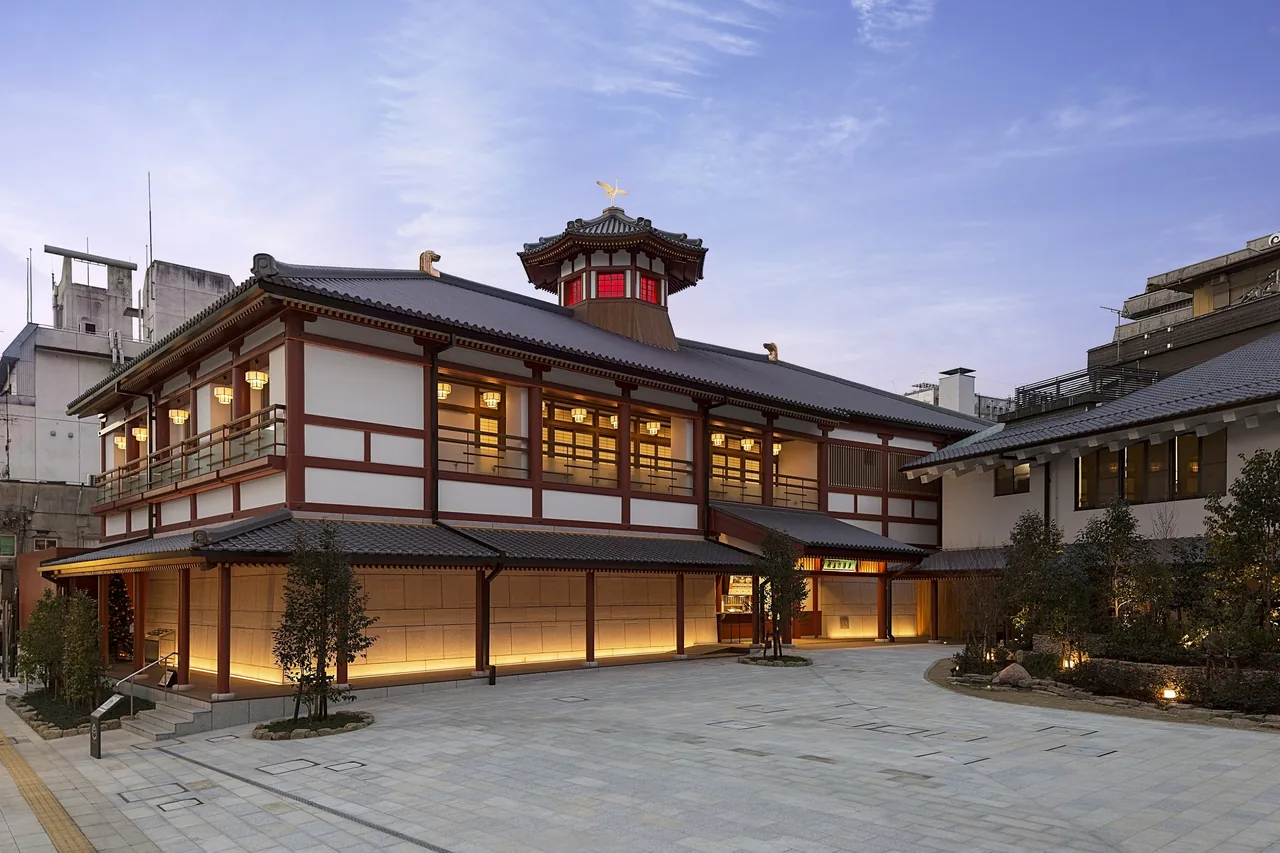
Round the corner from Honkan, past the shops, a white-walled building with red pillars and a tower on its roof faces a stone courtyard. At dusk the building is lit up. This is Asuka-no-Yu, the Dogo Onsen AnnexMap, the newest bath in Dogo, about 3 minutes on foot from Dogo Onsen Station. It was designed in the style of the Asuka period and won a Good Design Award in 2018.
Asuka-no-Yu: the newer annex with rest-room courses
Asuka-no-Yu has a ground-floor bath with an open-air section, fed straight from the source with no recycling (kakenagashi). Upstairs is a large hall of about 60 tatami mats and a handful of private rooms where you rest with tea and a sweet. One room, Tsubaki-no-Ma, has artwork made from Imabari towels. Down in the ground-floor bath, a projection-mapping show plays every 30 minutes from 6:30 to 22:30.
Prices for adults (12 and over) and children (2 to 11): ground-floor bath only ¥610 / ¥300. Bath plus the second-floor hall ¥1,280 / ¥630. Bath plus a second-floor private room ¥1,690 / ¥830. The ground-floor bath is open 6:00 to 23:00 with last entry at 22:30. The second-floor hall and private rooms close earlier, 6:00 to 22:00 with last entry at 21:00. Either way you get 90 minutes.
The special bath is the one to book. It recreates Yushinden, the imperial bath at Honkan, and you go in wearing a light robe called a yucho. It costs ¥2,040 per group plus ¥1,690 per adult or ¥830 per child, runs until 22:00 (last entry 20:30), and can be booked from 90 days ahead. No soap or shampoo is allowed in it. Nothing else at Asuka-no-Yu can be booked.
A few small things worth knowing. On the 26th of every month, “bath day” in Japan, the men’s and women’s baths swap over. Shoe lockers take a ¥100 coin that comes back to you, changing-room lockers are free, and towels can be rented. Shampoo, conditioner and body soap are provided in the ground-floor bath.
Tsubaki-no-Yu: a plain soak and nothing more
Across the same courtyard, a garden called Tsubaki no Mori, is Tsubaki-no-YuMap, Honkan’s “sister bath”. It shares Asuka-no-Yu’s address. First built in 1953 and renewed in 2017, it has a hot water spout (yugama) of the same shape as the one in Honkan. The ticket is for bathing only, with no rest room or tea on the menu: you come, you wash, you soak and you go home.
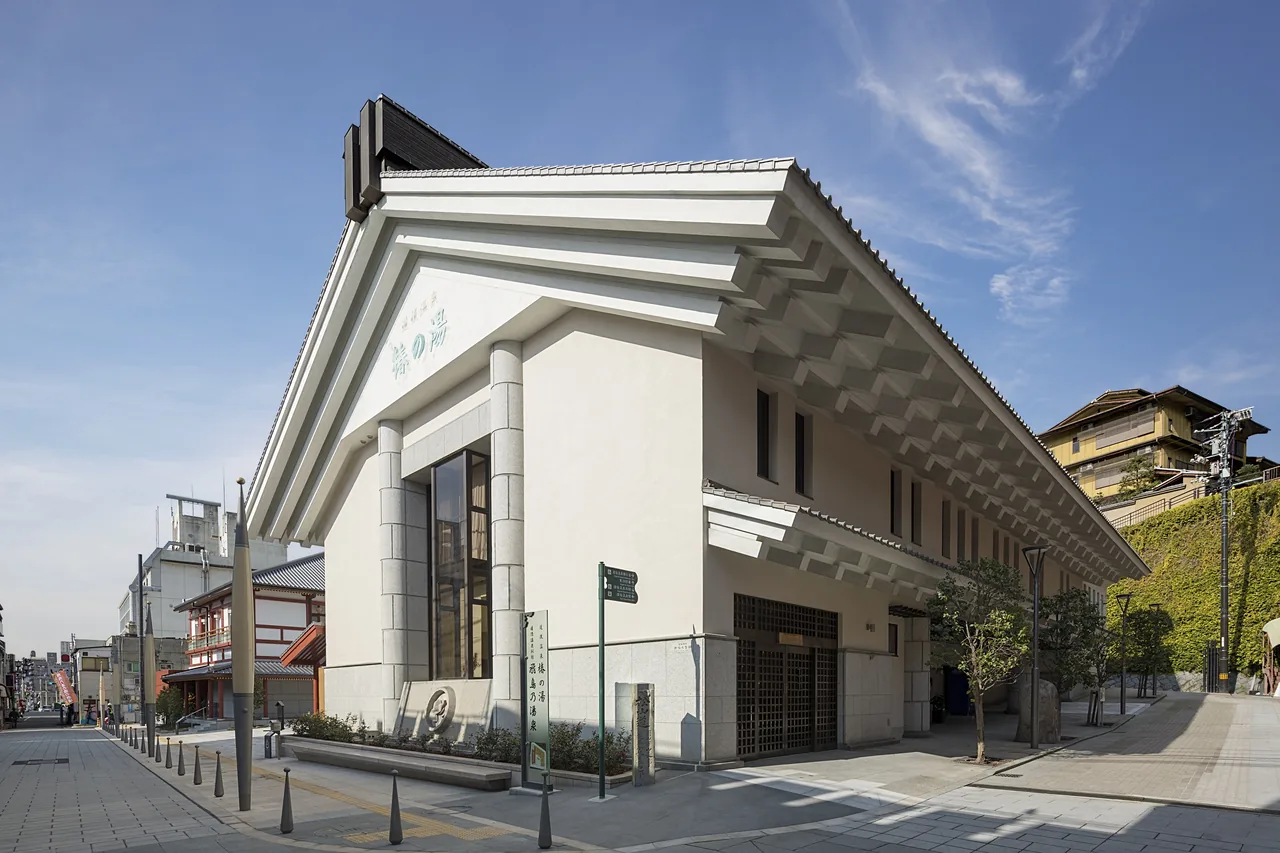
Tsubaki-no-Yu costs ¥500 for adults and ¥200 for children. The price recently went up when Ehime raised the cap on public bath fees. It is open 6:30 to 23:00, last entry 22:30, and you can stay up to an hour. No shampoo, conditioner or body soap is provided. Bring your own, or buy shampoo and conditioner at the counter for ¥50 each. Towels can be rented at the same prices as Honkan, ¥110 for a towel and ¥320 for a bath towel, and an original face towel is sold for ¥650. Hair dryers cost ¥10 for 3 minutes and lockers are paid.
Comparing the three baths
| Dogo Onsen Honkan | Asuka-no-Yu | Tsubaki-no-Yu | |
|---|---|---|---|
| Cheapest entry (adult) | ¥700 | ¥610 | ¥500 |
| Hours (last entry) | 6:00 to 23:00 (22:30) for Kami-no-Yu downstairs | 6:00 to 23:00 (22:30) for the ground-floor bath, second floor 6:00 to 22:00 (21:00) | 6:30 to 23:00 (22:30) |
| Time in the bath | 60 min (90 min for third floor and private rooms) | 90 min | Up to 1 hour |
| Rest area | Second-floor hall, Tama-no-Yu rest room or private rooms, on paid courses | Second-floor hall or private rooms, on paid courses | None, bathing only |
| Towels | Not on Kami-no-Yu courses (rent ¥110 / ¥320) | Rental available | Rent ¥110 / ¥320, original face towel sold (¥650) |
| Shampoo and soap | Provided | Provided (not in the special bath) | None provided, shampoo and conditioner sold (¥50 each) |
| Best for | The historic building, the imperial bath, the Botchan story | A newer building, open-air bath, long rest upstairs | A quick, cheap soak |
The two-day bath pass and the December cleaning day
If you want to try all three, the two-day bath pass gets you one visit each to Honkan’s Kami-no-Yu downstairs, the ground-floor bath at Asuka-no-Yu and Tsubaki-no-Yu. It costs ¥1,440 for adults and ¥680 for children and is valid on the day you buy it and the next day. It used to be a limited offer and is now sold all the time, at a slightly higher price than before.
Buy the two-day pass on the evening you arrive, use Tsubaki-no-Yu that night and the other two the next day. Bring a towel, since the pass covers the courses that don’t include one.
The three baths have no regular closing days. The one exception is a cleaning day in December, when each bath closes for a day: Honkan first, then Asuka-no-Yu the following day. Dogo Onsen calls this a yearly closure, so check its site for the date if you visit in December. Sora no Sanpomichi and the hot spring distribution tower also close for the morning on the cleaning day.
4. Walking around Dogo: the station, the clock, foot baths and the arcade
Most people arrive in Dogo by tram, and the trip ends at a Western-style wooden station building. Dogo Onsen StationMap is the terminus of the Iyotetsu city tram, and the building is a restoration of the old station built in 1911. It is lit up at night and open from 6:00 to 22:50. If a Botchan Train has just come in, wait a few minutes: the little engine changes direction at the back of the station, and you can watch it happen.
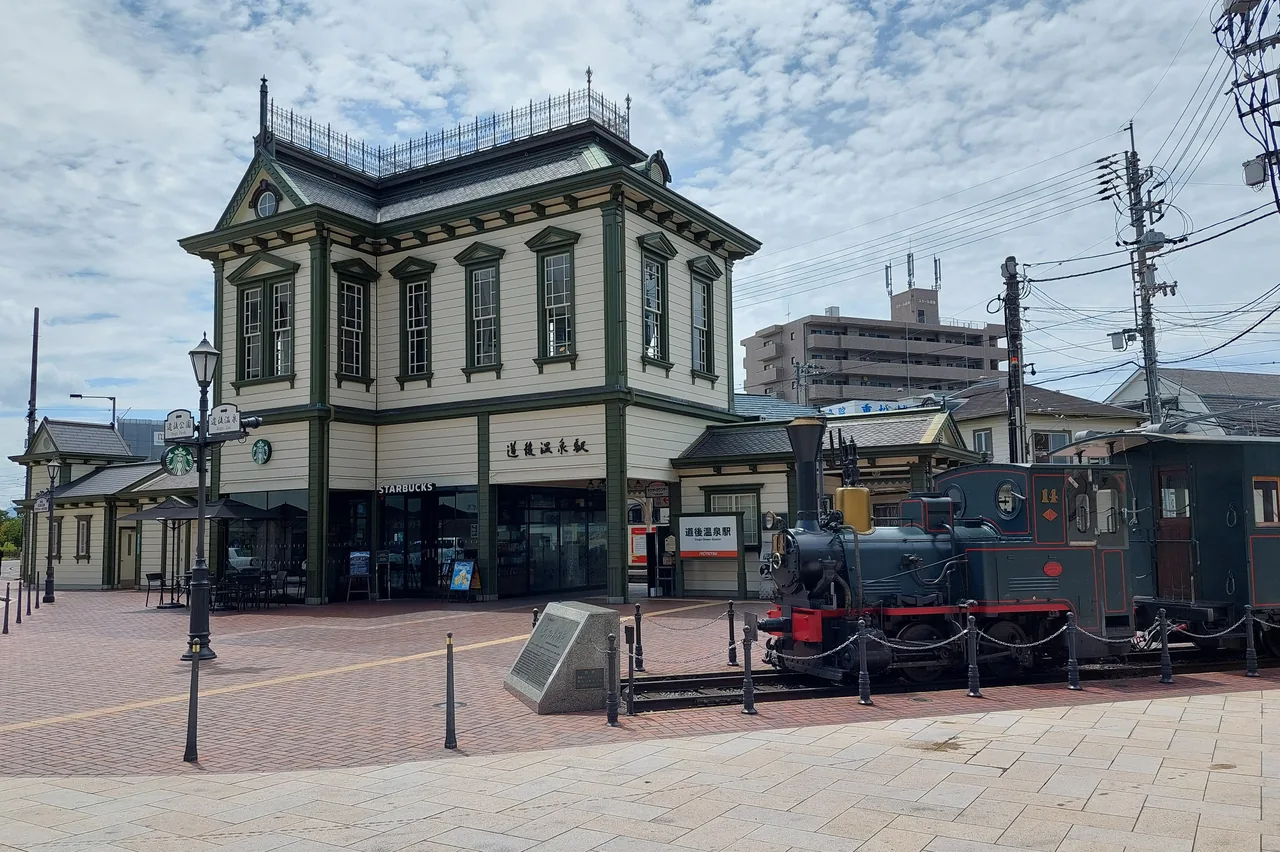
The station square, the clock and a free foot bath
The Dogo Tourist Information CenterMap is the first thing on your right as you leave the station, at the arcade entrance, open 8:30 to 17:00 every day. Across the square stands the Botchan Karakuri ClockMap, built for Honkan’s 100th anniversary in 1994. Its shape copies Shinrokaku, the little tower on Honkan’s roof. When it moves, it plays a tune.
The clock runs from 8:00 to 22:00 and moves every hour on the hour. On busier days it moves every 30 minutes: Saturdays, Sundays and holidays, every day in March, April, August and November, from 28 December to 5 January, and from 1 to 5 May. The tune changes through the day.
| When | Tune |
|---|---|
| 10:00, noon, 15:00, 18:00 | “Kono Machi de” |
| 8:00 to 11:00 | “Iyo Manzai” |
| Noon to 15:00 | “Botchan no Theme” |
| 16:00 to 22:00 | “Komoriuta-fu Iyo-bushi” |
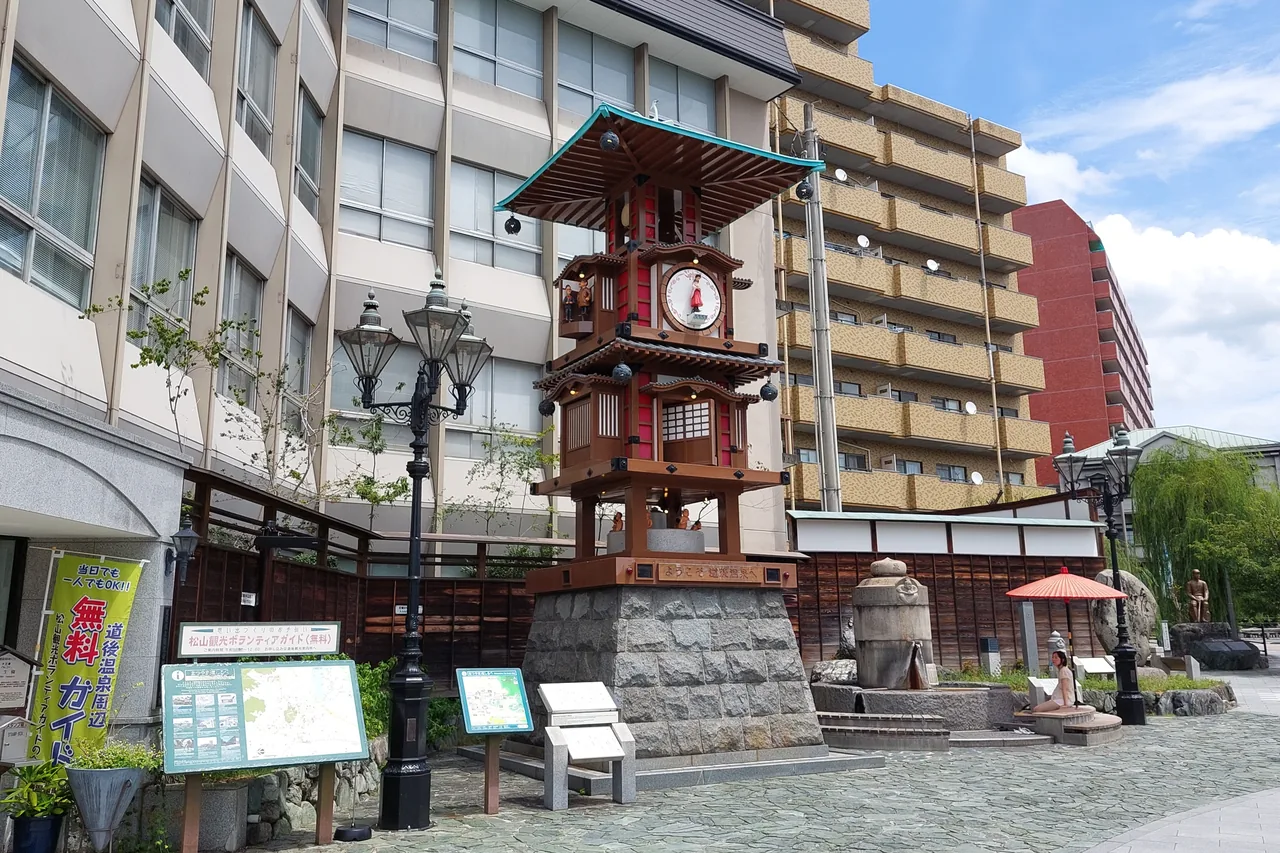
Right next to the clock is the Hojoen foot bathMap, free and open 6:00 to 23:00. Look at what the water pours out of: it is a yugama spout that was actually used inside Honkan. Free foot and hand baths are dotted around Dogo, at Hojoen, Sora no Sanpomichi, the distribution tower and several ryokan and hotels (Yamatoya Honten charges). Rickshaws wait in front of the clock and in front of Honkan, from ¥1,500 per person, and don’t run in rain.
Dogo Shopping Arcade (Haikara-dori)
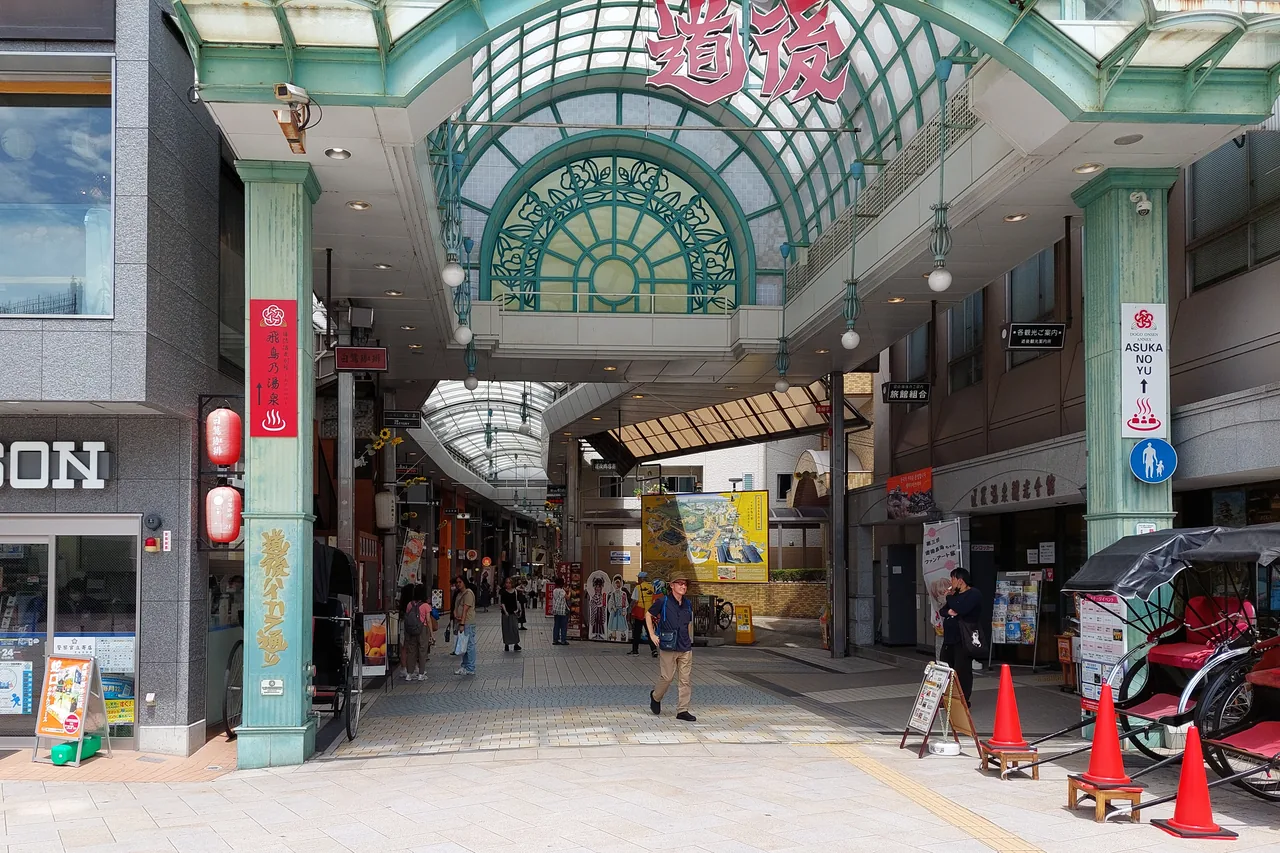
From the station, the Dogo Shopping ArcadeMap, also called Haikara-dori, runs about 250 m in an L shape to Honkan, entered under a green iron-and-glass arch. Shops line both sides, citrus juice stands among them, and there is a stamp rally called Dogo-mura Meguri if you want an excuse to go into every one. Halfway along, a stone path called Nikitatsu-no-Michi heads off west. A morning market is held there on the fourth Sunday of each month, though some months are skipped, so check the ryokan association’s notices.
Sora no Sanpomichi and the hot spring distribution tower
For the classic view down onto Honkan’s roofs, climb to Sora no SanpomichiMap, a walkway on the Kanmuriyama high ground just south of the bathhouse. There is a free foot bath up there, open 6:00 to 21:00, and you can sit with your feet in the water and watch the Toki-daiko tower opposite.
Dogo’s water is piped out from distribution points around town, and the Dai-4 Bun-yu-jo distribution towerMap is the only one you can visit. You can put your hands into water that has just come up from the source.
Enmanji, the Giyaman Glass Museum and DOGO ART
About 7 minutes’ walk from the station, EnmanjiMap has a white Jizo statue 3.67 m tall known as Yu no Ojizo, the hot spring Jizo. The story goes that when the hot spring stopped flowing in 1855, people prayed to this Jizo and the water came back. The temple is said to date from 812.
The Dogo Giyaman Glass MuseumMap, 3 minutes on foot from Honkan, collects glass crafts, including the red window panes from Shinrokaku. It is open 9:00 to 18:00 (last entry 17:30) with no closing days, and entry is ¥800. It recently reopened after a break.
Dogo has run art events regularly since 2014, and the current one, “Mika Ninagawa with EiM x Dogo Onsen DOGO ART”, is on now at Honkan, Tsubaki-no-Yu and along the shopping arcade. Check Dogo Onsen’s site for how long it runs.
5. Dogo Park, Isaniwa Shrine, Ishiteji and the pilgrimage temples
Get off at the Dogo Koen tram stop and a round park rises gently to a low hill in the middle. It looks like an ordinary city park until you notice the moat and earth banks. This is Dogo Park, the site of Yuzuki CastleMap, the seat of the Kono clan for about 250 years from the early 14th century to the late 16th. The park is about 350 m across, with restored samurai houses and earthen walls, and is listed among Japan’s 100 Fine Castles. In spring it is a popular cherry blossom spot.
Dogo Park and the Shiki Memorial Museum
The park is always open and free. The exhibition buildings open 9:00 to 17:00 and close on Mondays (the next weekday if Monday is a holiday) and from 29 December to 3 January. The tram stop is right at the park.
Inside the park is the Shiki Memorial MuseumMap, about Masaoka Shiki, the haiku poet born in Matsuyama, and the city’s literary history. The highlight is a recreation of Gudabutsu-an, the house where Shiki, back in his home town, and Soseki, then teaching English at the prefectural middle school, lived together for 52 days. The city tourism office calls it the only place the two ever lived together. Hours are 9:00 to 18:00 from 1 May to 31 October (last entry 17:30) and 9:00 to 17:00 from 1 November to 30 April (last entry 16:30). Closing days follow a calendar on the museum’s site. Entry is ¥500, ¥250 for 65 and over, free for school students, and it is 5 minutes on foot from Dogo Onsen Station.
Isaniwa Shrine and its stone steps
A few minutes’ walk from the station, a long, straight, steep flight of 135 stone steps climbs through the trees to a red gate. At the top is Isaniwa ShrineMap, old enough to be named in the Engishiki, an early register of shrines. The present buildings were put up by Matsudaira Sadanaga, the third lord, to give thanks after he succeeded at mounted archery (yabusame) at Edo Castle, and were finished in 1667.
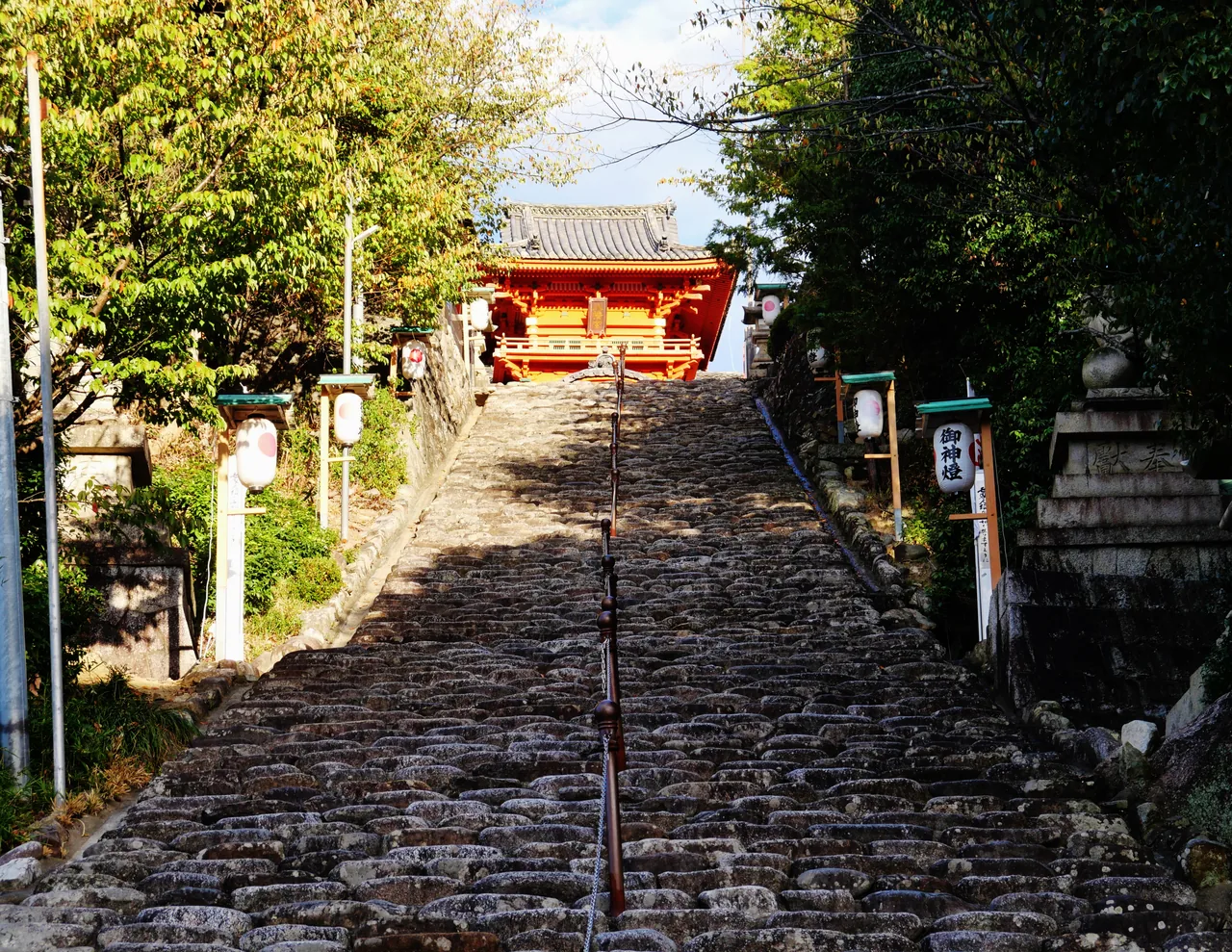
Isaniwa is built in the Hachiman style, and together with Iwashimizu Hachimangu and Usa Jingu it is counted among Japan’s three great examples of it. It became an Important Cultural Property in 1967. Locals also call it Yuzuki Hachiman or Dogo Hachiman. Goshuin stamps are given from 9:00 to 17:00. Try to imagine those steps during the autumn festival in early October, when teams carry heavy portable shrines up and down them. There is also a summer purification festival on 30 July. More on the shrine’s official site.
Two short stops if you have time. HogonjiMap, 10 minutes from the station, is the birthplace of Ippen Shonin, founder of the Ji school of Buddhism, and a prefectural historic site. In its grounds is a stone carved with Shiki’s haiku “Iro-zato ya / ju-ho hanarete / aki no kaze”, roughly “the pleasure quarter, and ten steps away, the autumn wind”. On the Iwaitani hill, 15 minutes from the station, Matsuyama ToshoguMap looks out to the castle from the top of its steps. It recently went back to its original name, and its autumn festival features the Yakko-odori dance.
Ishiteji, temple 51 of the Shikoku pilgrimage
Ride a bus to the Ishiteji-mae stop and you are at the gate of IshitejiMap, temple 51 on the Shikoku 88-temple pilgrimage. Its full name is Kumano-zan Kokuzo-in Ishiteji, it belongs to the Shingon Buzan school, and its main image is Yakushi Nyorai. Tradition says the monk Gyoki founded it in 729. The name, “stone hand temple”, comes from the legend of Emon Saburo, a man reborn clutching a stone in his hand.
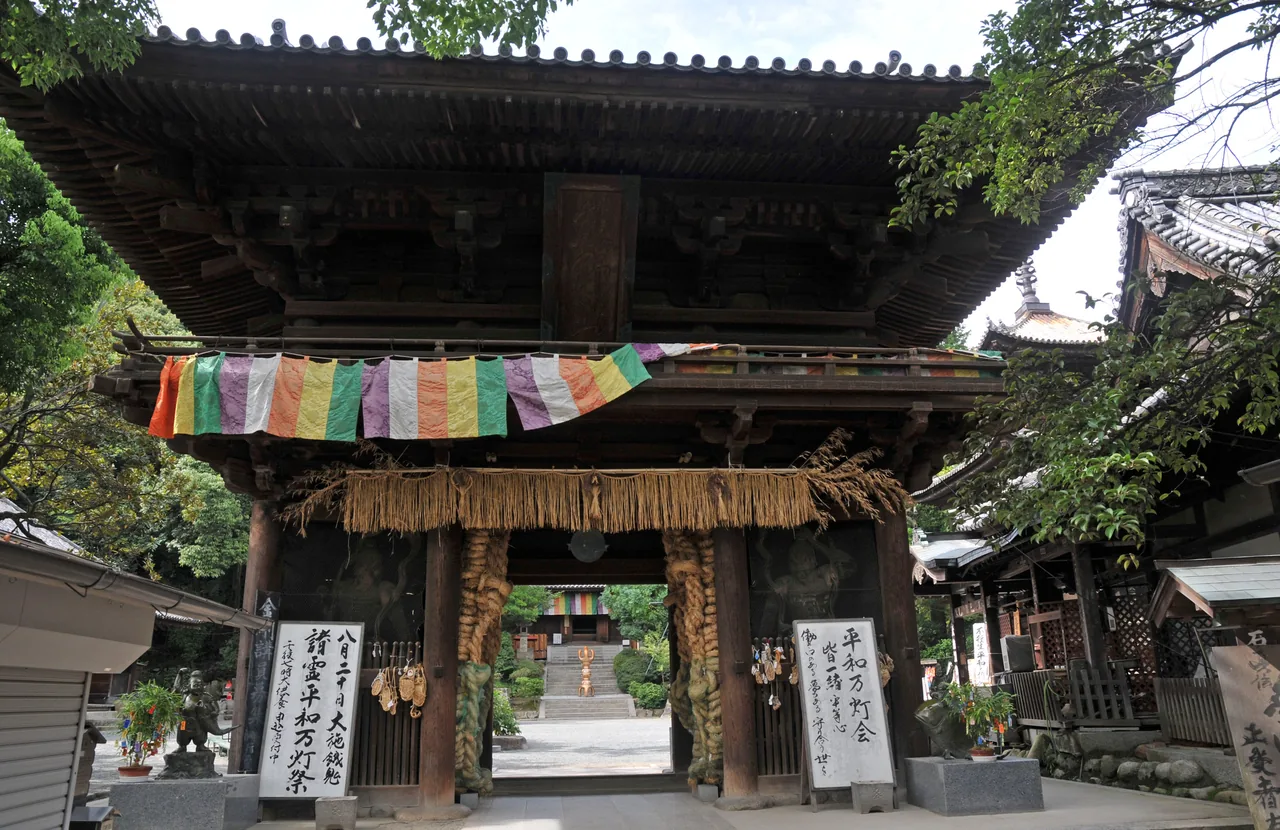
The Niomon gate, built in 1318 and 7 m tall, is a National Treasure, and it is hung with straw sandals and coloured cloth. The main hall, the three-storey pagoda and the bell tower are Important Cultural Properties, and the temple bell, inscribed with the year 1251, is the oldest in Ehime. There is a treasure hall, the Michelin Green Guide gives the temple one star, and the snack to try is the temple’s oyaki.
Several temples of the pilgrimage sit inside the city, one after another: 46 Joruriji, 47 Yasakaji, 48 Sairinji, 49 Jodoji, 50 Hantaji, 51 Ishiteji, 52 Taisanji and 53 Enmyoji. Locals sometimes hand pilgrims food or drinks along the way, a custom called osettai. TaisanjiMap, temple 52, has a main hall from 1305 that is a National Treasure and, according to legend, was put up in a single night. It is about 10 minutes on foot from the Taisanji bus stop, and the temple office is open 8:00 to 17:00. The pilgrims’ association has an English site for planning.
6. Matsuyama Castle: ropeway or chairlift, tickets and the keep
The keep you see from the tram sits in the main enclosure (honmaru) of Matsuyama CastleMap, on top of Katsuyama, 132 m high. The second and third enclosures lie at the foot of the hill, in what is now Horinouchi. The castle describes itself as a large hill-and-plain castle, part hilltop and part flatland, so a visit means a climb as well as a walk round the bottom.
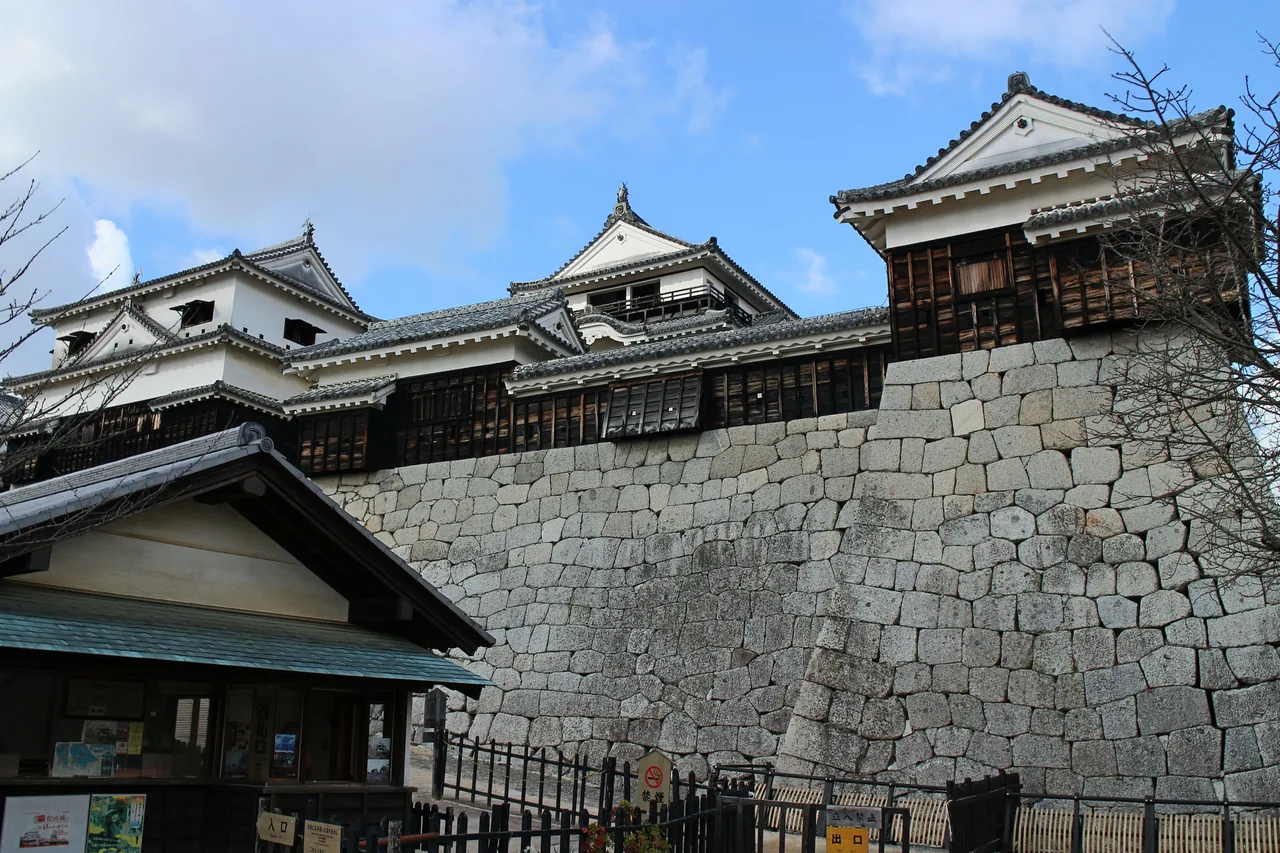
The keep and the Tokugawa crest on its roof
The keep you see today has a story. Lightning burned the old one at New Year in 1784. Rebuilding started in 1847, and the new keep was finished in 1854, the year after the Black Ships arrived. The castle calls it the last complete castle building of the Edo period. It has three tiers outside and three floors plus a basement inside, and the buildings linked to it were restored in 1968.
Look closely at the roof tiles. Among Japan’s castle keeps that still stand in their original form, this is the only one with the Tokugawa family’s hollyhock crest on its tiles. Another thing to look for on the way up are the climbing stone walls (nobori-ishigaki) running down the slope between the second enclosure and the top, and the castle notes that the southern ones survive almost perfectly. The whole of Shiroyama Park is a national historic site.
Going up: ropeway, chairlift or on foot
The easy way up starts at Shinonomeguchi StationMap, about 5 minutes’ walk from the Okaido tram stop at the top of Ropeway Street. You buy tickets on the ground floor and take an escalator to the third-floor platform. A tourist information desk on the ground floor is open 8:30 to 17:00. Two rides run side by side up the slope: a ropeway gondola that takes about 3 minutes and leaves every 10 minutes, and a single-seat chairlift that takes about 6 minutes, swinging your feet over the trees.
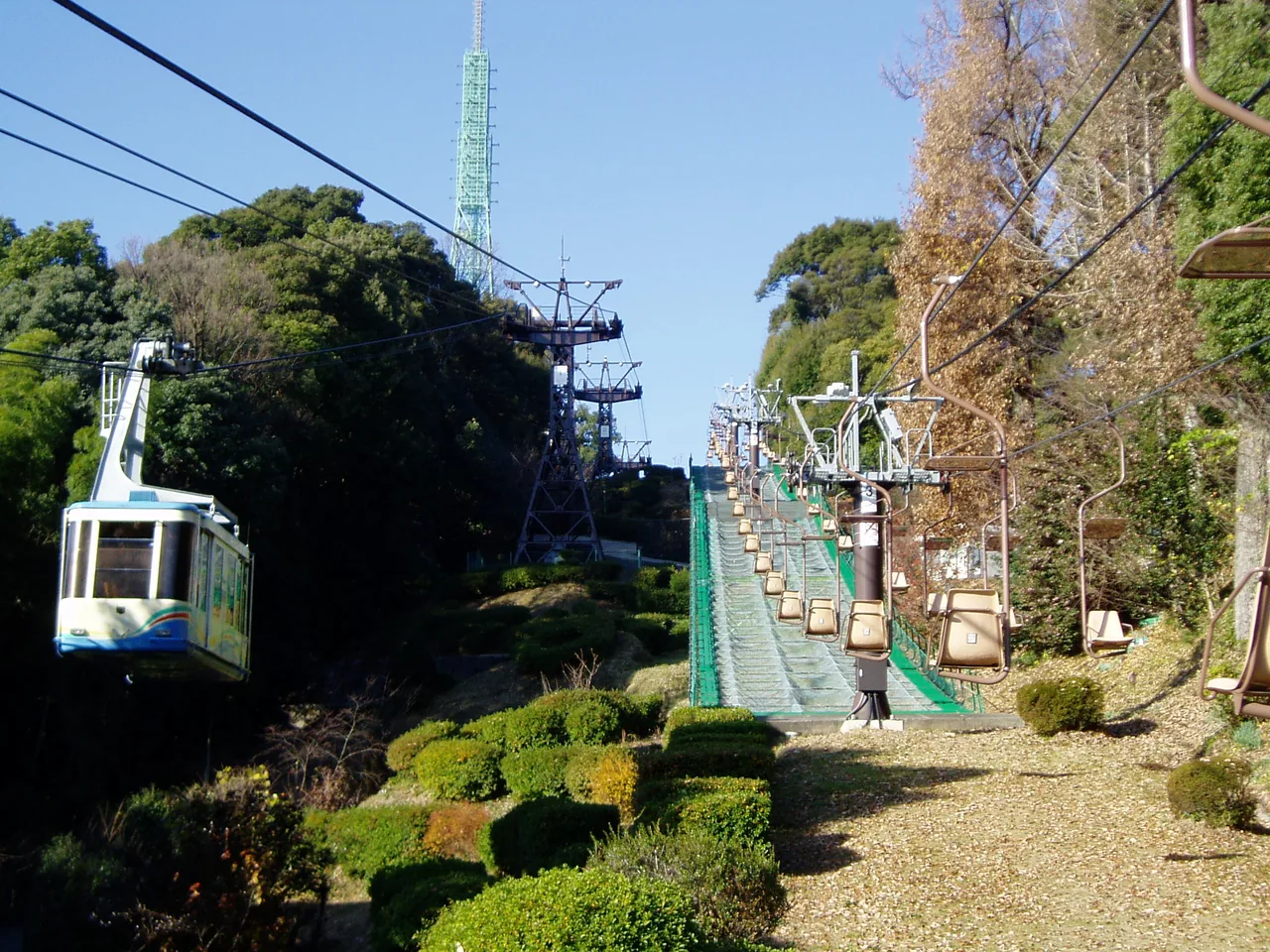
The same ticket covers both, and you choose which one to take each way. You could go up in the gondola and come down on the chairlift. Children must be of primary school age to ride the chairlift. The ropeway opened in 1955 and the chairlift in 1966. Dogs ride the ropeway in a carrier and the chairlift in your arms. Chojagenaru, the top station, lends wheelchairs, and with someone to push you can go in one from there up to the main square by the keep.
| Hours | Adult / child | Notes | |
|---|---|---|---|
| Ropeway | 8:30 to 17:30 (August to 18:00, December and January to 17:00) | Return ¥520 / ¥260, one way ¥270 / ¥140 (same ticket as the chairlift) | About 3 min, every 10 min, open every day |
| Chairlift | 8:30 to 17:00 | Same ticket as the ropeway | About 6 min, single seat, stops in rain |
| Castle keep | 9:00 to 17:00 (August to 17:30, December and January to 16:30), last entry 30 min before closing | ¥520 / ¥160 (primary school) | Closed on the third Wednesday of December |
| Combined ticket | Sold 8:00 to 14:00 on the ground floor of Shinonomeguchi Station | ¥1,040 / ¥420 | Ropeway or chairlift return plus the keep |
Cards, IC cards and QR payments work at the bottom, but Chojagenaru station at the top takes cash only. Carry some yen in case you buy a ticket for the ride down up there.
On a wet day the chairlift doesn’t run, so plan on the ropeway both ways.
From Chojagenaru it is a 10-minute walk up to the keep entrance. From Shinonomeguchi Station to the keep’s ticket office takes about 30 minutes, and the castle asks visitors to arrive at the station with about an hour to spare in total. Both rides are currently running normally.
You can also walk up. Shinonomeguchi is the best-kept path, about 30 minutes. The Kencho-ura path behind the prefectural office is a gentler slope past the climbing stone walls, also about 30 minutes, and it is currently closed to cars but open on foot. Kuromon-guchi is the old official route of the Edo period, with lots of stone steps, and Komachi-guchi takes about 40 minutes.
Cherry blossoms and how much time to allow
In early April the main square around the keep fills with cherry blossom, and Shiroyama Park is one of Japan’s top 100 cherry blossom spots. Plum blossoms come earlier, in early to mid-February. For timing across the country, see our Japan cherry blossom guide.
For the whole visit, count the hour to get up, then time inside the keep and in the main square, and more again if you walk down through the Ninomaru garden. A morning is about right. Hours and notices are on the castle’s official guide page.
7. Below the castle: Ninomaru Garden, Bansuiso and the Saka no Ue no Kumo Museum
Walk down the castle hill on the Kuromon-guchi path and you come out above a garden laid out in strips of water and flower beds inside earthen walls. From above, the pattern makes sense: it is the floor plan of a lord’s residence. This is Ninomaru Historical GardenMap, opened in 1992 on the site of the castle’s second enclosure.
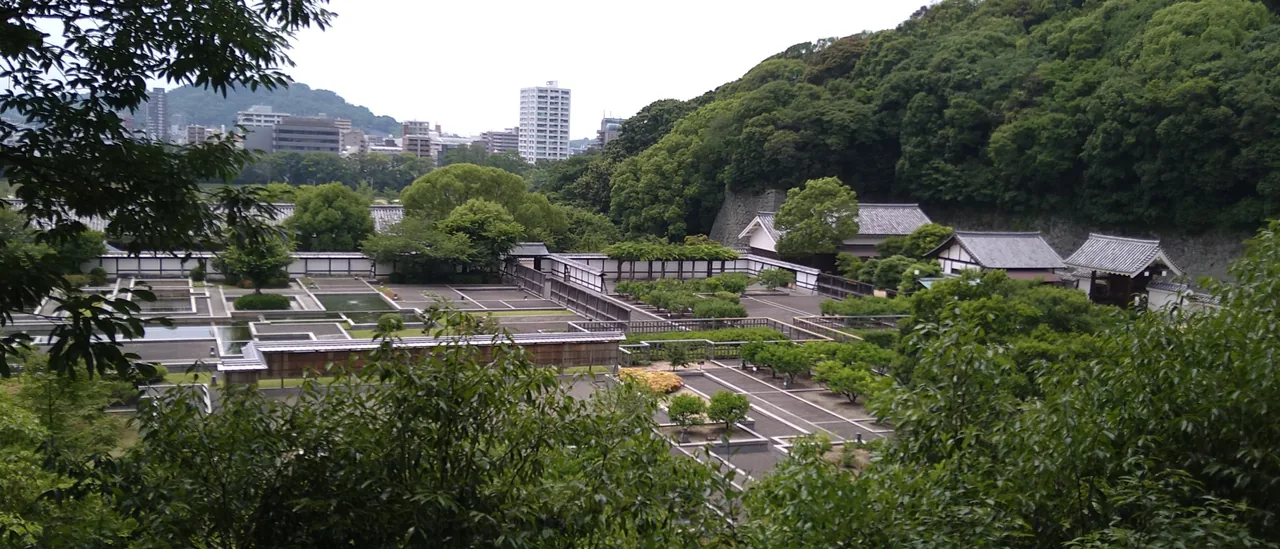
Ninomaru Historical Garden
The garden recreates the room layout of the old residence. The northern half, where the formal reception buildings stood, is a citrus and flower garden. The south-west, where the lord’s private quarters were, is a water garden called Ryusui-en, and the remains of a big well are on display. It has even been named a “Lovers’ Sanctuary”, a national list of romantic spots.
Entry is ¥200 for adults and ¥100 for primary school children. Hours are 9:00 to 17:00 (August to 17:30, December and January to 16:30), and it closes on the third Wednesday of December. It is about 5 minutes on foot from the Kenchomae tram stop, and the Kuromon-guchi path climbs from here to the keep, so you can walk the whole castle in one loop.
Bansuiso, a French mansion on the hillside
Half hidden by garden trees below the castle hill stands a white mansion that looks as if it belongs in France. BansuisoMap was built in 1922 as a villa for Count Hisamatsu Sadakoto, a descendant of the old lords of Matsuyama, in French Renaissance style. It is an Important Cultural Property.
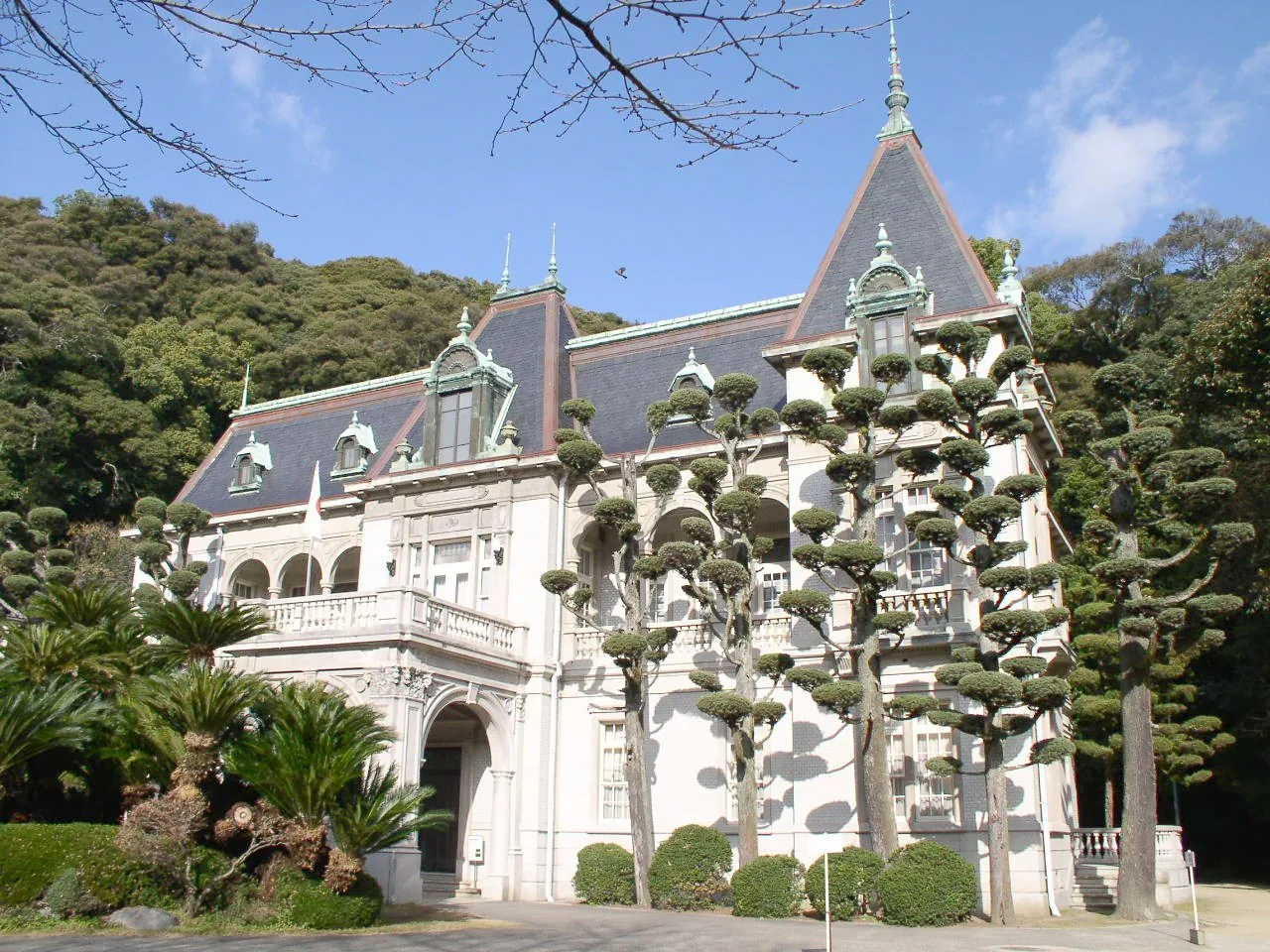
Bansuiso opens 9:00 to 18:00 and closes on Mondays (it opens if Monday is a holiday). Entry is normally ¥400 for adults and ¥200 for children. During special exhibitions the price changes, to ¥700 for example. It is about 5 minutes on foot from the Okaido tram stop. Only the ground floor and toilets are barrier-free. Details are on Bansuiso’s site.
Saka no Ue no Kumo Museum and the Akiyama brothers
Shiba Ryotaro’s novel “Saka no Ue no Kumo” (Clouds Above the Hill) follows three men from Matsuyama: the brothers Akiyama Yoshifuru and Akiyama Saneyuki, and Masaoka Shiki. The city treats the whole of Matsuyama as a “field museum” of their story, and the main building is the Saka no Ue no Kumo MuseumMap, a slanted glass building designed by Tadao Ando, about 2 minutes on foot from the Okaido tram stop.
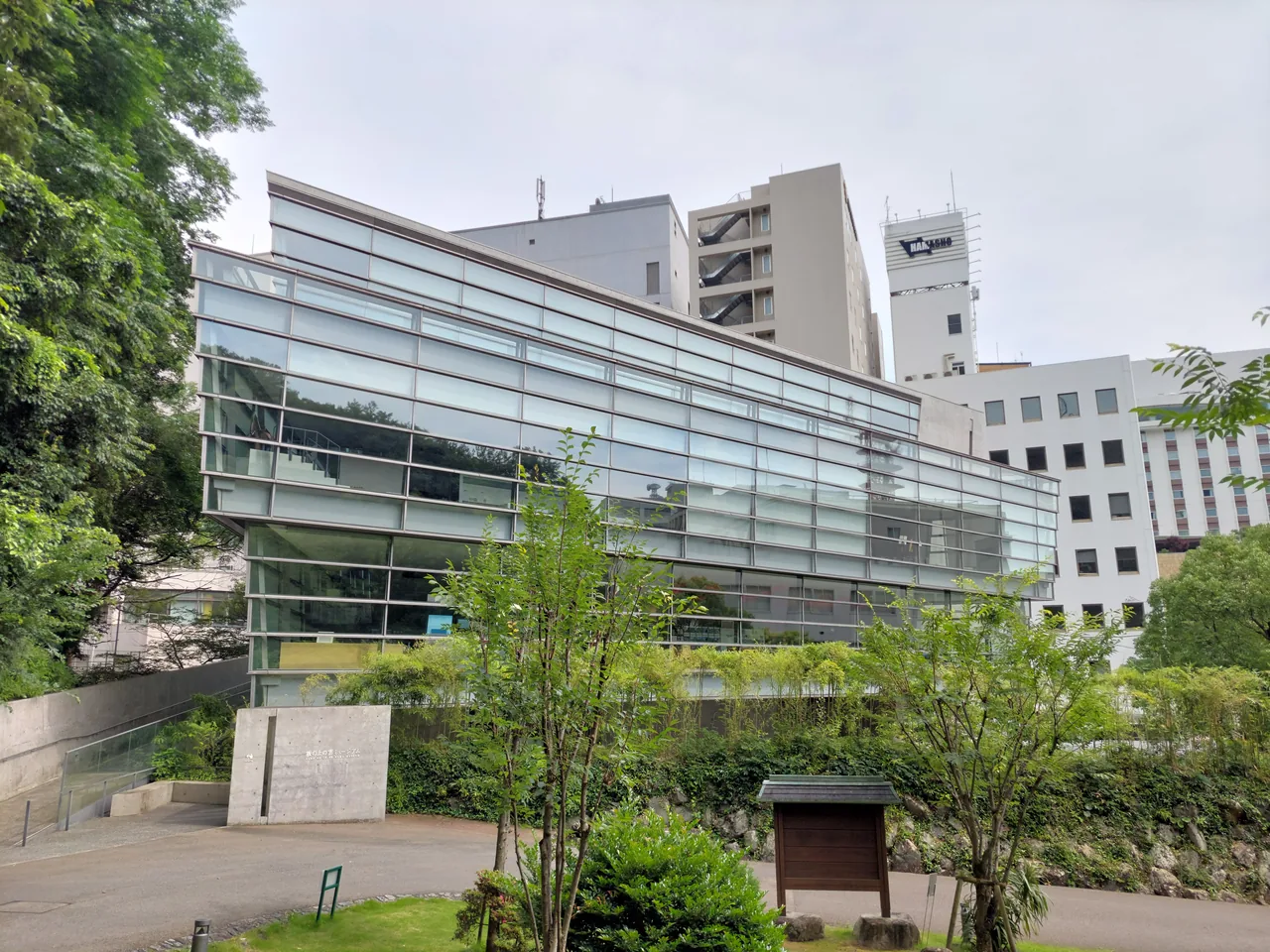
It opens 9:00 to 18:30 (last entry 18:00) and generally closes on Mondays, with exact dates on its calendar. It also closes for exhibition changes for a period in February and March. Entry is ¥500, ¥250 for over-65s and high school students, and free for junior high students and younger. Tadao Ando recently donated a children’s library, Kodomo Hon no Mori Matsuyama, on the second floor (9:30 to 17:30, timed reservations). See the museum’s site for closing days.
Three minutes from Okaido is the Akiyama brothers’ birthplaceMap. The original house burned in the wartime air raids, so what you see is a restoration, with displays and statues of the two brothers. It opens 10:00 to 17:00 (last entry 16:40), closes on Mondays (the next day if Monday is a holiday), and costs ¥400, free for high school students and younger.
Ehime Prefectural Museum of Art
Inside Shiroyama Park at Horinouchi, the Ehime Prefectural Museum of ArtMap shows foreign works, including Cezanne and Monet, alongside artists from Ehime. It opens 9:40 to 18:00 (last entry 17:30) and closes on Mondays and over New Year. It does open on the first Monday of each month, and when a Monday is a public holiday it opens and closes the next day instead. The collection galleries cost ¥340, ¥230 for high school and university students, and are free for junior high students and younger and for over-65s.
The museum is 3 minutes on foot from the Minamihoribata tram stop, which is 7 minutes by tram from JR Matsuyama Station. There is no car park. A closure for repair work is planned, so check the museum’s site for dates before you go.
8. Okaido, Gintengai and the city centre around Matsuyama-shi Station
Okaido is Matsuyama’s main shopping street: a wide pedestrian street under a high roof, with citrus juice stands and shops on both sides, running from the department stores at its north end toward Matsuyama-shi Station.
Okaido and Gintengai, the two covered arcades
The Okaido arcadeMap is 483 m long, 15 m wide and 13 m high, and its domed roof opens and closes automatically in three sections. At the north end are Matsuyama Mitsukoshi and Aeru Matsuyama, and the Okaido tram stop is right there. In summer there are Saturday night markets. At its south end, just across one street, the Gintengai arcadeMap carries on. It is about 600 m long and ends at Iyotetsu Takashimaya and the Matsuchika Town underground mall, 1 minute from Matsuyama-shi Station.
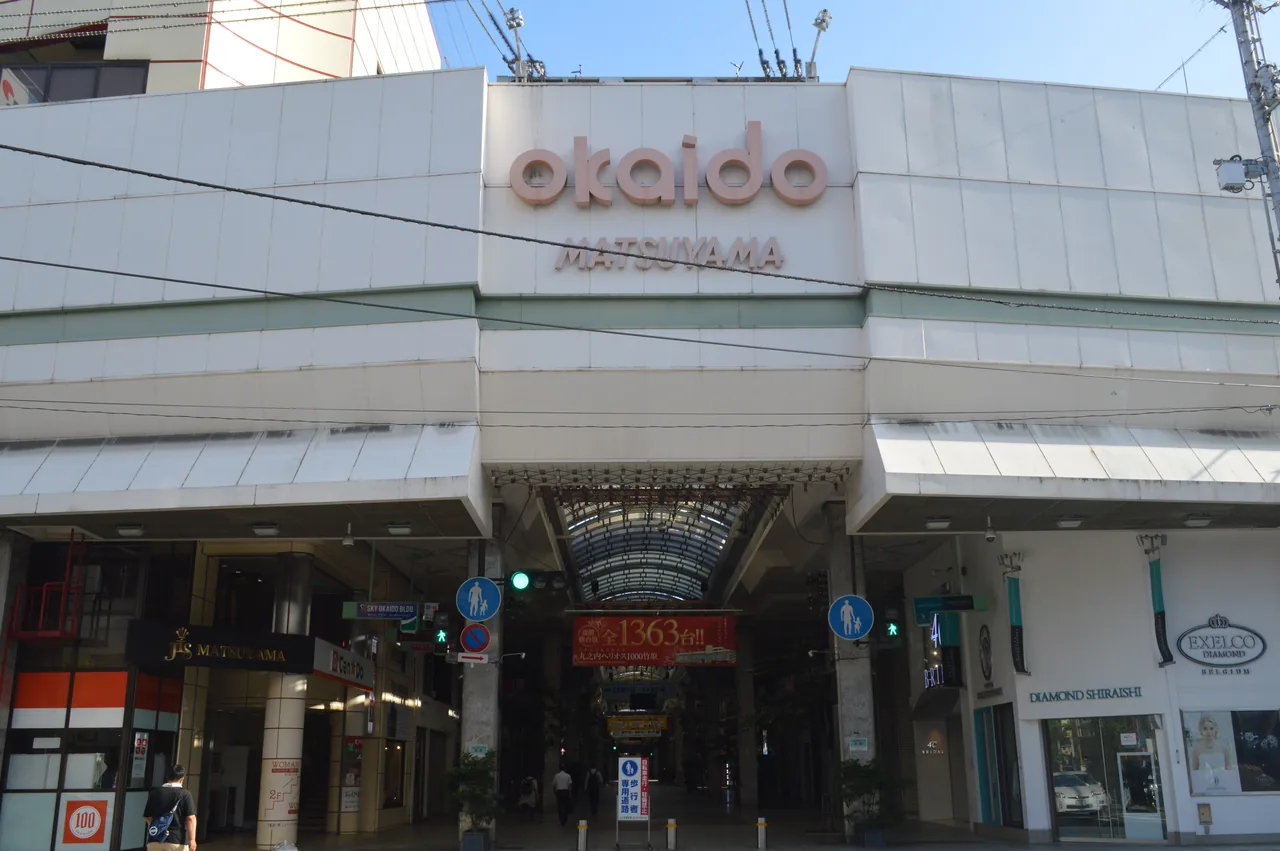
The Ehime-Matsuyama Tourist Information CenterMap on the ground floor of Matsuyama Mitsukoshi (10:00 to 19:00, closed on the store’s closing days) has a tax-free counter, currency exchange, and will store and send on your luggage. For how tax-free shopping works, see our Japan tax-free shopping guide.
Ropeway Street and the Ehime souvenir hall
North from the Okaido tram stop, Ropeway StreetMap runs about 500 m up to the castle ropeway, lined with restaurants and souvenir shops. Along it is the Ehime Egao Souvenir HallMap (Ehime Egao no Kanko Bussankan), selling products from all over Ehime. It opens 9:00 to 18:00, closes from 31 December to 2 January, and has English-speaking staff, so it is an easy place to ask what a local product is before you buy.
Diamond Cross, where a train crosses the tram tracks
Stand at the crossing in front of Otemachi Station and wait. A tram rolls along the street, stops, and an orange suburban train cuts straight across its path. This is Diamond CrossMap, where Iyotetsu’s suburban Takahama Line and the city tram tracks cross at right angles, on the level, in the middle of a road.
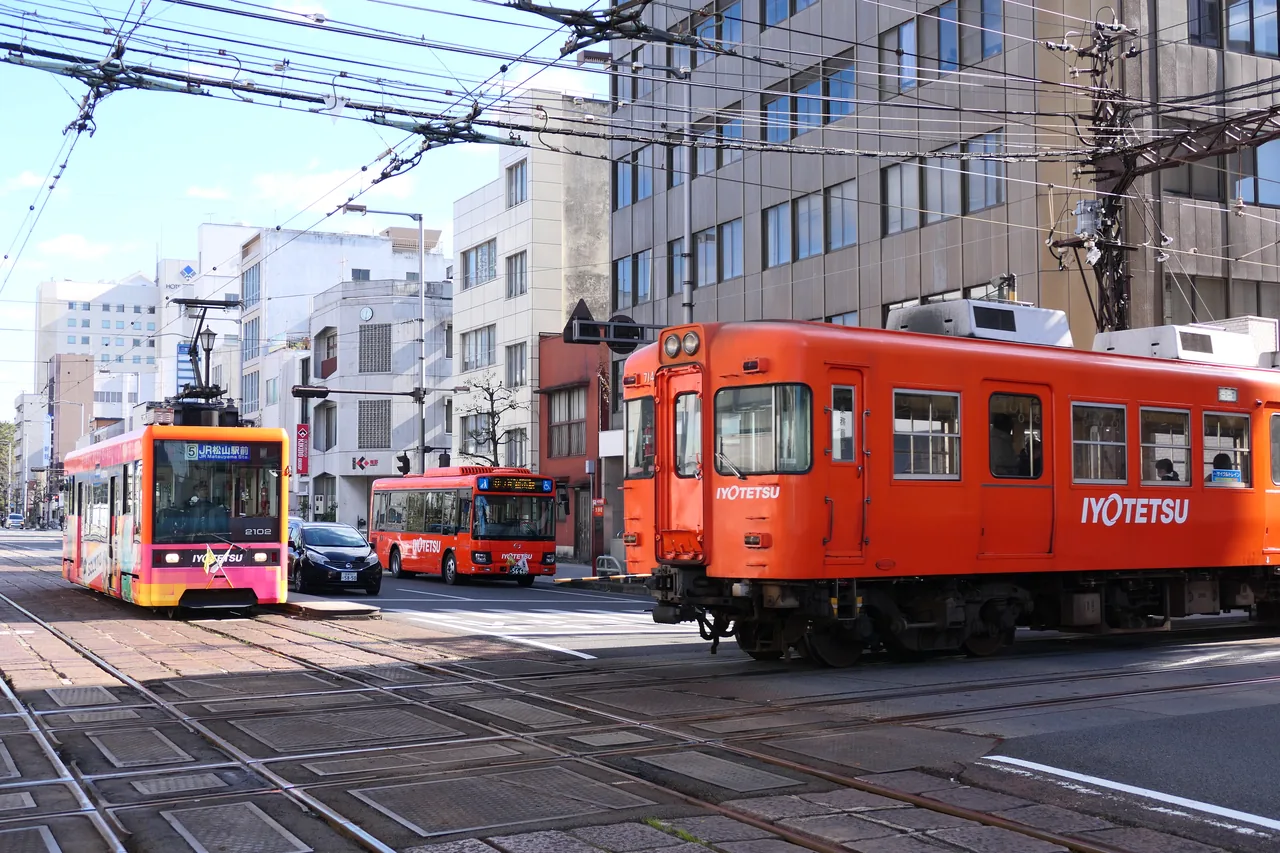
The reason it is rare: trams usually share the road with cars, while ordinary railways get their own track with level crossing gates. Here a railway line and a street tram line meet on the same level, so the tram has to wait at the crossing like a car. The Matsuyama tourism office says it is the only place in Japan where a railway and a city tram line cross at right angles. It is on the JR Matsuyama Station tram line, so you can see it on the way into town.
Matsuyama-shi Station, the Kururin wheel and Shikido
Matsuyama-shi StationMap (6:00 to 23:00) is where Iyotetsu’s suburban trains start, with trams, buses and taxis on its north side. The bus stops were recently moved during work on the station square, and the airport limousine now leaves from stop B3. There are coin lockers and parcel lockers.
On the roof of Iyotetsu Takashimaya, 9 floors up, turns the Kururin Ferris wheelMap, 45 m across and 85 m above the ground at the top. One turn takes about 15 minutes. It runs 10:00 to 21:00 (last ride 20:45). A regular gondola costs ¥800 and a see-through one ¥1,300, and a regular gondola is ¥500 once if you show a Botchan Train ticket or a tram 1Day ticket.
A 5-minute walk from the station, in the grounds of Shoshuji temple, is ShikidoMap, the restored house where Masaoka Shiki lived until he was 17. His desk and belongings are inside, and a Botchan Train carriage stands in the front yard. Entry is just ¥50 (cashless accepted), open 9:00 to 17:00 (last entry 16:40) every day.
9. The Botchan Train and Matsuyama’s street trams
A black steam engine with a tall chimney, pulling two little green carriages, rolls down the middle of a city street on the tram tracks, with cars and buses alongside. That is the Botchan Train (Botchan Ressha), and on a weekend you may well meet it on your way to Dogo.
The story of the Botchan Train
Iyotetsu began running steam trains in 1888, and they ran for 67 years. In 2001 the company brought the train back, rebuilt with a diesel engine. The “smoke” from the chimney is steam for effect. The original engine is a designated Railway Memorial and, with its carriages, a prefectural cultural property. As for the link to the novel, JR Shikoku notes that the original trains appear in “Botchan” as “matchbox-like steam trains”.
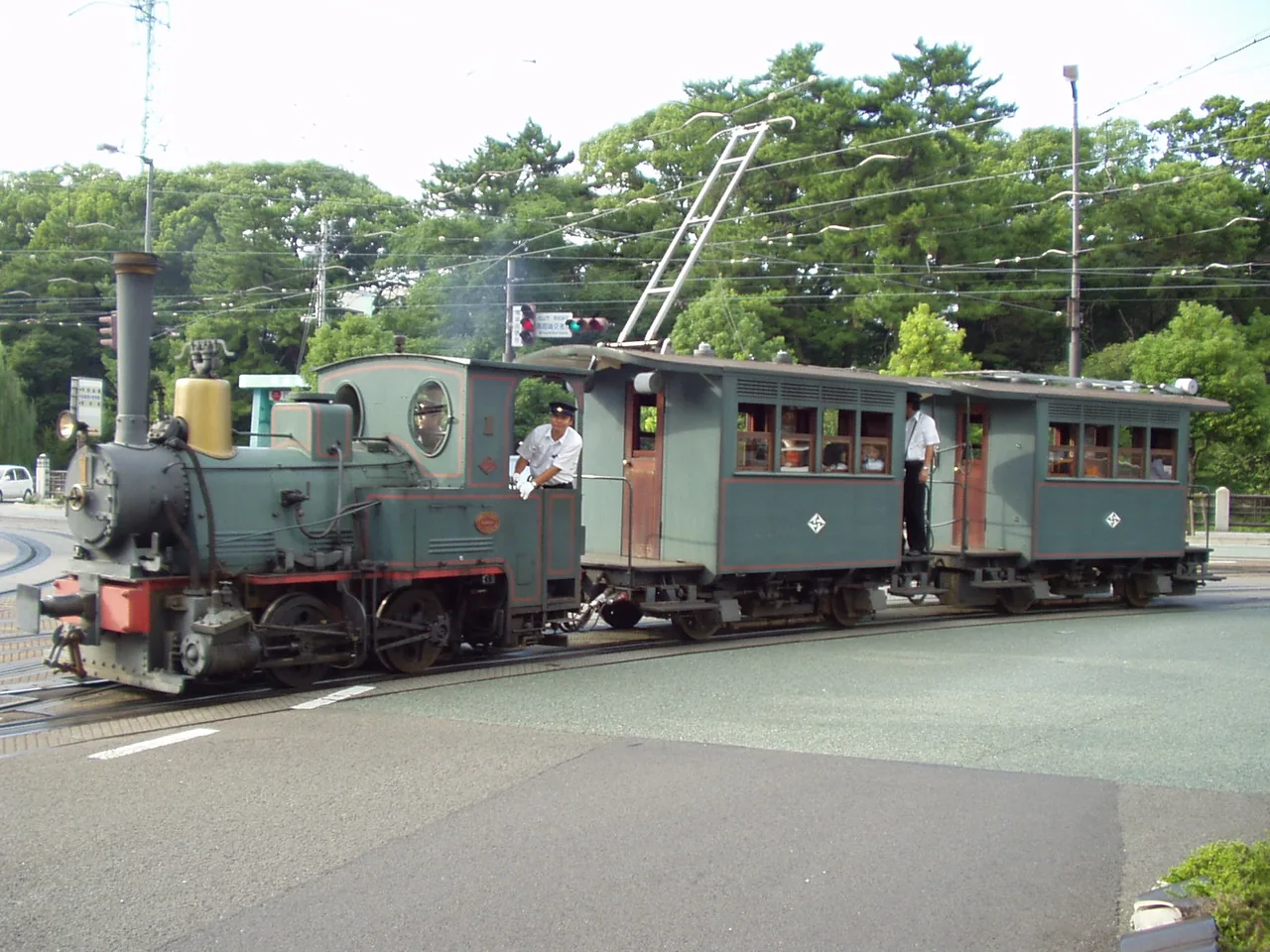
The train recently came back after a period when all runs were suspended, and it now runs on Saturdays, Sundays and public holidays only. It does not run from 30 December to 3 January even on weekends, there are no weekday runs during Golden Week or Obon, and it may be cancelled for weather or maintenance.
Fares, routes and how to get a seat
A ride costs ¥1,300 for adults and ¥650 for children, paid to the crew in cash or by IC card. The tram 1Day tickets are not valid. The main route runs between Dogo Onsen and Matsuyama-shi Station, a few return trips a day from morning to mid-afternoon, 20 minutes each way. There is also a single return trip from Dogo Onsen via Okaido and JR Matsuyama Station to Komachi around late morning. Timetables are on Iyotetsu’s Botchan Train page.
You can board at Dogo Onsen Station, Okaido, Matsuyama-shi Station, JR Matsuyama-ekimae and Komachi. Minamihoribata and Kamiichiman are drop-off only. The train holds at most 36 people and can’t be booked. For departures from Dogo Onsen, the Dogo ticket counter sells tickets from 8:30 and hands out numbered boarding slips with them. When the train is full, you may not get on even with a ticket, so on a holiday morning go to the counter early.
Neither the JR Pass nor the ALL SHIKOKU Rail Pass works on the Botchan Train or the trams, and the tram 1Day tickets don’t cover the Botchan Train either.
The Botchan Train Museum and the city trams
The free Botchan Train MuseumMap, on the ground floor of the Iyotetsu group head office 3 minutes from Matsuyama-shi Station, has a full-size replica of Iyotetsu’s first engine. It is open 7:00 to 21:00 with no closing days, and makes a good stop if the real train isn’t running.
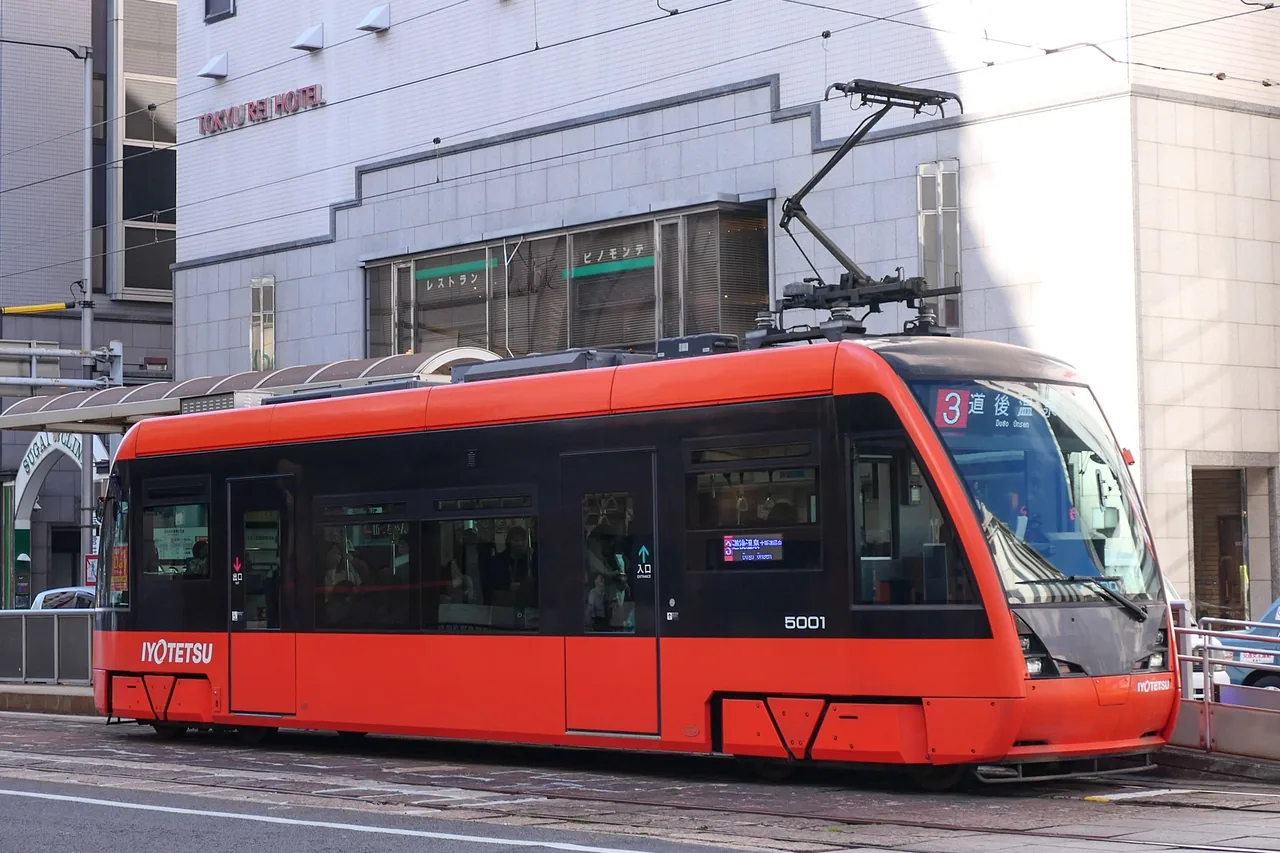
On weekdays you will ride the ordinary trams instead, between Dogo Onsen, Okaido and the two stations. In the daytime line 3 from Matsuyama-shi Station comes every 12 minutes and line 5 from JR Matsuyama-ekimae every 15, and both run at street level through the city. Line 5 passes Nishihoribata and Minamihoribata, beside the castle grounds, on its way to Okaido. The fare is ¥250 in cash or ¥230 by IC card however far you go, and the section on getting around below has the details.
10. Mitsuhama, Takahama and the islands off Matsuyama
Matsuyama has a coastline of its own, with old port streets and island ferries. The Iyotetsu Takahama Line runs out to it from Matsuyama-shi Station, and the ride to Baishinji Station takes about 20 minutes.
Mitsuhama’s old streets and the free ferry
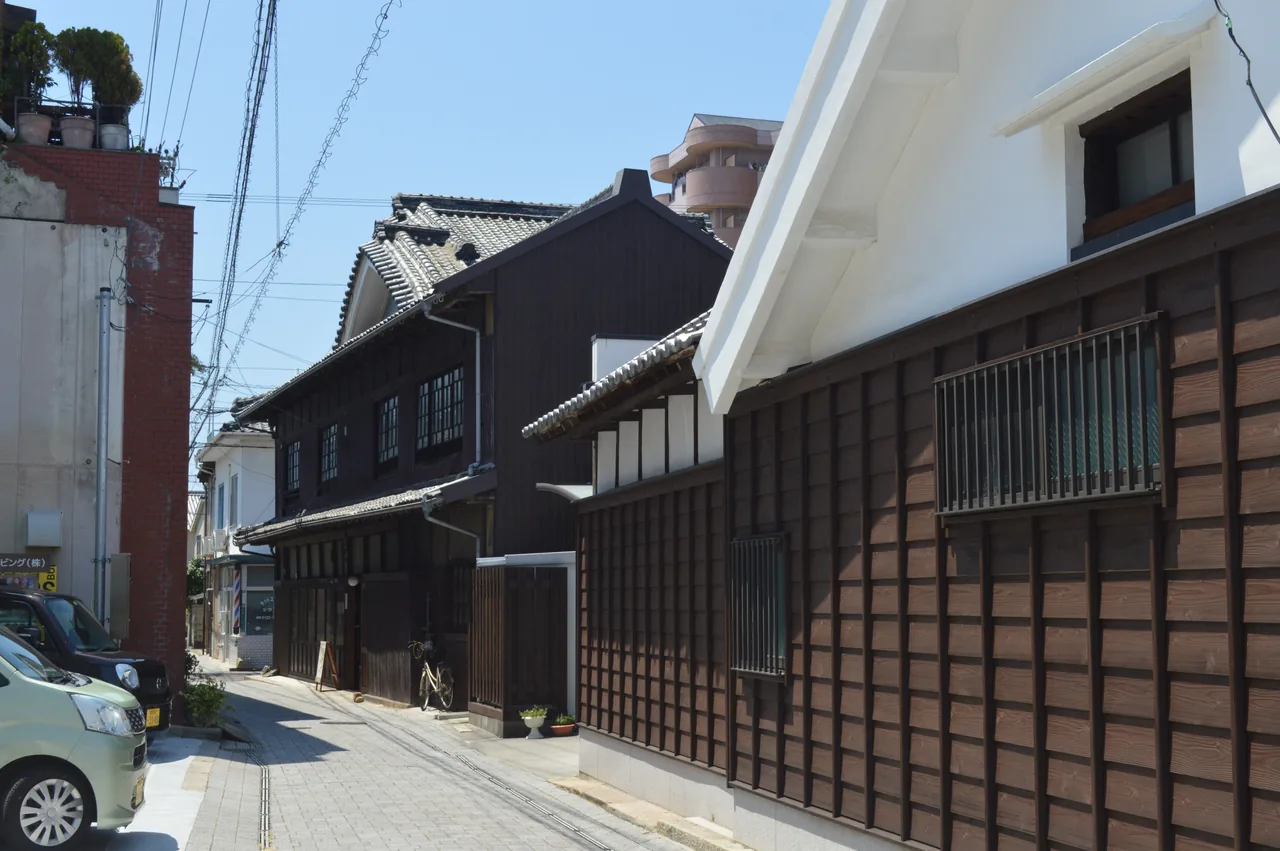
From the Edo period Mitsuhama was Matsuyama’s front door to the sea, a busy port for trade and fishing. It escaped the fires of the war, so buildings from before the early Showa era still line its lanes: dark wooden two-storey merchant houses, white plaster storehouses and the Old Bank Street (Kyu-Ginko-dori)Map. It is about 15 minutes on foot from Iyotetsu’s Mitsu Station, and a small information office called Mitsuhamaru is open 10:00 to 17:00 (closed Wednesdays and Thursdays).
The best ride in Mitsuhama is free. The Mitsu ferry (Mitsu no Watashi)Map is a small city boat between Mitsuhama and Minatoyama. Its official name is Matsuyama City Road Takahama Route 2. Because the boat is legally a city road, it runs every day of the year and the fare is free. It operates 7:00 to 19:00, is 5 minutes on foot from Minatoyama Station, and the crossing is said to go back to the Muromachi period.
Mitsuhama is also the home of Mitsuhama-yaki, a thin crepe-like savoury pancake, and specialist shops are dotted around the district. It is a good lunch stop before the ferry (more in the food section).
Baishinji Station and Mikyan Park
Further along the Takahama Line is Baishinji StationMap. Japanese viewers of a certain age know it from the final episode of the 1991 TV drama “Tokyo Love Story”: the station railing is where Rika tied her handkerchief. It is about 20 minutes from Matsuyama-shi Station and costs ¥460 (¥20 less by IC card).
Right in front of the station is Mikyan ParkMap. On the ground floor you can watch citrus being processed and buy the products, and upstairs is a citrus cafe. Entry is free, it is open 9:30 to 16:30 (this varies by season), and it closes on Mondays (the next day if Monday is a holiday).
Gogoshima and Kashima, two short island trips
Gogoshima is an island inside the city limits. Ferries from Takahama PortMap take 10 to 13 minutes and cost ¥300 for adults, paid on board, with no sailings from 31 December to 3 January. On GogoshimaMap, walk up to the hill called Koibito Toge for a view over the Iyo-nada sea.
North of the city in Hojo, KashimaMap is a small island 300 m offshore, 1.5 km around and 114 m high. It has deer in an enclosure, a swimming beach, a lookout at the top, and a huge straw rope about 40 m long strung between the Meoto-iwa rocks in the sea, which was recently replaced at the Hojo Kashima festival. Walk about 10 minutes from JR Iyo-Hojo StationMap to the pier, and the boat takes about 3 minutes. It runs 7:00 to 20:00 from April to November and until 19:00 from December to March, and a return ticket is ¥230 for adults and ¥120 for children.
The city tram and suburban train 1Day ticket (¥2,000, via the Jorudan app) covers the trains to Baishinji and Takahama as well as all city trams.
11. What to eat in Matsuyama: tai-meshi, nabeyaki udon and citrus
Tai-meshi, sea bream rice, is the dish to look for in Matsuyama, but Ehime has two kinds and they look nothing alike.
Tai-meshi: the cooked kind and the raw kind
The Matsuyama and Hojo version is cooked rice. Kombu goes on top of the rice, a whole sea bream is laid on that, and it is all cooked together in a clay pot, often with fried tofu and carrot. Hojo’s own Hojo tai-meshi uses nothing but the fish. The Uwajima version, from southern Ehime, is raw. Slices of sea bream sashimi are marinated in soy sauce, mirin, raw egg, sesame and stock, and the whole lot, sauce included, is poured over hot rice. Japan’s agriculture ministry explains it as a fishermen’s dish, from boats where they couldn’t light a fire, and Uwajima also links it to the old Iyo navy based on Hiburijima island.
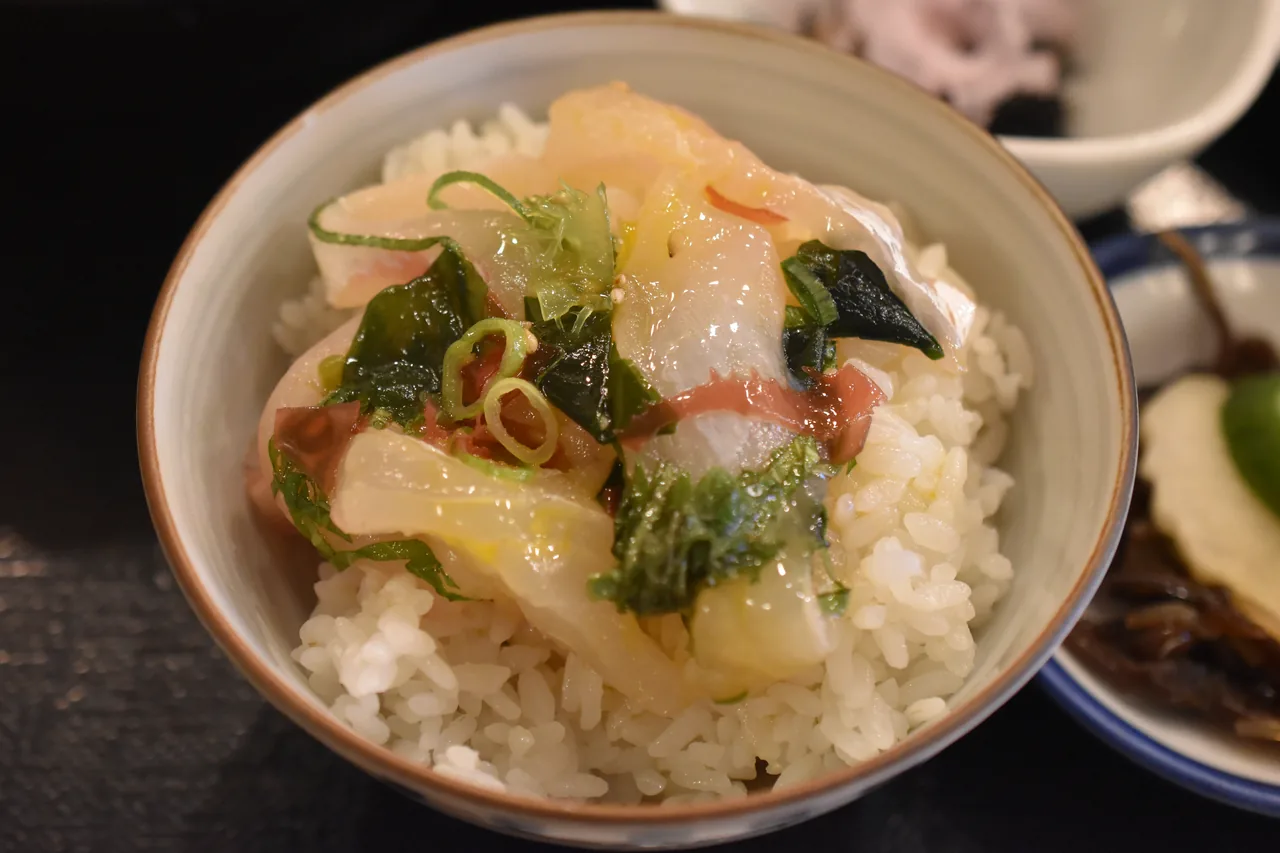
According to the ministry, restaurants in Matsuyama serve both kinds, so read the menu and pick. The city tourism office notes that south of Matsuyama the sashimi type is the usual one. Around Imabari in the east they cook a whole fish and then mix the flaked flesh through the rice, and Ehime’s own guidebook simply presents tai-meshi as two dishes.
Nabeyaki udon in an aluminium pot
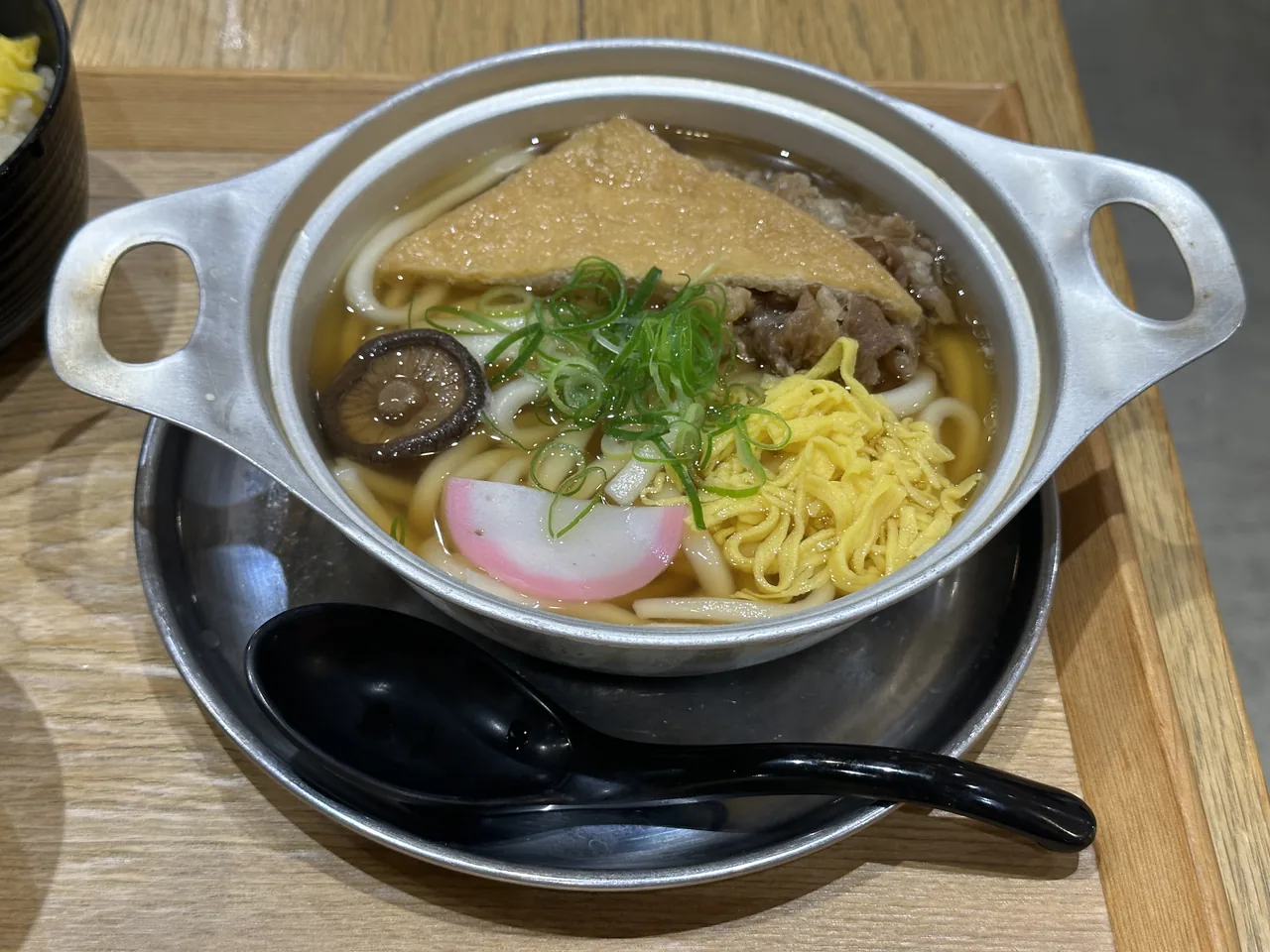
Matsuyama’s nabeyaki udon comes in an aluminium pot, with sweetish broth and soft noodles, and was born just after the war. If you came from Takamatsu, forget Sanuki udon: the taste and texture are completely different. The two best-known shops are both in Minatomachi, in a side street next to Gintengai: AsahiMap, founded in 1947, and KotoriMap, founded in 1949.
Mitsuhama-yaki, Botchan dango and taruto
Mitsuhama-yaki is a local okonomiyaki. The batter is spread thin like a crepe and sprinkled with fish powder, then cabbage, chikuwa fish cake and soba noodles are folded inside. Specialist shops are clustered in Mitsuhama.
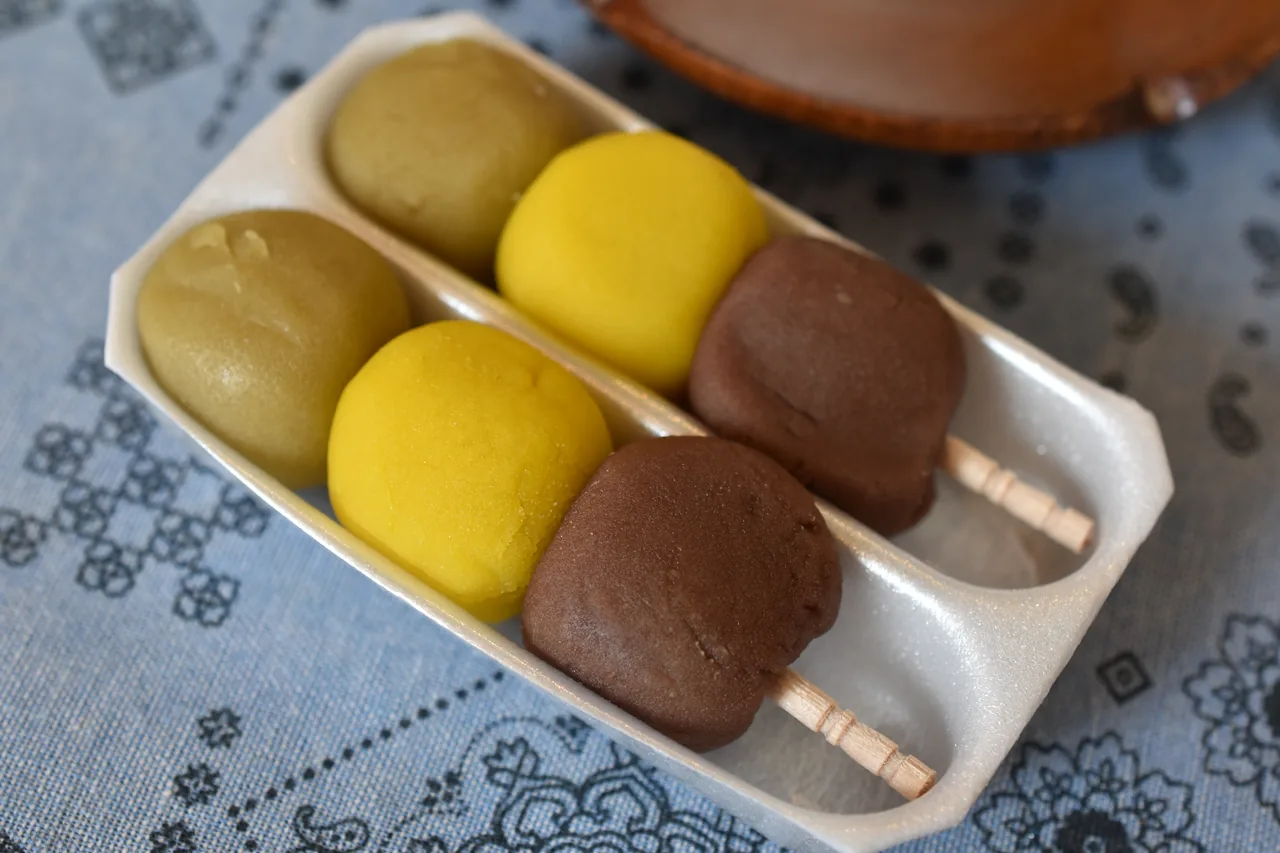
Botchan dango are skewers of three small dumplings, coloured with red bean, egg and matcha. They are named after the dango that turn up in “Botchan” and are served to guests at Honkan. The Honkan shop sells a box of five for ¥864.
Taruto looks like a Swiss roll: a thin sponge rolled around red bean paste flavoured with yuzu. The story behind it, as Japan’s agriculture ministry tells it, is that in 1647 the lord Matsudaira Sadayuki went on coastal guard duty to Nagasaki, where Portuguese ships came in. There he came across a Nanban (European-style) sweet called a “tart”, and on his return he had it remade with yuzu. The first version was sponge rolled with jam, the bean paste version is thought to be Sadayuki’s own idea, and the recipe stayed in the lord’s family until it passed to confectioners after the Meiji era. “Ichiroku Taruto” is one maker’s brand, from Ichiroku Honpo, whose shops include one opposite Honkan, Ichiroku Honpo Dogo Honkan-maeMap, as well as Katsuyama Honten and Okaido Honten.
Citrus, sake and a few more local tastes
Matsuyama grows many kinds of citrus, including Beni Madonna and Setoka, and ordinary unshu mikan are around for most of the year except early spring. Juice stands are on Okaido, the Dogo arcade and Ropeway Street, and the shops at Honkan and Asuka-no-Yu sell mikan juice for ¥180. Nakajima, offshore, is known as the “mikan island”, and 14 April is celebrated as Orange Day.
For drinks, try local sake brewed from Matsuyama Mitsui, the area’s own sake rice, or Dogo Beer. Dogo Cider (¥350 at Honkan) is a soft drink. Matsuyama-zushi is a sweet vinegared rice made with stock from small fish and topped with conger eel and more. Shiki loved it and wrote several haiku about it. Tai somen, sea bream on noodles, is a dish for celebrations, and goshiki somen comes in five colours. Jakoten, fried patties of fish ground with bones and skin, actually belongs to southern Ehime (Yawatahama and Uwajima). Records say Uwajima’s first lord, Date Hidemune, brought fish cake makers from Sendai in 1615. Inside Matsuyama city, the place to get it freshly fried is the Fuwari roadside station in Hojo.
| Dish | What it is | Where |
|---|---|---|
| Tai-meshi, Matsuyama and Hojo style | Whole sea bream cooked with rice and kombu in a clay pot | Restaurants around the city, Hojo |
| Tai-meshi, Uwajima style | Raw sea bream in a soy, egg and sesame sauce over hot rice | Restaurants around the city, check the menu |
| Nabeyaki udon | Soft udon in sweet broth, in an aluminium pot | Asahi and Kotori, Minatomachi |
| Mitsuhama-yaki | Thin okonomiyaki with fish powder, cabbage, chikuwa and soba | Mitsuhama |
| Botchan dango | Three-colour dumplings on skewers | Honkan shop (box of five) |
| Taruto | Sponge roll with yuzu bean paste | Ichiroku Honpo shops, including opposite Honkan and on Okaido |
| Citrus juice | Fresh mikan and other citrus | Okaido, Dogo arcade, Ropeway Street, Mikyan Park |
| Jakoten | Fried fish patty from southern Ehime | Fuwari roadside station, Hojo |
12. Day trips from Matsuyama: Uchiko, Ozu, Shimonada Station and the Shimanami Kaido
Matsuyama is a good base for the rest of Ehime. Trains on the JR Yosan Line run south-west along the coast and inland, and north-east to Imabari, so most of these trips need no car.
Uchiko: a merchant town built on wax
Uchiko is about 40 km south-west of Matsuyama, about 25 minutes by JR limited express. Its old street, the Yokaichi-Gokoku townscapeMap, runs for about 600 m up a gentle slope, with tiled-roof shops and white plaster houses. It was the first place in Shikoku chosen as a national preservation district for groups of traditional buildings. The Kamihaga residence, now the Japanese wax museum, is a merchant house where every building is an Important Cultural Property, open 9:00 to 16:30 for ¥500.
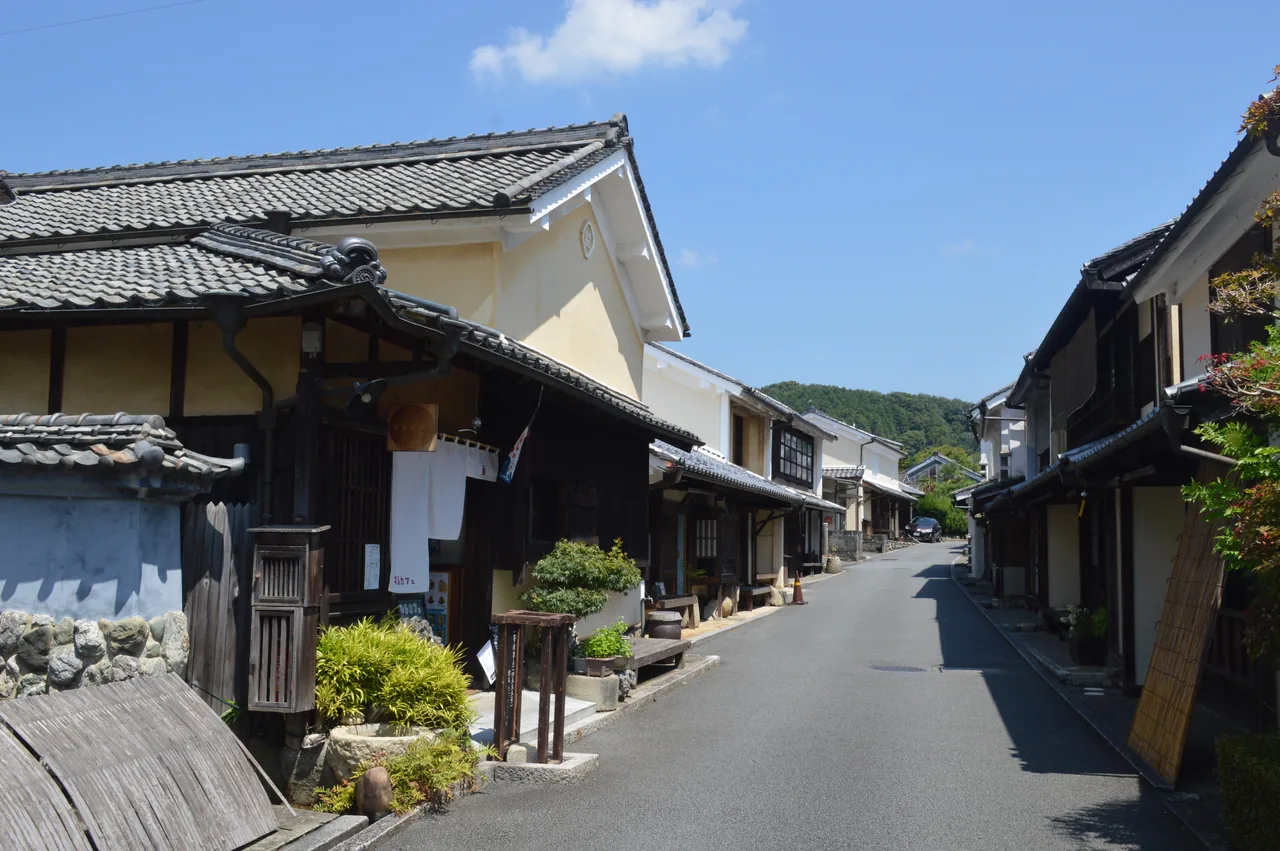
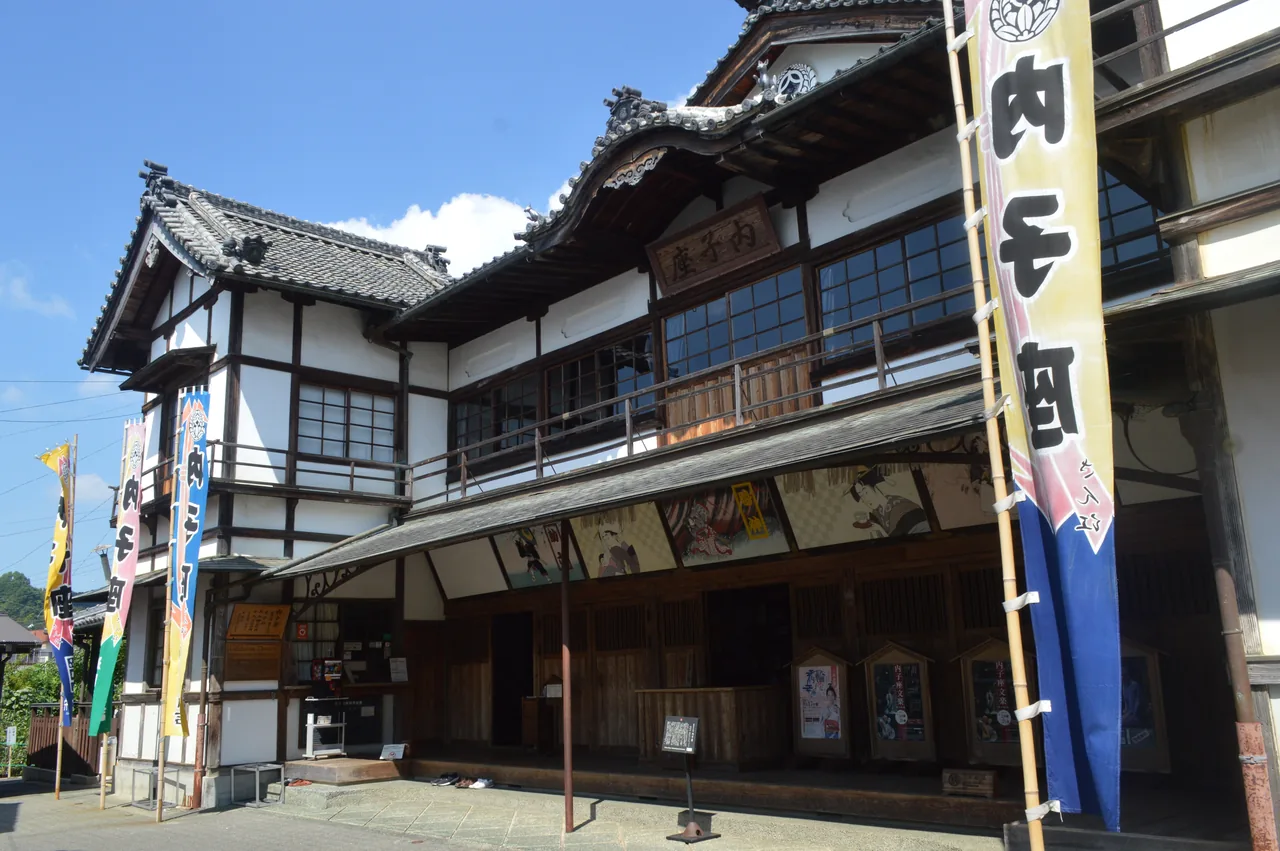
The town’s best-known building, Uchiko-zaMap, is a two-storey wooden kabuki theatre from 1916 with a revolving stage and a hanamichi walkway, and an Important Cultural Property. It is currently under restoration, and only the dressing rooms are open to visitors (¥200, 9:00 to 16:30). The reopening is planned a few years from now. It is about 10 minutes on foot from JR Uchiko Station.
Ozu: a wooden castle and Garyu Sanso
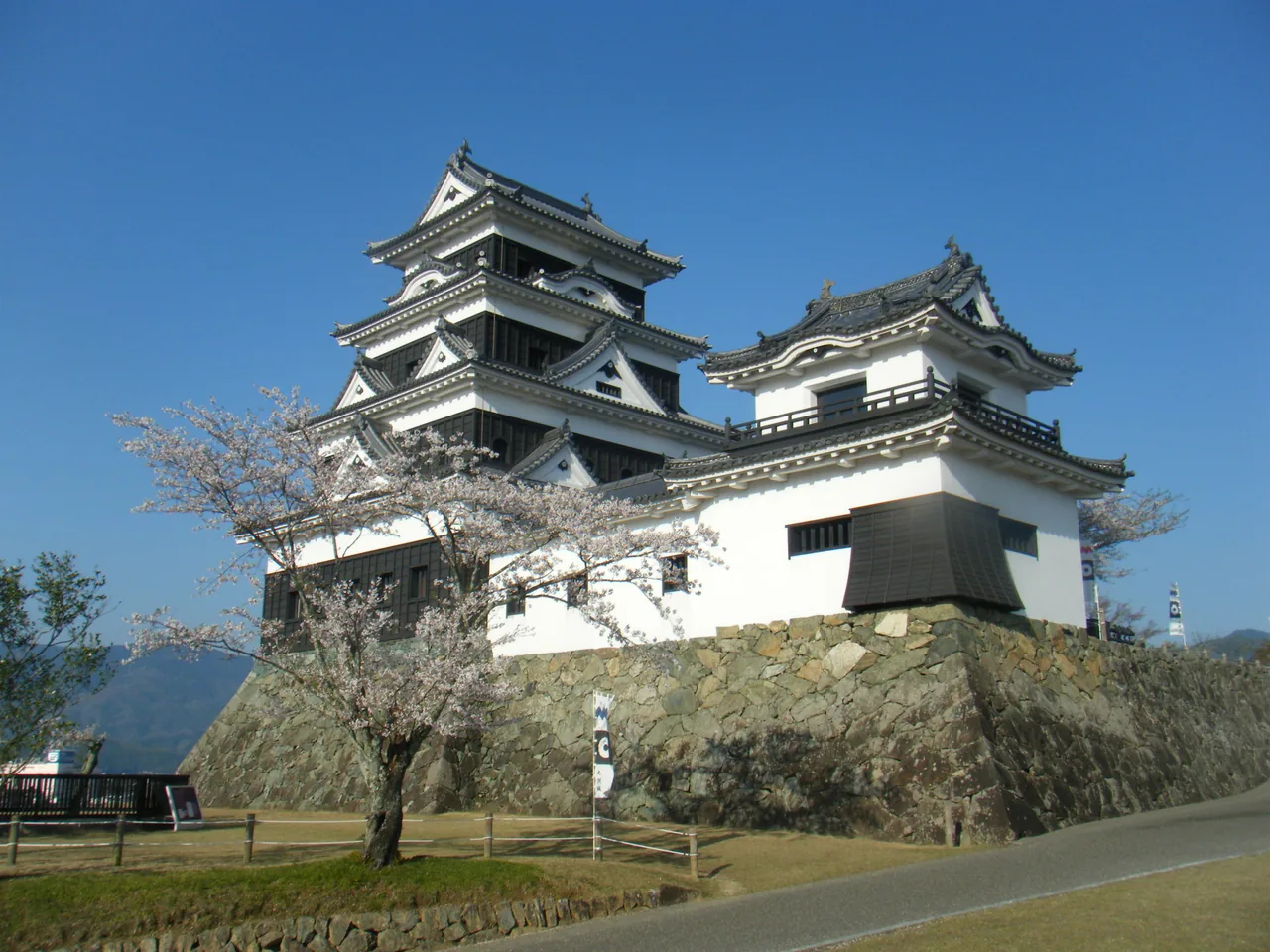
Ozu is about 40 minutes from Matsuyama by JR limited express. The keep of Ozu CastleMap, four storeys high, was rebuilt in wood in 2004, and its Edo-period turrets are Important Cultural Properties. It opens 9:00 to 17:00 and costs ¥550. The castle also offers a “castle stay”, where guests sleep inside.
Garyu SansoMap, a villa finished in 1907, is an Important Cultural Property and a national Place of Scenic Beauty, and costs ¥550. A combined ticket for both is ¥880. From Iyo-Ozu Station it is about 30 minutes on foot to the castle and about 25 minutes to Garyu Sanso.
Shimonada Station: a platform above the sea
The tiny unmanned platform of Shimonada StationMap looks straight out over the sea, with nothing between the bench and the horizon. It is in Futami, in Iyo City, on the JR Yosan Line, and less than an hour from JR Matsuyama Station. Before the coast road was built on reclaimed land, waves came right up under the platform. It is a famous sunset spot and has appeared in films and posters. Visit Ehime says some passengers think of a scene from “Spirited Away” when they ride the one-car train that stops here.
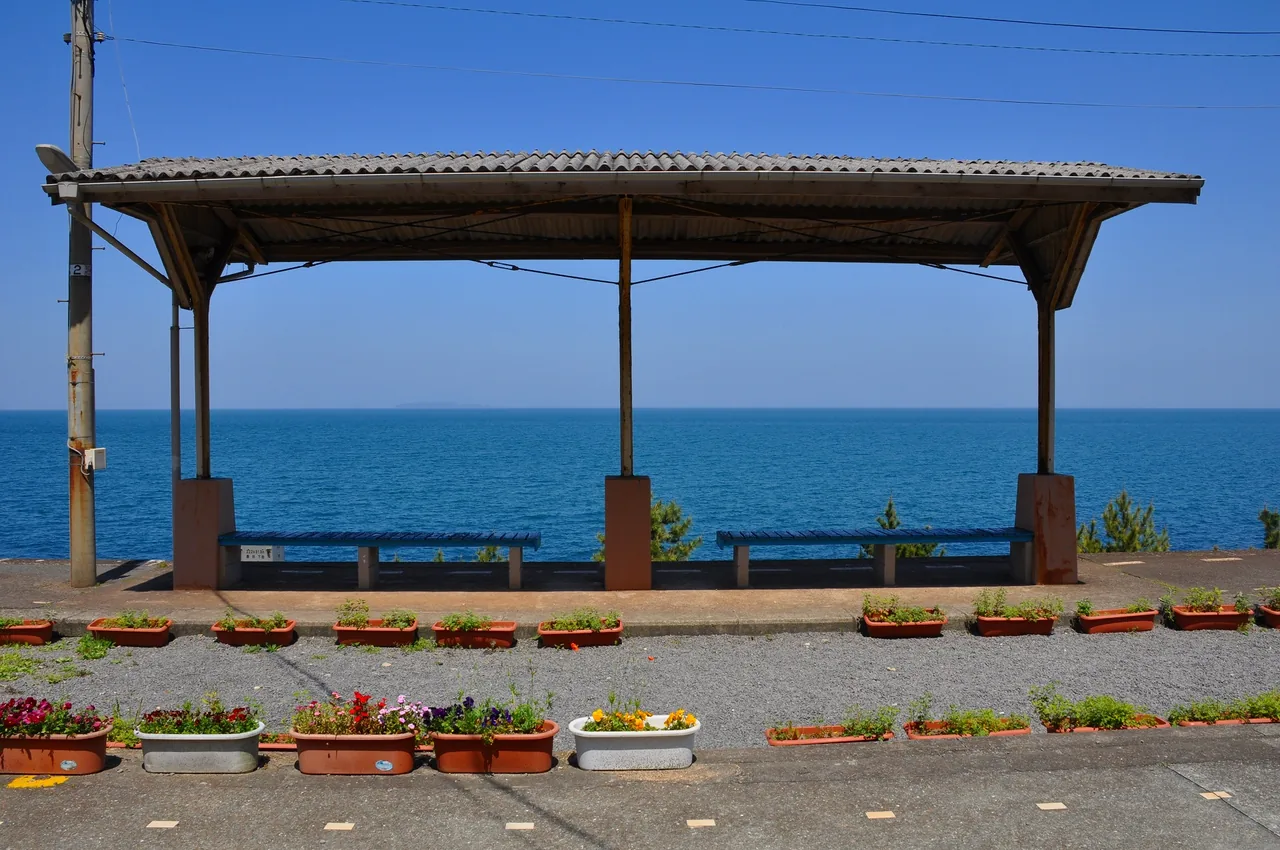
The Iyonada Monogatari sightseeing train, run by JR Shikoku mainly on weekends and holidays with all seats reserved in Green Car class, stops here for a few minutes so passengers can step out for photos. Nearby, the Michi-no-Eki FutamiMap roadside station and Futami Seaside Park are listed among Japan’s 100 best sunset spots.
The Shimanami Kaido by bicycle
The Shimanami Kaido links Imabari in Ehime with Onomichi in Hiroshima Prefecture by island-hopping bridges, and it is the only road link between Honshu and Shikoku you can cross on foot or by bicycle. The cycling route is about 70 km in total. From Matsuyama, the JR limited express Ishizuchi takes about 40 minutes to Imabari StationMap.
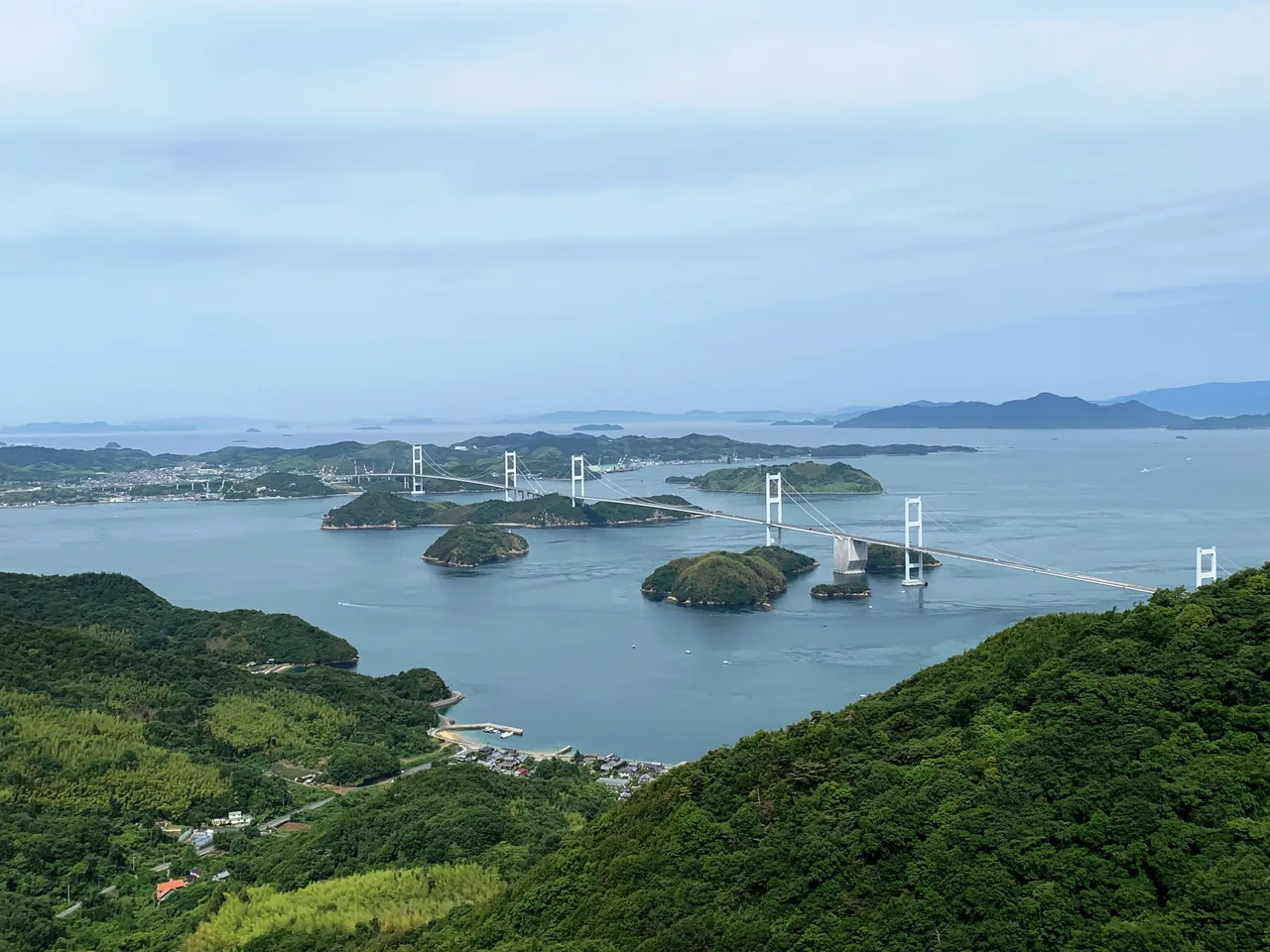
Shimanami Japan rents bikes by the day: ¥3,000 for a cross bike or city bike, ¥4,000 for an electric-assist bike and ¥8,000 for an E-bike. Returning a bike at a different terminal costs extra, so check that fee before you set off. On the Imabari side, the Imabari Station and Imabari Itoyama terminals open 8:00 to 19:00 from March to November and 8:00 to 18:00 from December to February. Helmets are free. Riding after dark is not allowed, so start early. If you are carrying on to the Honshu side, our Hiroshima travel guide covers the next stop. Rental details are on Shimanami Japan’s site.
Uwajima and Tobe, briefly
Uwajima, further south, is the home of the raw-fish tai-meshi and of jakoten. Tobe, closer in, has made Tobe-yaki porcelain for about 250 years. The Tobe-yaki Traditional Industry HallMap opens 9:00 to 17:00, closes on Mondays and costs ¥300, and the nearby Tobe pottery studio lets you paint a piece from ¥400 or try the wheel from ¥2,000 (booking needed). Tobe is about 15 minutes by car from the Matsuyama interchange. To rent a car you need an international driving permit and must be 18 or over.
| Place | How | Time from Matsuyama | What to see |
|---|---|---|---|
| Uchiko | JR limited express | About 25 min | Yokaichi-Gokoku street, Kamihaga residence, Uchiko-za dressing rooms |
| Ozu | JR limited express to Iyo-Ozu | About 40 min | Ozu Castle, Garyu Sanso |
| Shimonada Station (Iyo City) | JR Yosan Line | Under 1 hour | Sea-view platform, sunset, Michi-no-Eki Futami |
| Shimanami Kaido | JR limited express Ishizuchi to Imabari, then rental bike | About 40 min to Imabari | Bridges and islands, cycling route of about 70 km |
| Tobe | Car | About 15 min from Matsuyama IC | Tobe-yaki porcelain, painting and wheel classes |
13. When to go: Matsuyama’s weather, cherry blossoms and festivals
Matsuyama’s winters are mild: even in January, the coldest month, the average low stays above freezing. Summers are hot, August most of all, and the rainiest stretch is June and July.
Matsuyama’s weather month by month
| Month | Average (°C) | High (°C) | Low (°C) | Rain (mm) | Sunshine (hours) |
|---|---|---|---|---|---|
| January | 6.2 | 10.2 | 2.6 | 50.9 | 129.2 |
| February | 6.8 | 11.0 | 2.8 | 65.7 | 142.2 |
| March | 9.9 | 14.4 | 5.6 | 105.1 | 175.1 |
| April | 14.8 | 19.6 | 10.3 | 107.3 | 190.8 |
| May | 19.4 | 24.2 | 15.0 | 129.5 | 205.9 |
| June | 22.9 | 27.0 | 19.4 | 228.7 | 151.1 |
| July | 27.1 | 31.2 | 23.8 | 223.5 | 189.0 |
| August | 28.1 | 32.6 | 24.6 | 99.0 | 218.1 |
| September | 24.6 | 29.1 | 21.0 | 148.9 | 164.3 |
| October | 19.1 | 23.8 | 15.1 | 113.0 | 174.1 |
| November | 13.6 | 18.1 | 9.6 | 71.3 | 144.9 |
| December | 8.5 | 12.6 | 4.8 | 61.8 | 129.8 |
These are the Japan Meteorological Agency’s 30-year averages for Matsuyama. August is the hottest month, January the coldest, and typhoons come closest most often in September, so keep a day spare if you travel then (see our Japan typhoon season guide). For the rest of the country, our best time to visit Japan guide compares the seasons.
Spring: the Dogo Onsen festival and cherry blossoms
The Dogo Onsen Festival opens with a prayer of thanks for the water, then teams of women race portable shrines against each other, and rice cakes are thrown to the crowd. It was held on 19 to 21 March in both of the last two years. Plum blossoms at the castle come before it, in early to mid-February.
Cherry blossoms peak in early April, when the main square around the castle keep turns pink, and Dogo Park is another favourite blossom spot. The Matsuyama Spring Festival, also called the Castle Festival, was recently held mainly over the weekend in early April. It started in 1967 to celebrate the decision to rebuild the castle’s small keep, and features a feudal lord’s procession and a national yakyuken contest (the same yakyuken that gives the big summer dance festival its name).
Summer: light-ups, fireworks and dancing
The castle has held an evening light-up, Hikari no Omotenashi, from late July to mid-August, 18:30 to 21:00, at the main square, Shinonomeguchi and Chojagenaru, so check whether it is on for your dates. The Dogo Onsen Summer Festival is in early August. The Mitsuhama fireworks have been on the first Saturday of August in each of the last two years.
The big summer event is Matsuyama Yakyuken Odori, the festival once called the Matsuyama festival, held over three days from Friday to Sunday in early to mid-August in the last two years, around Chifune-machi, Okaido and Shiroyama Park. In late August, because this is Shiki’s city, high school students compete in Haiku Koshien, a haiku tournament held on a special stage in Okaido and at other venues.
Autumn: clashing portable shrines
The Matsuyama Autumn Festival runs from 5 to 7 October, which the tourism office gives as the dates every year. Its loudest moment is the hachiawase, when teams ram their portable shrines into each other, shouting “motekoi, motekoi”. The clashes happen at several places around the city, including Itsukushima Shrine and the square in front of Dogo Onsen Station, and the one at the station is early in the morning of the 7th. The shrines are also carried up and down Isaniwa Shrine’s steep steps. Hojo’s autumn festival, from the Friday to the Monday that includes the second Monday of October, is known for the mikoshi-otoshi, when a portable shrine is dropped down a flight of 39 stone steps. Dogo Park recently held a moon-viewing festival at the Yuzuki Castle site in mid-October.
Winter: bathing season
Cold, clear days are the best time for a long soak. From late October to mid-February, the Fuwari roadside station in Hojo is a spot where, on some clear cold evenings, you can see the “Daruma sunset”, when the setting sun and its reflection on the sea join into a shape like a daruma doll. The Tsubaki Matsuri at Iyozuhiko-no-Mikoto Shrine is held on the 7th to 9th of the first lunar month, so its date moves each year, and the Hatsune Matsuri at Yu Shrine falls on the second Sunday of January and Coming of Age Day. Remember the December cleaning day at the three baths, and the castle keep’s closure on the third Wednesday of December.
14. Getting to Matsuyama by plane, train, ferry or bus
There are no flights to Matsuyama from Europe, North America or Australia, so from there you will connect via Tokyo or Osaka. The two usual ways in are a short domestic flight or a train ride across the Seto Ohashi bridge from Okayama.
By plane from Tokyo or Osaka
From Haneda, ANA takes about 90 minutes and JAL about 85. From Narita, Jetstar Japan takes about 100 minutes. From Osaka’s Itami Airport, ANA and JAL take about 50 minutes. There are also routes from Fukuoka, Chubu, Naha and Kagoshima. There is no flight from Kansai Airport, so from Osaka use Itami or the train. Visit Ehime sums it up as under an hour and a half from Tokyo and under an hour from Itami. Our guides to getting from Narita and Haneda to central Tokyo and the Osaka travel guide cover the other end.
By train on the Shiokaze from Okayama
The Shiokaze limited express runs from Okayama to Matsuyama in about 2 hours 45 minutes, crossing the Seto Ohashi bridge and running through Kagawa. Fare plus an unreserved seat is ¥6,820. From Takamatsu, the Ishizuchi takes about 2 hours 30 minutes and costs ¥6,160. The two trains are coupled together for part of the way. From Tokyo the whole trip takes about 6 hours 10 minutes, from Shin-Osaka about 3 hours 40 minutes and from Kyoto about 3 hours 50 minutes, all changing at Okayama. It has been announced that the Shiokaze will soon become all reserved seats, while the Ishizuchi keeps its unreserved cars.
The JR Pass covers the Sanyo Shinkansen and the Shiokaze all the way to Matsuyama, according to Visit Ehime. You arrive at JR Matsuyama StationMap, with the JR Matsuyama-ekimae tram stop right outside. The pass does not cover Iyotetsu, which is a private company. See our JR Pass guide for whether it pays off on your route.
By ferry from Hiroshima, or overnight from Osaka
The Linear Jet high-speed boat (Setonaikai Kisen and Ishizaki Kisen) runs from Hiroshima Port to Matsuyama Kanko PortMap in 1 hour 20 minutes direct, or 1 hour 30 minutes via Kure. It costs ¥9,000 (¥7,100 from Kure), with sailings spread from morning to evening. Booking ahead is recommended, and you pay at the counter on the day (IC cards accepted, but not PiTaPa). The slower Cruise Ferry takes about 2 hours 40 minutes (Hiroshima and Kure to Matsuyama) and costs ¥6,000 (¥4,900 from Kure). Foot passengers can’t book, just buy at the counter at least 20 minutes before departure. Fares on both recently went up, and some Cruise Ferry weekday sailings are cut in December. The ferry company also offers a hands-free luggage delivery service.
From the port, a connecting bus (about 2 minutes, ¥270) takes you to Takahama Station, and the Iyotetsu Takahama Line reaches Matsuyama-shi Station in about 21 minutes, every 15 minutes in the daytime. Port to Matsuyama-shi Station costs ¥790 in total. For Dogo, change at Matsuyama-shi Station to tram line 3. A port limousine bus exists, but it makes one run timed to a late-evening ferry arrival and only goes as far as Matsuyama-shi Station. The port information desk is open 8:30 to 17:00.
From Osaka, the Orange Ferry sails overnight to Toyo Port, leaving at 22:00 and arriving at 6:00. A connecting bus, booked together with the ferry, runs from Toyo Port to Matsuyama-shi Station, JR Matsuyama Station and Dogo Onsen for ¥1,400.
By highway bus
Iyotetsu runs highway buses to Matsuyama from Tokyo (Shinjuku, on certain days), Nagoya, Osaka, Kyoto, Kobe, Okayama, Fukuoka, Takamatsu and Kochi. From Osaka the day bus takes 5 hours 40 minutes and the night bus 7 hours 50 minutes, all seats reserved. The Madonna Express from Okayama takes 3 hours 25 minutes and costs ¥5,000, four times a day. The Botchan Express from Takamatsu costs ¥4,400. IC cards can’t be used on highway buses.
From Matsuyama Airport into the city
Matsuyama AirportMap is about 15 minutes by car from the city. The Iyotetsu airport limousine bus leaves from stops 4 and 5 and calls at JR Matsuyama-ekimae, Ehime Shimbunsha-mae, Matsuyama-shi Station, Okaido, Minamimachi Kenmin Bunka Kaikan-mae and finally Dogo Onsen-ekimae. Buses leave to match flight arrivals rather than on a fixed interval, and some only go as far as Matsuyama-shi Station. On the current timetable the last one from the airport leaves in the 9 pm hour, but this may change when the winter timetable starts. You pay when you get off, and no booking is needed.
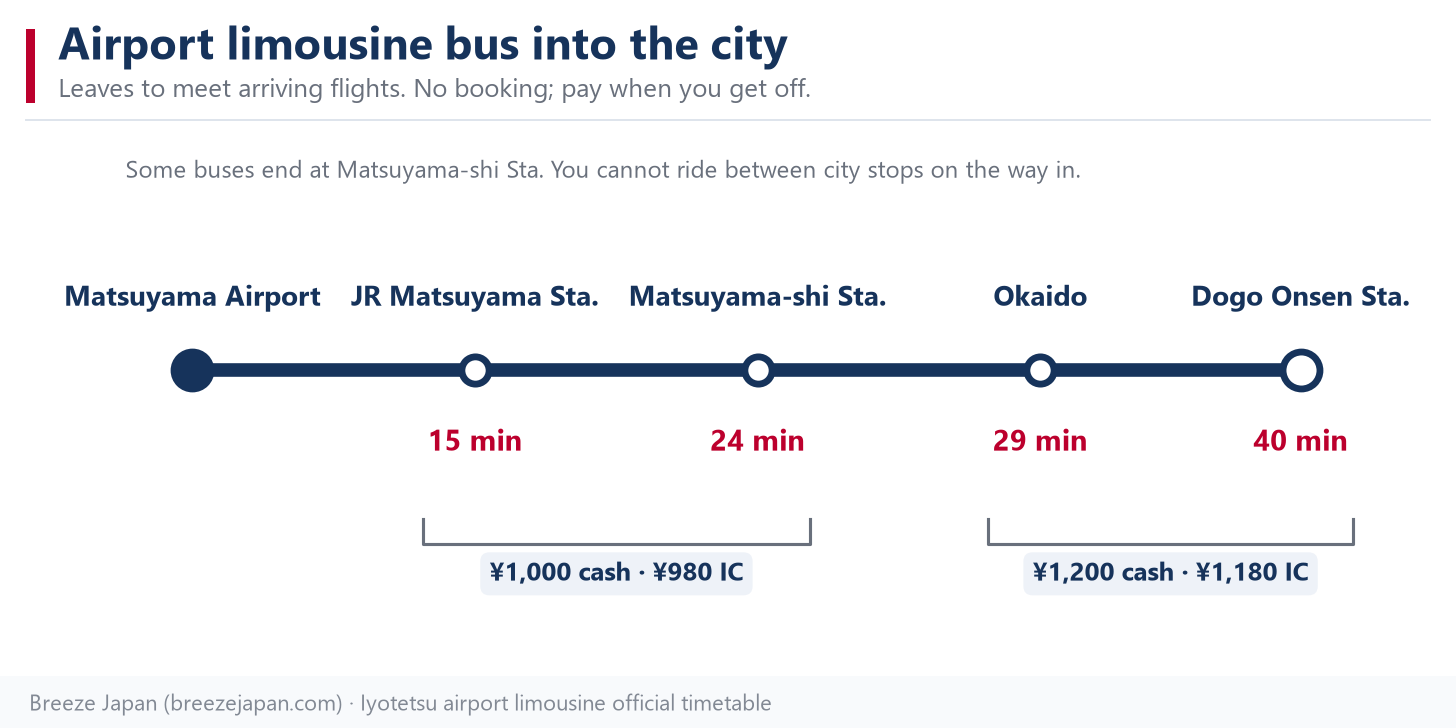
| Option | To | Time | Fare (cash / IC) |
|---|---|---|---|
| Airport limousine | JR Matsuyama-ekimae | 15 min | ¥1,000 / ¥980 |
| Airport limousine | Matsuyama-shi Station | 24 min | ¥1,000 / ¥980 |
| Airport limousine | Okaido | 29 min | ¥1,200 / ¥1,180 |
| Airport limousine | Dogo Onsen-ekimae | 40 min | ¥1,200 / ¥1,180 |
| Route bus 52 (stop 3) | JR Matsuyama-ekimae / Matsuyama-shi / Okaido (Ichibancho) / Dogo Onsen-ekimae | Stops along the way | ¥530 / ¥510, ¥640 / ¥620, ¥720 / ¥700, ¥830 / ¥810 |
| Taxi | Anywhere | About 15 min by car to the city | Standard car, at most ¥600 for the first 1.0 km, then ¥100 per 315 m |
Into town you can only board at the airport, and back out you can only get off at the airport. You can’t ride it between city stops.
Going back, buses leave Dogo Onsen-ekimae for the airport without calling at Matsuyama-shi Station (first 6:02, last 18:22), and a direct bus runs from stop B3 at Matsuyama-shi Station every 30 minutes, taking about 20 minutes (6:41 to 18:25). Taxis wait to the right as you leave the arrivals lobby, and the GO app works here. Ehime’s maximum taxi fare for a standard car recently changed to ¥600 for the first 1.0 km and ¥100 for every 315 m after that. The airport information desk on the ground floor is open 8:30 to 19:30 (depending on flights), has a writing board for questions, and takes cash in yen only. There are coin lockers and a delivery counter, plus an Imabari towel shop. Timetables are on Iyotetsu’s limousine page.
The ALL SHIKOKU Rail Pass
The ALL SHIKOKU Rail Pass is for foreign short-term visitors and is now sold only as a 3-day pass (¥12,000) and a 7-day pass (¥20,000). It covers JR Shikoku lines. It does not cover Iyotetsu, so no city trams, suburban trains or Botchan Train, and no buses at all. It also doesn’t cover the Okayama to Kojima section, so on the Shiokaze from Okayama you pay for that stretch. You can exchange or buy it at the JR Matsuyama Station ticket office, 7:00 to 19:40. Details are on the official pass site.
15. Getting around Matsuyama: trams, fares, day tickets and luggage
Matsuyama’s trams are slow, frequent and easy to use, and the fare is the same wherever you go. For a visitor, two lines do almost everything.
The tram lines you’ll actually use
Line 3 runs from Matsuyama-shi Station through Okaido to Dogo Onsen, and line 5 runs from JR Matsuyama-ekimae through Okaido to Dogo Onsen. Both stop at Okaido for the castle. Lines 1 and 2 go round a loop in opposite directions, and line 6 runs on weekdays only. Line 5 is the one that crosses the railway at Diamond Cross.
| Line | Route | Daytime frequency |
|---|---|---|
| 1 | Loop line, clockwise (Matsuyama-shi Station, JR Matsuyama-ekimae, Komachi, Okaido) | Every 10 min |
| 2 | Loop line, anticlockwise | Every 10 min |
| 3 | Matsuyama-shi Station, Okaido, Dogo Onsen | Every 12 min |
| 5 | JR Matsuyama-ekimae, Otemachi, Okaido, Dogo Onsen | Every 15 min |
| 6 | Matsuyama-shi Station to Honmachi 6-chome | Weekdays only |
The fare is ¥250 in cash or ¥230 with an IC card or the Mikyan app, wherever you get off (children ¥130 or ¥120). The cash fare recently went up. Trams stop around 10 pm: the last ones leave Dogo Onsen at about that time, so if you are staying near the stations and bathing late in Dogo, check the last tram first.
Nationwide IC cards such as ICOCA and Suica work on all Iyotetsu trams, trains and buses, except highway buses. You can’t top up on board, so charge your card at a convenience store first. Our Japan IC card guide explains how they work.
Day tickets are app-only
There are no paper day tickets any more. The city tram and limousine bus 1Day ticket costs ¥2,300 (child ¥1,150) and covers all city trams plus the airport limousine and the port limousine (from Kanko Port into the city only). The city tram and suburban train 1Day ticket costs ¥2,000 (child ¥1,000) and covers the trams plus the suburban trains, for example to Baishinji and Takahama. Neither covers the Botchan Train, and either one gets you a single ¥500 ride on the Kururin wheel (normally ¥800). Multi-day tickets are no longer sold.
Iyotetsu’s own Mikyan app needs a Japanese phone number, so visitors in practice use the Jorudan app. Each phone holds one ticket, so every person in your group needs their own device.
With fares of ¥250 a ride, a day ticket only pays off if you ride a lot, or if you take the airport limousine to Okaido or Dogo and then use the tram several more times that day. The English purchase page is on Jorudan’s site.
Suburban trains, buses, taxis and bikes
Iyotetsu’s suburban trains all start from Matsuyama-shi Station. The first fare zone is ¥250, Baishinji is ¥460 and Takahama ¥520, each ¥20 less by IC card. City buses start at ¥270 (¥250 by IC). For taxis, the maximum fare for a standard car is ¥600 for the first 1.0 km and ¥100 for every 315 m after that.
The city tourism office lists bike rentals at shops and some hotels, such as Cycle Station Monkeys Ichibancho, Flower Cycle, Giant Store Matsuyama Dogo Kitadai and Shikoku Tours Cycling Base in Iwaitani. There is also an OpenStreet bike share. On foot, the Okaido tram stop to the ropeway is 5 minutes.
Tourist information and luggage
The city runs tourist information desks with foreign-language leaflets: at JR Matsuyama Station (8:30 to 20:30, every day), at Dogo Onsen Station (8:30 to 17:00, every day), on the ground floor of Matsuyama Mitsukoshi (10:00 to 19:00, except on the store’s closing days), on the ground floor of the ropeway station (8:30 to 17:00) and at the Kanko Port terminal (8:30 to 17:00).
For bags, there are coin lockers at JR Matsuyama Station (in Dandan-dori), coin lockers and parcel lockers at Matsuyama-shi Station, lockers and a delivery counter at the airport, and luggage storage and delivery at the information center in Matsuyama Mitsukoshi. Our money and cards in Japan guide is useful for the places that still want cash.
16. Where to stay in Matsuyama: Dogo, the city centre or JR Matsuyama Station
Where you sleep in Matsuyama comes down to one question: do you want to walk to the baths in a yukata, or walk to dinner in the city centre? The tram connects the two in 12 minutes, but the evening feels different in each.
The three areas compared
| Area | Good for | Less good for | Examples |
|---|---|---|---|
| Dogo | Late-night and early-morning baths, evening strolls in yukata, hot spring ryokan, the airport limousine’s last stop | Restaurants and nightlife (a tram ride to Okaido), the last tram is around 10 pm | Funaya, Dogo Yamanote Hotel, Dogo Onsen Yamatoya Honten, Hotel Katsuragi Spa Resort Dogo, Chaharu, Dogo Prince Hotel |
| Okaido and Matsuyama-shi Station | Restaurants, shopping, the castle, suburban trains to the coast | Bathing at Dogo late at night | Daiwa Roynet Hotel Matsuyama, Dormy Inn Matsuyama, REF Matsuyama City Station by Vessel Hotels, ANA Crowne Plaza Hotel Matsuyama |
| JR Matsuyama Station | Early JR trains to Uchiko, Shimonada or Imabari, arriving on the Shiokaze | Further from Dogo (25 min by tram) | Hotel MyStays Matsuyama |
Staying in Dogo
Dogo is where the classic Matsuyama night happens. Honkan opens at 6:00 and closes at 23:00, the Karakuri Clock plays until 22:00, and the station is lit up at night, so you can bathe after dinner and again before breakfast. If you want to ride the Botchan Train, the Dogo ticket counter starts handing out tickets at 8:30, and on the morning of 7 October one of the autumn festival’s shrine clashes happens right outside the station. Dogo is also the last stop on the airport limousine, 40 minutes from the airport.
The local ryokan association lists plenty of inns and hotels, from Funaya, Dogo Oyu, Yamanote Bettei Hagakure and Koto no Niwa to Hanayuzuki, Dogo Grand Hotel, Hotel Koyuen Haruka, Yamatoya Besso and Dogokan. While DOGO ART is running, guests at participating Dogo inns can borrow an original DOGO ART yukata. The downside is dinner: the restaurants of Okaido and Ropeway Street are a tram ride away, and the trams stop around 10 pm.
Staying in the city centre or by JR Matsuyama Station
Around Okaido and Matsuyama-shi Station you are close to the restaurants on Ropeway Street and in the arcades, and a short walk from the ropeway. Daiwa Roynet Hotel Matsuyama is about 1 minute from the Okaido tram stop, and Dormy Inn Matsuyama, REF Matsuyama City Station by Vessel Hotels and ANA Crowne Plaza Hotel Matsuyama are all in this area. The airport limousine stops here too. By JR Matsuyama Station, Hotel MyStays Matsuyama suits anyone arriving late on the Shiokaze or catching an early train to Uchiko or Imabari. If you are also staying a night in Takamatsu, our where to stay in Takamatsu guide covers that city.
Bathing tax and accommodation tax
Matsuyama charges a bathing tax of ¥150 per person per day to anyone who bathes in a hot spring in the city. If you stay at a hot spring hotel or ryokan, you pay it along with your room charge. Children under 12, school trips and people using public bathhouses are exempt, so you don’t pay it at Honkan, Asuka-no-Yu or Tsubaki-no-Yu. Neither Matsuyama nor Ehime has announced an accommodation tax so far. Our Japan accommodation tax guide tracks the cities that have one.
On a two-night stay, one night in Dogo and one near Okaido gives you both an evening bath and an evening out, and the tram between them takes 12 minutes.
17. Dogo Onsen for first-timers: what to bring, bath manners and tattoos
If this is your first Japanese public bath, Dogo is a good place to start, because the rules are the same at all three bathhouses. The full list is on Dogo Onsen’s manners page. Here is what it means in practice, in the order you will meet it.
From the door to the water
Pay at the counter for your course and go through to the changing room. Lock your things in a locker and wear the key band on your wrist. Undress completely: swimsuits are not allowed and you can’t wear a towel into the bath either. Don’t bathe after drinking alcohol.
In the bathing area, sit on a stool and wash your whole body at the taps before you get into the water. Shower sitting down. Tie up long hair. Keep your small towel out of the water. Don’t save spots, swim, dive or run, don’t wash yourself at the spout where the hot water comes in, and don’t dye your hair, cut it or wash clothes. When you’re done, rinse your stool and bowl and put them back, dry off before you go into the changing room, and drink some water.
Phones and photography are not allowed in the changing rooms or baths, so leave your phone in the locker.
Towels, soap and what to bring
| Bath | Towel | Shampoo and soap | Lockers |
|---|---|---|---|
| Honkan, Kami-no-Yu courses | Bring or rent (¥110 / ¥320) | Provided | Yes |
| Honkan, Tama-no-Yu courses and private rooms | Towel set included | Provided | Yes |
| Asuka-no-Yu | Rental available | Provided (none allowed in the special bath) | Shoe lockers ¥100 returned, changing lockers free |
| Tsubaki-no-Yu | Bring or rent (¥110 / ¥320) | None provided, bring your own or buy shampoo and conditioner (¥50 each) | Paid |
Bring a small bag for your wet towel. You can’t take food into any of the three baths.
Tattoos and bathing wear
The three bathhouses’ own websites, including the course pages, FAQ and manners page, say nothing about tattoos either way. According to the Japan National Tourism Organization (JNTO), all three bathhouses are tattoo-friendly, and its tattoo-friendly onsen story includes Dogo. If you want to be certain, call Honkan on 089-921-5141 before you go. For other places, see our guide to onsens that accept tattoos.
The ¥500 bathing wear sold at the three shops is a special garment made to cover scars from operations such as breast cancer surgery or skin grafts, and it is the only clothing allowed in the water. Ordinary underwear and swimsuits are not. It is not meant as a tattoo cover.
Timing your bath
Honkan’s call system kicks in when it gets busy, so build some slack into your evening. If you hold a numbered ticket, stay within reach of your phone: you have 15 minutes from the call to get in. All three baths close only for a single cleaning day in December, so any other day of the year is fine.
18. One-day and two-day Matsuyama itineraries
Here is how the pieces fit together on a short visit. Both plans assume you sleep in Matsuyama and use the trams.
Day one: castle in the morning, Dogo in the evening
Start at Shinonomeguchi Station when the ropeway opens at 8:30 and be at the keep when it opens at 9:00. Come down by the chairlift if it is dry, or walk down the Kuromon-guchi path to Ninomaru Historical Garden. Walk over to Bansuiso or the Saka no Ue no Kumo Museum, then have lunch around Okaido: nabeyaki udon in Minatomachi, or tai-meshi.
In the afternoon, take tram 3 or 5 to Dogo Onsen (12 minutes from Okaido). Climb the steps of Isaniwa Shrine, walk through Dogo Park to the Shiki Memorial Museum, and catch the Karakuri Clock on the hour. Go up to Sora no Sanpomichi for the view over Honkan, then bathe in the evening. Finish with a walk down the lit-up arcade.
| Time | Day one | Day two, option A | Day two, option B |
|---|---|---|---|
| Morning | Ropeway from 8:30, castle keep from 9:00 | Early bath at Honkan from 6:00, then Ishiteji | JR to Uchiko (about 25 min), Yokaichi-Gokoku street |
| Midday | Ninomaru Garden or Bansuiso, lunch in Okaido | Suburban train to Mitsuhama, Mitsuhama-yaki for lunch | JR on to Ozu (castle and Garyu Sanso) |
| Afternoon | Tram to Dogo, Isaniwa Shrine, Dogo Park | Mitsu ferry, Baishinji Station and Mikyan Park | Back toward Matsuyama, stopping at Shimonada Station for sunset |
| Evening | Bath at Honkan, Karakuri Clock, the arcade | Dinner around Okaido or Gintengai | Dinner and a late bath in Dogo |
Day two: the coast or one day trip
Option A keeps you close to town. Take an early bath at Honkan from 6:00, walk out to Ishiteji, then ride the suburban train to Mitsuhama for lunch, the free ferry and a stroll along the old streets, and carry on to Baishinji. Option B uses the JR line south: Uchiko in the morning, Ozu at midday, and Shimonada Station on the way back for the evening light. If you’d rather cycle, give the whole day to the Shimanami Kaido from Imabari, starting early since riding after dark is not allowed. On a weekend, fit the Botchan Train in wherever it suits.
If Matsuyama is one stop on a bigger route, our Japan golden route itinerary shows how a Shikoku detour can fit around Tokyo, Kyoto and Osaka.
Changing the plan for rain or winter
In rain, the chairlift stops but the ropeway runs, and the Okaido and Gintengai arcades keep you dry. Swap the outdoor stops for the Saka no Ue no Kumo Museum, the Shiki Memorial Museum, the Giyaman Glass Museum and the prefectural art museum, and spend longer upstairs at Asuka-no-Yu.
In winter the days are short: the keep closes at 16:30 and the ropeway at 17:00 in December and January, so do the castle first. It is the best season for long soaks. Check the December cleaning day at the baths and the keep’s closing day on the third Wednesday of December before you fix your dates.