
Tokyo Winter Illuminations: Marunouchi, Roppongi, Shibuya and How Long They Run
Tokyo files its winter light installations under Christmas. Eight of the eleven are still switched on in the middle of January.
| Venues | Eleven venues across Tokyo run a winter lighting programme. |
|---|---|
| Christmas cut-off Only two of them switch off on Christmas night. | |
| Longest free run Ebisu Garden Place stays lit for 114 days. | |
| Latest of all | Yomiuriland, the one paid venue, runs to early April. |
| Switch-on | Four venues light at 16:00, before dark. |
| Weather | January is the sunniest month of the Tokyo year at 192.6 hours. |
| Next season | Last year the dates appeared between late August and late October. |
1. What is still lit after Christmas
2. Every venue, with its dates, hours, price and scale
3. What ends, what changes name, and what keeps going
4. Next season’s dates arrive after most long-haul bookings
5. Switch-on times, and how early it gets dark
6. December, January and February in numbers
7. Marunouchi, Tokyo Station and Yurakucho
8. Roppongi: Keyakizaka and Tokyo Midtown
9. Ebisu Garden Place holds the longest free run
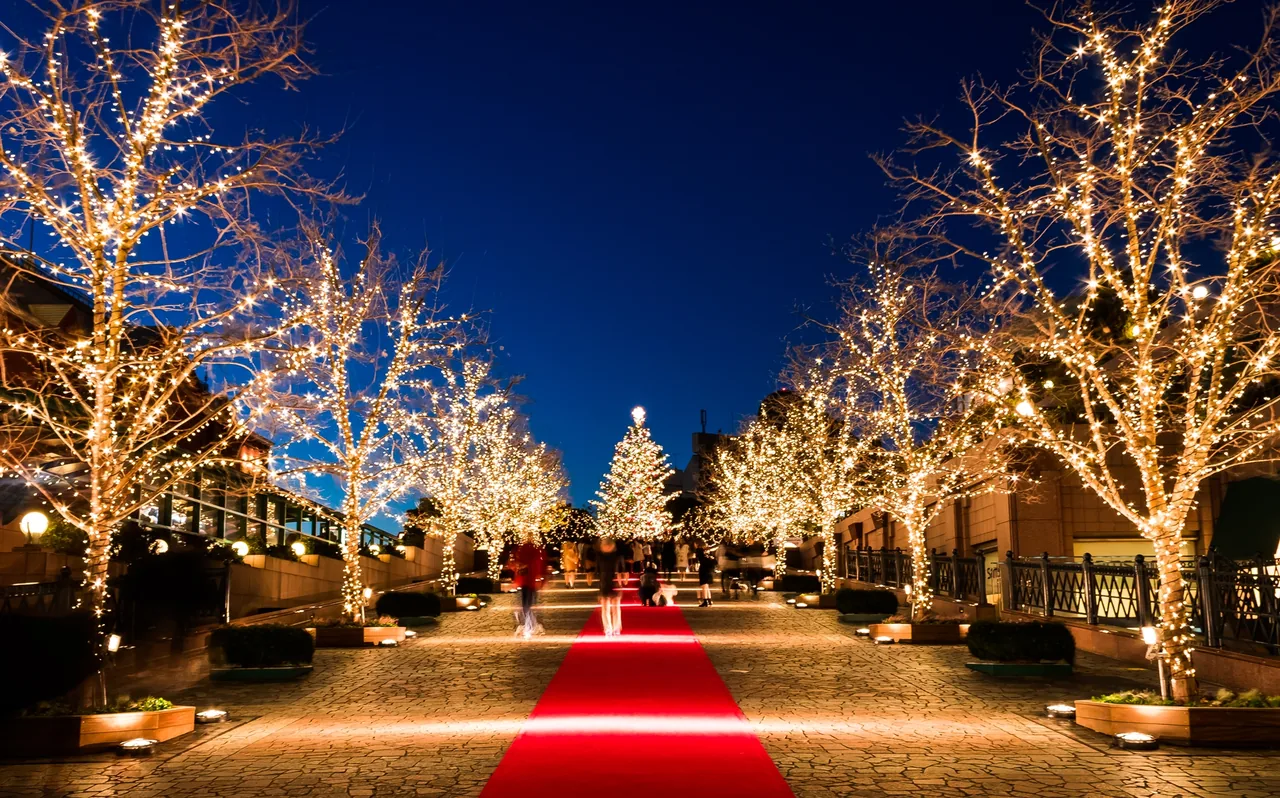
10. Shibuya and Omotesando run the shortest seasons
11. Shinjuku: the station’s south side and the government building
12. Sumida and Tokyo Skytree
13. Inagi and the Yomiuriland lights
14. Putting one evening together
15. The one that stopped
16. When the crowds show up
17. January and February on their own terms
18. Dressing for it, and photographing it
1. What is still lit after Christmas
Tokyo’s illumination season is about four and a half months long, and the Christmas part of it lasts roughly a month.
Eleven venues across the metropolis run a winter lighting programme. Three of them finish in December. The other eight are still lit in the middle of January, and one is still lit at the start of April.
Two venues switch off on Christmas night. One is the blue tunnel that runs from Shibuya’s Koen-dori down to Yoyogi Park, which is only lit for three weeks in total. The other is the Christmas programme at Tokyo Skytree, which takes its market and its projection mapping with it.
The zelkova avenue on Omotesando is the third December departure. Its main run stops a few days after Christmas, and only the low trees stay lit into the first third of January.
Two more venues change rather than end. The slope at Roppongi Hills drops its Christmas name the morning after Christmas and carries on in blue and white until late February, with the same number of lights on the same 400 metres of road. Midtown Hibiya swaps its Christmas staging for something else and keeps its lights on to the end of February.
The remaining six never had a Christmas identity to lose. Marunouchi and the six buildings south of Shinjuku Station run to the middle of February. Tokyo Midtown’s gold-lit walk runs to late February, Ebisu Garden Place into the start of March, and the paid theme park out in Inagi to early April. The projection mapping on the west side of Shinjuku has no closing date at all.
So the question is not whether you have missed the season. The question is which half of it you are booking. December has the markets, the projection mapping and the three-week installations, along with the crowds those pull in. January and February have the driest and brightest weather of the Tokyo year, fewer venues, and more room to stand in front of them.
The lights also sit awkwardly in a day. Nothing switches on before four in the afternoon except one chandelier, and most venues close between eleven at night and midnight. That leaves a wide evening slot and a full daytime that has to be filled with something else, so it is worth working out how the city fits together before you fix the evenings.
2. Every venue, with its dates, hours, price and scale
Every figure comes from the most recently completed season, the last one with confirmed dates rather than expectations.
Ten of the eleven venues are free. The exception is a theme park, where the lighting sits inside the paid gate. Sub-events are listed under the venue they belong to, because several venues run a Christmas-branded programme and a longer winter programme side by side.
| Venue | Ward | Dates | Lit | Price | Scale |
|---|---|---|---|---|---|
| Yomiuriland Jewellumination | Inagi | October 23 to April 5, minus park closure days; weekday daytime operation only from March 2 to March 13 | 16:00 to 20:30 | Adult 1,800 yen, secondary school 1,500 yen, primary school, preschool and 65 or over 1,000 yen | About 6.5 million lights |
| Ebisu Garden Place, whole site | Shibuya | November 8 to March 1 | 16:00 to 23:00, from 17:00 on the opening day | Free | Entrance pavilion, clock square, hill promenade, chateau square |
| Baccarat chandelier, Ebisu | Shibuya | November 8 to January 12 | 11:00 to 23:00, from 17:00 on the opening day | Free | Centre square, 26th edition |
| Midtown Hibiya | Chiyoda, Yurakucho | November 13 to February 28 | 16:00 to 23:00 | Free | 108 days; Christmas staging to December 25, then replaced |
| Tokyo Midtown, walk of light | Minato | November 21 to February 23 | From early evening | Free | About 340,000 gold lights |
| Tokyo Midtown Christmas | Minato | November 13 to December 25 | 17:00 to 23:00 | Free | Midtown Garden |
| Keyakizaka winter edition | Minato | December 26 to February 22 | 17:00 to 23:00 | Free | About 930,000 lights in blue and white |
| Roppongi Hills Christmas | Minato | November 4 to December 25 | 17:00 to 23:00, opening day differs | Free | About 400 m of Keyakizaka, the same 930,000 lights |
| Marunouchi Illumination | Chiyoda | November 13 to February 15 | 16:00 to 23:00; 16:00 to 24:00 from December 1 to December 31 | Free | About 250 trees, about 775,000 champagne gold LEDs, about 1.2 km, 24th edition |
| Gyoko-dori | Chiyoda | November 28 to December 25 | 16:00 to 24:00 | Free | About 10 trees, about 36,000 lights |
| Marunouchi Street Park Winter | Chiyoda | November 13 to December 25 | Event hours | Free | Christmas market and food trucks |
| Shinjuku Minami Lumi | Six facilities, most of them in Shibuya ward | November 12 to February 15 | 17:00 to 24:00; from 16:30 from December 1 | Free | Six facilities south of Shinjuku Station, 11th edition |
| Skytree Dream Christmas | Sumida | November 1 to December 25, special lighting from November 6 | 17:30 to 22:00; to 24:00 on December 24 and December 25 | Free for the town lighting | About 530,000 lights, Sky Arena projection mapping, Christmas market |
| Omotesando, with Fendi | Shibuya | December 1 to December 28; low trees to January 5 | Sunset to 22:00 | Free | 154 zelkova trees, about 900,000 lights, about 1 km |
| Ao no Dokutsu Shibuya | Shibuya | December 4 to December 25 | 17:00 to 22:00 | Free | About 900 m from Koen-dori to Yoyogi Park, about 500,000 lights |
| Metropolitan Government Building projection mapping | Shinjuku | Year-round, no closing date | Winter weekdays, nine shows from 17:30 to 21:30 | Free | Guinness recognised, 13,904.956 square metres of projection surface, east wall of Building No. 1 |
Two values move during the season. Marunouchi pushes its closing hour back by one hour for the whole of December, and the Shinjuku south side brings its switch-on forward by half an hour from the start of December. Both revert once the month is over.
Light counts are the figures each venue publishes for itself, and venues do not all count the same way. Some quote individual bulbs and some quote fixtures, so the numbers are useful as a sense of scale and not as a like-for-like measurement.
The price column also hides a difference in kind. At the theme park the ticket buys the whole park, rides included, and the lighting is one part of it. Everywhere else the lighting is decoration on a shopping street or a plaza, which is why there is no gate to pay at.
3. What ends, what changes name, and what keeps going
Three of the eleven venues finish in December, two change their name or their staging and keep running, and six run unchanged from opening night to closing night.
| Pattern | Count | Venues |
|---|---|---|
| Switches off on Christmas night | 2 | Ao no Dokutsu Shibuya, the Skytree Christmas lighting |
| Finishes later in December | 1 | Omotesando, with its low trees into the first third of January |
| Changes name or staging, keeps running | 2 | Keyakizaka, which becomes a winter edition the day after Christmas; Midtown Hibiya, whose Christmas staging is replaced |
| Runs unchanged to its closing date | 6 | Marunouchi, Tokyo Midtown’s walk of light, Ebisu Garden Place, the Shinjuku south side, Yomiuriland, the Metropolitan Government Building |
Put in closing order, the season unwinds slowly rather than all at once.
- Early April: Yomiuriland, the only paid venue
- Start of March: Ebisu Garden Place, the whole site
- End of February: Midtown Hibiya
- Late February: Tokyo Midtown’s walk of light, with Keyakizaka closing one night earlier
- Middle of February: Marunouchi and the Shinjuku south side, on the same night
- Middle of January: the Baccarat chandelier at Ebisu, while the rest of that site carries on
- Late December: Omotesando
- Christmas night: Ao no Dokutsu and the Skytree Christmas lighting
- No closing date: the Metropolitan Government Building
There is a logic to which venues die with Christmas. The two that go out on Christmas night are the two whose whole identity is Christmas: a themed tunnel and a market with a projection show. Once the holiday has passed there is nothing left for them to be.
The venues that run into February are avenues of street trees. The lighting there is decoration for a shopping street that stays open all winter, so there is no reason to strip the trees in January, and the operators do not. Marunouchi has been doing it for twenty-four seasons, and Midtown Hibiya keeps its programme running for 108 days.
The two that change are the ones worth understanding before you book a January trip. Keyakizaka keeps every one of its roughly 930,000 lights and simply changes the event name and the colour, from Christmas warmth to blue and white. Midtown Hibiya keeps its lights and replaces the content. Neither is a wind-down, and neither shortens its hours.
This is also where old listings mislead. When a venue name sits next to December in a round-up, the dates given often belong to the Christmas sub-event rather than to the venue. Roppongi Hills and Marunouchi both look like December-only venues if you read the sub-event line and stop there.
4. Next season’s dates arrive after most long-haul bookings
Last season’s announcements landed between late August and late October, which is later than a long-haul trip usually gets booked.
| Venue | Announced | Opened |
|---|---|---|
| Yomiuriland | Late August | Late October |
| Midtown Hibiya | Late September | Middle of November |
| Tokyo Midtown | Late September | Middle of November |
| Roppongi Hills | End of September | Early November |
| Marunouchi | Second half of October | Middle of November |
| Short December events, including Ao no Dokutsu | November | December |
Yomiuriland announces first and opens first, with roughly two months between the two. The two Midtown sites and Roppongi Hills follow within a week of each other at the end of September. Marunouchi is the last of the large venues to speak, and it leaves about four weeks between its announcement and its opening night.
Marunouchi is the clearest case of a pattern. It has announced in October for four seasons running, and there is no September case in that run. The exact day has moved by a couple of weeks from one year to the next, so the month is dependable and the week is not.
As of the end of July, no winter-limited venue has published dates for the coming season. The projection mapping in Shinjuku is the one exception to the whole problem, because it is permanent and has no season to announce.
If you book flights three to six months ahead, the practical consequence is that you book on last season’s shape. Opening nights for the street-tree venues have sat in the first half of November, the paid park has opened in late October, and the short December installations have appeared in the first week of December. Only one season is documented end to end, so the sensible assumption is that the shape repeats while the exact days move by a few days in either direction.
That is also an argument for choosing a district before choosing a date. A trip built around Marunouchi and Ebisu has a four-month window to land in, so almost any winter date works. A trip built around the Shibuya tunnel has a three-week window, and three weeks is not much to aim at from the far side of the world with unconfirmed dates.
5. Switch-on times, and how early it gets dark
Four venues light at 16:00, which is before the sun goes down in Tokyo in early winter.
| Switch-on | Venues |
|---|---|
| 11:00 | The Baccarat chandelier at Ebisu Garden Place |
| 16:00 | Marunouchi, Yomiuriland, Ebisu Garden Place, Midtown Hibiya |
| 16:30 | The Shinjuku south side, from December |
| 17:00 | Keyakizaka, Tokyo Midtown Christmas, Ao no Dokutsu Shibuya |
| 17:30 | Tokyo Skytree, and the first winter weekday show at the Metropolitan Government Building |
| Sunset | Omotesando |
Tokyo’s earliest sunset is 16:28, and it holds at that time for fifteen days from the end of November into the middle of December. The same fifteen-day stretch repeats in 2026. Civil twilight runs about half an hour beyond sunset, so full darkness arrives close to five in the afternoon.
The shortest day and the earliest sunset are not the same day. At the winter solstice the sun sets at 16:32, four minutes later than the earliest sunset a fortnight before it. The gain accelerates after that: 16:51 by the middle of January, 17:07 by the end of the month, which is nearly forty minutes later than the year’s earliest.
This is what makes the 16:00 venues worth arriving early for. Marunouchi, Ebisu, Midtown Hibiya and the theme park in Inagi are all lit while the sky is still blue, so the same trees read twice in one hour, once against colour and once against black. By the second half of January that first look has shifted almost forty minutes later in the evening.
The two outliers pull in opposite directions. The Baccarat chandelier is lit from eleven in the morning, which makes it the only piece in the city you can look at over lunch. Omotesando fires at sunset instead of a clock time, so its start drifts later week by week and it never has a blue-hour overlap to speak of.
Closing times matter as much as opening ones for a long evening. Most venues run to 23:00, the Shinjuku south side and Gyoko-dori run to midnight, and Marunouchi joins them at midnight for the whole of December. The theme park is the earliest to close, at 20:30, which is a full two and a half hours before the city centre.
6. December, January and February in numbers
January is both the coldest month in Tokyo and the sunniest month of its entire year.
| Month | Average high | Average low | Mean | Rainfall | Sunshine |
|---|---|---|---|---|---|
| December | 12.0 C | 3.8 C | 7.7 C | 57.9 mm | 174.4 h |
| January | 9.8 C | 1.2 C | 5.4 C | 59.7 mm | 192.6 h |
| February | 10.9 C | 2.1 C | 6.1 C | 56.5 mm | 170.4 h |
Those are the 1991 to 2020 normals from the national weather service. January’s 192.6 hours of sunshine is the highest of any month in Tokyo, ahead of May at 179.6 and April at 178.8. Tokyo winter is a bright, dry season rather than a grey one, which is not what most visitors from the northern hemisphere expect from a cold month.
Rainfall says the same thing from the other side. The three driest months of the Tokyo year are February at 56.5 mm, December at 57.9 mm and January at 59.7 mm, all clustered within about three millimetres of each other. June, by contrast, brings 167.8 mm and only 124.2 hours of sun, September brings 224.9 mm and October 234.8 mm. An evening spent walking under lit trees is far less likely to be rained off in winter than in any other season, though there are indoor options for the evening it does rain.
The number that misleads is the average high. Nobody looks at illuminations at two in the afternoon. The lights are on during the cold end of the day, so the average low is the figure to dress for, and in January that is 1.2 C with a daily swing of 8.6 degrees.
One footnote on the records themselves. Tokyo’s official observations come from Kitanomaru Park, and that site reads about 1.4 C colder on minimum temperature than the Otemachi site used before 2014. Older averages therefore look milder than current ones for reasons that have nothing to do with the weather.
The season also opens while autumn is still finishing. The first switch-ons in the middle of November happen with colour still on the ginkgo and maple in the city’s parks, so an early trip can catch both, and the way the colour moves down the country decides how much of the overlap you get.
7. Marunouchi, Tokyo Station and Yurakucho
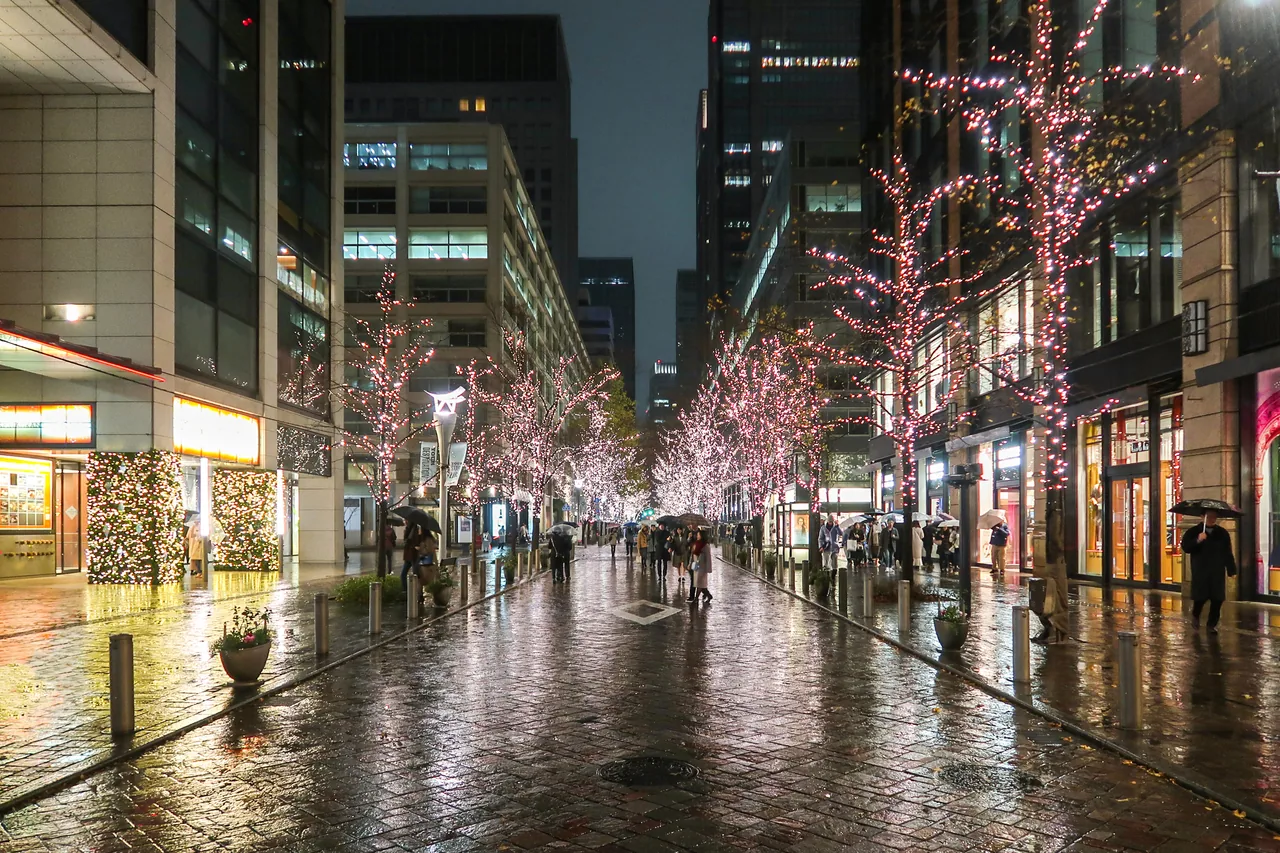
Marunouchi holds the longest continuous stretch of lit street trees in Tokyo, and it runs from the middle of November to the middle of February.
| What | Scale | Runs to | Hours |
|---|---|---|---|
| Marunouchi Illumination, on Nakadori | About 250 trees, about 775,000 champagne gold LEDs, about 1.2 km, 24th edition | Middle of February | 16:00 to 23:00, one hour later through December |
| Gyoko-dori | About 10 trees, about 36,000 lights | Christmas | 16:00 to 24:00 |
| Marunouchi Street Park Winter | Christmas market and food trucks | Christmas | Event hours |
| Midtown Hibiya | 108 days; Christmas staging replaced afterwards | End of February | 16:00 to 23:00 |
Nakadori is the shopping street that runs parallel to the tracks between Otemachi and Yurakucho, one block back from Tokyo Station. Every tree along about 1.2 km of it carries the same champagne gold LED, roughly 775,000 of them across some 250 trees, and the single colour is the point. There is no themed section and no colour change, which is why the same installation works in November and still works in February.
Marunouchi NakadoriMapThe station itself anchors the north end. The brick facade on the Marunouchi side faces a plaza that is lit for the season, and the plaza is where most people take their first photograph before turning into Nakadori.
Tokyo Station, Marunouchi buildingMapGyoko-dori is the wide, straight avenue that runs from that plaza towards the palace grounds. It is a small installation, about ten trees and 36,000 lights, and it closes with Christmas. So in January the grand axis in front of the station is dark while the shopping street one block away is still fully lit, which surprises people who arrive expecting the opposite.
The other Christmas-only piece here is Marunouchi Street Park Winter, a market with food trucks that also ends on Christmas night. Between them, those two are the reason the district feels busier in December than its light count alone would suggest.
Yurakucho StationMapWalk south past Yurakucho Station and you reach Midtown Hibiya, which runs 108 days, longer than any free venue except Ebisu. It shows Christmas staging until Christmas and then replaces it rather than closing, so a February evening still has something to look at there. Everything in this district lights at 16:00, which makes it the logical place to start an evening while there is still light in the sky.
Tokyo Midtown HibiyaMap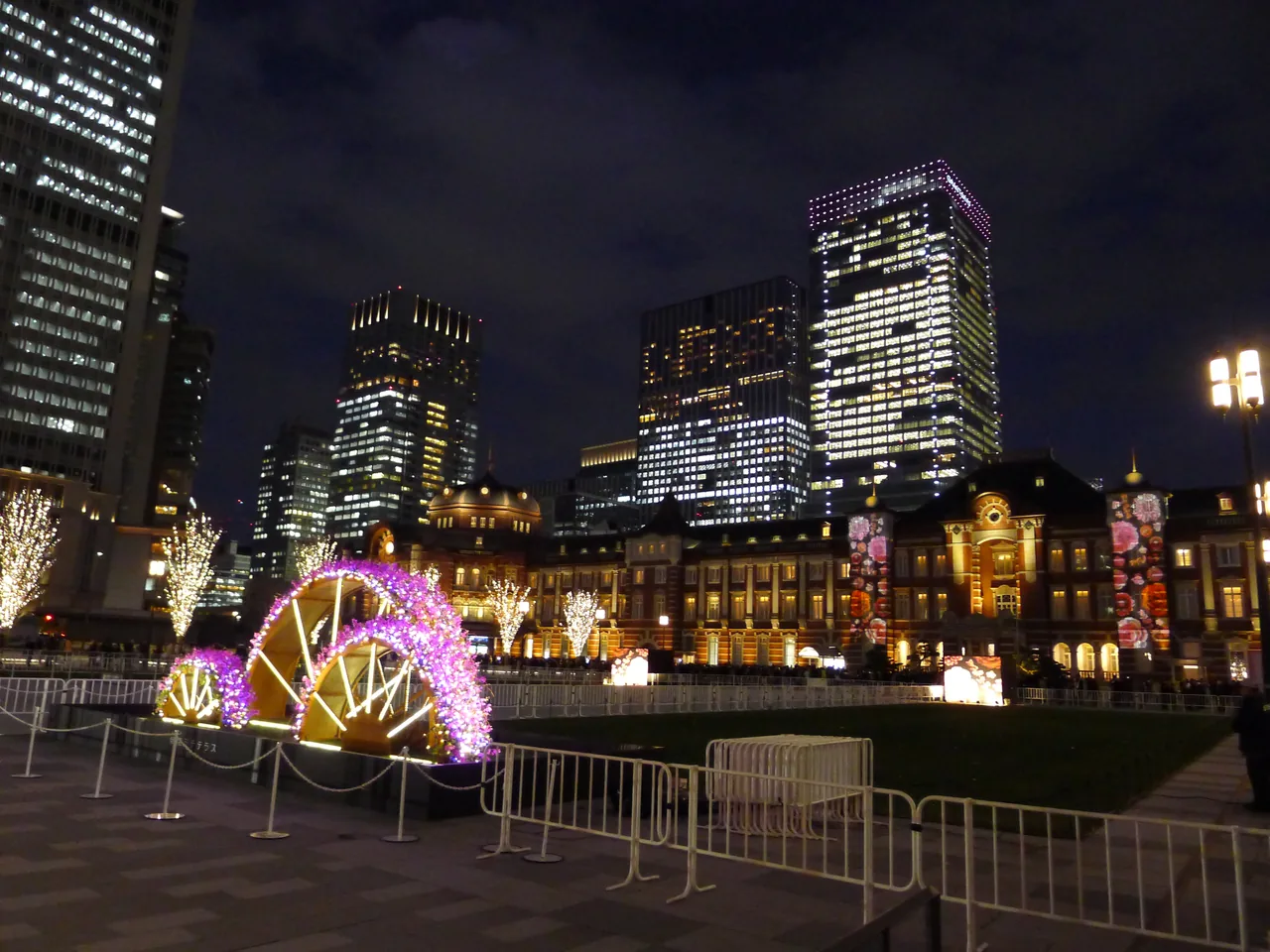
8. Roppongi: Keyakizaka and Tokyo Midtown
Keyakizaka is the one Tokyo illumination that changes its name mid-season and keeps every single light.
| What | Scale | Period | Hours |
|---|---|---|---|
| Roppongi Hills Christmas, on Keyakizaka | About 400 m of road, about 930,000 lights | Early November to Christmas | 17:00 to 23:00, opening night differs |
| Keyakizaka winter edition | The same road and the same 930,000 lights, in blue and white | Day after Christmas to late February | 17:00 to 23:00 |
| Tokyo Midtown Christmas | Midtown Garden | Middle of November to Christmas | 17:00 to 23:00 |
| Tokyo Midtown, walk of light | About 340,000 gold lights | Late November to late February | From early evening |
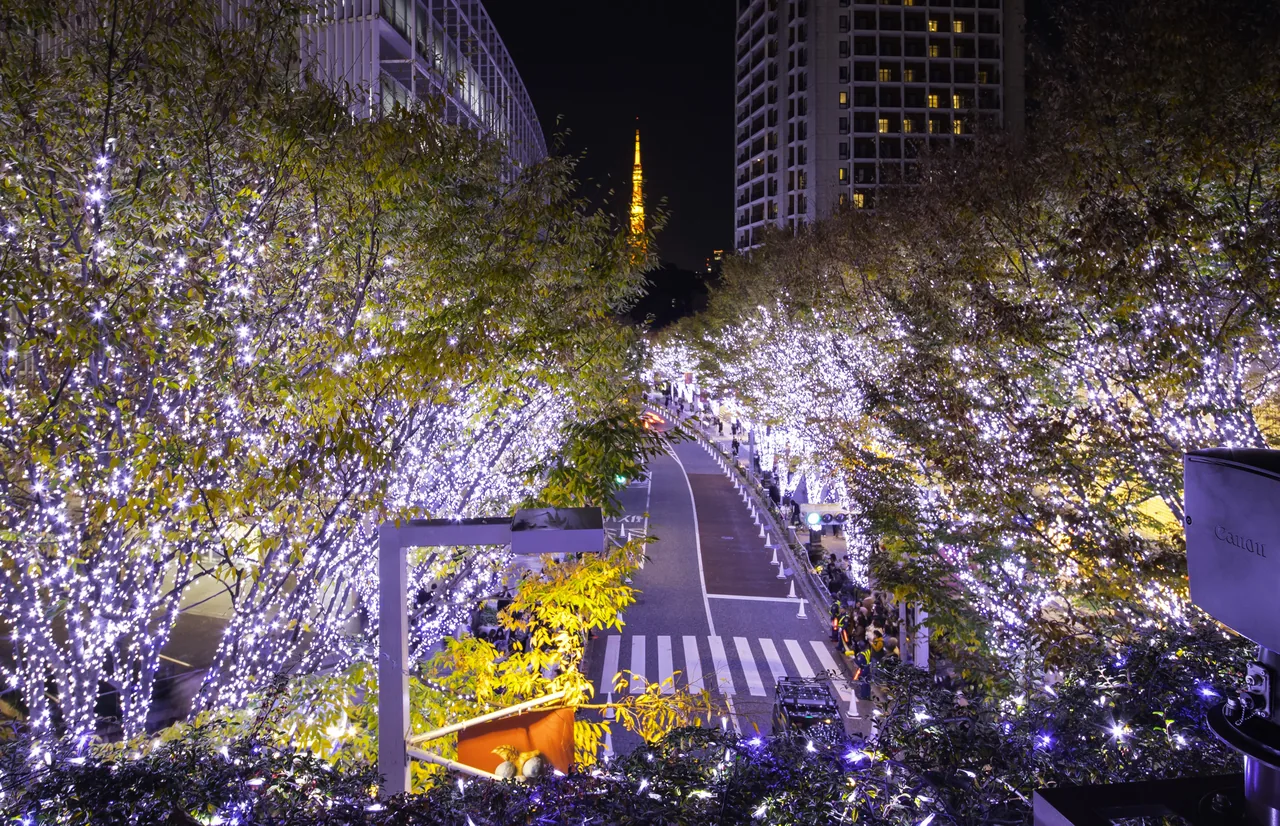
Keyakizaka is a sloping road about 400 metres long, and the slope is what makes it work. Standing at the top you look down a corridor of lit trees with Tokyo Tower squared up at the far end, which is why this one stretch of pavement produces more Tokyo winter photographs than anywhere else in the city.
Keyakizaka, RoppongiMapThe event name changes the day after Christmas and the colour goes from warm to blue and white. The light count does not move, the road does not shorten, and the hours stay at 17:00 to 23:00. A visitor in the middle of February sees the same 930,000 lights on the same slope as a visitor in the middle of December, in a different colour and with fewer people in the frame.
Roppongi HillsMapTokyo Midtown, a short walk away in the same ward, splits its season in two deliberately. The Christmas staging in the garden runs to Christmas and then stops. The walk of light, roughly 340,000 lights in gold, runs from late November all the way to late February and overlaps the Christmas programme rather than replacing it.
Tokyo MidtownMapThat overlap is the practical difference between the two venues. At Roppongi Hills the Christmas and winter programmes are the same installation under two names, so nothing is lost by arriving late in the season. At Midtown they are two separate things, so a February visitor gets the gold walk and not the garden.
Both venues light at the same hour, and both are indoors-adjacent, which matters in a season where the average low sits near freezing. Neither is a long walk from a station, and a single evening covers the pair without a train in between.
9. Ebisu Garden Place holds the longest free run
Ebisu Garden Place stays lit for 114 days, longer than any other free venue in Tokyo.
| Part of the site | Notes | Runs to | Hours |
|---|---|---|---|
| Whole site | Entrance pavilion, clock square, hill promenade, chateau square | Start of March | 16:00 to 23:00, from 17:00 on the opening day |
| Baccarat chandelier | Centre square, 26th edition | Middle of January | 11:00 to 23:00 |
The site is a single planned complex rather than a street, and the lighting is spread over four distinct areas: the entrance pavilion, the clock square, the sloping promenade and the chateau square at the top. That layout means the walk has a direction to it, from the station end up to the far square, and it takes as long as you want it to take.
Ebisu Garden PlaceMapThe centrepiece is a Baccarat chandelier in the centre square, in its twenty-sixth edition. It is also the piece that leaves first. The chandelier comes down in the middle of January while the rest of the site keeps running for another six or seven weeks, so a February visitor gets the site without its headline object.
The chandelier is unusual in another way. It is lit from eleven in the morning, not from four in the afternoon, which makes it the only piece of Tokyo winter lighting you can see in full daylight. In a season where nothing else starts before late afternoon, that turns Ebisu into a place you can visit twice on the same trip for two different effects.
The site’s own hours are 16:00 to 23:00, with a later start on the opening day only. Combined with the closing date at the start of March, this is the venue that decides whether a late-season trip has any illumination in it at all. Together with Midtown Hibiya, which finishes days earlier, it is one of only two free venues still lit in the last week of February.
Ebisu is one stop from Shibuya on the Yamanote line, which makes the pairing obvious in December when the Shibuya tunnel is running. In January and February that pairing disappears, and Ebisu becomes a destination on its own rather than the second half of an evening.
10. Shibuya and Omotesando run the shortest seasons
Shibuya and Omotesando hold the two shortest runs in the city, and both are effectively finished inside December.
| What | Scale | Period | Hours |
|---|---|---|---|
| Ao no Dokutsu Shibuya | About 900 m from Koen-dori to Yoyogi Park, about 500,000 blue lights | Three weeks in December, ending Christmas night | 17:00 to 22:00 |
| Omotesando, with Fendi | 154 zelkova trees, about 900,000 lights, about 1 km | December, low trees into the first third of January | Sunset to 22:00 |
Ao no Dokutsu is a blue tunnel about 900 metres long, running from Koen-dori down towards Yoyogi Park, with roughly 500,000 lights in a single cold colour. Three weeks is its entire life. It opens in the first week of December and switches off on Christmas night, which gives it the shortest window of any venue in Tokyo.
Koen-dori, ShibuyaMapThe route ends at the park, so the walk moves from department stores into trees within a kilometre. That transition is part of why the installation photographs the way it does, and it is also why the crowd is a moving one rather than a standing one.
Yoyogi ParkMapOmotesando is the larger of the two and the shorter-lived in a different way. Its 154 zelkova trees carry about 900,000 lights along roughly a kilometre of avenue, which makes it one of the two biggest free installations in the city by light count. The main run covers December only. After it ends, the low trees stay lit into the first third of January and the tall trees do not.
OmotesandoMapIts switch-on is tied to sunset rather than to a clock, so the start time slides later through the month while the 22:00 close stays put. The usable window therefore shrinks slightly as December goes on. The lighting has run under a fashion house’s sponsorship, and the sponsor name travels with the event title.
One administrative oddity is worth knowing when you read venue lists. Shibuya ward extends further north than most visitors assume, and the six facilities of the Shinjuku south side programme sit mostly inside Shibuya ward rather than Shinjuku ward. Ward names in official listings are not a reliable guide to which neighbourhood you are actually standing in.
For a January or February trip, these two are the losses. They are also the two that dominate social media in December, which is why the season looks shorter online than it is.
11. Shinjuku: the station’s south side and the government building
The projection mapping on the Metropolitan Government Building has no closing date, which makes it the only Tokyo light show you cannot arrive too late for.
| What | Scale | Period | Hours |
|---|---|---|---|
| Shinjuku Minami Lumi | Six facilities south of the station, 11th edition | Middle of November to the middle of February | 17:00 to 24:00, from 16:30 in December |
| Metropolitan Government Building projection mapping | 13,904.956 square metres of projection surface on the east wall of Building No. 1 | Year-round, no closing date | Nine winter weekday shows, 17:30 to 21:30 on the half hour |
Minami Lumi is a coordinated programme rather than a single installation. Six commercial facilities on the south side of the station light up together, now in the eleventh edition, and the effect is a lit corridor of walkways and terraces rather than one avenue of trees. It closes at midnight, the latest of any venue in the city, and from December it starts half an hour earlier than the rest of the season.
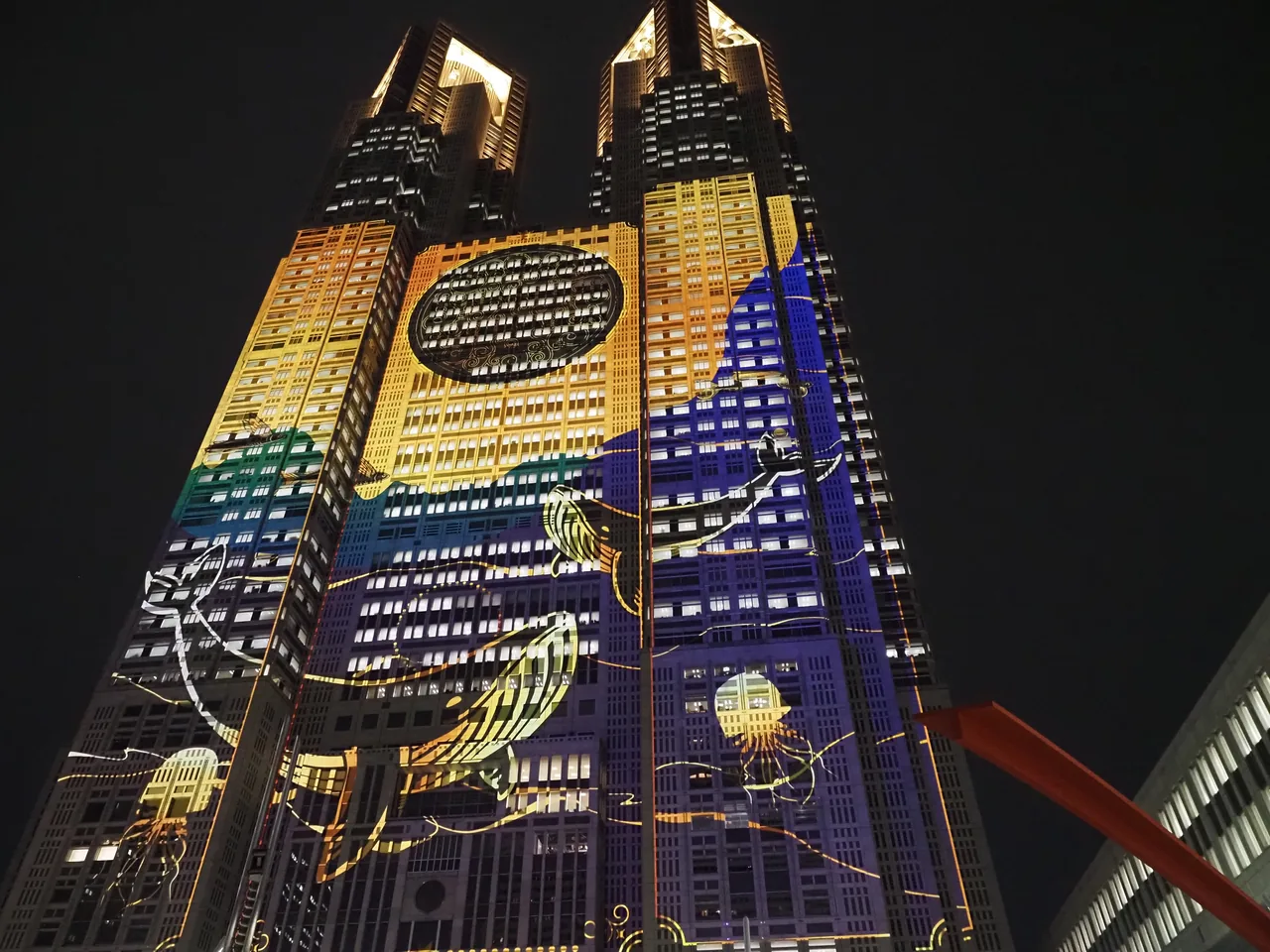
Shinjuku Southern TerraceMapOn the other side of the station, the west side, the government building runs a projection show on the east wall of its first tower. The projection surface measures 13,904.956 square metres, and the installation holds Guinness recognition as the largest permanent architectural projection mapping display. It is free, and the viewing area is the plaza in front of the wall.
Tokyo Metropolitan Government Building No. 1MapThe schedule is the useful part. On winter weekdays there are nine shows, starting at 17:30 and repeating every half hour until 21:30. That means you never need to plan around a single start time, and it also means this is the one fixed timetable in an evening where everything else is simply on or off.
Because it is permanent, it is also the answer to the awkward dates. A trip in March, or in the second week of January, or in a year when nothing else has confirmed its schedule, still has this. Nothing else on the list can say the same.
The two Shinjuku venues sit on opposite sides of the station, and the station is walkable underneath. One evening covers both comfortably, and the half-hourly shows mean the order does not matter much.
12. Sumida and Tokyo Skytree
Skytree runs the largest Christmas programme in Tokyo and takes all of it down on Christmas night.
| What | Detail | Period | Hours |
|---|---|---|---|
| Dream Christmas town lighting | About 530,000 lights, free | Start of November to Christmas | 17:30 to 22:00 |
| Special lighting | Begins a few days after the season opens | Second week of November to Christmas | Within lighting hours |
| Sky Arena projection mapping | Projected in the plaza at the base of the tower | To Christmas | Within lighting hours |
| Christmas market | Stalls in the town complex | To Christmas | Within lighting hours |
| Christmas Eve and Christmas night | Extended closing | Two nights only | To 24:00 |
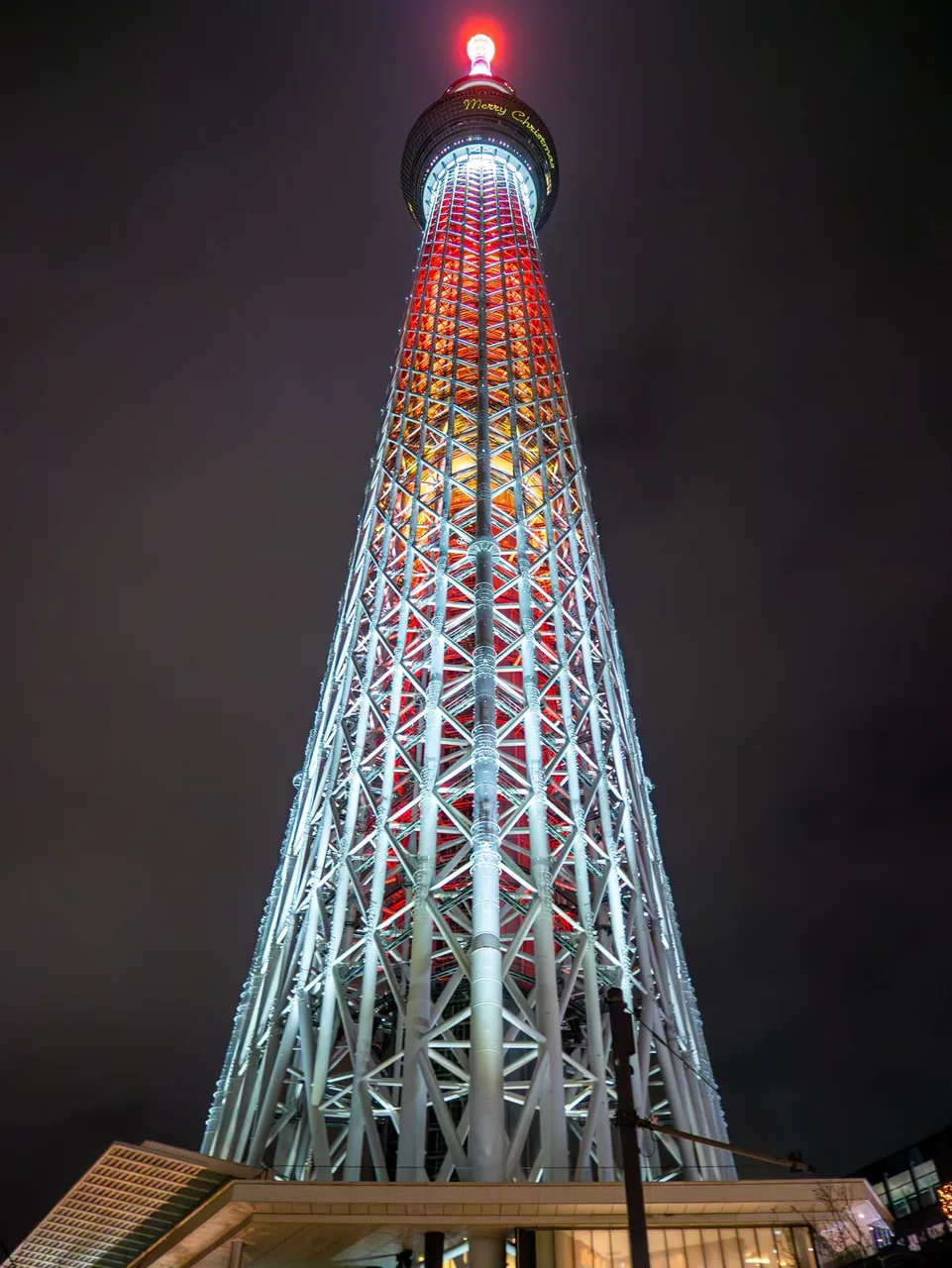
The programme has three parts that most venues do not attempt together: about 530,000 lights through the shopping complex, a projection mapping show in the arena at the base of the tower, and a Christmas market. It also has the longest lead-in of any Christmas-branded event in the city, opening at the start of November, with the special lighting following a few days later.
Tokyo Skytree TownMapThe town lighting is free, so the plaza and the shopping levels cost nothing to walk through. Standard hours are 17:30 to 22:00, which is the shortest daily window among the central venues, and the two nights of Christmas Eve and Christmas are the exception, running to midnight.
Then it all stops. After Christmas night the market, the projection mapping and the seasonal lighting are finished, which puts Skytree in a category of two along with the Shibuya tunnel. A visitor arriving in the second week of January will find the town complex open and the Christmas programme gone.
Geography reinforces the point. Skytree sits on the east side of the city, well away from the Marunouchi, Roppongi and Shibuya cluster, so it does not combine with any of them on foot or in a single short hop. It needs an evening of its own, and in December that evening is worth planning around the 22:00 close rather than the later closes downtown.
The 17:30 start is late enough that darkness is guaranteed for the whole run, in December and in the shoulder weeks either side. There is no blue-hour phase here, which suits the projection mapping and makes the arrival time less critical than at the 16:00 venues.
13. Inagi and the Yomiuriland lights
The only Tokyo illumination you pay to enter is also the largest by a wide margin and the last to close.
| Item | Value |
|---|---|
| Lights | About 6.5 million |
| Season | Late October to early April |
| Hours | 16:00 to 20:30 |
| Adult | 1,800 yen |
| Secondary school | 1,500 yen |
| Primary school, preschool, 65 or over | 1,000 yen |
| Not lit | Park closure days, and a stretch in early March when the park opens for weekday daytime hours only |
The scale is not close. About 6.5 million lights against roughly 775,000 on Marunouchi’s 1.2 km of avenue means something like eight times the count of the largest free installation in the city centre. That is possible because this is a theme park, not a street: the lighting is spread across a hillside site with rides running through it, rather than hung on a row of trees.
YomiurilandMapIt also owns both ends of the calendar. It opens in late October, weeks before any other venue, and closes in early April, weeks after the last of them. For a traveller whose dates are fixed and awkward, this is often the only lit option, and it is the reason the season stretches to four and a half months rather than three.
The cost is real but modest by theme park standards. An adult ticket is 1,800 yen, secondary school students pay 1,500 yen, and primary school children, preschoolers and visitors aged 65 or over pay 1,000 yen. Two adults with two primary school children come to 5,600 yen, which is the only illumination bill of the trip if everything else on the itinerary is free.
Two practical limits matter more than the price. The lighting closes at 20:30, two and a half hours earlier than central Tokyo, so a late dinner and a visit here do not fit in the same evening. And the park closes on its own scheduled days, with a stretch in early March given over to weekday daytime operation only, which means the park is open and the lights are not.
The location is Inagi, on the western edge of the metropolis rather than in central Tokyo. That is a train ride out and a train ride back, ending well before midnight because of the early close, so this works best as a deliberate evening rather than an add-on to a day downtown.
14. Putting one evening together
Switch-on times decide the order of an illumination evening, not distances.
| Pairing | On foot | Earliest start | Note |
|---|---|---|---|
| Marunouchi, Gyoko-dori and Midtown Hibiya | Yes | 16:00 | One continuous walk from Otemachi to Hibiya |
| Roppongi Hills and Tokyo Midtown | Yes | 17:00 | Same ward, short walk between them |
| Shinjuku south side and the government building | Yes | 16:30 in December, 17:00 otherwise | Opposite sides of one station |
| Ebisu and Shibuya | Partly | 16:00 at Ebisu | One stop apart on the Yamanote line; the Shibuya piece is December only |
| Tokyo Skytree | Own evening | 17:30 | East side of the city, closes at 22:00 |
| Yomiuriland | Own evening | 16:00 | Western edge of Tokyo, closes at 20:30 |
The 16:00 group is the natural opener, and not only because it is first. Those venues are lit while the sky still has colour, full darkness lands about an hour later, and the same trees give two different results inside that hour. Starting anywhere else wastes the only part of the evening that cannot be repeated.
From there the sequence runs west or south to a 17:00 venue. Marunouchi to Hibiya is a walk; Roppongi Hills to Midtown is a walk; Shinjuku’s two venues face each other across one station. Anything that needs a train between two lit places costs twenty to thirty minutes of an evening that only has five or six usable hours in it.
Two venues refuse to combine. Skytree is on the east side and closes at 22:00, and the theme park in Inagi is on the western edge and closes at 20:30. Each takes an evening, and each rewards arriving at the switch-on rather than after dinner.
The government building’s nine half-hourly shows are the only fixed timetable in the whole city, so an evening in Shinjuku can be built backwards from whichever show you want. Everywhere else is simply on, and you can arrive when you arrive.
Practical mechanics: an evening like this means four to six short train hops, all of them paid at a gate, so a stored-value card is worth having sorted before the first evening rather than during it. How the IC cards work is a five-minute read that saves queuing at machines in the cold. Where you sleep also does more work than usual in winter, because a base between Tokyo Station and Shibuya puts most of these venues inside twenty minutes and lets you go back to the room to warm up; choosing which district to sleep in is the decision that shapes every evening after it.
15. The one that stopped
One well-known Tokyo illumination has not run since the winter of 2019 and 2020, and old lists still recommend it.
Caretta Shiodome ran an illumination for years and held its last one from the middle of November 2019 to the middle of February 2020. The official page for the following winter still exists, and its title carries the cancellation notice in brackets ahead of the event name. It does not appear in any current season listing.
The building itself is fine. The complex is operating normally and has issued press releases for summer events, so what ended was the illumination and not the venue. That distinction matters because the address still turns up in search results attached to a light show that no longer happens.
Among the venues checked for the current season, this is the only confirmed discontinuation. There is no pattern of closures to worry about, and nothing in the data suggests another venue is about to follow. It is a single case, which is exactly why it keeps catching people out.
The useful habit is knowing which source is authoritative. A venue’s own news page is; an aggregated round-up is not, and an old event page on the venue’s own site is not either, because operators rarely delete them. Absence from the current season’s official announcement is the signal, not the presence of a page that looks official.
Announcement timing makes this worse than it sounds. Because winter venues publish between late August and late October, an aggregator page updated in September may carry only half the season’s confirmed venues and fill the rest from last year. That is how a cancelled event survives in listings for years after it stopped.
For planning, the practical form of this is simple. Check each venue you actually intend to visit against its own site once the season is announced, and treat any venue you cannot find in that season’s announcements as not running, however many blog posts still describe it.
16. When the crowds show up
The venues themselves show where demand sits, because four separate operators extend their hours in December and in no other month.
Marunouchi pushes its close from 23:00 to midnight for the whole of December. Gyoko-dori runs to midnight for its entire short life, all of which falls in December. The Shinjuku south side brings its switch-on forward by half an hour from the start of the month. Skytree, which normally closes at 22:00, stays on until midnight on the two nights of Christmas Eve and Christmas.
Four operators, four independent commercial decisions, one conclusion. None of them extends hours in January or February, and none of them needs to.
The short-run venues concentrate demand further. Ao no Dokutsu has three weeks and Omotesando has about four, so every visitor who wants either of them has to be there in December. The venues that run for 108 or 114 days spread the same interest across three or four times the nights.
Christmas is not a public holiday in Japan, which changes the shape of the crowd rather than its size. Christmas Eve is an ordinary working day, so the pressure arrives after office hours and builds through the evening instead of filling the afternoon. That is another argument for the 16:00 venues: their first hour is quiet even in the busiest week of the year.
Ten of the eleven venues are free and sit on public streets or in open plazas. There is no ticket cap, no timed entry and no way to reserve a slot, so the only levers you have are the day of the week and the hour you arrive. The theme park in Inagi is the exception, and a paid gate does more to regulate numbers than any amount of planning.
For comparison, Tokyo’s other big seasonal crowds behave differently. The summer festival calendar concentrates enormous numbers onto single fixed dates, which is a scheduling problem. Illuminations spread a smaller crowd across a whole month, which is a timing problem, and timing problems are the kind you can solve by turning up an hour earlier.
17. January and February on their own terms
The back half of the season trades venue count for weather, space and hours.
Eight venues are still lit in the middle of January: Marunouchi, Midtown Hibiya, Tokyo Midtown’s walk of light, Keyakizaka in its winter colours, Ebisu Garden Place, the Shinjuku south side, the theme park in Inagi and the projection mapping in Shinjuku. That is more than most first-time visitors expect to find after the holiday.
The count thins in stages rather than all at once. Six remain by the third week of February, once Marunouchi and the Shinjuku south side have finished in the middle of the month. Four remain in the final days of February, and after the start of March only the theme park and the projection mapping are left.
The weather argument is stronger than the venue count suggests. January delivers 192.6 hours of sunshine, more than any other month in Tokyo, and February is the driest month of the year at 56.5 mm. Clear, dry evenings are the normal case rather than the lucky one, which is not something December can promise more reliably.
There is one weak window inside this half of the season. Many shops and facilities close for about six days across the turn of the year, so the first days of January have the lights running while a lot of the city around them is shut. Everything reopens, but a trip built entirely into that window will feel thin outside the evenings. What December looks like elsewhere in Japan is the useful comparison if you are weighing the two halves against each other.
Two further costs are worth naming. The Christmas markets are gone, and Tokyo’s markets are compact events inside commercial complexes rather than European-scale affairs, so the loss is smaller than the word suggests. And the sun sets later, 17:07 by the end of January, so the wait for full darkness stretches out and an early evening start buys less than it does in December.
Against that, hotel evenings are easier. The venues that survive into February are the large, free, walkable ones in Marunouchi, Roppongi and Ebisu, which are also the districts with the most rooms within twenty minutes.
18. Dressing for it, and photographing it
The number to dress for is the overnight low, not the daytime high, because the lights are only on during the cold end of the day.
January averages a high of 9.8 C and a low of 1.2 C, a swing of 8.6 degrees, and the illumination hours sit at the bottom of that curve. December’s low is 3.8 C and February’s is 2.1 C. None of that is severe cold, but two hours of standing still on pavement is a different exposure from two hours of walking in daylight.
The dry figures change what you carry. At 56 to 60 mm of rain a month, a heavy waterproof shell is doing less work in a Tokyo winter than it would in June’s 167.8 mm, and an extra insulating layer is doing more. Gloves, a warm hat and something under the shoes matter more than a rain jacket.
One caveat on the numbers themselves: Tokyo’s official readings come from Kitanomaru Park, and minimums there run about 1.4 C below the Otemachi site used before 2014. Older climate figures therefore describe a slightly milder city than the current records do.
For photography, the timing is set by two facts. The earliest sunset is 16:28, and civil twilight runs about half an hour past sunset. So at the four venues that light at 16:00, there is roughly an hour in which the lights are on and the sky still holds colour, ending near five in the afternoon in early December and closer to twenty to six by the end of January.
That window does not exist everywhere. Omotesando switches on at sunset, so its lights and the last colour in the sky never really overlap. Keyakizaka, Tokyo Midtown Christmas and the Shibuya tunnel all start at 17:00, which in December is after full dark. If the blue-hour frame is what you want, it has to be Marunouchi, Ebisu, Midtown Hibiya or the theme park in Inagi.
The government building is the easiest subject to work on, because nine shows run every half hour on winter weekdays. You can shoot one, look at what you got, change something and wait thirty minutes for another attempt. Nothing else in the city gives you repeat takes.
Assume hand-held shooting in a moving crowd on a public pavement. Keyakizaka in particular is a working road with a view down the slope, which means the good position is also the position everyone else wants, and it is not a place to set up slowly.