
Late-Night Arrival at Haneda: Last Trains, Night Buses and the Gap Until 05:09
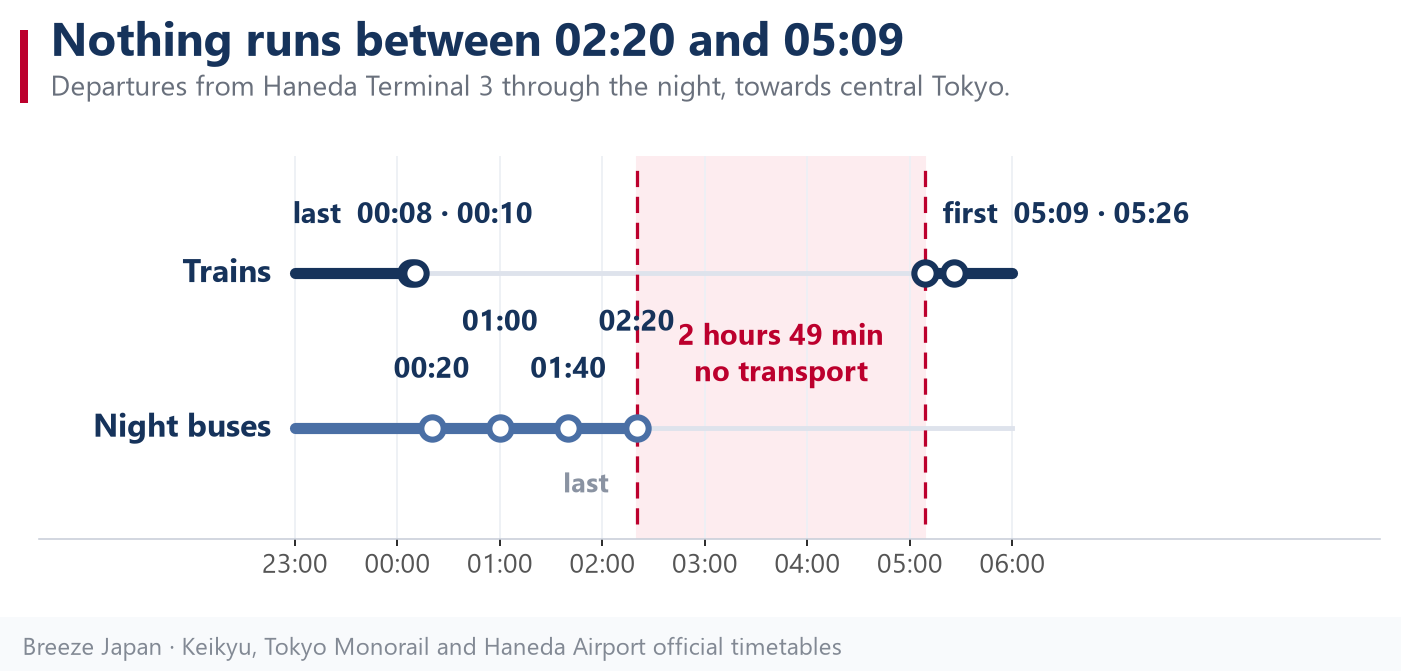
The last train into the city leaves Haneda at 00:10, the last night bus at 02:20, and the first train of the morning arrives at 05:09. Between the bus and the first train there is a stretch of two hours and forty-nine minutes with no public transport at all. Terminal 3 stays open through the night, but Terminals 1 and 2 do not, and that single fact decides where you spend those hours.
| Last train | 00:10 on the Monorail, 00:13 on the Keikyu Line. |
|---|---|
| Last bus | 02:20 from Terminal 3 towards Shinjuku and Ikebukuro. |
| The gap | Nothing runs into the city between 02:20 and the 05:09 first train. |
| Terminals | Only Terminal 3 stays open. Terminals 1 and 2 shut from 00:00 to 05:00. |
| Showers | Terminal 3 has them around the clock, and takes no reservations. |
| Narita | A runway curfew means an on-time flight never lands there late at night. |
1. Only one terminal stays open
2. Last train 00:10, last bus 02:20, first train 05:09
3. The trains stop before the buses do
4. Night buses run until 02:20
5. Between 02:20 and 05:09 nothing runs
6. You cannot wait on the secure side
7. Showers and reclining rooms at Terminal 3
8. Taxis have flat fares, and the amount is not published
9. Which airports are open in the middle of the night
10. Narita has no scheduled late-night arrival
11. Connecting to a domestic flight the next morning
12. Connecting to Narita for a morning departure
13. How long from touchdown to the arrivals lobby
14. A hotel at the airport or one in the city
15. What to have with you for the wait
16. The following day is the one that suffers
17. Check the times again before you fly
18. Group size and luggage change the answer
19. Find your situation and go
1. Only one terminal stays open
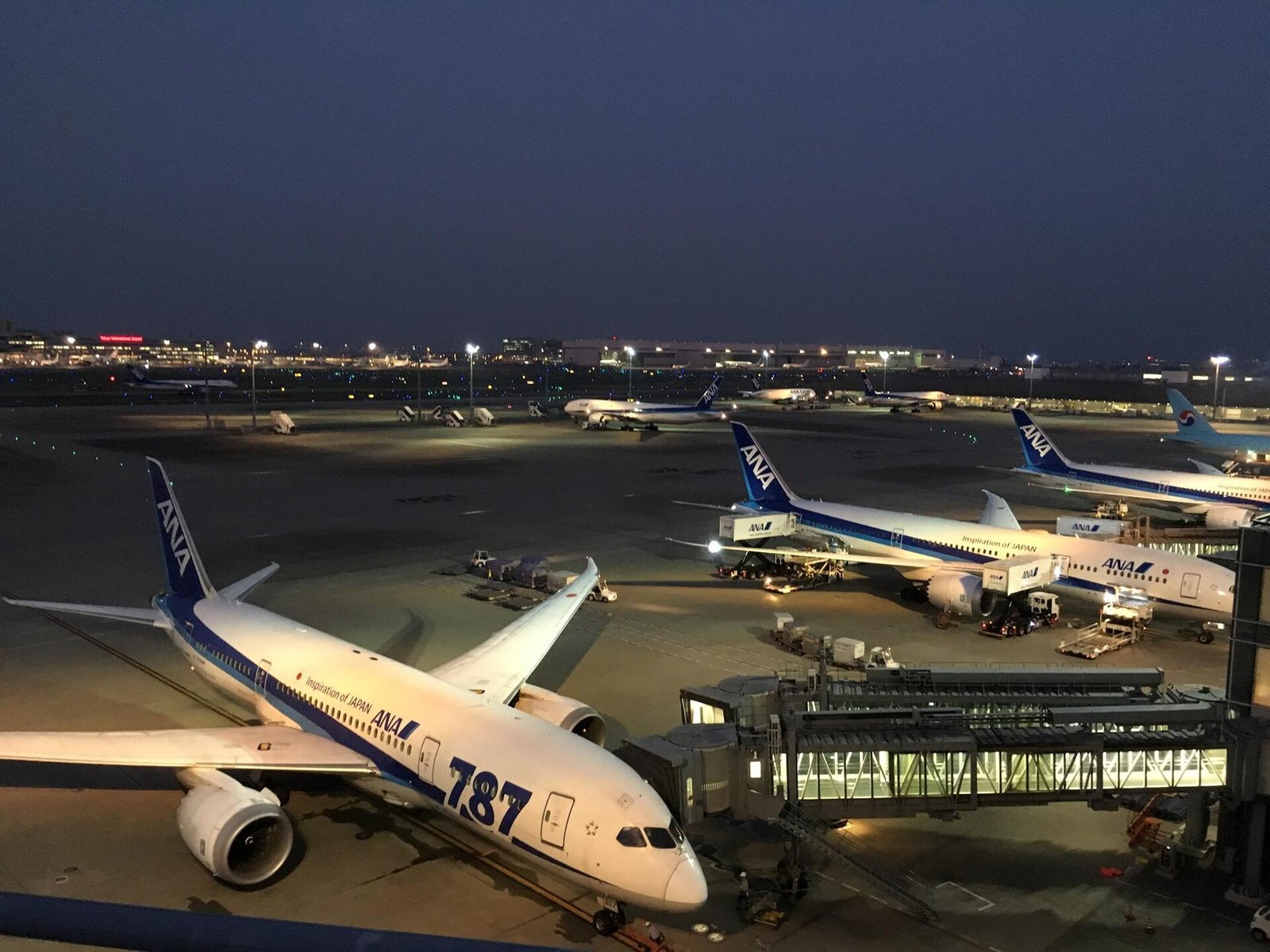
Haneda has three passenger terminals and only Terminal 3, the international one, is open through the night. Terminals 1 and 2 handle domestic flights and are closed to passengers from midnight to 05:00 as a general rule, so if you land on an international flight you are already in the right building and should stay in it.
| Terminal | Flights | Overnight |
|---|---|---|
| Terminal 3 | International | Open through the night |
| Terminal 1 | Domestic | Closed 00:00 to 05:00 |
| Terminal 2 | Domestic and some international | Closed 00:00 to 05:00 |
This catches people connecting onwards
A passenger who lands at 01:00 and has a domestic flight at 07:00 will often try to move to the domestic terminal and wait there. That does not work, because the building is shut at the hour they would arrive.
The move to Terminal 1 or 2 has to wait until the early morning. Until then, Terminal 3 is where you are, whatever your onward ticket says.
The airport is open, which is not the same as everything being open
Around the clock operation refers to the terminal itself and the runways. Shops, counters and rail ticket offices keep their own hours, and most of them are closed at 03:00.
Plan on the assumption that you can sit down, use a bathroom and buy from a vending machine. Anything beyond that is worth checking on the day rather than counting on.
Japan eSIM cost calculator
Enter how long you stay and how much data you expect to use. The table shows what each provider actually charges for that trip, what you get, and how many days you end up paying for but not using.
Rows are in a fixed order by provider. That order is not a ranking.
They price on different axes. Airalo sells a fixed ladder of trip lengths alongside a grid of data caps. Yesim sells unlimited by the exact day, so a 12-day trip costs 12 days rather than a 15-day package. Saily sells a few data bundles with a fixed validity, plus unlimited plans where you pick the number of days.
- Airalo · Network: Softbank 5G · KDDI 5G
- Airalo · Speed limit on unlimited packages: Unlimited means unlimited until 3 GB in one day. After that the speed drops to 1 Mbps for the rest of that day, then resets.
- Yesim · Network: not disclosed by the provider
- Saily · Network: not disclosed by the provider
- Saily · Speed limit on unlimited packages: Unlimited means unlimited until 5 GB in one day. After that the speed drops to 1 Mbps for the rest of that day, then resets.
- Every option here is data only. None of them gives you a local phone number, so if you need one for calls, deliveries or SMS codes, an eSIM of this kind is not the answer.
Working out what data will cost before you land: the eSIM cost calculator
2. Last train 00:10, last bus 02:20, first train 05:09
The last train into the city leaves at 00:10, the last night bus at 02:20, and the first train of the morning arrives at 05:09. Work out roughly when you will clear customs, then find that time in the table below.
| Time you reach the arrivals lobby | How you get into the city |
|---|---|
| Before 00:10 | Tokyo Monorail or the Keikyu Line |
| 00:10 to 02:20 | Night bus to Shinjuku and Ikebukuro, or to Yokohama until 01:20 |
| 02:20 to 05:09 | Taxi, or wait at Terminal 3 |
| After 05:09 | First train |
Landing time is not the number you want
An aircraft that touches down at 01:30 does not put you in the arrivals lobby at 01:30. Taxiing, immigration, the baggage belt and customs all sit between the two, and the total varies with how many flights arrived at once.
If you carry hand baggage only, you remove the longest and least predictable part of that sequence. On a late arrival that is worth more than it is on a daytime one.
Miss the last bus and you wait nearly three hours
If you get out before 02:20 you simply board something. It gets hard after that, because nothing runs into the city for the next two hours and forty-nine minutes.
Most guidance stops at the night bus, which is exactly where a delayed connection tends to leave you. The sections below carry on past it.
3. The trains stop before the buses do
Rail service out of Haneda ends shortly after midnight, more than two hours before the last night bus. The Tokyo Monorail runs until 00:10 and the Keikyu Line until 00:13, and both start again a little after five in the morning.
| Line | Towards | Last | First |
|---|---|---|---|
| Tokyo Monorail | Hamamatsucho | 00:10 | 05:09 |
| Keikyu Line | Shinagawa | 00:08 | 05:26 |
| Keikyu Line | Keikyu Kamata only | 00:13 | 05:26 |
These are Terminal 3 station times, and weekdays, Saturdays and holidays are identical. A Saturday arrival has no later service than a Tuesday one.
The final Keikyu train stops short
The 00:13 departure is the last one of the day, but it terminates at Keikyu Kamata rather than continuing to Shinagawa. The last train that runs through to Shinagawa without a change leaves five minutes earlier, at 00:08.
Five minutes is a small difference and the destinations are not. If you are heading into central Tokyo, treat 00:08 as your deadline and ignore the later departure.
Rail is the cheapest option and it is available longer than people assume
Passengers on a late flight often assume rail is already finished and start pricing taxis while still on the aircraft. If you reach the lobby at 23:40 you have a train, and it costs a fraction of the alternatives.
The Monorail reaches Hamamatsucho in about 20 minutes and the Keikyu Line reaches Shinagawa in about 15. The night bus to Shinjuku takes around 50 minutes, so rail is faster as well as cheaper where it goes.
Two gate locations, two different directions
At Terminal 3 the Keikyu gates for the city and Yokohama are on the second floor, in the arrivals lobby. The gates on basement level 2 lead to Terminals 1 and 2, which is a different journey altogether.
The Monorail has gates on the second floor and again on the third. With a last train a few minutes away, getting the floor right matters more than getting to the station quickly.
4. Night buses run until 02:20
After the trains finish, five more departures leave Terminal 3, and the last of them is at 02:20. Two destinations are served overnight and everything else on the airport bus network waits for morning.
| Towards | Departures from Terminal 3 | Stop |
|---|---|---|
| Shinjuku and Ikebukuro | 00:20, 01:00, 01:40, 02:20 | 3 |
| Yokohama Station and Sakuragicho | 01:20 | 7 |
| Shinjuku and Ikebukuro, from Terminal 1 | 00:10 | 4 |
| Shinjuku and Ikebukuro, from Terminal 2 | 00:05 | 5 |
Yokohama has a single departure
One bus per night serves Yokohama Station and Sakuragicho, at 01:20. Compared with four departures towards Shinjuku, that leaves very little room if immigration runs slowly.
Riding a Shinjuku bus and doubling back is not a workaround either, since the two destinations lie in opposite directions from the airport. Missing the 01:20 puts you into the taxi and waiting decision an hour earlier than everyone else.
The airport bus network does not run around the clock
The Tokyo Bus Association states plainly that services are not operated 24 hours. The departures in the table above are the whole of the overnight offering, and routes towards Akasaka, Ginza, Shiodome and Akihabara are suspended rather than merely infrequent.
Older trip reports still list those routes, which is how travellers end up looking for a stop that no longer takes passengers. Check the current network for your arrival date rather than trusting a write-up from a previous year.
Buy the ticket before you go to the stop
Tickets come from a machine or a counter inside the terminal, not from the driver at the kerb. The counter may be closed at that hour, so locate a machine while you are still in the arrivals lobby.
Even a short queue costs a few minutes, and those minutes come out of your margin for the 02:20 departure. Treat ticket purchase as part of the journey rather than something you do on the way out.
5. Between 02:20 and 05:09 nothing runs
Once the last night bus has left, the next departure into the city is the 05:09 Monorail, two hours and forty-nine minutes later. There is no rail service, no bus and no shuttle in that window.
| Line | First train | Wait after 02:20 |
|---|---|---|
| Tokyo Monorail, towards Hamamatsucho | 05:09 | 2 hours 49 minutes |
| Keikyu Line, towards Shinagawa | 05:26 | 3 hours 6 minutes |
First trains are the same on weekdays and at weekends. The Monorail leaves 17 minutes earlier, so it sets the end of the gap.
Choose the first train by destination, not by clock
The Monorail departs first but only reaches Hamamatsucho, where most passengers change to another line. The Keikyu Line leaves 17 minutes later and runs through to Shinagawa and beyond without a change.
Saving those 17 minutes and then changing trains at Hamamatsucho with luggage rarely comes out ahead. Work out where you are going before deciding which first train to wait for.
Yokohama passengers face a longer gap
The single overnight bus towards Yokohama leaves at 01:20, a full hour before the last Shinjuku departure. Anyone heading that way enters the empty window an hour sooner.
It is a common error to read the 02:20 figure, assume it applies to every destination, and plan a Yokohama arrival around it. The deadline that applies to you depends on where you are going.
Only a taxi crosses the gap
Inside that window the choice narrows to two: pay for a taxi, or stay at Terminal 3 until the first train. Group size, luggage and the following day’s schedule settle which one makes sense.
Travelling alone with a cabin bag usually favours waiting. Three people with checked suitcases usually favour one taxi, because the fare is shared and the luggage stops being a problem.
6. You cannot wait on the secure side
After landing you pass immigration and customs and come out into the public part of the terminal, and you cannot go back through security to wait near a gate. Departure security opens in line with the morning flights, not for passengers who want somewhere quiet at 03:00.
This surprises people who are used to connecting airports where a transit lounge is always available. At Haneda an international arrival puts you landside, and landside is where you stay until check-in opens for whatever you fly next.
What being landside actually gives you
The arrivals area has seating, bathrooms and vending machines, and it is the part of the building that stays lit and staffed overnight. It is not a lounge, and the seating is ordinary public seating with armrests.
If sleeping matters to you, the paid options below are worth the money precisely because the free seating is not designed for it. Anyone who has spent a night on airport benches already knows this.
Jet lag changes the calculation
Passengers arriving from Europe or North America are often wide awake at 03:00 regardless of what the seating is like. In that case the wait is easier than it sounds and a taxi fare is harder to justify.
Coming from a shorter flight within Asia, the opposite tends to hold. The same three hours feel very different depending on which direction you crossed.
7. Showers and reclining rooms at Terminal 3
Terminal 3 has shower rooms on the second floor of the arrivals lobby and they are open around the clock. Terminal 2 has them only during the day, and Terminal 1 has none at all, which is one more reason the international terminal is where you stay.
| Where | Hours | Price |
|---|---|---|
| Terminal 3, standard room | 24 hours | ¥1,500 for 30 minutes, ¥750 per extra 15 |
| Terminal 3, refresh room | 24 hours | ¥3,000 for 60 minutes, ¥1,500 per extra 30 |
| Terminal 2 | 05:00 to 22:00, last entry 21:30 | ¥1,500 for 30 minutes |
| Terminal 1 | No shower rooms | Not applicable |
The refresh rooms are the ones with a chair
A refresh room contains a reclining chair as well as the shower, which makes it the closest thing in the building to somewhere you can lie down without booking a hotel. There are five of them against 21 standard rooms.
At an hour for ¥3,000, two of the three hours you need to fill costs ¥6,000. Against a taxi fare into central Tokyo that is not obviously the expensive choice, and you arrive in the morning having slept and washed.
No reservations, so arrival order decides
The airport states that reservations are not accepted. Rooms go in the order people turn up, and several late flights landing together will produce a queue.
Towels, shampoo, conditioner, body soap and a hairdryer are provided in each room. A toothbrush and a razor cost extra, so bring your own if you have them in your bag.
Where this fits against a hotel
For a three hour wait, a shower and a chair cover the need at a fraction of a room rate. For a six hour wait before a morning domestic flight, a room starts to win.
The dividing line is roughly whether you want to sleep properly or simply arrive at your first appointment presentable. Only one of those requires a bed.
8. Taxis have flat fares, and the amount is not published
Haneda operates flat fares to the 23 wards of Tokyo and to Kanagawa Prefecture, with expressway tolls charged on top. The airport does not publish the amounts and directs passengers to ask the taxi companies, so treat any figure you find online as unverified.
A flat fare means the meter is not running, which removes the risk of a slow route costing you more. It does not mean the total is small, and the tolls are a separate line on the bill.
Two different pick-up points
Ordinary taxis wait at the rank on the first floor, by the arrivals lobby. Taxis booked through an app or reserved in advance use separate stands, near exit 7 on the second floor at Terminal 1 and near exit 2 on the second floor at Terminal 2.
Standing at the wrong one at three in the morning is a slow way to learn this. If you intend to book through an app, find the stand before you order the car.
Confirm the fare before you get in
Since the published guidance stops short of an amount, the reliable moment to ask is at the rank, before loading your luggage. Staff are present at the airport rank and the flat fare for your destination is a routine question.
Anyone quoting you a precise figure in advance is guessing. The structure is documented, the number is not.
9. Which airports are open in the middle of the night
A flight can only land in the small hours at an airport that operates around the clock. The Japanese airports that do are listed below, and everywhere else closes overnight, so a schedule that looks late still puts you on the ground before midnight.
| Airport | Late-night arrivals |
|---|---|
| Haneda | Scheduled |
| Kansai | Scheduled |
| Chubu Centrair | Yes |
| New Chitose | Yes |
| Naha | Yes |
| Kitakyushu | Yes |
Fukuoka is not on the list
Fukuoka carries a great deal of traffic from Korea and Taiwan and is not a 24 hour airport, so the problem in this article does not arise there. Travellers often assume otherwise because the airport sits so close to the city.
Kitakyushu, in the same prefecture, does operate around the clock. The two are easy to conflate and they behave differently after midnight.
Kansai and Naha have the same shape of problem
Both take scheduled late arrivals, so the question of what runs after the last train applies there too. The specific times differ and the Haneda figures in this article do not transfer. At Kansai the wait is longer: the last ride into the city is the 00:15 night bus to Umeda, and the first Nankai train leaves at 05:45, about 5 hours 30 minutes later. How to get through that gap is in our guide to late-night arrival at Kansai Airport.
Naha is the gentler case because the city centre is close to the airport, which keeps a late taxi within reason. Kansai sits further out and behaves more like Haneda.
10. Narita has no scheduled late-night arrival
Narita operates under a runway curfew, so an on-time flight does not land there in the middle of the night. Guidance that treats Narita and Haneda as one late-arrival problem has the premise wrong.
| Airport | Operating hours |
|---|---|
| Narita, Runway A | 06:00 to 24:00, extended to 24:30 under flexible operation |
| Narita, Runway B | 06:00 to 23:00 |
| Haneda | 24 hours |
Delays are the exception
Weather or a late inbound aircraft can push a flight into the extended window, and those arrivals do happen. They are the result of disruption rather than the schedule, which changes what you should do about them.
When a delay causes you to miss the last connection, the airline is the first place to ask. What is offered depends on the cause, and that assessment belongs to the carrier rather than to the airport.
The airport pair matters when you book
A late Haneda arrival is a choice you make at the booking stage, usually because the fare is lower. A late Narita arrival is not available at all, so the two airports are not interchangeable for an overnight itinerary.
If the cheaper fare lands at Haneda after midnight, add the cost of getting into the city to the comparison. That addition often closes the gap between the two tickets.
11. Connecting to a domestic flight the next morning
The trains towards the domestic terminals run later than the trains into the city, and the terminals themselves are shut when those trains arrive. This combination catches people who check a timetable and assume the building follows it.
| Line | Last towards Terminals 1 and 2 | First |
|---|---|---|
| Keikyu Line | 00:23 | 05:28 |
| Tokyo Monorail | 00:16 | 05:12 |
A train departing at 00:23 will carry you to a terminal you cannot enter. The service and the opening hours are set by different operators and they do not line up.
Wait in Terminal 3 and move in the morning
The practical sequence is to stay in the international terminal overnight and travel across once the domestic buildings reopen. The first Monorail towards Terminal 2 leaves at 05:12 and the first Keikyu train at 05:28.
Inter-terminal free buses also exist, and their overnight operation is restricted in the same way. Plan the move for after five rather than trying to do it at three.
An early domestic departure is a tight fit
Changing from an international arrival to a domestic flight usually means collecting your bags and checking them in again, on top of the terminal transfer. None of that is quick at the start of the day.
A late morning or afternoon domestic flight removes the pressure entirely. The first departure of the day, after a night without a bed, is the version of this plan that goes wrong.
12. Connecting to Narita for a morning departure
The two airports are 1 hour 45 minutes apart by the official reckoning, and the link does not operate overnight. Landing at Haneda after midnight and departing from Narita in the morning is an itinerary with no sleep in it.
Buses and trains between the airports run during the day. In the small hours the only way across is a taxi, over a distance that makes the fare substantial.
Move the night to the Narita side
Where the schedule cannot be changed, the workable version is to cross early and rest near Narita rather than near Haneda. That turns a rushed morning transfer into a short walk.
The alternative is to accept the taxi cost and treat it as part of the airfare. Either way the expense belongs to the itinerary, not to bad luck on the night.
They sit on opposite sides of the city
Haneda is on Tokyo Bay to the south, and Narita is in Chiba Prefecture to the east. The distance between them is a journey in its own right rather than a transfer.
Booking both legs through the same airport removes the problem. The fare difference rarely covers the cost and the hours of crossing between them.
13. How long from touchdown to the arrivals lobby
Every deadline in this article is measured from the arrivals lobby, and the time between landing and reaching it is not fixed. Immigration, the baggage belt and customs each add an interval that depends on how many aircraft arrived together.
A late arrival often coincides with several other late arrivals, since the schedule bunches at the end of the day. That is precisely when the queues are longest.
Hand baggage removes the longest wait
Passengers with cabin bags only skip the baggage belt, which is the least predictable part of the sequence. On a night when you are trying to reach a 02:20 bus, that alone can decide it.
If you have checked luggage and are aiming for the last bus, a landing in the one o’clock hour gives a comfortable margin. Later than that and you should have a fallback in mind before you land.
Complete the entry formalities in advance
Immigration and customs declarations can be prepared online before you travel, which shortens the queue you join. Filling in forms after landing puts you behind everyone who did it earlier.
Doing this in the air requires onboard connectivity, and doing it after landing requires a working data connection. Both are avoidable by preparing before departure.
14. A hotel at the airport or one in the city
If your next day starts early, paying for a room near the airport is simpler than crossing the city twice. Haneda has accommodation attached to the terminal, which removes the transfer at both ends of a short night.
| Compare | At the airport | In the city |
|---|---|---|
| Getting there | On foot or a short move | Taxi or the first train |
| Next morning | You still have to travel in | Your day starts where you are |
| Cost | Room only | Room plus the fare to reach it |
You are paying a night rate for a few hours
Checking in at 02:00 and leaving at 07:00 is five hours against a full night’s price. Whether that is reasonable depends entirely on what the next day requires of you.
An early Shinkansen or a morning domestic flight generally justifies it. A leisurely start in the afternoon generally does not, and the first train costs nothing beyond the fare.
Check that reception is staffed overnight
Going straight to a city hotel requires that somebody is there to check you in. Smaller properties often have no overnight staff, and self check-in systems vary in how late they operate.
Entering your arrival time when you book usually resolves this. Reservations have been released before now because a guest arrived at four in the morning without warning.
15. What to have with you for the wait
Three hours in a terminal at night is much easier if you packed a few things, none of which you can reliably buy at that hour. They all fit in a cabin bag.
| Item | Why it matters at 03:00 |
|---|---|
| Power bank | Sockets in the seating areas are limited |
| A layer to put on | The building is cool in the early hours |
| Something to drink | Shops may be closed |
| Yen in cash | Vending machines and small purchases |
Cash matters more at this hour than during the day, since the machines that are still running take coins and notes. Card acceptance is covered in the cash and cards guide.
Luggage storage is not guaranteed
Coin lockers are limited in number and may all be occupied overnight. Assume you will have your bags with you for the whole wait.
Where luggage is heavy, the balance tips towards a taxi or a room near the airport. In practice the number of suitcases changes this decision more often than the number of people does.
Top up your travel card before you need it
If you intend to take the first train, load the card in advance so that the gate is not where you discover the balance is short. Ticket windows are unstaffed at that hour.
On an iPhone the card can be issued and topped up before you leave home. That is one queue removed from a night that has enough of them.
16. The following day is the one that suffers
The real difficulty with a late arrival shows up the following day. Reaching a bed at four in the morning leaves three or four hours of sleep, and a full itinerary planned on top of that rarely holds together.
Hotel check-in is usually mid-afternoon, so an early morning arrival at your accommodation means storing bags and filling the hours until the room is ready. The arrival time and the check-in time are simply not compatible.
Book the previous night if the budget allows
Paying for the night you arrive, rather than starting from the following one, removes the storage problem and the wait. It costs one more room night and returns most of a day.
For a short trip that trade is usually worth making. On a two week itinerary it matters less, because one slow morning is easier to absorb.
Leave the first morning empty
Timed entry tickets and anything requiring a reservation belong on the second day or later. The morning after a late arrival is not a slot you should commit to in advance.
Starting in the afternoon has very little practical downside. If you book an early attraction and then miss it, the ticket is gone.
17. Check the times again before you fly
Every departure time here comes from official sources, and airport notices state that overnight bus times can change with the flight schedule. One check before you travel is enough to catch a revision.
There are three places to look: the airport’s own guidance, the bus operators, and the rail companies for the first and last trains. Confirm against your arrival date rather than the current month, since seasonal timetables exist.
Suspended routes are the common trap
Several airport bus routes are listed as suspended rather than removed, so they still appear in older articles and in some search results. Building a plan around one of them ends with you looking for a stop that is not operating.
The same applies to daytime routes, which is worth knowing if your return journey is at an ordinary hour. Check the network rather than a single route.
Rail timetables are revised on fixed dates
The first and last trains quoted here come from the current published timetables at Terminal 3 station. Revisions happen on announced dates and shift departures by a few minutes at a time.
A few minutes rarely changes which of the three cutoffs you fall into. It can matter if you were relying on the very last train, so check that one specifically.
18. Group size and luggage change the answer
The same arrival time produces different decisions depending on who is with you. A flat taxi fare does not increase with the number of passengers, which is what drives the comparison.
| Travelling | Tends towards |
|---|---|
| Alone | Night bus, or waiting for the first train |
| Two | Taxi worth considering for closer destinations |
| Three or more | Taxi usually wins |
| With children | A bed, whatever the group size |
Children change it completely
Waiting in a terminal until dawn is an adult’s option. With children the priority moves from cost to somewhere to lie down, and the arithmetic stops being the deciding factor.
A few hours of proper sleep near the airport protects the next day. A child who starts the trip exhausted sets the tone for more than one morning.
Suitcases weigh more than people in this decision
Large cases make the bus harder, the wait harder and the taxi more likely. Three adults with three large cases may not fit in a single vehicle, which changes the sums again.
When the luggage is heavy, staying near the airport and moving in daylight is the simplest version. Hauling cases through a transfer at four in the morning is the hardest.
Once the trains restart, a day pass may be the cheaper way to move. The thresholds are in the Tokyo transport passes guide.
Yokohama is 27 to 28 minutes from Haneda on the Keikyu Line, which is closer than Ueno, Shibuya or Shinjuku. Starting the trip there instead is worked through in the Yokohama travel guide.
19. Find your situation and go
Your arrival time and your destination are enough to settle this. Locate the row that matches and the decision is made.
| Situation | Do this |
|---|---|
| Out by 23:40, heading to Shinagawa or Hamamatsucho | Last Monorail or Keikyu train |
| Out in the one o’clock hour, heading to Shinjuku | Night bus, up to 02:20 |
| Out before 01:20, heading to Yokohama | The 01:20 night bus |
| Past 02:20, three or more of you | Flat-fare taxi |
| Past 02:20, travelling alone | Terminal 3 until the 05:09 first train |
| Early start the next morning | A room at the airport |
| Departing from Narita | Cross early and stay on that side |
Most of this is settled at booking
Comparing arrival times while choosing the ticket removes the need for the table above. A cheaper late flight carries a cost in transport and sleep that belongs in the comparison.
Where the saving is smaller than the taxi fare, the cheaper ticket is not cheaper. Look at the arrival time and your destination together.
If you prepare one thing
Work out when you expect to reach the arrivals lobby and hold it against 00:10, 02:20 and 05:09. Those three numbers cover every version of this night.
After that, data. Ride-hailing, maps and messaging your accommodation all depend on a connection working the moment you land.