
Where to Stay in Osaka: 5 Best Areas Compared (2026)
Umeda/Kita, Namba & Dotonbori, Shin-Osaka, the Bay Area near USJ, or Tennoji/Abeno — which of Osaka’s five areas actually fits your trip, decided by trip shape, transport and the lodging tax, not by fear of picking wrong.
| Best all-round pick for most first-timers | Namba & Dotonbori — the most walkable, most central to food and nightlife, and sitting right on the Midosuji subway line that runs the length of the city. |
|---|---|
| Osaka is more forgiving than Kyoto — don’t over-optimize | the Midosuji line strings Shin-Osaka, Umeda, Namba and Tennoji together end to end, so almost any central zone works fine. The real decision is your trip shape: heavy Shinkansen day-tripping (lean Shin-Osaka or Umeda), nightlife and food (lean Namba/Dotonbori), or a USJ-first family trip (lean the Bay Area). |
| Cheapest and best value | Tennoji/Abeno and Shin-Osaka give you the most reliable rooms per yen, with solid multi-line transport and business/value hotels rather than resort pricing. |
| The splurge | Umeda/Kita has Osaka’s densest cluster of five-star international hotels — quieter and more upscale at night than Namba, right at the JR/Hankyu/Hanshin transit hub. |
| Families and USJ-first trips | the Bay Area near Universal Studios Japan, with official park-partner hotels; 2026 is USJ’s 25th-anniversary year, which is pulling extra crowds and booking pressure specifically to this zone — book earlier than you normally would. |
| The lodging tax | Osaka charges a flat, low accommodation tax per person, per night (exempt under ¥5,000, then ¥200–¥500 by tier) — much lower and flatter than Kyoto’s tax, which tops out at ¥10,000. |
1. The short answer: which Osaka area is right for you?
2. The one decision in Osaka: trip shape, not fear of a wrong pick
3. How Osaka lays out
4. Zone 1 — Umeda & Kita
5. Zone 2 — Namba & Shinsaibashi / Dotonbori
6. Zone 3 — Shin-Osaka
7. Zone 4 — Bay Area (near USJ)
8. Zone 5 — Tennoji & Abeno
9. Getting around Osaka from your base
10. Osaka’s lodging tax
11. Business hotel vs apart-hotel vs luxury vs USJ resort hotel
12. When to book & seasons
13. Getting to your hotel from the airport
14. Decision matrix by traveller type
15. Continue planning your Osaka trip
1. The short answer: which Osaka area is right for you?
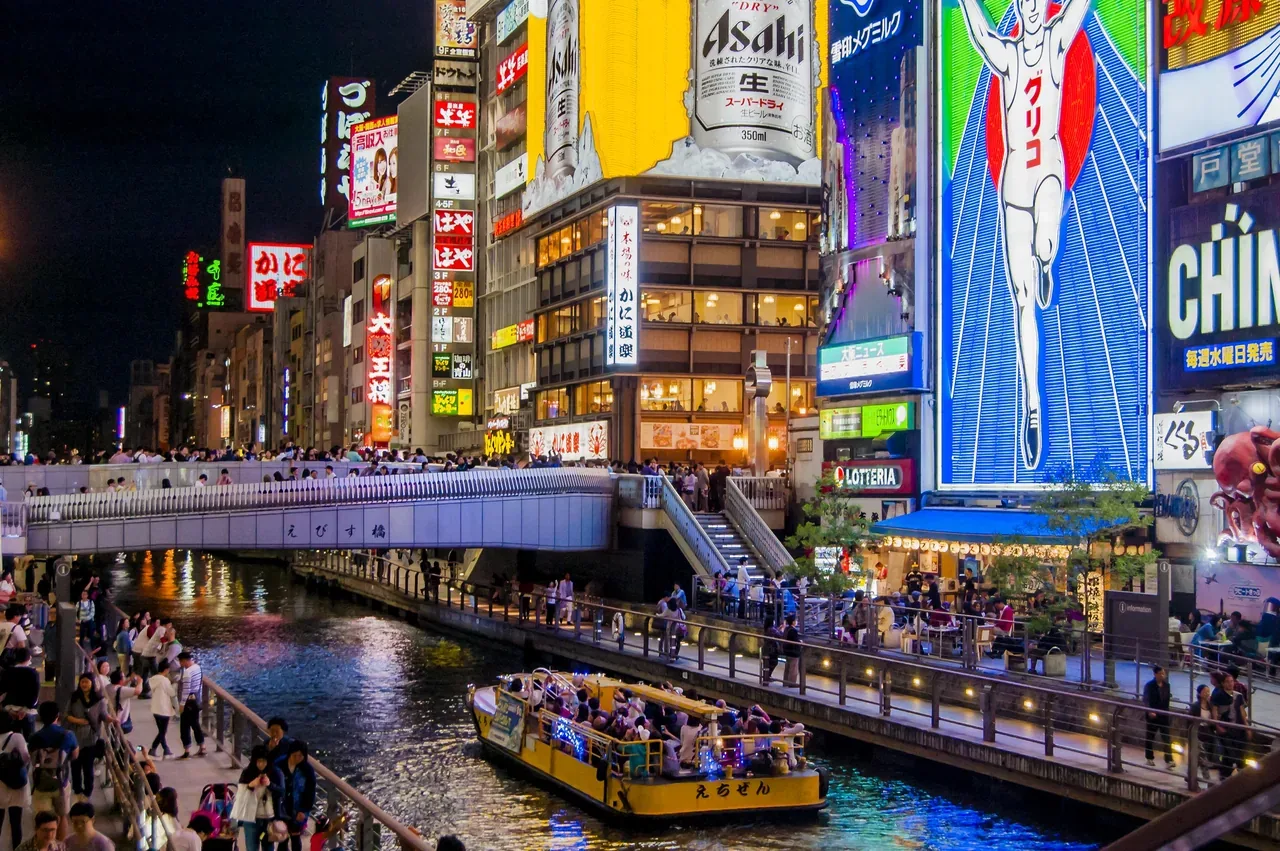
For most first-timers the best base is Namba & Dotonbori — the most walkable, closest to Osaka’s signature food and nightlife, and directly on the Midosuji subway line. But unlike Kyoto, there’s genuinely no wrong answer here: Osaka’s subway grid is dense enough that almost any central zone gets you everywhere else in 20–30 minutes.
That’s the single biggest thing to understand before you book: Osaka doesn’t punish an “imperfect” area choice the way Kyoto does. Read the scan table below like a menu — who each area suits, what a typical mid-range room runs, and whether it’s an easy first-timer pick — then dive into the zone sections for the honest detail, cons included.
| Area | Vibe in 3 words | Best for | Mid-range/night | Atmosphere | First-timer? |
|---|---|---|---|---|---|
| Umeda & Kita | Polished, business, transit | Day-trippers, business travel, upscale quiet evenings | ¥15,000–30,000 | Corporate-central, calmer at night | ★ Great (easy) |
| Namba & Dotonbori | Neon, buzzy, nonstop | Foodies, nightlife, first-timers, couples | ¥13,000–28,000 | Loud, lively, tourist-central | ★ Top pick |
| Shin-Osaka | Functional, fast, gateway | Heavy Shinkansen day-tripping, JR Pass users, early departures | ¥10,000–20,000 | Practical, little atmosphere | Good (if day-tripping a lot) |
| Bay Area (near USJ) | Resort, family, park-first | USJ-focused families, theme-park trips | ¥18,000–40,000+ | Resort-style, quiet after dark | So-so (unless USJ is the point) |
| Tennoji & Abeno | Local, grounded, value | Budget travellers, longer stays, retro-food fans | ¥9,000–18,000 | Local, less touristy | Good (value) |
The rest of this guide unpacks each zone honestly, then matches a base to your trip type and the season. New to the city overall? Start with our complete Osaka travel guide and come back here for the where-to-sleep decision.
2. The one decision in Osaka: trip shape, not fear of a wrong pick
Osaka has a real subway spine — the Midosuji line runs Shin-Osaka → Umeda → Namba → Tennoji, connecting nearly everything worth reaching — so unlike Kyoto, almost any central zone works. The actual decision is about your trip’s shape, not which zone is “correct.”
Osaka is not Kyoto — the grid actually works here
Kyoto forces a real trade-off because its subway is only two thin lines and the sights are spread east-to-west with buses filling the gaps. Osaka is a different city entirely: the Midosuji subway line runs a straight north–south spine through the four busiest districts, and it’s backed up by the JR Osaka Loop Line circling the centre and connecting out to the Bay Area and USJ. Practically, that means you can sleep in Umeda and be in Dotonbori in about 20 minutes, or sleep in Namba and be at Shin-Osaka for a bullet train in a similar window.
Because of that, the honest advice is: don’t over-optimize. Instead, match your base to the shape of your trip.
| Your trip shape | What matters most | Lean towards |
|---|---|---|
| Lots of day trips by Shinkansen (Kyoto, Kobe, Hiroshima, Tokyo) | Minimal transfer time to the bullet train | Shin-Osaka, or Umeda (a few Midosuji stops away) |
| Food and nightlife first | Walking distance to Dotonbori, Shinsaibashi-suji, izakaya-hopping | Namba & Dotonbori |
| USJ-anchored family trip | Short hop to the park gates, resort-style hotel amenities | Bay Area |
| Business trip or quieter evenings | Upscale hotels, calmer streets after dark, transit hub | Umeda & Kita |
| Budget-first, longer stay | Value rooms, still on the subway grid | Tennoji & Abeno, or Shin-Osaka |
3. How Osaka lays out
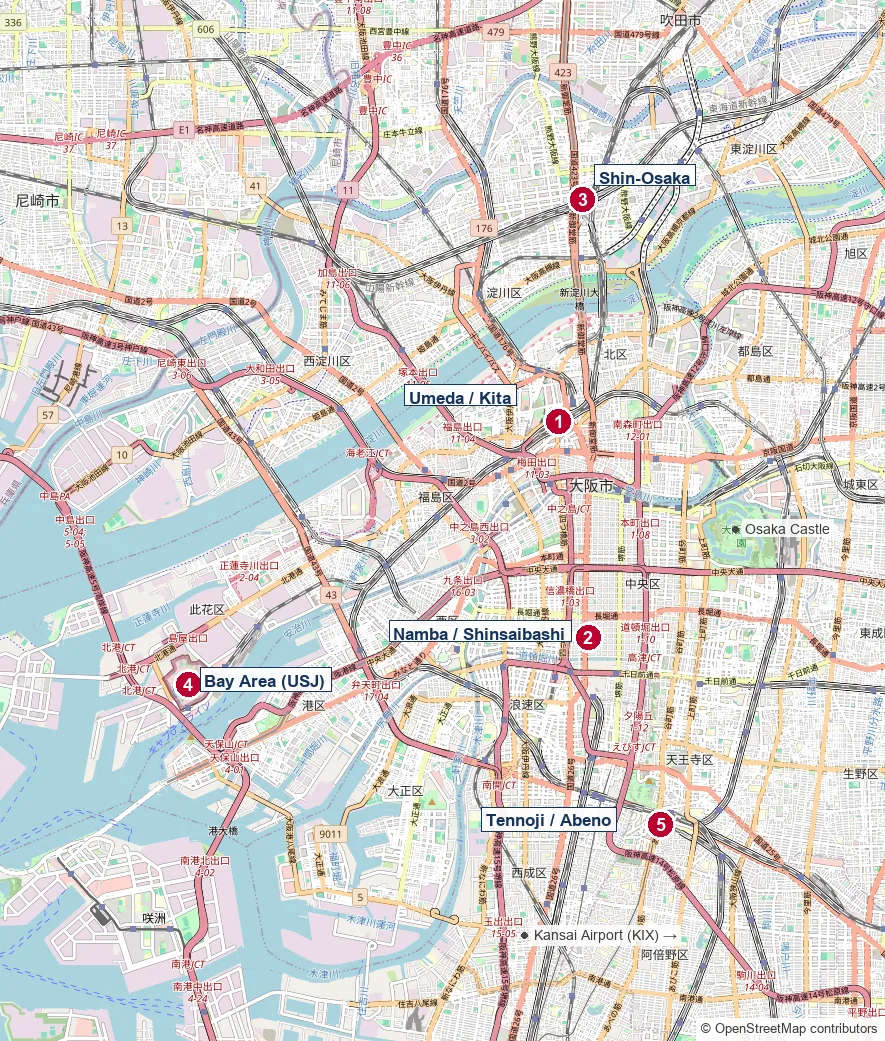
Picture Osaka as a line running north to south, with a resort pocket sitting off to the west: once you see how the five zones string along that line, choosing between them gets much simpler.
Start at the northern gateway, Shin-Osaka Station Shin-Osaka Station, OsakaMap, where the Shinkansen arrives. Head a few Midosuji subway stops south and you reach Osaka Station and Umeda Osaka Station, OsakaMap, the business and transit core where JR, Hankyu and Hanshin all converge. Continue south down the same line and you land in Namba Namba Station, OsakaMap, the gateway to Dotonbori Dotonbori, OsakaMap, the canal-front strip with the Glico sign and the Shinsaibashi-suji arcade — Osaka’s tourist-central heart. Keep going south on the Midosuji line and you reach Tennoji, anchored by Abeno Harukas Abeno Harukas, OsakaMap, Japan’s former tallest building, and the ancient Shitennoji Temple Shitennoji Temple, OsakaMap, founded in 593 CE, nearby. Off to the west, reached by the JR Loop Line and the Yumesaki line, sits the resort-style Bay Area around Universal Studios Japan Universal Studios Japan, OsakaMap.
How to read it
Two mental anchors make the city click. The Midosuji subway line is the spine: Shin-Osaka, Umeda, Namba and Tennoji sit on it in that order, north to south, so moving between any of them is a short, direct subway ride. The Bay Area is the one detour — it sits west of the spine, reached via the JR Loop Line to Bentencho or Nishikujo and then a transfer to the Yumesaki line into Universal City, or a direct JR line from Osaka Station. It’s not far, but it is a deliberate side-trip rather than a stop on the main line.
The map below plots these landmarks so you can see how the zones relate before you choose.
4. Zone 1 — Umeda & Kita
At a glance: Osaka’s polished, quieter, best-connected core — Osaka Station ties together JR, Hankyu and Hanshin lines, making it the natural pick if day trips, business travel or an easy exit matter more than late-night noise.
Stay here if you’re day-tripping a lot by JR or Shinkansen, travelling for business, want upscale hotels and calmer streets after dark, or like being steps from Grand Front Osaka’s shopping and dining. Skip it if you want to walk straight out into Dotonbori-style nightlife, or you want a more local, less corporate feel — Umeda is built for movement and business, not late-night wandering.
The trade-off is honest: Umeda’s nightlife thins out earlier than Namba’s and the area can feel a touch corporate after dark, especially around the office towers north of the station. You’re about 15–20 minutes from Dotonbori’s late-night action via the Midosuji subway, which is convenient but not a walk.
| Hotel | Style | Price band | Sub-area | Photos & rates |
|---|---|---|---|---|
| The Ritz-Carlton, Osaka | Luxury | ¥¥¥¥ | Central Umeda | 📷 Photos, check price |
| InterContinental Hotel Osaka | Luxury | ¥¥¥¥ | Grand Front Osaka, north Umeda | 📷 Photos, check price |
| Hotel Granvia Osaka | Upper/full-service | ¥¥¥ | Inside Osaka Station | 📷 Photos, check price |
| The Royal Park Canvas – Osaka Kitahama | Boutique/mid | ¥¥¥ | Kitahama, quieter south edge | 📷 Photos, check price |
| Hotel Hankyu Respire Osaka | Business | ¥¥ | Near Hankyu Umeda | 📷 Photos, check price |
| HOTEL LiVEMAX Umeda Doyama | Budget | ¥ | Doyama-cho, north Umeda | 📷 Photos, check price |
Price bands above are a rough guide: ¥ = value (roughly under ¥12,000), ¥¥ = mid (¥12,000–25,000), ¥¥¥ = upper (¥25,000–50,000), ¥¥¥¥ = luxury (¥50,000+), for a well-reviewed double at rack rate — the real-time rate for your dates is what actually matters, so treat these as orientation, not a quote.
Rate links in this guide (Trip.com, Agoda, Booking.com) are affiliate links — we may earn a small commission at no extra cost to you, and it’s always worth comparing the live price before booking.
Who each suits: the Ritz-Carlton and InterContinental are Osaka’s top international luxury picks, both well north of the station near Grand Front’s shopping; Hotel Granvia Osaka is the convenience play, literally inside the station building; Royal Park Canvas Kitahama is the quieter boutique option on the calmer south edge of the district; Hankyu Respire is a dependable business hotel steps from Hankyu Umeda; and LiVEMAX Doyama is the straightforward budget bed in north Umeda’s bar-and-dining pocket.
5. Zone 2 — Namba & Shinsaibashi / Dotonbori
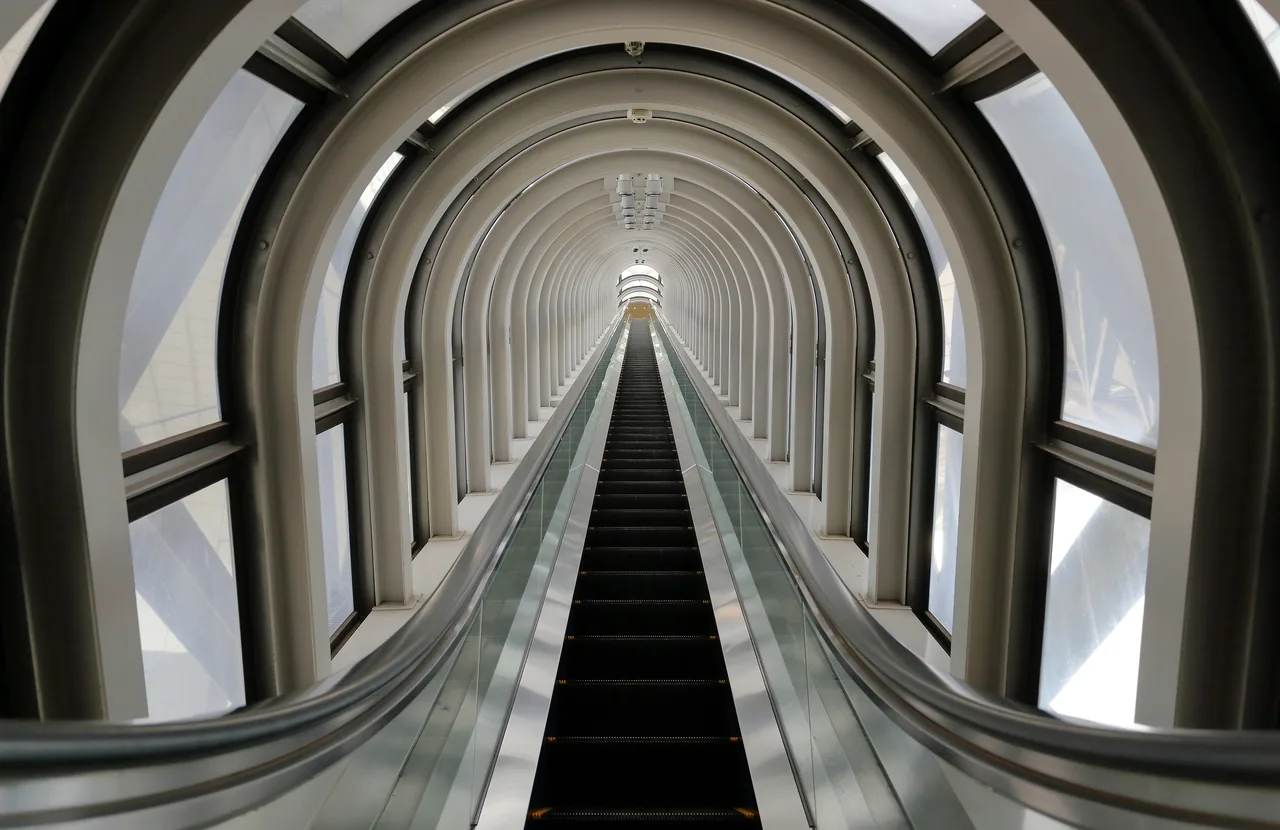
At a glance: Osaka’s tourist-central nightlife heart — the Dotonbori canal, the Glico running-man sign, and the Shinsaibashi-suji shopping arcade are all walkable from here, on the same Midosuji subway spine as everything else. This is the buzziest, most “Osaka” zone, and it can be genuinely loud at night.
Stay here if food and nightlife are the priority, you’re a first-timer who wants to walk to dinner and back, or you simply want to be in the middle of the action without needing transit. Skip it if you need quiet sleep, you’re travelling with young kids on an early bedtime, or crowds wear you down — Dotonbori draws heavy foot traffic well into the evening, especially on weekends.
The honest downside is noise: canal-front and arcade-adjacent rooms pick up crowd sound, street music and delivery-scooter traffic late into the night, and the area gets genuinely packed on weekends and holidays. It’s also more tourist-dense than any other zone, which some travellers love and others find exhausting after a few days.
| Hotel | Style | Price band | Sub-area | Photos & rates |
|---|---|---|---|---|
| Swissotel Nankai Osaka | Luxury | ¥¥¥¥ | Directly atop Namba Station | 📷 Photos, check price |
| The Royal Park Hotel Iconic Osaka Midosuji | Upper | ¥¥¥ | Shinsaibashi/Midosuji | 📷 Photos, check price |
| Courtyard by Marriott Osaka Honmachi | Upper-mid | ¥¥¥ | Honmachi, quieter north edge | 📷 Photos, check price |
| Citadines Namba Osaka | Apart-hotel (kitchenette) | ¥¥ | Namba | 📷 Photos, check price |
| Toyoko Inn Osaka Semba Higashi | Budget-business chain | ¥¥ | Semba | 📷 Photos, check price |
| &AND HOSTEL HOMMACHI EAST | Hostel/budget | ¥ | Honmachi | 📷 Photos, check price |
Who each suits: Swissotel Nankai sits directly above Namba Station itself, about as convenient as a luxury stay gets; Royal Park Iconic is the upscale pick right on the Shinsaibashi/Midosuji shopping stretch; Courtyard by Marriott Honmachi trades a few minutes’ extra walk for a noticeably calmer night’s sleep; Citadines is the apart-hotel choice with a kitchenette for families or longer stays; Toyoko Inn Semba Higashi is the reliable budget-business chain bed; and &AND HOSTEL is the simplest budget option, a short walk from the arcade.
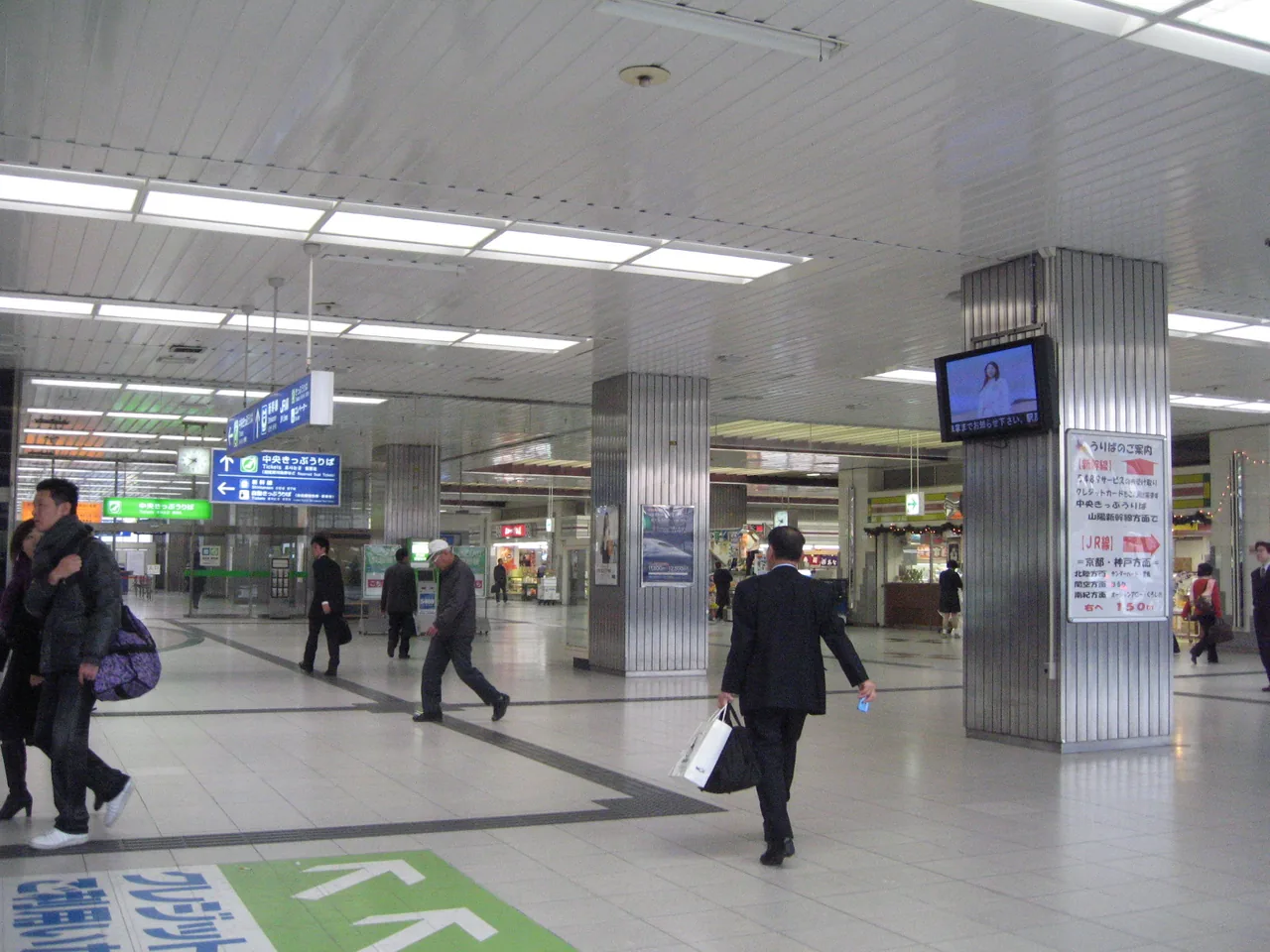
6. Zone 3 — Shin-Osaka
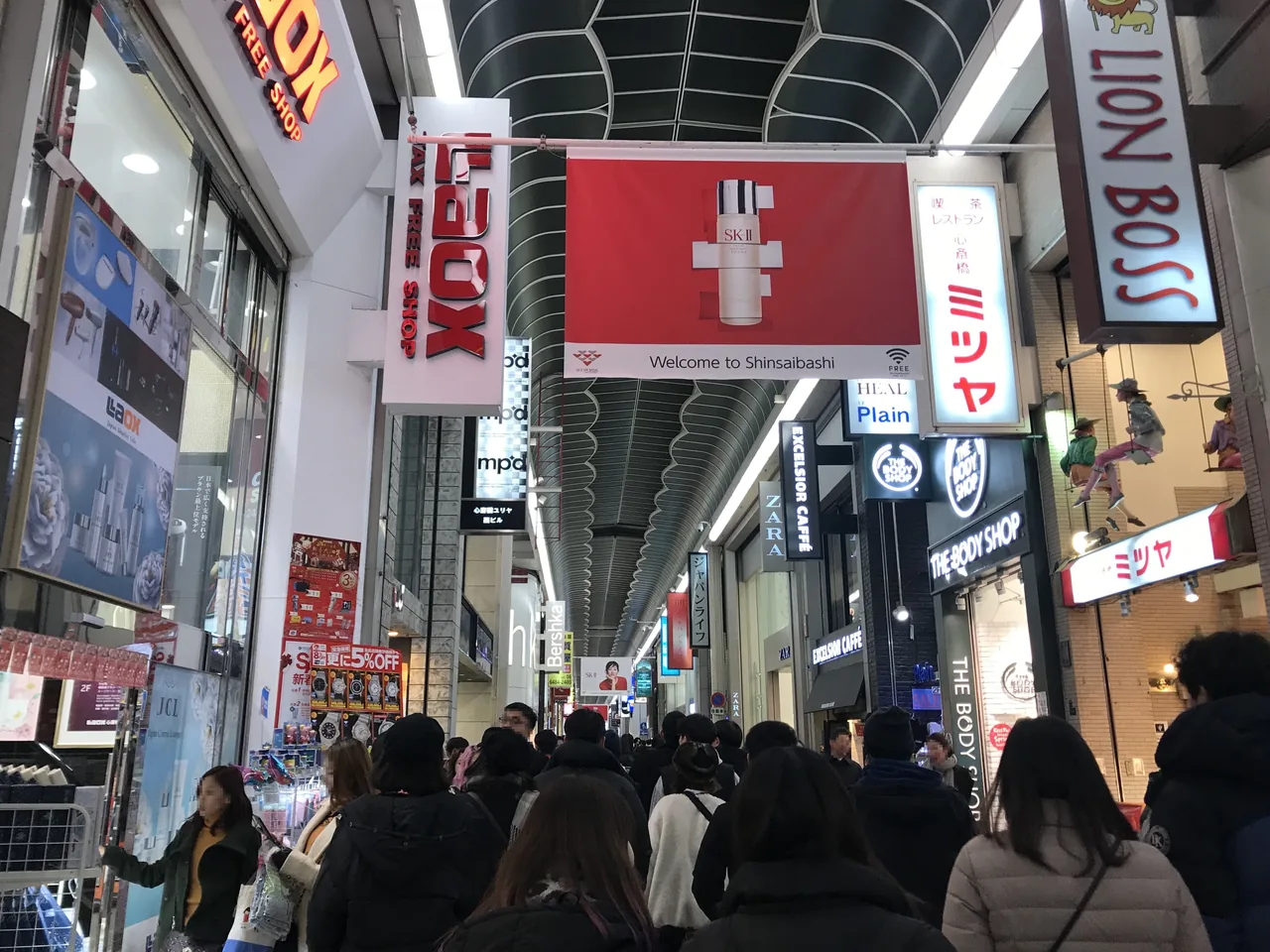
At a glance: the Shinkansen gateway — bullet trains to Kyoto (~15 min), Kobe (~13 min), Hiroshima (~1.5 hr) and Tokyo (~2.5 hr) all leave from here. It’s functional rather than atmospheric, and it earns its keep specifically if you’re day-tripping a lot by bullet train.
Stay here if you’re using the Shinkansen frequently, you’re a JR Pass holder who wants the station on your doorstep, or you have an early departure or late arrival and don’t want to cross the city with luggage. Skip it if you don’t plan to use the bullet train much — you’d be paying a transit-convenience premium for a benefit you’re not using, and central Osaka’s nightlife and dining are a subway ride away rather than a walk.
The honest downside is atmosphere: this is a station district of business hotels and office buildings, not somewhere you’ll linger in the evening. Our JR Pass and Kansai pass guide is worth a look before you commit to a Shin-Osaka base, since whether the pass pencils out affects how much you’ll actually value being right at the station.
| Hotel | Style | Price band | Sub-area | Photos & rates |
|---|---|---|---|---|
| Remm Shin-Osaka | Upper business | ¥¥¥ | Directly at Shin-Osaka Station | 📷 Photos, check price |
| karaksa hotel grande Shin-Osaka Tower | Mid, newer tower | ¥¥¥ | By the station | 📷 Photos, check price |
| Comfort Hotel Shin-Osaka | Mid | ¥¥ | Near the station | 📷 Photos, check price |
| Shin Osaka Washington Hotel Plaza | Business | ¥¥ | Near the station | 📷 Photos, check price |
| HOTEL MYSTAYS Shin Osaka Conference Center | Budget-business | ¥ | Near the station | 📷 Photos, check price |
| Osaka Tomato Hostel | Hostel/budget | ¥ | Near the station | 📷 Photos, check price |
Who each suits: Remm Shin-Osaka is the polished pick for stepping straight off the Shinkansen into your lobby; karaksa hotel grande is the newer tower option with modern rooms nearby; Comfort Hotel and Shin Osaka Washington Hotel Plaza are dependable mid-range and business standards; MYSTAYS Conference Center is the budget-business fallback; and Osaka Tomato Hostel is the cheapest bed for travellers optimizing purely around train logistics.
7. Zone 4 — Bay Area (near USJ)
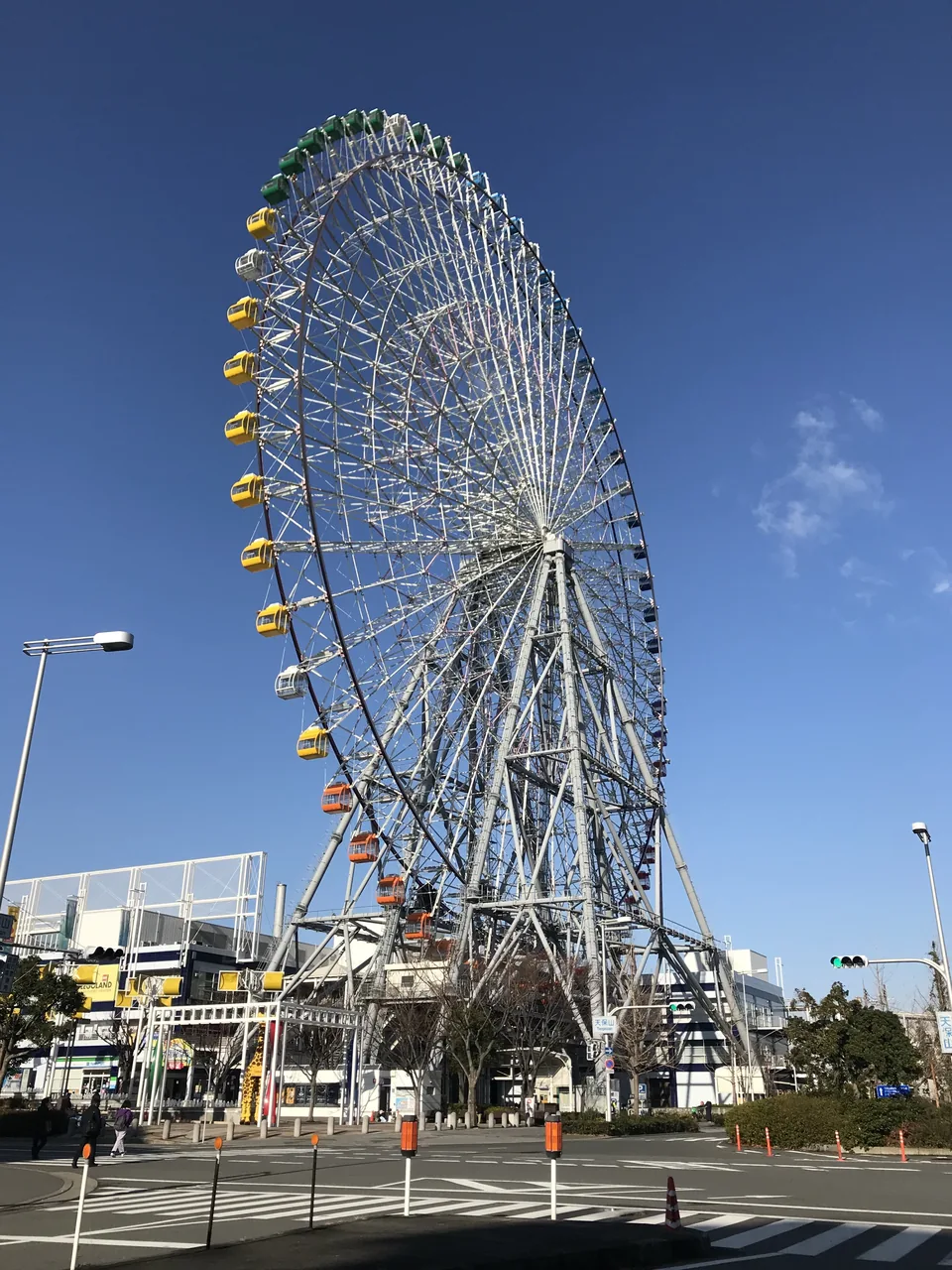
At a glance: resort-style hotels clustered around Universal Studios Japan, with the Osaka Aquarium Kaiyukan and the Tempozan Ferris wheel nearby. Easy park access is the whole point here — it’s genuinely less convenient for everything else in the city.
Stay here if USJ is the anchor of your trip, you’re travelling with kids and want an early start at the gates, you value resort-style hotel amenities over city buzz, or you’re visiting during USJ’s 2026 25th-anniversary year and want to lock in a room early. Skip it if USJ isn’t on your itinerary — this zone adds real transfer time to Namba, Umeda and everywhere else, purely to save a few minutes getting into the park.
The honest downside beyond distance: dining options thin out fast once you’re outside the park’s own restaurants and the hotels’ in-house options, and prices near USJ can spike hard around event periods and school holidays.
| Hotel | Style | Price band | Sub-area | Photos & rates |
|---|---|---|---|---|
| THE SINGULARI HOTEL & SKYSPA at UNIVERSAL STUDIOS JAPAN | Luxury, USJ-adjacent | ¥¥¥¥ | Universal City | 📷 Photos, check price |
| Grand Prince Hotel Osaka Bay | Upper resort | ¥¥¥ | Osaka Bay/Cosmosquare area | 📷 Photos, check price |
| The Park Front Hotel at Universal Studios Japan | Upper, official USJ partner | ¥¥¥ | Universal City | 📷 Photos, check price |
| HOTEL UNIVERSAL PORT | Upper-mid, official USJ hotel | ¥¥¥ | Universal City | 📷 Photos, check price |
| Hotel Keihan Universal Tower | Mid | ¥¥ | Universal City | 📷 Photos, check price |
| Porta Inn Bentencho | Budget | ¥ | Bentencho, a few subway stops from USJ | 📷 Photos, check price |
Who each suits: THE SINGULARI is the top-tier splurge with a sky spa right at Universal City; Grand Prince Osaka Bay is a large-scale resort a short ride from the park, near the aquarium and Ferris wheel; Park Front and HOTEL UNIVERSAL PORT are the official park-partner hotels, valued for early-entry-style perks and being an easy walk from the gates; Hotel Keihan Universal Tower is the mid-range option right in Universal City; and Porta Inn Bentencho is the budget play for families willing to take a short subway or JR ride into the park each morning.
8. Zone 5 — Tennoji & Abeno
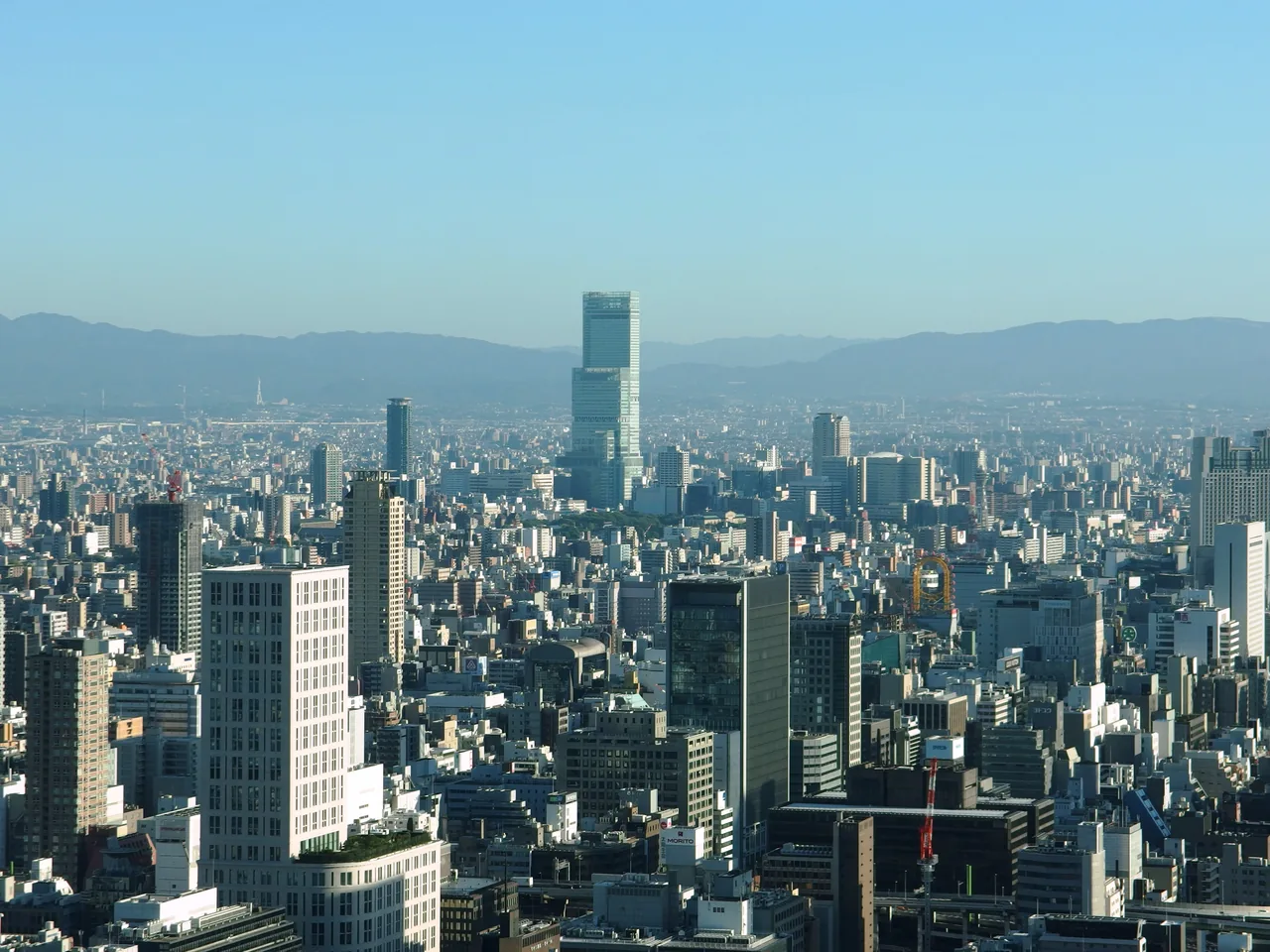
At a glance: a grounded, local, budget-friendly district built around Abeno Harukas — Japan’s tallest building from 2014 to 2023, now its second-tallest at 300 metres — and the ancient Shitennoji Temple, founded in 593 CE. Transport is genuinely solid and it’s noticeably less tourist-dense than Namba or Umeda.
Stay here if value matters more than being in the thick of it, you want a more local feel, you’re interested in Shinsekai’s retro kushikatsu scene nearby, or you’re arriving via KIX on the JR Kansai Airport Rapid Service, which runs direct to Tennoji. Skip it if you want to be in the middle of nightlife and shopping — it’s still on the Midosuji line, but it’s a real ride rather than a walk to Dotonbori’s late-night buzz.
The honest downside: high-end dining and nightlife options thin out at the doorstep, and the area reads as workaday rather than polished once the sun goes down — which is exactly the trade some travellers are looking for and others aren’t.
| Hotel | Style | Price band | Sub-area | Photos & rates |
|---|---|---|---|---|
| Sheraton Miyako Hotel Osaka | Luxury | ¥¥¥¥ | Tennoji, by Abeno Harukas | 📷 Photos, check price |
| Daiwa Roynet Hotel Osaka-Uehonmachi | Business | ¥¥ | Uehonmachi | 📷 Photos, check price |
| Anda no Mori Osaka Tennoji Tower | Mid | ¥¥ | Near Abeno Harukas | 📷 Photos, check price |
| Toyoko Inn Osaka Tsuruhashi Ekimae | Budget-business chain | ¥¥ | Tsuruhashi | 📷 Photos, check price |
| Smile Hotel Osaka Tennoji | Budget chain | ¥ | Tennoji | 📷 Photos, check price |
| Hotel Trad | Budget/boutique-ish | ¥ | Shitaderamachi, near Tennoji | 📷 Photos, check price |
Who each suits: Sheraton Miyako is the district’s luxury anchor, right by Abeno Harukas with sweeping city views; Daiwa Roynet Uehonmachi is a dependable business standard a short ride from Tennoji itself; Anda no Mori and Toyoko Inn Tsuruhashi cover solid mid-range and budget-business needs; and Smile Hotel Tennoji and Hotel Trad are the value picks for travellers happy to trade polish for a lower rate and a more local street feel.
9. Getting around Osaka from your base
Here’s roughly how long it takes to move between Osaka’s key nodes from each base — because unlike Kyoto, the honest answer for most pairs is “not long,” which is exactly why the area decision matters less here.
The core logic from earlier holds: the Midosuji subway line is the spine connecting Shin-Osaka, Umeda, Namba and Tennoji north to south, and the JR Osaka Loop Line circles the centre, connecting out toward the Bay Area via Bentencho or Nishikujo. The table below is approximate, station to station — always check live times for your exact route.
| From ↓ / To → | Umeda | Namba | Shin-Osaka | Bay Area / USJ |
|---|---|---|---|---|
| Umeda | — | Midosuji subway ~10 min | Midosuji subway ~6 min | JR Loop/JR direct ~15–20 min |
| Namba | Midosuji subway ~10 min | — | Midosuji subway ~15 min | Subway + JR transfer ~25–30 min |
| Shin-Osaka | Midosuji subway ~6 min | Midosuji subway ~15 min | — | Subway + JR transfer ~25–30 min |
| Tennoji | Midosuji subway ~15 min | Midosuji subway ~10 min | Midosuji subway ~20 min | JR Loop + transfer ~30–35 min |
Midosuji line vs the JR Loop Line
The Midosuji subway line is the workhorse for anything on the north–south spine — fast, frequent, and the reason almost any of those four zones works as a base. The JR Loop Line circles the central city and is your route out to the Bay Area, transferring onto the Yumesaki line toward Universal City, or riding JR direct from Osaka Station.
Passes and IC cards
For most itineraries, a rechargeable IC card is simpler than a day pass — just tap on and off every subway, JR and bus ride. Our ICOCA or Suica guide covers which to get and how to top up. If you’re combining Osaka with day trips to Kyoto, Kobe or Nara, it’s also worth checking whether a regional rail pass beats paying per ride — our JR Pass and Kansai pass guide runs the numbers.
10. Osaka’s lodging tax
Osaka charges an accommodation tax per person, per night — but it’s flat and low compared with Kyoto’s, topping out at just ¥500 rather than climbing into the thousands.
The tax is charged per person, per night, based on the room rate, with a straightforward four-tier scale:
| Room rate / person / night | Tax / person / night |
|---|---|
| Under ¥5,000 | Exempt |
| ¥5,000 – ¥14,999 | ¥200 |
| ¥15,000 – ¥19,999 | ¥400 |
| ¥20,000 and over | ¥500 |
For context, this is much flatter and lower than Kyoto’s 2026 tax, which runs five tiers from ¥200 up to ¥10,000 per person, per night. Even a top luxury room in Osaka adds only ¥500 per person per night — a rounding error next to the room rate itself — so it’s worth budgeting for, but it won’t meaningfully change your area decision the way Kyoto’s tax can on a splurge stay.
11. Business hotel vs apart-hotel vs luxury vs USJ resort hotel
Osaka doesn’t have a “ryokan district” the way Kyoto does — its accommodation scene is built around business hotels, apart-hotels, international luxury and USJ’s resort-style properties. The type you pick matters almost as much as the zone.
| Type | What it is | Best for | Where it clusters |
|---|---|---|---|
| Business hotel | Compact, efficient, reliable — the backbone of Japanese city travel | First-timers, day-trippers, value seekers | Every zone, especially Shin-Osaka and Tennoji |
| Apart-hotel | Kitchenette, more space, sometimes laundry (Citadines and similar) | Families, longer stays, self-catering | Namba, Umeda |
| International luxury | Ritz-Carlton, InterContinental, Swissotel, Sheraton and the like — full-service five-star | Splurge, business travel, service-first stays | Umeda & Kita, Namba |
| USJ resort hotel | Park-adjacent, family amenities, some with official partner perks | USJ-anchored family trips | Bay Area / Universal City |
Which to pick
For most trips, a solid business hotel in Namba, Umeda or Tennoji is the easiest, best-value choice — clean, efficient and close to the subway. Choose an apart-hotel if you’re a family or staying a week and want a kitchen and laundry. Reach for international luxury if service and space are the point of your stay, concentrated in Umeda and Namba. And if USJ is the anchor of your trip, a resort-style hotel in the Bay Area buys back time and energy that a city-centre base would spend on transfers.
12. When to book & seasons
Osaka’s tightest windows are cherry blossom season (late March–early April, especially around Osaka Castle Park) and Tenjin Matsuri in late July, one of Japan’s three great festivals — both push prices up and shrink availability, so book ahead if your dates land on either.
Beyond those two spikes, 2026 adds a specific pressure point: USJ’s 25th-anniversary year is drawing extra crowds and booking demand specifically to Bay Area hotels, so if you’re basing there in 2026, book earlier than usual. Summer (June–August) is hot and humid across the city, which softens demand slightly outside festival dates. Winter is milder than most of Japan and the quietest, cheapest season overall, with illumination events lighting up Umeda and Osaka Castle. Our best time to visit Japan guide covers how Osaka’s seasons compare to the rest of the country.
| Season | Demand & price | Book ahead |
|---|---|---|
| Cherry blossom (late Mar–early Apr) | Peak — especially around Osaka Castle Park | 3+ months |
| Tenjin Matsuri (late July) | High, city-wide spike | 2–3 months |
| 2026: USJ 25th-anniversary year | Extra pressure on Bay Area hotels specifically | Earlier than usual if basing at USJ |
| Summer (Jun–Aug, off-festival) | Moderate, hot & humid | 1–2 months |
| Winter | Quietest & cheapest, illumination events | Weeks ahead |
13. Getting to your hotel from the airport
Most international visitors arrive at Kansai Airport (KIX); the fastest route into central Osaka is the Nankai “Rapi:t” limited express to Namba in about 38 minutes, while the JR “Haruka” reaches Shin-Osaka in about 50 minutes. Domestic flyers usually land at Itami (ITM), about 30–50 minutes from Umeda.
| Route | Time | Fare |
|---|---|---|
| KIX → Namba, Nankai “Rapi:t” limited express | ~38 min | ¥1,670 paper ticket (¥1,520 via Nankai’s ticketless service) |
| KIX → Namba, Nankai regular/rapid (no reservation) | ~44 min | ~¥970 |
| KIX → Shin-Osaka, JR “Haruka” limited express | ~50 min | ~¥3,070 reserved, or ¥1,800 with the foreign-passport HARUKA discount ticket |
| KIX → Tennoji, JR Kansai Airport Rapid Service | ~50 min | ~¥1,060 (free with any JR Pass) |
| KIX → Osaka Station/Umeda, airport limousine bus (KATE) | ~48–50 min | ¥1,800 |
| KIX → central Osaka, taxi | ~45 min | ~¥15,000 daytime / ~¥18,000 at night |
| ITM → Umeda, Osaka Monorail + Midosuji subway | ~48 min | ~¥700 combined |
| ITM → Umeda, limousine bus | ~30 min | ~¥650–730 |
Which route makes sense depends on your base: the Rapi:t and regular Nankai lines both land in Namba, so that’s the easiest arrival zone if you fly into KIX; the Haruka favours a Shin-Osaka or Umeda base; and the JR Kansai Airport Rapid Service drops you directly at Tennoji, free with any JR Pass.
Planning day trips from your Osaka base? Kyoto is about 29 minutes away via JR Special Rapid (~¥580) — see our Kyoto travel guide — while Nara, Kobe and Himeji are all under an hour by JR or Kintetsu.
14. Decision matrix by traveller type
Still deciding? Match your situation to a base below — this is the quick shortcut through everything above.
| Situation | Stay here | Why |
|---|---|---|
| First-timer, one base | Namba & Dotonbori (or Umeda & Kita) | Osaka’s grid makes almost any central zone workable; Namba is the liveliest all-round pick, Umeda the calmer alternative |
| Food & nightlife priority | Namba & Shinsaibashi/Dotonbori | Dotonbori canal, the Glico sign and Shinsaibashi-suji arcade all on your doorstep |
| Heavy day-tripping by Shinkansen | Shin-Osaka | Bullet trains to Kyoto (~15 min), Kobe (~13 min), Hiroshima (~1.5 hr) and Tokyo (~2.5 hr) right at the station |
| Business trip / quieter evenings | Umeda & Kita | Best transit hub for JR/Hankyu/Hanshin, more upscale, calmer at night |
| USJ-first family trip | Bay Area | Walking distance or a short ride to Universal Studios Japan, Kaiyukan and Tempozan; book early for the 2026 anniversary year |
| Budget / value | Tennoji & Abeno, or Shin-Osaka | The most reliable rooms per yen, with solid multi-line transport |
| Local, less touristy feel | Tennoji & Abeno | Grounded neighbourhood around Abeno Harukas and Shitennoji Temple, near Shinsekai’s retro kushikatsu scene |
15. Continue planning your Osaka trip
Base sorted? Here’s the rest of the puzzle. These guides round out the bigger picture of your Osaka trip.
- Start with our complete Osaka travel guide for the full itinerary, sights and food.
- Planning Universal Studios Japan? Our USJ complete guide covers tickets, rides and current closures.
- Weighing a JR Pass or Kansai pass for day trips? Run the numbers with our JR Pass and Kansai pass guide.
- Getting around by subway and JR is easiest with an IC card — see our ICOCA or Suica guide.
- Osaka pairs naturally with a day or two in Kyoto — our travel guide covers the full trip.
- New to Japan altogether? Our complete Japan travel guide covers entry, money, connectivity and etiquette.
- Not sure when to go? Check our best time to visit Japan guide before you lock in dates.
Osaka is more forgiving than Kyoto, so the logic here stays simple: pick your trip shape first — Shinkansen-heavy, food-and-nightlife-first, or USJ-anchored — and the right zone follows. Namba & Dotonbori and Umeda & Kita are the safest first choices, the Bay Area wins if USJ anchors your trip, and Tennoji & Abeno or Shin-Osaka win on value. Compare live rates for your dates once you’ve picked a zone, and enjoy Osaka.