
JR Pass: Is It Worth It, and the Four-Ride Break-Even
Divide the seven-day pass, ¥50,000, by one long hop, ¥14,720 from Tokyo to Shin-Osaka, and you get 3.4. Four long one-way rides is where the nationwide pass starts paying for itself. Below are the fares, the October price rise, the Nozomi surcharge and the regional passes, so you can run the sum on your own route.
| Break-even | Four long one-way rides, or the pass loses to plain tickets. |
|---|---|
| Price rise | The seven-day ordinary pass goes from ¥50,000 to ¥53,000 on 1 October. |
| Nozomi | Not included, and the supplement is charged per segment you ride. |
| Regional | Kansai runs ¥5,800 for three days, all-Kyushu ¥22,000 for three. |
| Cities | Subways and private railways sit outside every JR pass. |
1. One division decides it
2. The price rises on 1 October
3. The pass does not include Nozomi or Mizuho
4. Where the plane wins before the pass is even relevant
5. Fares differ by corridor, so run your own numbers
6. Three itineraries, priced
7. The Golden Route added up
8. Kansai only: the ¥5,800 answer
9. Kyushu is where a regional pass usually wins
10. JR East, and why company boundaries matter
11. Reserved seats open one month ahead at 10:00
12. Cities run on IC cards, not passes
13. Green Car: when the ¥20,000 is not wasted
14. Buying it, and who is eligible
15. What the pass will not do
16. Choosing by the shape of your trip
1. One division decides it
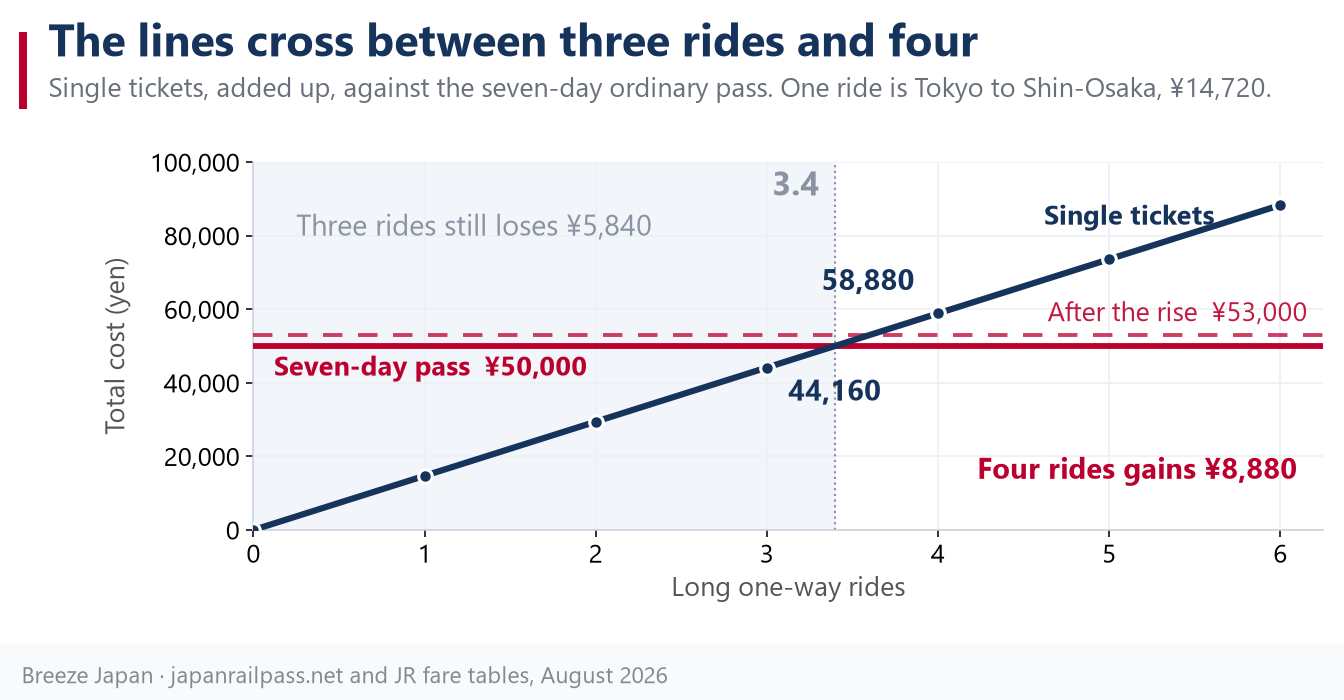
The nationwide JR Pass is a bulk price on long-distance seats, so the question is how many long seats you will actually use. The seven-day ordinary pass costs ¥50,000. One reserved Nozomi seat from Tokyo to Shin-Osaka costs ¥14,720. Divide the first by the second and you get 3.4, which means the fourth long ride is where the pass moves ahead.
| Long one-way rides | Paid individually | Against the ¥50,000 pass |
|---|---|---|
| 2 | ¥29,440 | ¥20,560 wasted |
| 3 | ¥44,160 | ¥5,840 wasted |
| 4 | ¥58,880 | ¥8,880 ahead |
| 5 | ¥73,600 | ¥23,600 ahead |
What counts as a long ride
A long ride here means something on the scale of Tokyo to Shin-Osaka, roughly two and a half hours and roughly ¥15,000. Tokyo to Nagoya is cheaper at around ¥11,000, so a trip built from short hops needs more of them. Tokyo to Hakata is around ¥23,000, so a trip built from those reaches break-even in three.
Count one-way rides, not return journeys. The pass refunds you per seat used, and counting a return trip as one event is the single most common way travellers talk themselves into buying.
Most first trips end at two or three
Tokyo, then Kyoto, then Osaka, then back to Tokyo is two long rides. Kyoto to Osaka is a half-hour commuter run at around ¥580 and does not belong in the count. That itinerary loses more than ¥20,000 against the pass, which is why the honest answer for a standard two-week first trip is usually no.
If you fly into one city and out of another, the count drops again. An open-jaw booking into Tokyo and out of Osaka removes the return leg entirely and leaves you at one long ride.
2. The price rises on 1 October
Every nationwide pass gets more expensive from 1 October. The ordinary seven-day pass moves from ¥50,000 to ¥53,000, and the longer durations and Green Car versions move with it.
| Duration | Ordinary now | Ordinary after | Green now | Green after |
|---|---|---|---|---|
| 7 days | ¥50,000 | ¥53,000 | ¥70,000 | ¥74,000 |
| 14 days | ¥80,000 | ¥84,000 | ¥110,000 | ¥116,000 |
| 21 days | ¥100,000 | ¥105,000 | ¥140,000 | ¥147,000 |
The break-even barely moves
The increase is about six per cent, which is not enough to change the arithmetic. ¥53,000 divided by ¥14,720 is 3.6, so the answer is still four long rides. The only itineraries the rise flips are the ones that were already sitting on the line at three and a half.
What matters more is when you pay. The price applies at the point of purchase rather than the date you travel, so a trip in November booked before October is charged at the current price. If your dates are fixed, buying early saves ¥3,000 on the seven-day pass with no other change.
Children pay exactly half
The child fare covers ages six to eleven and is precisely half the adult price, so the seven-day pass runs ¥25,000 now and ¥27,000 later. From twelve the adult price applies, which catches families with a secondary-school child off guard.
For a family the halving changes the sum more than the price rise does. Two adults and two primary-age children buy four passes for ¥150,000, while the same four people pay roughly ¥44,000 for one long ride on tickets. That family needs three or four long rides before the passes make sense, and children’s tickets are also half price, so the ratio holds.
3. The pass does not include Nozomi or Mizuho
The fastest trains on the Tokaido, Sanyo and Kyushu Shinkansen sit outside the nationwide pass. You can ride them, but only after buying a supplement for each segment.
| Segment | Supplement |
|---|---|
| Tokyo to Nagoya | ¥4,180 |
| Tokyo to Kyoto | ¥4,960 |
| Tokyo to Shin-Osaka | ¥4,960 |
| Tokyo to Hiroshima | ¥6,500 |
| Shin-Osaka to Hakata | ¥4,960 |
| Hakata to Kagoshima-Chuo | ¥5,150 |
The supplement ignores your seat class
JR states the same figure for Green Car, reserved and non-reserved seats. Holding a Green Car pass gives you no discount on the Nozomi supplement, so a Green Car holder and an ordinary pass holder pay the identical ¥4,960 between Tokyo and Shin-Osaka.
Add these amounts to the pass side of your calculation, not the ticket side. A Tokyo to Shin-Osaka return on Nozomi adds ¥9,920 to a ¥50,000 pass, which pushes break-even from four long rides to nearly five.
How much slower Hikari actually is
The pass covers Hikari and Kodama on the same tracks. Nozomi runs Tokyo to Shin-Osaka in about two and a half hours and Hikari in about three, so the supplement buys back around thirty minutes for ¥4,960.
Kodama stops everywhere and takes over four hours for the same distance, which turns a travel day into a whole day. If you plan to travel on the pass, build the itinerary around the Hikari timetable rather than assuming Shinkansen departures every ten minutes.
4. Where the plane wins before the pass is even relevant
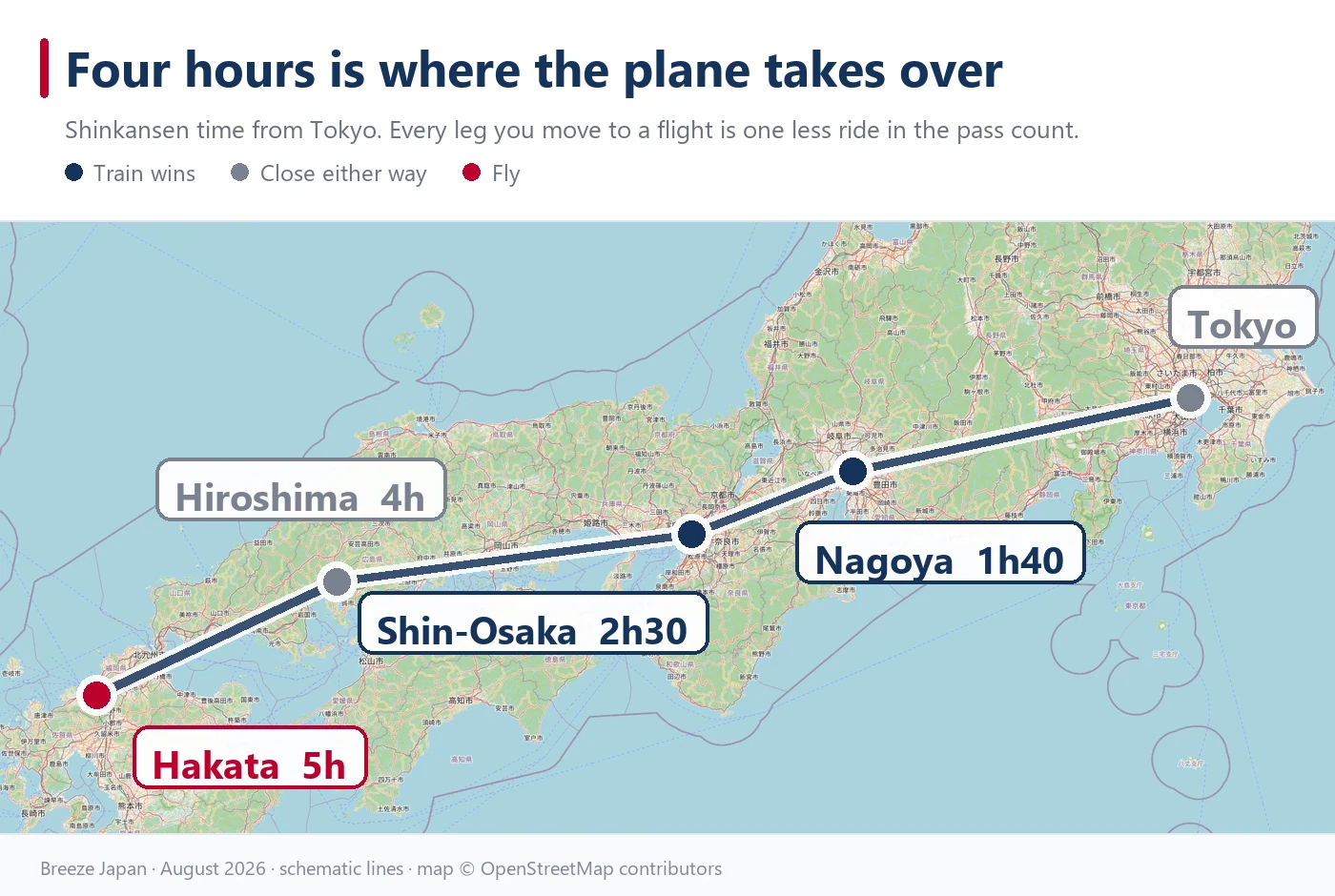
Decide how you are covering each leg before you price any pass. Past a certain distance the Shinkansen stops being the faster option, and every leg you move to a plane removes a ride from the pass count.
| Route | Shinkansen time | Verdict |
|---|---|---|
| Tokyo to Nagoya | about 1h40 | Train, comfortably |
| Tokyo to Shin-Osaka | about 2h30 | Train |
| Tokyo to Hiroshima | about 4h | Close either way |
| Tokyo to Hakata | about 5h | Check flights |
| Tokyo to Sapporo | 8h+ with a change | Fly |
Four hours is the practical line. Under it, city-centre stations and no check-in put the train ahead door to door. Over it, the flight time is short enough that airport transfers and security no longer cancel the advantage, and domestic fares on those routes are often lower than the rail fare.
This is what flips the pass calculation
A Tokyo to Hakata return priced as rail gets a pass most of the way to break-even on its own. Move that same leg to a flight and the pass falls behind again, which is why the order of decisions matters more than the arithmetic itself.
Work in this order: fix the route, choose a mode for each leg, then count only the Shinkansen legs that remain. Choosing the pass first and fitting the route around it produces long rides you did not need.
Hokkaido sits outside the sum
Shinkansen services from Tokyo terminate at Shin-Hakodate-Hokuto, where you change to a limited express for the remaining stretch to Sapporo. The full journey exceeds eight hours, so almost nobody rides it even holding a valid pass.
If Hokkaido is the trip rather than a detour, look at the JR Hokkaido area passes instead. Fitting Hokkaido into a nationwide pass calculation rarely survives contact with the timetable.
5. Fares differ by corridor, so run your own numbers
The break-even above uses Tokyo to Shin-Osaka, but your corridor may be cheaper or dearer. A trip made of short hops and a trip made of long hauls reach opposite conclusions from the same pass price.
| Tokyo to Shin-Osaka | Fare |
|---|---|
| Nozomi, reserved | ¥14,720 |
| Hikari or Kodama, reserved | ¥14,400 |
| Non-reserved, any train | ¥13,870 |
Reserved seats on Nozomi carry a ¥320 premium over Hikari and Kodama, and skipping the reservation saves ¥850 against Hikari. Those are the three prices you are choosing between whenever you travel without a pass.
Reserved fares move with the season
Reserved seat fares carry a seasonal adjustment: ¥400 more in the peak periods, ¥200 more in high season, ¥200 less in low season. Non-reserved fares stay flat all year.
New Year, Golden Week and the Obon period are the peaks. Travelling then raises the ticket-side total slightly, which nudges the pass forward, though those are also the weeks when reserved seats sell out and a pass guarantees you nothing.
Travelling non-reserved changes the answer again
At ¥13,870 per ride, ¥50,000 divides into 3.6, so the threshold is still four rides but a little further away. Non-reserved travel is the cheapest way to move without a pass and the strongest argument against buying one on a short trip.
The limitation is space. Non-reserved cars have no oversized baggage seats, so a large suitcase leaves you standing in the vestibule with it, and on peak days you may stand for the entire run.
6. Three itineraries, priced
The same division applied to real itineraries settles most cases in a line or two. These three cover the majority of first and second trips.
| Itinerary | On tickets | Seven-day pass | Result |
|---|---|---|---|
| Tokyo, Kyoto, Osaka, return | about ¥29,000 | ¥50,000 | Tickets win by ¥21,000 |
| Tokyo, Kyoto, Hiroshima, Hakata, Tokyo | about ¥60,000 | ¥50,000 | Pass wins by ¥10,000 |
| Tokyo only | a few thousand yen on an IC card | ¥50,000 | No comparison |
One shape wins, and it is a specific one
The pass wins on a loop: out from Tokyo, steadily west, and back within the week. That shape is the only reliable way to stack four or more long rides into seven consecutive days.
Any itinerary that settles in one region loses regardless of how you arrange it. Five days based in Kyoto with day trips produces almost no long-distance fares, so there is nothing for a pass to recover.
Longer trips need a different comparison
Two and three-week visitors often assume the fourteen or twenty-one day pass scales the same way. It does not automatically, because a longer trip usually means more nights per city rather than more long rides.
Fourteen days at ¥80,000 needs about five and a half long rides to break even, and twenty-one days at ¥100,000 needs almost seven. Count the rides you would genuinely take rather than assuming a longer trip fills the pass.
7. The Golden Route added up
Tokyo, Hakone, Kyoto and Osaka is the most common first itinerary, so it is worth pricing in full. Adding the segments one by one shows where the pass has nothing to recover.
| Segment | Service | Fare |
|---|---|---|
| Tokyo to Odawara | Shinkansen, reserved | around ¥3,000 |
| Within Hakone | Private rail, cable car, bus | Not covered by any JR pass |
| Odawara to Kyoto | Shinkansen, reserved | around ¥11,000 |
| Kyoto to Osaka | JR local line | around ¥580 |
| Osaka to Kansai Airport | Haruka or private rail | ¥1,000 to ¥3,000 |
The total struggles to pass ¥20,000, against ¥50,000 for the pass. Fly out of Kansai rather than returning to Tokyo and the total falls further, because the itinerary contains no return leg at all.
Hakone is almost entirely outside JR
The mountain railway, cable car, ropeway and lake boats belong to a private operator. A nationwide pass carries you to Odawara and stops there.
For the Hakone loop itself, price the Hakone Free Pass separately. Holding a nationwide pass does not reduce what you pay inside Hakone by a single yen.
Returning to Tokyo still does not do it
Flying home from Tokyo adds one more long ride and brings the count to three. That is closer, and still short of the threshold.
To get a pass into this itinerary you would need to extend west to Hiroshima or Hakata. Adding that to a seven-day trip that already includes Hakone leaves very little time in any one place, which is why the combination rarely works in practice.
8. Kansai only: the ¥5,800 answer
A trip that stays in one region belongs to a regional pass, not the nationwide one. The JR West Kansai Area Pass is the clearest example.
| Duration | Adult | Child |
|---|---|---|
| 1 day | ¥2,800 | ¥1,400 |
| 2 days | ¥4,800 | ¥2,400 |
| 3 days | ¥5,800 | ¥2,900 |
| 4 days | ¥7,000 | ¥3,500 |
It covers JR local, rapid and special rapid services across Osaka, Kyoto, Kobe, Nara and Wakayama, and it includes a reserved seat on the Haruka express to and from Kansai Airport.
No Shinkansen, and no other limited express
Shinkansen services are excluded, as are limited express trains other than the Haruka, in both reserved and non-reserved cars. This is a pass built for moving around inside Kansai and nothing else.
The Haruka inclusion is what makes the price work. A reserved Haruka seat between Kansai Airport and Kyoto runs about ¥3,000 each way, so two airport journeys recover more than half of a ¥5,800 three-day pass before you ride anything else.
Check the boundary before you assume coverage
The name suggests more ground than the pass covers. Himeji and Tsuruga fall outside it and belong to wider JR West passes that cost considerably more.
If one day of your itinerary crosses the boundary, buy a ticket for that day rather than upgrading the whole pass. A single Himeji return usually costs less than the difference between the two passes.
9. Kyushu is where a regional pass usually wins
The JR Kyushu Rail Pass includes Shinkansen services, which changes the maths entirely. It sells in three coverage areas.
| Area | Duration | Adult | Child |
|---|---|---|---|
| All Kyushu | 3 days | ¥22,000 | ¥11,000 |
| All Kyushu | 5 days | ¥24,000 | ¥12,000 |
| All Kyushu | 7 days | ¥26,000 | ¥13,000 |
| Northern Kyushu | 3 days | ¥15,000 | ¥7,500 |
| Northern Kyushu | 5 days | ¥17,000 | ¥8,500 |
| Southern Kyushu | 3 days | ¥12,000 | ¥6,000 |
Shinkansen included, unlike Kansai
The all-Kyushu pass covers the Kyushu Shinkansen from Hakata to Kagoshima-Chuo and the Nishi-Kyushu Shinkansen from Takeo-Onsen to Nagasaki. Northern Kyushu reaches Kumamoto, and Southern Kyushu runs from Kumamoto to Kagoshima-Chuo.
Because the cities are far apart and the fast trains are included, three days of ordinary sightseeing frequently exceeds ¥22,000 in tickets. Kyushu is one of the few places where the pass answer is yes without any careful accounting.
Extra days cost very little
Three days at ¥22,000 becomes five days at ¥24,000, so two additional days cost ¥2,000. At ¥1,000 a day, taking the longer option is usually the safer choice when your plans are not final.
Seven days runs ¥26,000, again ¥2,000 above the five-day version. Anyone spending a full week in Kyushu should start at the seven-day pass rather than working up to it.
10. JR East, and why company boundaries matter
Each JR company sells passes valid on its own network, and the nationwide pass exists to cross between them. If your itinerary stays inside one company, a regional pass is almost always cheaper.
| Where you are going | What to price |
|---|---|
| Tokyo, then a wide western loop | Nationwide pass |
| Kansai only | Kansai Area Pass |
| Kyushu only | JR Kyushu Rail Pass |
| Tokyo, then Tohoku or Nagano | JR East area passes |
Where the boundaries actually fall
On the Shinkansen network, everything west of Tokyo belongs to JR Central, the Tohoku, Joetsu and Hokuriku directions belong to JR East, Shin-Osaka to Hakata is JR West and everything below Hakata is JR Kyushu.
A JR East pass therefore cannot take you from Tokyo to Kyoto, however wide its coverage looks on a map. Consider the nationwide pass only when your route genuinely crosses these boundaries.
Two regional passes can beat one nationwide pass
If your trip splits between two regions, price the pair. A three-day Kansai pass at ¥5,800 plus a three-day all-Kyushu pass at ¥22,000 totals ¥27,800, well under the ¥50,000 nationwide price.
The gap between the two regions is on you: Shin-Osaka to Hakata is covered by neither pass and costs around ¥15,000 on its own. Add that segment before comparing, and the pair still comes out ahead.
11. Reserved seats open one month ahead at 10:00
Reservations open at exactly 10:00 on the day one month before travel, whether you hold a pass or buy tickets. On busy dates the seats are settled in that first minute.
| Travel date | Reservations open |
|---|---|
| 29 December | 29 November, 10:00 |
| 2 January | 2 December, 10:00 |
| 13 August | 13 July, 10:00 |
You do not have to be awake for it
JR East’s Ekinet takes advance requests. From 14:00 on the same weekday one week before the sale date until 09:54 on the sale date itself, you submit what you want, and the system processes every request together at 10:00 and reports back.
A request is not a guarantee. When too many people want the same train the request fails like anyone else’s. It does remove the queue at the ticket office and the need to sit at a screen at ten in the morning in a different time zone.
Reservations cost pass holders nothing
The nationwide pass includes unlimited seat reservations at no extra charge, so there is no reason to travel non-reserved while holding one.
That matters most with luggage. A suitcase measuring more than 160cm across its three sides requires an oversized baggage seat, and those seats exist only in reserved cars.
12. Cities run on IC cards, not passes
No JR pass is useful for getting around inside Tokyo or Osaka. Subways and private railways belong to other operators, and the JR lines that do exist inside the cities are too cheap to recover a pass price.
| Service | Covered by the nationwide pass |
|---|---|
| JR Yamanote Line | Yes |
| Tokyo Metro and Toei subway | No |
| Osaka Metro | No |
| Kintetsu, Hankyu, Keihan and other private lines | No |
| City buses | Generally no |
What you actually ride in Tokyo
Most Tokyo sightseeing runs on the subway. Asakusa, Ginza and Roppongi are subway destinations, while Shibuya and Shinjuku are reachable on JR, so an ordinary day mixes both networks without much pattern.
An IC card removes the decision. You tap through any operator’s gates, the fare is deducted automatically, and the same card pays at convenience stores and vending machines.
Airport access depends on the line, not the pass
The Narita Express is a JR service and is covered by the nationwide pass. The Keisei Skyliner into Ueno is a private railway and is not, despite serving the same airport.
From Kansai Airport, the Haruka is JR and is covered. It is also included in the Kansai Area Pass, which is the cheaper way to get it on a Kansai-only trip.
The city tickets themselves are compared in the Tokyo transport passes guide, including the two 700-yen day passes and the 1,000-yen visitor ticket.
13. Green Car: when the ¥20,000 is not wasted
The Green Car pass costs ¥20,000 more than ordinary for seven days, and whether that is worth it depends on how often you sit down.
| Duration | Difference | Per long ride |
|---|---|---|
| 7 days | ¥20,000 | ¥5,000 across four rides |
| 14 days | ¥30,000 | ¥3,750 across eight rides |
| 21 days | ¥40,000 | ¥4,000 across ten rides |
Buying a Green Car seat individually between Tokyo and Shin-Osaka costs roughly ¥5,000 above ordinary, so at four long rides the upgrade is already priced fairly. Beyond that it is cheaper than paying per ride.
Availability is the stronger argument
Green cars often still have space on trains where ordinary reserved seats have sold out. Travelling over New Year or Obon, that difference decides whether you travel at all on the service you planned.
The premium also gets you two-plus-two seating instead of two-plus-three, and more space at the seat, which matters on the five-hour runs to Kyushu more than on a two-hour hop.
It does not help with Nozomi
As covered above, the Nozomi supplement is identical for every seat class. A Green Car pass holder pays the same ¥4,960 between Tokyo and Shin-Osaka as anyone else.
So do not buy the Green Car pass expecting it to include the fast trains. It upgrades the seat you get on Hikari, Kodama and the limited expresses, and nothing more.
14. Buying it, and who is eligible
The nationwide pass sells through the official site and through agents, and the prices are not always the same. The official online price is the reference figure.
Buying official links straight into seat reservations
Purchasing on the official site lets you reserve seats before you arrive, which is the whole game on peak dates. You collect the pass itself in Japan at a designated station office, showing your passport.
Exchange offices sit at the airport stations and the major city stations, and they keep business hours. Arriving late at night means a closed counter, so plan the first day accordingly.
Agents are convenient, with conditions attached
Travel agents and resellers handle payment and delivery in your own language and time zone. Prices can differ from official, and refund and exchange terms are often stricter, so read the cancellation policy before paying.
Either way, the pass is sold only to foreign visitors entering on temporary visitor status. The exchange office checks the stamp or sticker from immigration, and residents of Japan are not eligible under any purchase route.
Choose the start date deliberately
You nominate the activation date when you exchange, and it does not have to be your arrival day. If you are spending three days in Tokyo before heading west, start the pass on the day you head west.
Once it starts, the clock runs on consecutive days and cannot be paused. A seven-day pass covers the activation day and the six days after it, so every city day inside that window is a day the pass earns nothing.
15. What the pass will not do
The nationwide pass is valid across the JR group and stops at its edges. Anything run by another company is charged separately, and a few JR services carry their own supplements.
| Service | Status |
|---|---|
| Nozomi and Mizuho | Supplement required per segment |
| Hikari, Kodama, Sakura | Included |
| JR limited express trains | Included |
| Private railways and subways | Not included |
| Some sightseeing trains | Separate charge in places |
Seats are not guaranteed by holding a pass
The pass entitles you to reserve, and reserving is still first come, first served. Over New Year and Obon the reserved cars fill within minutes of opening, and pass holders queue with everyone else.
The fallback is a non-reserved car, where you may stand for two hours or more. Anyone travelling in those weeks should treat the 10:00 reservation slot as part of the trip planning rather than a formality.
Refunds and changes are restricted
An unused pass can generally be refunded within its validity window, with a handling charge, but once it has been exchanged and activated the options narrow sharply. Buying early to beat the October rise is safe; buying early on a trip that might not happen is not.
Check the terms of the specific seller before paying, particularly with agents. The refund rules attached to resale channels are often tighter than the official ones.
16. Choosing by the shape of your trip
Most trips can be sorted by shape before anybody adds up fares. Find your itinerary below, then run the division only if you are near the line.
| Trip | What to buy |
|---|---|
| Tokyo only, or Osaka only | An IC card. No pass at all |
| Tokyo, Kyoto, Osaka and back | Individual tickets as you go |
| Based in Kansai with day trips | Kansai Area Pass |
| Kyushu only | JR Kyushu Rail Pass |
| A full western loop inside a week | Nationwide seven-day pass |
| Two weeks or more, moving constantly | Nationwide 14 or 21-day pass |
When you are unsure, count again
There is only one number to check: how many rides on the scale of Tokyo to Shin-Osaka your itinerary contains. Four or more points to the nationwide pass, three or fewer points to tickets.
If Nozomi is part of the plan, add the supplements to the pass side first. A single return adds close to ¥10,000 and moves the threshold by most of a ride.
Sitting exactly on the line
At three and a half rides, skip the pass. Planned rides get dropped far more often than extra ones get added, usually because one city turns out to deserve a whole day.
Tickets carry no such risk, since you buy each one when you know you need it. Commit to a pass only when the count clears four with room to spare.
If you have decided, do these two things
Set the activation date to the block of days containing your long rides, and reserve the long-distance seats at 10:00 one month out. Skipping either one leaves you standing in a non-reserved car holding a ¥50,000 pass.
And if your dates are already fixed, pay before 1 October. The pass is the same product either side of that date and ¥3,000 cheaper on the near side.