
Kagoshima Travel Guide: Sakurajima, the Ferry, Senganen, Ibusuki and Chiran
Sakurajima is an active volcano and the area within about 2km of its crater is closed, so there is no summit walk. Planning Kagoshima means choosing where you look at the mountain from. Ferry times, the viewpoints on the island and the places in the city that face it are all here.
| Crater | the 2km zone is closed, so there is no hiking route. |
|---|---|
| Ferry | fifteen minutes, every twenty minutes in daylight. |
| Night | nothing sails between midnight and 4am. |
| Viewpoint | Yunohira sits 2.5km from the crater, the closest you can get. |
| Pass | the CUTE ticket that includes the ferry is sold only in an app. |
| Admission | resident and visitor prices differ, and visitors pay the higher one. |
1. You cannot go within 2km of the crater on Sakurajima
2. The crossing takes fifteen minutes and runs every twenty in daylight
3. Nothing sails between midnight and four in the morning
4. The closest you can stand to the crater is Yunohira
5. The island bus only covers the western side
6. Some days the ash comes down
7. Places in the city that face the mountain
8. The tram costs 200 yen wherever you get off
9. The three sightseeing buses cover different ground
10. To include the ferry you buy CUTE in an app
11. The night route only runs on Saturdays
12. Senganen was laid out to put the volcano inside the garden
13. More than thirty entries in the city’s sights list are people
14. Resident and visitor admission prices are different
15. Closing days follow no common rule
16. Most public baths in this city are hot springs
17. Where to get into the water on Sakurajima
18. Walking between Tenmonkan and the station
19. Choosing between the station and Tenmonkan for a room
20. Where to eat kurobuta pork and satsuma-age
21. Shochu is the default drink here
22. The airport is forty minutes out by bus
23. What to check before booking a shinkansen
24. At Ibusuki you get buried in sand
25. The combined ticket at Chiran is no use on a Wednesday
26. The main hall at Kirishima Shrine is a national treasure
27. Yakushima costs a different order of money to reach
28. Two days splits like this
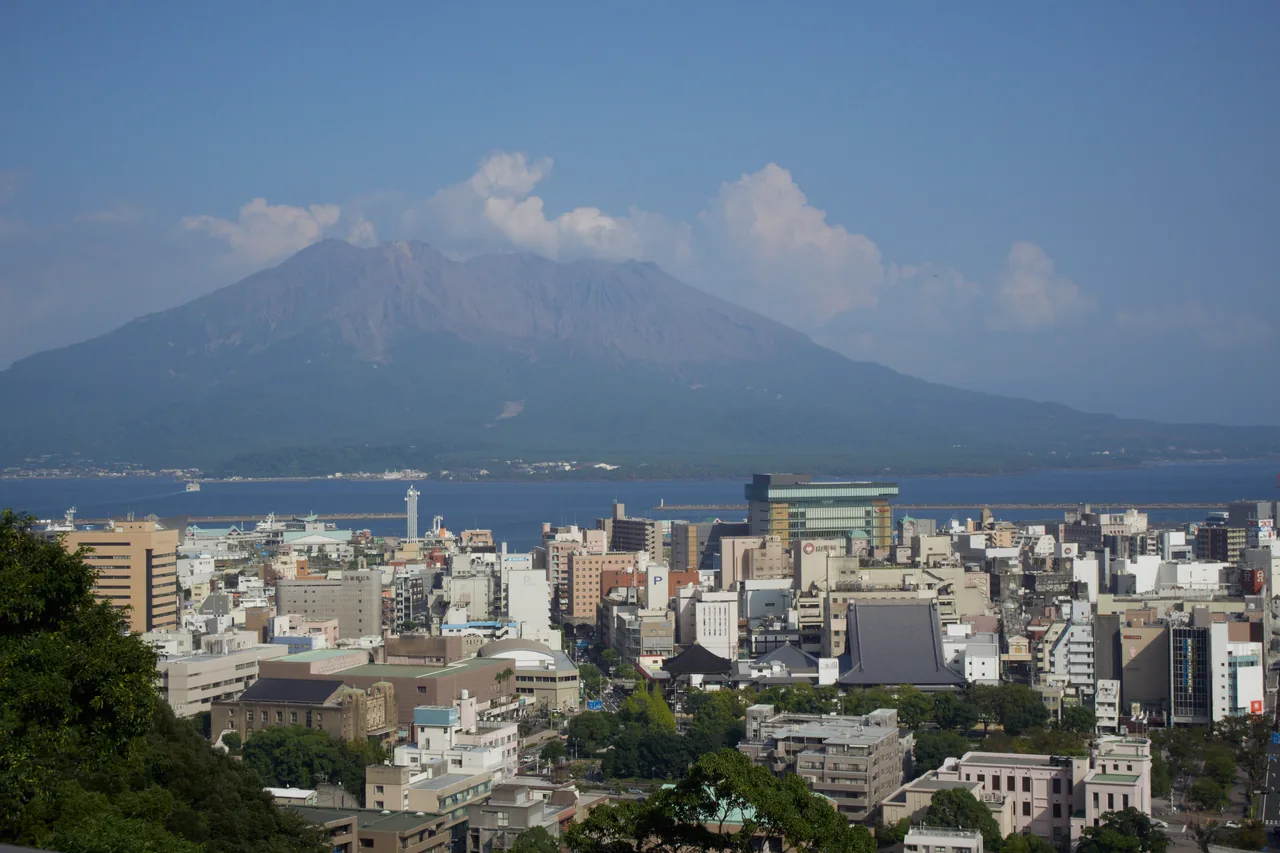
1. You cannot go within 2km of the crater on Sakurajima
There is no path to the summit of Sakurajima. The Japan Meteorological Agency holds the volcano at eruption warning level 3, and the area within roughly 2km of the Minamidake summit crater and the Showa crater is closed. That is the zone where large volcanic blocks land and pyroclastic flows can run. The warning came down from level 5 in the summer of 2022 and has stayed at 3 since. Map
So crossing to the island means looking at the mountain rather than climbing it. Where you stand changes the view: from some points the crater fills the sky, from others the whole cone sits in the frame. Choosing that spot is the first decision in a Kagoshima itinerary.
Kagoshima City publishes how far each visitor site on the island sits from the crater. The nearest is the Yunohira Observatory at 2.5km. Everything else falls between 3km and 5.5km.
How far the island sites sit from the crater
| Place | From the crater |
|---|---|
| Yunohira Observatory | 2.5km |
| Furusato hot spring area | 3.0km |
| Arimura Lava Observatory | 3.5km |
| Shirahama hot spring centre | 3.7km |
| Kurokami buried torii | 4.5km |
| Visitor Centre, lava park foot bath | 5.5km |
It stopped being an island in 1914
The name says island, but Sakurajima is joined to the mainland. Lava from the 1914 eruption filled the strait on the east side and welded the cone to the Osumi Peninsula. There is a road around, so you can drive in without taking a boat.
Going the long way takes far longer, though. From central Kagoshima the fifteen minute ferry wins by a wide margin. A shrine gate buried by ash in that same eruption still stands on the eastern side of the island.
The volcano is still working
The agency’s bulletins record eruptions several times a week, with plumes rising more than a thousand metres above the crater rim on some days. Magma has been accumulating deep under the Aira caldera for a long time, and the current pattern is expected to continue.
None of that makes the trip dangerous. Every visitor site sits outside the restricted zone and the ferries run as normal. What it does mean is that ash falls on some days and you sometimes hear the mountain. For where Kagoshima sits in a wider Japan itinerary, see our Japan travel guide.
2. The crossing takes fifteen minutes and runs every twenty in daylight
The ferry between Kagoshima Port and Sakurajima Port takes fifteen minutes and costs 250 yen for an adult. Rough weather can stretch it to twenty, and disembarking adds another two or three minutes after docking. Kagoshima City runs the service itself, which is why the timetable is so dense.
There are 94 sailings on weekdays and 104 on Saturdays, Sundays and public holidays. Through the middle of the day boats leave every twenty minutes, so you can turn up at the terminal without checking times.
| From Kagoshima | From Sakurajima | |
|---|---|---|
| First sailing | 4:30 | 4:00 |
| Daytime departures | :00, :20, :40 | :05, :25, :45 |
| Last sailing | 23:30 | 23:00 |
| Adult one way | 250 yen | |
| Child one way | 130 yen | |
Weekend afternoons run every fifteen minutes
On Saturdays, Sundays and public holidays the gap narrows to fifteen minutes between about 2pm and 7pm, with departures at :00, :15, :30 and :45. That is when the crossing is busiest. The rest of the day matches the weekday pattern.
Vehicles are charged separately. A car under three metres long costs 1,280 yen and the price climbs with length. Bicycles are 160 yen and mopeds 330 yen.
A Kyushu bus pass covers the crossing
Show a SUNQ Pass, the Kyushu-wide bus pass, and no ferry fare is collected while the pass is valid. That is worth knowing if you are working your way south from Fukuoka by bus.
One pre-school child travels free with each fare-paying adult. A second child pays the child fare.
Getting to the ferry terminal
The Kagoshima side terminal sits next to the aquarium. Take the tram to Suizokukan-guchi and walk five minutes, or the City View or a city bus to Kagoshima Aquarium and walk one. Map
You buy a ticket only on the Kagoshima side. Coming back you pay as you leave through the gate at Sakurajima.
Taking a bike or a motorcycle across
A bicycle costs 160 yen and a moped 330 yen. Larger motorcycles are 480 or 640 yen depending on engine size. These are charged on top of your own fare.
The island roads connect all the way round, so some people ride. Furusato is about an hour from the port by bicycle. There are climbs, and some stretches carry a layer of ash.
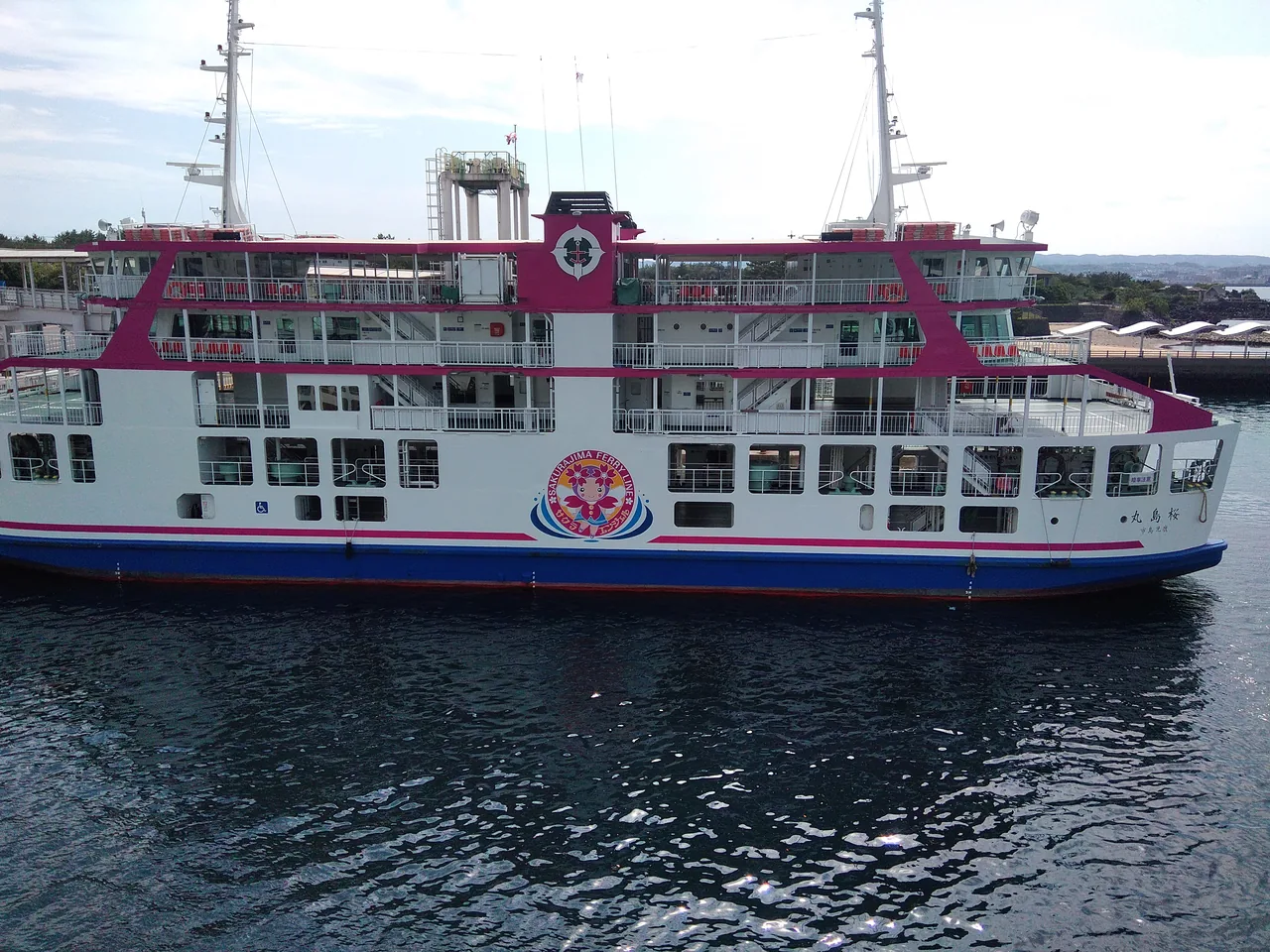
3. Nothing sails between midnight and four in the morning
The Sakurajima ferry ran around the clock for years and stopped doing so in autumn 2025. The last boat now leaves Kagoshima at 23:30 and Sakurajima at 23:00. The first ones go at 4:00 from Sakurajima and 4:30 from Kagoshima.
Once the last sailing has gone, both terminals and the toll booths close completely. You cannot wait inside. Sakurajima terminal reopens about fifteen minutes before the first boat, Kagoshima terminal about thirty.
Evening gaps get long
The twenty minute daytime pattern becomes half-hourly after 7pm, and from around 9pm there is one boat an hour. If you plan to eat on the island or use a hot spring there, check your return sailing before you settle in.
From Kagoshima the late boats leave at 21:30, 22:30 and 23:30. From Sakurajima they leave on the hour at 20:00, 21:00, 22:00 and 23:00. Those times are all you need to remember.
Ambulances are the exception
During the closed hours, emergency vehicles are still carried when the fire service or another agency asks. The crew can have a boat moving in about half an hour. That provision exists for the people who live on the island.
For a visitor the practical version is to decide before evening whether you are sleeping on the island or in the city. There is a public lodge and there are hot spring inns if you want to stay.
Crossing early
The first boats leave at 4:00 and 4:30, so sunrise from the island is possible. The island loop bus does not start until 9:30 though, so before then you are limited to whatever you can reach on foot from the port.
If you want to be at the observatory, aim for a crossing that connects with the bus. An early boat gets you the harbour and the water, and little else.
4. The closest you can stand to the crater is Yunohira
The Yunohira Observatory sits 373 metres above sea level and 2.5km from the crater. No public viewpoint is closer. From the deck the flank of the mountain fills the view ahead, and turning round gives you Kinko Bay with the city on the far shore. Map
The deck itself is free and open at any hour. Only the shop keeps hours, 9am to 5pm. From Sakurajima Port the island loop bus takes about forty minutes.
Each viewpoint faces a different way
There are several observatories around the island and they look at different faces. Yunohira looks up the western flank. Arimura Lava Observatory looks toward the crater from the south. Karasujima and Akamizu sit close to the water and give you the mountain with the sea in front of it.
| Viewpoint | Getting there | From the crater |
|---|---|---|
| Yunohira Observatory | Loop bus, 40 min | 2.5km |
| Akamizu Observation Plaza | Loop bus | about 4km |
| Karasujima Observatory | Loop bus | about 5km |
| Arimura Lava Observatory | 20 min by car | 3.5km |
| Kurokami buried torii | 30 min by car | 4.5km |
Walking on lava that has set
Arimura Lava Observatory has a boardwalk laid across lava that flowed in 1946. Pines have taken root between the black rocks, and the crater stays in view as you walk. Map
The Kurokami buried torii is a shrine gate that the 1914 eruption filled with ash. The pillars stood over three metres and only the top section shows now. Both of these are on the southern and eastern sides, which the loop bus does not reach. Map
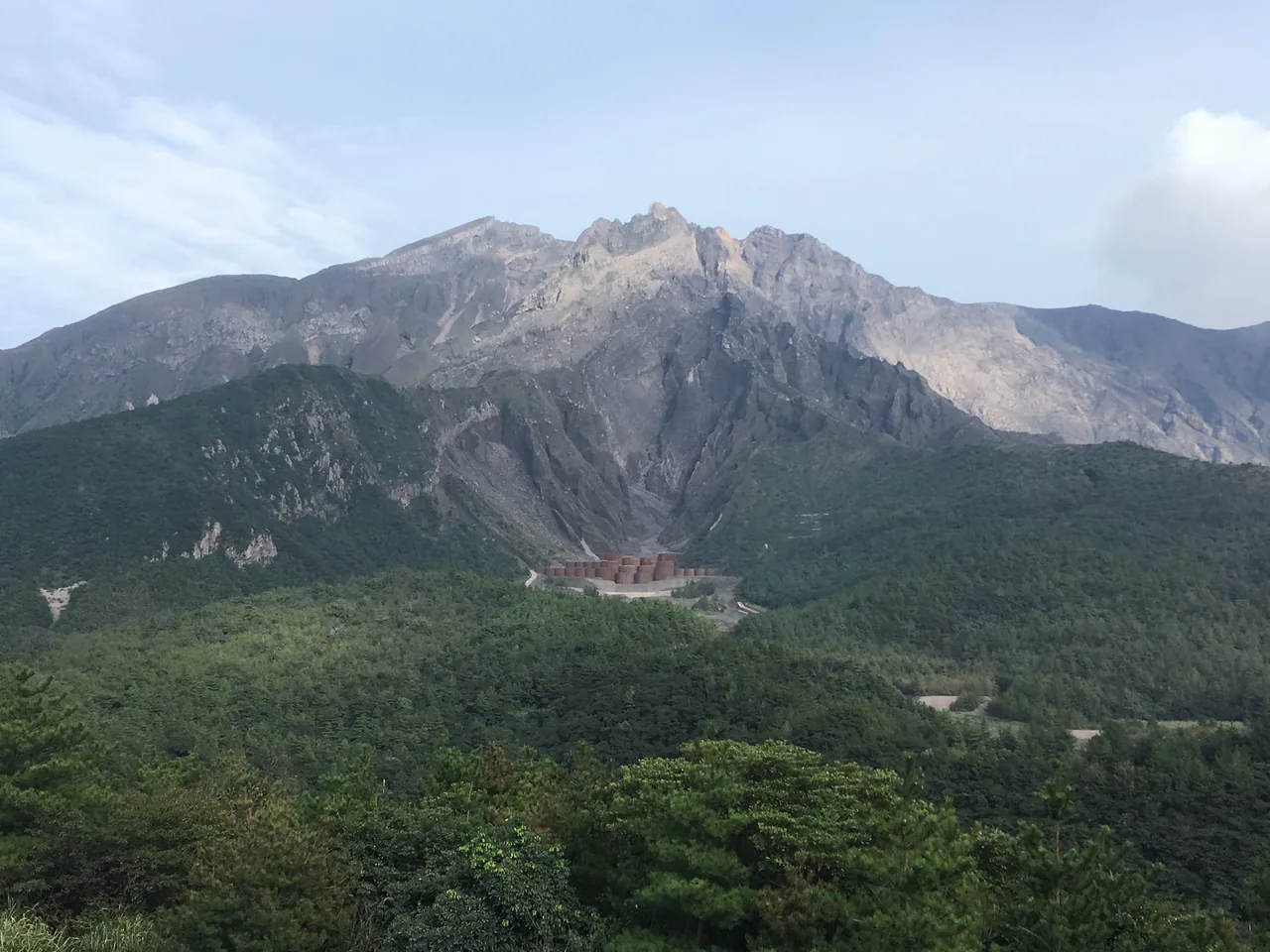
5. The island bus only covers the western side
The Sakurajima Island View bus circles the western part of the island. It leaves Sakurajima Port, calls at the Visitor Centre, Karasujima Observatory and Akamizu Observation Plaza, climbs to the Yunohira Observatory and comes back. One lap takes about 55 minutes.
Departures run every thirty minutes from 9:30 to 16:30. A single ride is 230 yen for an adult, and a day ticket for this bus alone is 500 yen. If you get off at two viewpoints, the day ticket is the easier option.
The east and south have no bus
Arimura Lava Observatory and the Kurokami buried torii are on the far side. From the port they are twenty and thirty minutes by car, and neither is on the Island View route. You need a rental car, a taxi, or one of the few local service buses.
The ring road is continuous, so with a car you can take in the western viewpoints, the southern lava boardwalk and the eastern buried gate in half a day. Bringing a car across on the ferry costs 1,280 yen for a vehicle under three metres.
One stop is only served on the half hour
The International Volcanic Sabo Centre is served only by buses leaving Sakurajima Port at half past the hour. Take the one leaving on the hour and you go straight past. Time your departure if you want to see it.
The loop buses are low floor vehicles that take wheelchairs. On busy days you may not fit on the bus you wanted, so leave one departure of slack.
Start at the Visitor Centre
Ten minutes on foot from Sakurajima Port, the Visitor Centre opens 9am to 5pm every day of the year. Models and film show how the volcano formed and how far the lava reached in each eruption. Map
If this is your first crossing, seeing it before the viewpoints changes how the mountain reads. The loop bus stops outside.
Walking on the island
A boardwalk over the lava starts near the port and runs about three kilometres. You walk between black rock with pines growing out of it. There and back takes around an hour.
The island also has a sea fishing park and a playground with dinosaur models, both useful with children. Each sits more than five kilometres from the crater.
6. Some days the ash comes down
Ash falls on central Kagoshima when the wind blows that way. The volcano stands directly across the water from the built-up area, so after an eruption whatever is in the air comes over. The city and the meteorological agency both publish the wind above Sakurajima and an ash forecast.
On those days you see umbrellas out in dry weather. Ash stings the eyes and clings to clothing.
What helps
A hat or an umbrella, and glasses rather than contact lenses. Ash shows up on pale clothing. Keep a camera in the bag between shots so grit does not settle on the lens.
You will notice yellow bags around the city. Residents fill them with ash swept from doorways and put them out for collection. A row of them means ash fell in that neighbourhood recently.
You sometimes hear an explosion
The agency warns that the air shock from a large explosion can break window glass. That scale of event is rare, but on some days there is a sound like distant thunder. In the city it is treated as ordinary.
After heavy ashfall, rain can set off debris flows, so the valleys on the island are places to stay out of. Visitor routes are laid away from them.
This is not a reason to move your dates
Ashfall follows the wind rather than the calendar. Summer winds tend to push it away from the city, winter winds send it south. The city gets ash when the wind sits in the east.
Southern Kyushu also sits on the typhoon track. What to check if you are travelling then is set out in our Japan typhoon season guide.
7. Places in the city that face the mountain
You do not have to take the ferry to see Sakurajima properly. The city sits on the shore directly opposite, so anywhere near the water gives you the mountain. With only one day, staying on this side works.
The viewing spots fall into three kinds: the hill at Shiroyama, the waterfront looking straight across, and the garden at Senganen.
Shiroyama looks down on it
Shiroyama is the hill on the western edge of the centre. From the observation deck you get the city roofs, the bay and the volcano in one frame. The City View bus stops at Shiroyama right beside it. Map
It is free and there is no closing time. A nature trail climbs from below and takes about twenty minutes on foot.
The waterfront gives you the boats as well
This is the strip with the aquarium and the ferry terminal. The mountain stands straight out of the water and a ferry crosses every fifteen minutes in front of it. From the tram stop at Izuro-dori it is an eight minute walk. Map
Io World Kagoshima Aquarium is next door, open 9:30 to 6pm with last admission at 5pm. During Golden Week and on summer weekends there are evenings when it stays open until 9pm. Map
Inside there is a section for the creatures of Kinko Bay, which is deep water formed by volcanic activity and holds species that are hard to see elsewhere. A whale shark swims in the main tank.
The aquarium closes in early December
Io World shuts for four days from the first Monday in December and opens as normal over the new year. That reverses the usual Japanese pattern, so it catches people out.
Dolphins swim in a channel outside the building, and you can watch them without buying a ticket.
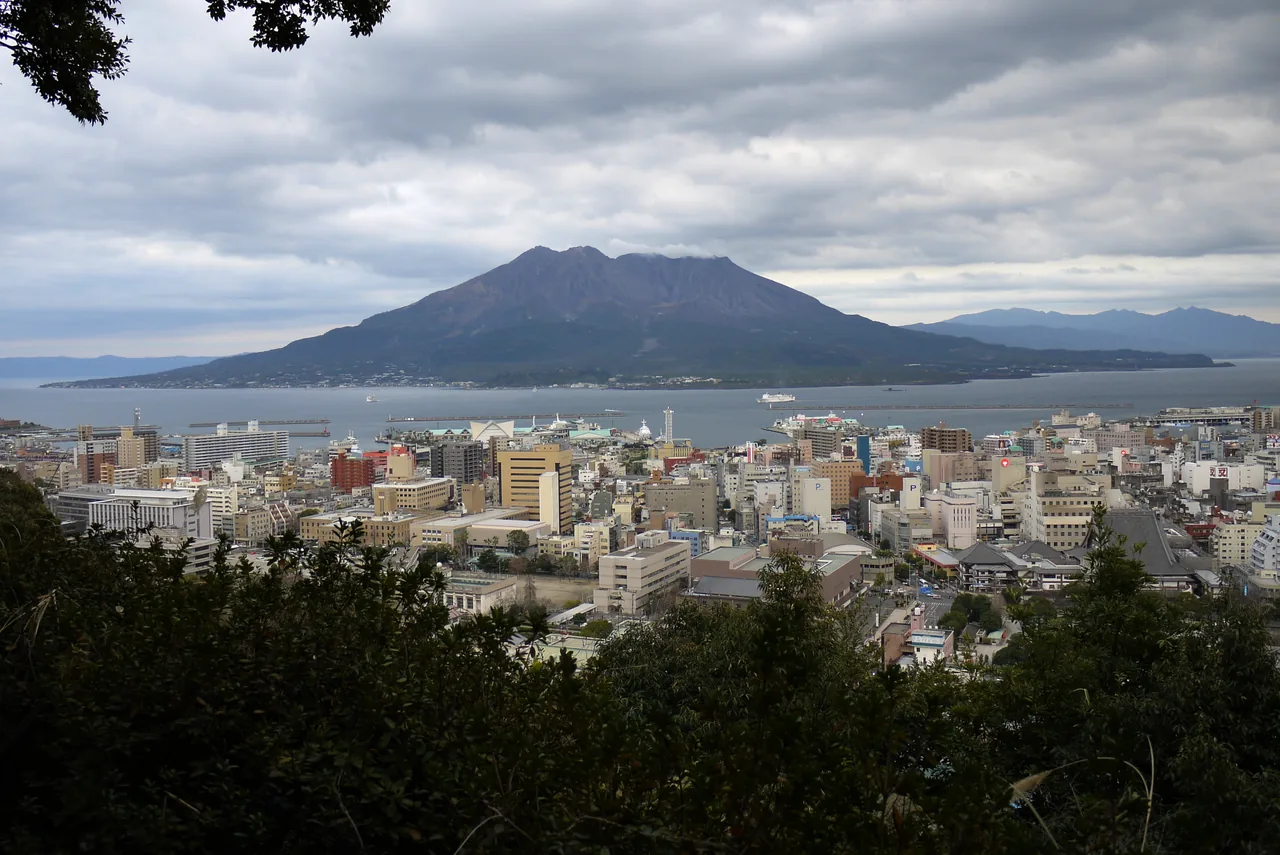
8. The tram costs 200 yen wherever you get off
Kagoshima’s tram is a flat fare across the whole network at 200 yen for an adult. One stop or the full line costs the same. Children pay 100 yen. The route runs from Kagoshima-Chuo Station through Tenmonkan and down toward the harbour, which covers most of what visitors want.
City buses are also flat, at 230 yen for an adult. The sightseeing buses, City View and Island View, charge the same 230 yen.
| Service | Adult | Child |
|---|---|---|
| Tram, flat fare | 200 yen | 100 yen |
| City bus, flat fare | 230 yen | 120 yen |
| City View, Island View | 230 yen | 120 yen |
| One day ticket | 700 yen | 350 yen |
| 24 hour ticket | 900 yen | 450 yen |
The day ticket pays from the fourth ride
At 200 yen a tram ride, the 700 yen day ticket starts paying from your fourth journey. It covers trams, city buses and the City View. It also comes with a discount passport that reduces admission at a list of attractions.
The 24 hour ticket costs 900 yen and runs for a full day from first use, which suits an afternoon arrival followed by a morning of sightseeing.
There is a ticket that only works after dark
The Night Pass is 300 yen and valid from 5pm to the last service. It is only sold in March and April, July and August, and December and January. There is no child version.
Nationwide travel cards and the local card do not cover the same services. Which card works where is set out in our Japan IC card guide.
You pay the City View as you get off
On the City View you drop cash into the box as you leave. Travel cards and the day ticket work too. At Kagoshima-Chuo the stop is bay East 4 in the east exit bus terminal. Map
Several stop names are used in more than one direction, so the boarding point depends on where you are heading. Tenmonkan and Satsuma-Gishihi-mae are the two that catch people.
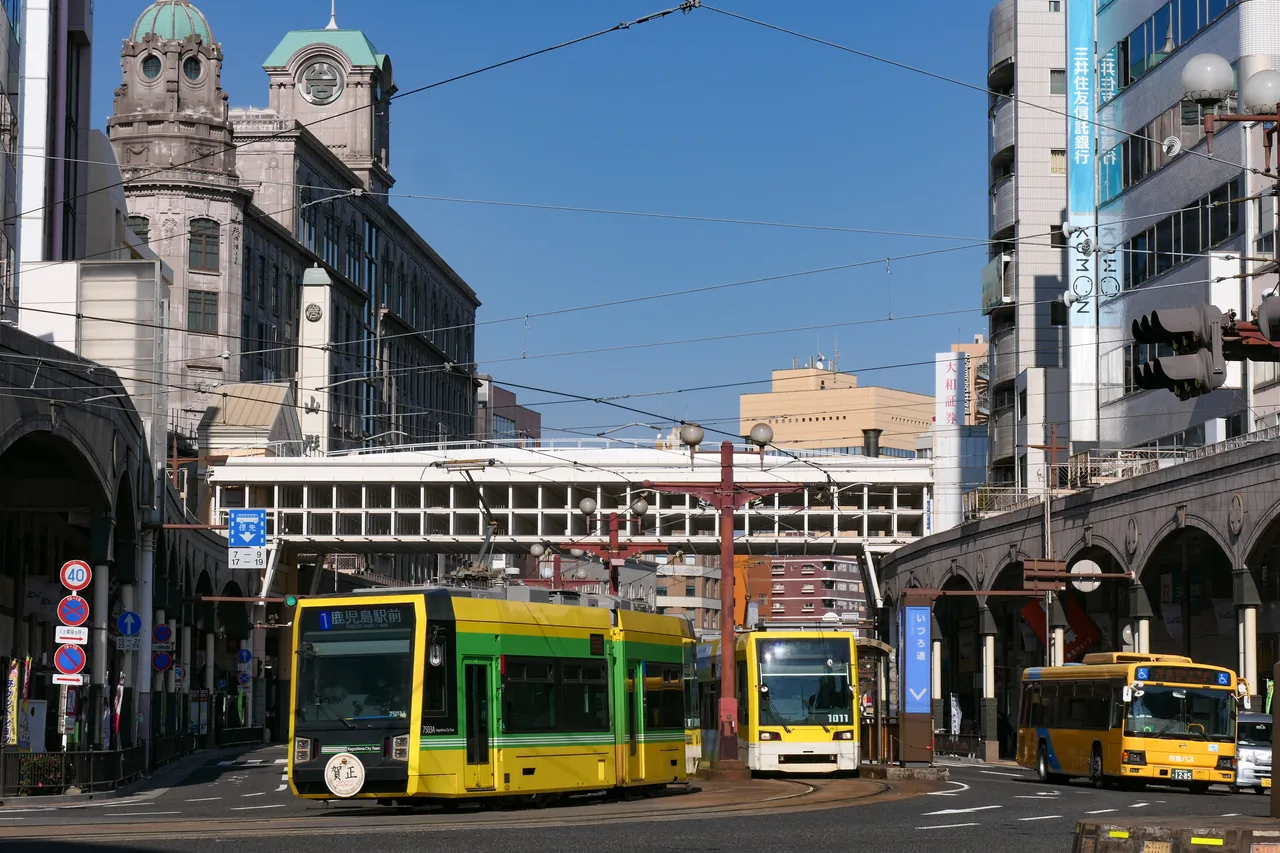
9. The three sightseeing buses cover different ground
Kagoshima City runs the City View, the City View night route and the Sakurajima Island View. The names are similar and the routes do not overlap. One does the city, one does Shiroyama after dark, one does western Sakurajima.
The city route runs daily and takes about eighty minutes for a lap. From Kagoshima-Chuo it calls at the Ishin Furusato-kan, Tenmonkan, the Saigo statue, Shiroyama, Nanshu Park, Senganen, Ishibashi Memorial Park and the aquarium before returning.
| Route | Covers | Lap | Runs |
|---|---|---|---|
| City View | City sights | about 80 min | Daily |
| City View night route | Shiroyama after dark | about 60 min | Saturdays |
| Island View | Western Sakurajima | about 55 min | Daily, 9:30 to 16:30 |
Kagoshima-Chuo is the terminus
The City View lap ends at Kagoshima-Chuo. To carry on round you settle the fare again. With a day ticket you can simply stay in your seat.
Three dedicated vehicles run the route, and on two of them the seats are angled five degrees toward the windows. The interiors are finished in timber with a viewing bench at the back. On busy days or when a vehicle is being serviced, an ordinary bus takes over.
The City View is how you reach Senganen
Senganen sits north of the centre, beyond the tram network. The City View stops at the front gate. City buses go there as well.
Ishibashi Memorial Park and the Ijinkan are in the same direction, which makes them easy to combine. The park is free and open 9am to 5pm, or until 7pm in July and August. Map
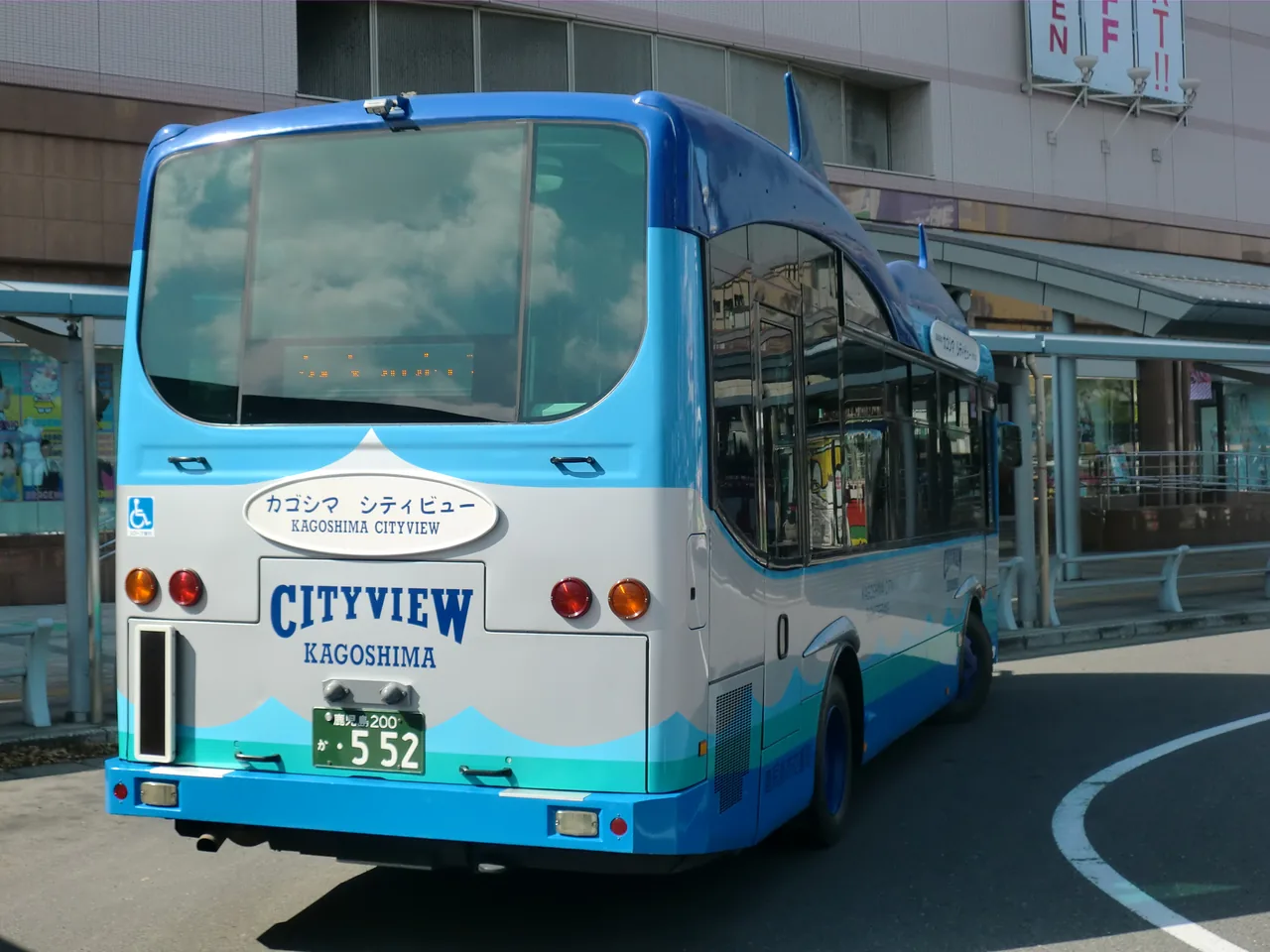
10. To include the ferry you buy CUTE in an app
CUTE is the ticket that adds the Sakurajima ferry to city transport, and the one day version is 1,400 yen for an adult. It covers city buses, trams, the City View, the Island View and the ferry, with no limit on journeys. Two days costs 2,100 yen.
On a day when you cross to the island it settles the whole question. The ferry alone is 500 yen return, and the city trams and island bus stack on top of that.
| Ticket | Adult | Child |
|---|---|---|
| CUTE one day | 1,400 yen | 700 yen |
| CUTE two day | 2,100 yen | 1,050 yen |
| Island View day ticket | 500 yen | 250 yen |
| Night route day ticket | 250 yen | 130 yen |
Counters do not sell it
CUTE became a digital ticket, so it is bought in an app. It appears in the Kyushu transport app myroute under the discounted tickets section for Kagoshima Prefecture, and in the Kagoshima city app. You need a data connection to display it.
There are no changes or refunds after purchase, and the ticket has an expiry, so buy it on the day you travel. You show the screen to the driver as you get off, and to the staff on the Sakurajima side of the ferry.
Private operators are not included
CUTE covers services the city runs. Private bus companies and private ferries charge separately, and the airport limousine is one of them.
If you are only moving around on the island, the 500 yen Island View day ticket is cheaper. It is sold on board and at the tourist information desks at Kagoshima-Chuo Station and Sakurajima Port, among others.
11. The night route only runs on Saturdays
The City View night route operates on Saturdays only. In August, December and January it adds Fridays. From Kagoshima-Chuo it goes through Tenmonkan and the waterfront, stands at Shiroyama for fifteen minutes, then returns past the Saigo statue. A lap is about an hour.
That fifteen minute stop is the point of the service. You get off, walk up to the deck, look at the city lights and get back on. There is no convenient alternative up the hill after dark.
The route has its own 250 yen day ticket
A day ticket valid on the night route alone costs 250 yen for an adult and 130 yen for a child, bought on board. A single ride is 230 yen, so it pays as soon as you get off and back on.
The standard day ticket and CUTE are both accepted. If you have spent the day on city transport, there is nothing more to buy.
It does not run on fireworks night
The night route is suspended on the day of the Kinko Bay Summer Night fireworks, when the roads it uses are closed. During long holidays and the Obon period extra departures are sometimes added.
Boarding is at bay East 4 at the east exit of Kagoshima-Chuo. The Shiroyama stop is just past the left turn toward the observation car park.
Where to walk at night
Without the night bus, Tenmonkan is the part of town to walk after dark. The arcades are covered and the shops stay open late. Get off the tram at Tenmonkan-dori. Map
By the station there is a shopping complex with a ferris wheel on the roof, which also gives you the city from above. It connects straight through from Kagoshima-Chuo.
12. Senganen was laid out to put the volcano inside the garden
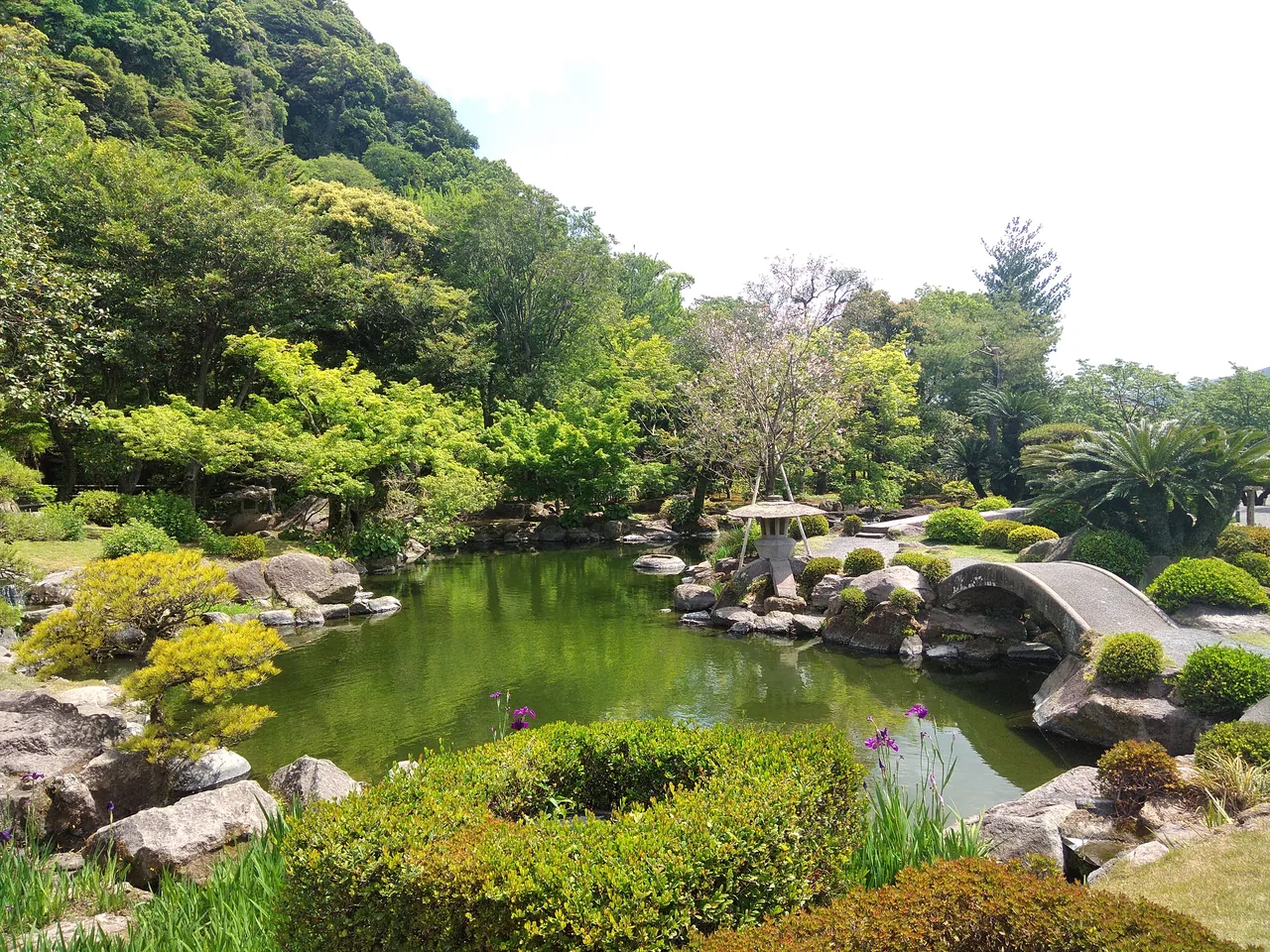
Senganen is the Shimadzu family villa garden, arranged so that Sakurajima stands beyond the pond as part of the composition. That placement was designed in from the start. It is a nationally designated place of scenic beauty and admission is 1,600 yen, or 800 yen for school students. Map
Opening is 9am to 5pm with last entry at 4:30pm. It stays open all year except for one day, the first Sunday in March, when the Kagoshima Marathon closes it.
The ticket includes the residence and the museum
The 1,600 yen ticket covers the garden, the Goten residence and the Shoko Shuseikan. The Goten is the house the family actually used. The Shuseikan is a museum housed in the oldest surviving Western style factory building in Japan. Seeing all three takes around two hours.
The Iso district around the Shuseikan is part of a World Heritage listing. Cannon, glass and ships were made here in the closing years of the Edo period and some of those works remain. You come for a garden and end up reading about industry.
An annual passport costs 2,400 yen, which is about one and a half admissions, so it pays on a second visit.
Closing times differ inside the grounds
| Area | Hours | Last entry or order |
|---|---|---|
| Garden | 9:00 to 17:00 | 16:30 |
| Goten residence | 9:00 to 17:00 | 16:50 |
| Shoko Shuseikan | 9:00 to 17:00 | |
| Gozensho Okatei restaurant | 11:00 to 16:00 | 15:30 |
| Craft workshops | 9:00 to 17:00 | 16:00 to 16:40 |
Leave your bags at the entrance
Coin lockers sit to the right of the reception entrance at 300, 400 and 500 yen depending on size. Anything too big is held at the reception desk for 500 yen per item. Bag storage cannot be reserved.
Gravel paths and slopes make parts of the garden hard going in a wheelchair. Wheelchairs are 500 yen to hire, and a small powered mobility unit that handles gravel is 2,000 yen for the day.
13. More than thirty entries in the city’s sights list are people
Open the Kagoshima City tourism board’s list of sights and over thirty entries are a single person rather than a building or a view. Oyama Iwao, Murata Shinpachi, Kuroda Kiyotaka, Shimadzu Shigehide. Most were born or raised here around the time of the Meiji Restoration.
Sort the list by the city’s own categories and history and historic sites come first by a wide margin. Walking central Kagoshima means passing statues and stone markers. Set the volcano aside and what this city puts forward is mostly people.
There is a walk that follows Saigo Takamori
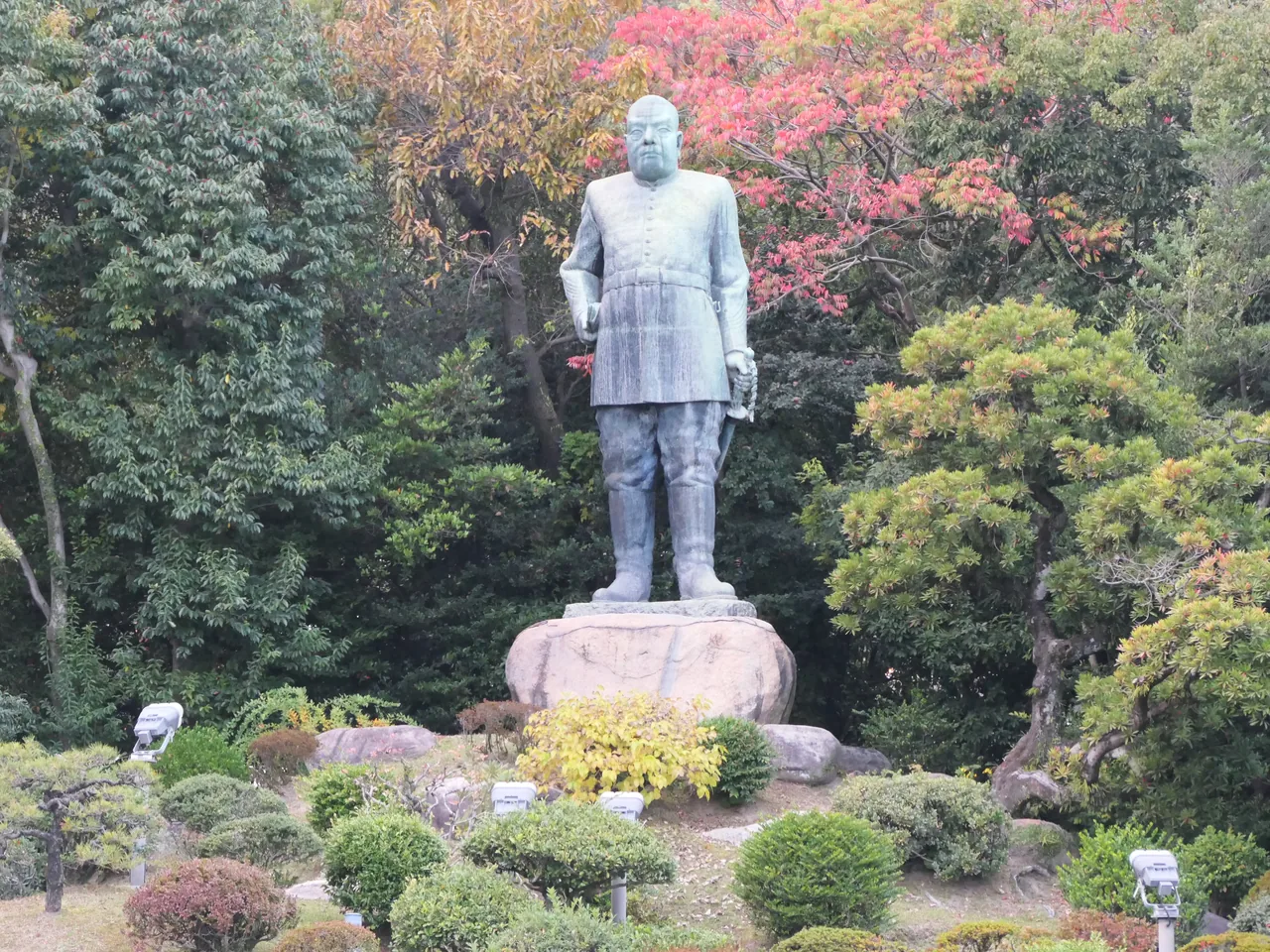
The best known stop is the Saigo Takamori statue, right beside the City View stop of that name and an eight minute walk from the Asahi-dori tram stop. Map
Climb toward Shiroyama from there and you reach the cave where he spent his last five days, and a little further on the marker where he died. The three are within walking distance of each other and take about an hour.
The Ishin Furusato-kan supplies the background
An eight minute walk from Kagoshima-Chuo, this museum explains why so many figures came out of this domain and what they did. It opens 9am to 5pm with last admission at 4:30pm. Map
See the statues first and the names attach to faces here. Do it the other way round and the markers start standing out as you walk.
Only the gate of the castle was rebuilt
Kagoshima Castle, also called Tsurumaru, has no surviving buildings. The main gate, the Goromon, was rebuilt in its original form in 2020. Get off the City View at Satsuma-Gishihi-mae or walk ten minutes from the Shiyakusho-mae tram stop. Map
The Reimeikan, the prefectural history and art centre, stands beside it. Admission is 430 yen and it opens 9am to 6pm.
Nanshu Park closes the walk
Saigo and the men who followed him are buried together at Nanshu Park, alongside a shrine and the Nanshu Kenshokan memorial hall. The hall opens 9am to 5pm, costs 400 yen for visitors and closes on Mondays.
The City View stops outside. It is fifteen minutes by car from Kagoshima-Chuo, and being on a rise it gives you another look at the water.
14. Resident and visitor admission prices are different
Several city-run attractions charge Kagoshima residents less than everyone else, and visitors pay the higher figure. Both prices appear side by side on the board, which is why it reads oddly at first.
To be charged the resident rate you have to show a driving licence, My Number card, student ID or similar at the window proving you live in the city. Someone else cannot show it for you.
| Attraction | Resident | Visitor |
|---|---|---|
| Io World Kagoshima Aquarium | 1,500 yen | 2,000 yen |
| Hirakawa Zoological Park | 750 yen | 1,000 yen |
| Ishin Furusato-kan | 450 yen | 600 yen |
| Nanshu Kenshokan | 300 yen | 400 yen |
Getting some of it back
The day ticket and CUTE both come with a discount passport for attractions. The reduction varies by site, but part of the ticket price returns that way. If you are visiting two or three places, buy the transport ticket first.
There is also a combined ticket covering the Chiran Peace Museum and the aquarium at 2,000 yen for an adult, even though the two are over an hour apart by road.
Senior discounts are also residence based
The aquarium halves admission for people aged 70 and over who live in Kagoshima, Kumamoto, Fukuoka or Kitakyushu, on production of documents showing address and age. Visitors are outside that.
Holders of a disability certificate are admitted free at the aquarium, along with one companion. Other sites generally offer reductions too.
The zoo is out of town
Hirakawa Zoological Park lies south of the city, thirty minutes by car from Kagoshima-Chuo. By train you get off at Goino and walk twenty minutes, or take a bus for the last five. It opens 9am to 5pm with last entry at 4:30pm.
It closes from 29 December to 1 January. Pre-school children are free and primary and middle school students pay 200 yen.
15. Closing days follow no common rule
Closing days vary enough between Kagoshima attractions that it is worth checking before you fix a day. Some close on Mondays, some for four days in early December, one on the 25th of every month, and some never.
The Reimeikan is the one to watch: it closes on Mondays and also on the 25th of each month, unless that date falls on a Saturday, Sunday or public holiday, in which case it opens.
| Attraction | Closed |
|---|---|
| Senganen | Open all year, except the first Sunday in March |
| Io World Aquarium | Four days from the first Monday in December |
| Reimeikan | Mondays, the 25th, 31 Dec to 2 Jan |
| Nanshu Kenshokan | Mondays, 29 Dec to 1 Jan |
| Hirakawa Zoological Park | 29 Dec to 1 Jan |
| Sakurajima Visitor Centre | Open all year |
| Ishibashi Memorial Hall | Mondays |
What is open on a Monday
Senganen, the aquarium and Sakurajima all run. The city museums are mostly shut, so a Monday is a good day to cross to the island or pair the garden with the aquarium.
Wet days work similarly. The aquarium, the Reimeikan and the Ishin Furusato-kan are indoors, and so is the Sakurajima Visitor Centre.
Shops and department stores
Yamakataya department store opens 10am to 7pm and closes only on 1 January. It is a minute from the Asahi-dori tram stop. Amu Plaza Kagoshima connects straight through from Kagoshima-Chuo, with the main building open until 8pm and the fifth and sixth floor restaurants until 10pm.
The yatai village under Kagoshima-Chuo terminal opens in two blocks, 11:30 to 2pm and 5pm to 11:30pm, closed in between. It shuts on the first Monday of each month. Map
16. Most public baths in this city are hot springs
Kagoshima has close to 270 hot spring sources within the city limits, and most neighbourhood bathhouses draw on them. No other prefectural capital in Japan has as many. These are not resort baths but ordinary sento in residential streets.
Around sixty hot spring facilities belong to the prefectural bathhouse association and charge 420 yen for an adult. Towels and soap are bought or brought.
Visitors are welcome
Local bathhouses rarely have signage for tourists, but nothing stops you going in. Shoes go in the rack, you pay at the counter, and that is the process. Tattoo rules differ from place to place.
If the etiquette is new to you, our guide to Japanese onsen and ryokan covers the order of things, which is the same nationwide.
The island water runs a different colour
Baths on Sakurajima carry iron and come out reddish brown, because the water passes through different rock. City bathhouses are generally clear.
Furusato is a hot spring area fifteen minutes by car from Sakurajima Port, or about an hour by bicycle. It faces the sea, so you sit in the water looking at Kinko Bay.
There is a foot bath at the airport
Kagoshima Airport has a natural hot spring foot bath, named with the local phrase for thanks for your trouble. People use it while waiting for a flight.
Bathing here reads less like an outing and more like the way a day finishes. Plenty of hotels have hot spring baths of their own.
What to take to a bathhouse
Many neighbourhood baths do not supply towels or soap. Some sell or rent them at the counter and some do not, so bringing them from the hotel is simpler. Payment is usually cash.
Changing room lockers commonly take a 100 yen coin and return it, so carry one.
17. Where to get into the water on Sakurajima
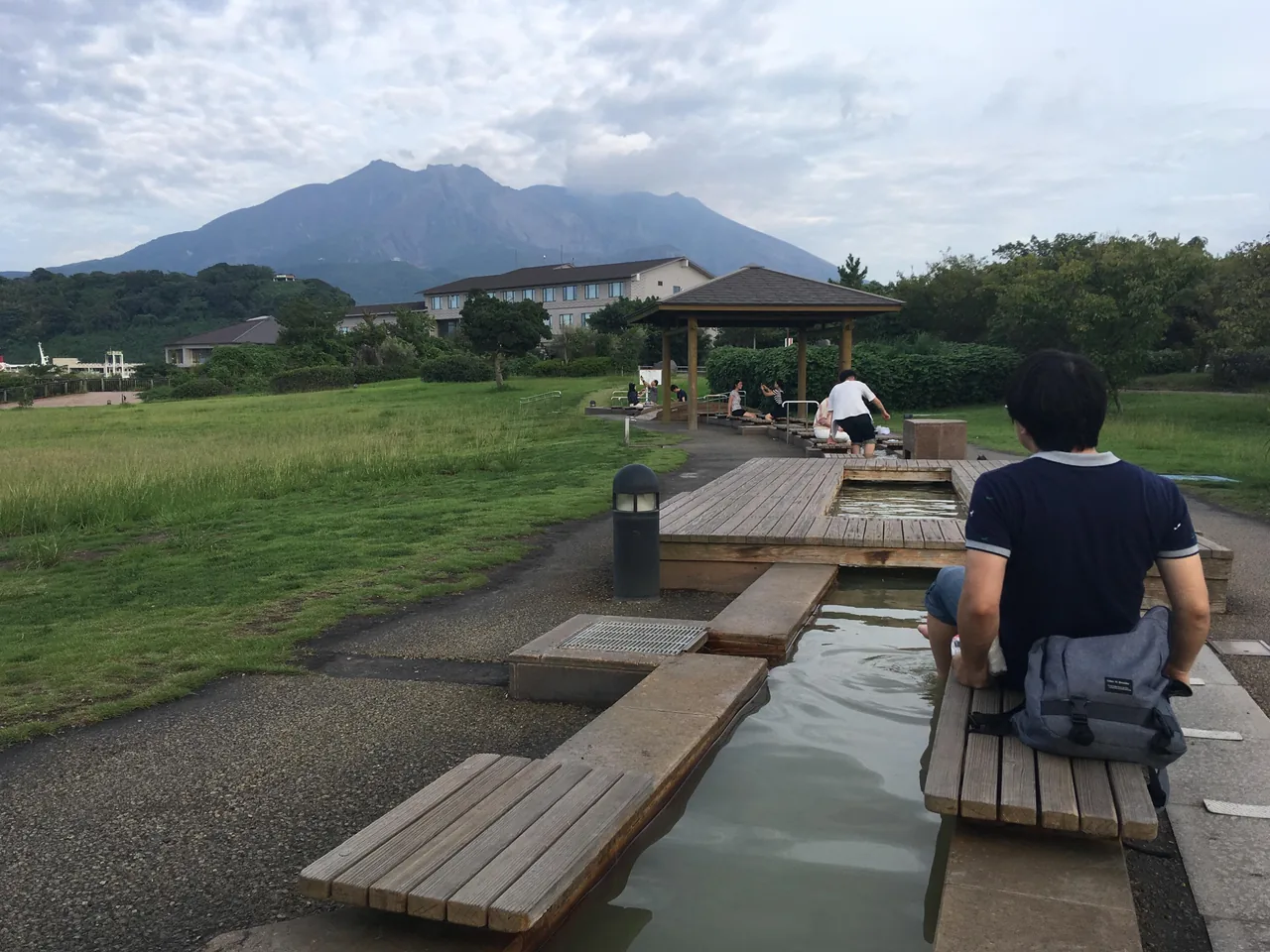
The foot bath at Sakurajima Lava Nagisa Park runs about a hundred metres and is free. The water comes up from a thousand metres down and carries a reddish brown colour. It opens at 9am and closes at sunset, every day. From Sakurajima Port it is eight minutes on foot. Map
Kinko Bay is in front of you and the volcano behind. Plenty of people put their feet in while waiting for a ferry.
Buy a towel nearby if you forget
The foot bath does not supply towels. The Sakurajima Visitor Centre and the Rainbow Sakurajima lodge both sell them, and both are a few minutes away.
The lava boardwalk starts alongside the foot bath and runs about three kilometres, an hour or so there and back.
The magma bath closes on Wednesday mornings
The Magma Onsen inside the Rainbow Sakurajima public lodge charges 460 yen for a day visit. It opens 11am to 9pm with reception closing at 8pm. On Wednesdays cleaning delays opening until 1pm. Map
It is five minutes on foot from the port, right by the Rainbow Sakurajima loop bus stop. Guests staying overnight can also use it until 11pm and again from 6:30 to 9am.
Staying on the island
If you want the evening without watching the clock for the last ferry, the public lodge is the way to do it. The mountain is directly outside the window in the morning.
There are not many rooms on the island, so book ahead. Staying in the city and crossing back and forth gives you far more choice.
18. Walking between Tenmonkan and the station
Tenmonkan is where the shops and restaurants are, and Kagoshima-Chuo is where the shinkansen stops. They are about five tram stops apart, or twenty minutes on foot. Most of the city’s listed sights cluster around these two areas.
Tenmonkan is a covered arcade district, so it works in the rain. It also works on a day when ash is falling.
Where the name comes from
The Shimadzu family built an astronomical observatory on this spot in the Edo period, used for calendar work and star observation. The building is long gone and only a marker remains, but the name stayed with the district.
Today it holds department stores, arcades and restaurants. More places stay open late here than anywhere else in the city.
A newer complex inside the arcade puts a bookshop, a cinema and restaurants under one roof, which is useful on a wet or ashy afternoon.
The station side has the shopping
Amu Plaza adjoins Kagoshima-Chuo with a ferris wheel on the roof. Being connected to the station makes it a place to wait out weather or a gap before a train.
Under the station there is a yatai village, a cluster of small counters serving pork, fish and local shochu. It splits its hours between lunch and evening and closes in the afternoon.
The tram links the two
At a flat 200 yen, moving between the districts costs nothing to think about. From the station it is a few minutes to Tenmonkan-dori.
Accommodation splits the same way. The station side suits trains and the airport bus, Tenmonkan suits evenings out. Lodging tax rules are covered in our Japan accommodation tax guide.
19. Choosing between the station and Tenmonkan for a room
Hotels in Kagoshima cluster around Kagoshima-Chuo Station and around Tenmonkan. The two are about five tram stops apart and either works for getting around. What decides it is how much you use the trains and how late you are out.
The station side puts the shinkansen, the airport bus and the Ibusuki train at your door. Tenmonkan lets you walk home from dinner.
| Area | Suits | Close to |
|---|---|---|
| Kagoshima-Chuo | Train based trips | Shinkansen, airport bus, Ibusuki line, shopping |
| Tenmonkan | Evenings out | Arcades, restaurants, department stores |
| Waterfront | Frequent ferry use | Ferry terminal, aquarium |
| Sakurajima | Waking up under the volcano | Hot springs, viewpoints |
A sea view is not always a volcano view
The city faces the mountain, so an upper floor on the eastern side usually gets it. Buildings block some rooms, though, so check the aspect when booking. Many hotels label a Sakurajima view room separately.
Rates differ by aspect within the same hotel, and the mountain side generally costs more.
Lodging tax varies by municipality
Some Japanese municipalities levy an accommodation tax and some do not. Where and how much is set out in our Japan accommodation tax guide.
If you want a hot spring in the building, check whether the bath is open to day visitors only or to guests only before booking.
20. Where to eat kurobuta pork and satsuma-age
Kagoshima puts its name to kurobuta, black pork. Shabu-shabu and tonkatsu are the two usual forms, and the city’s own produce categories list black pork as a heading of its own. The specialist restaurants sit around Tenmonkan and Kagoshima-Chuo.
Satsuma-age is fish paste, shaped and deep fried. It started here and spread nationwide. Arcades and department store food halls sell it hot.
Some of it comes with instructions
Kurobuta shabu-shabu goes into the broth briefly and comes straight out. Cook it long and it toughens. Plenty of restaurants tell you how many seconds.
Tonkatsu arrives cut thick. Some places serve salt or yuzu pepper alongside instead of sauce.
Shirokuma is sold all year
Shirokuma is shaved ice with condensed milk and fruit on top. It began in Kagoshima and now turns up in convenience stores across Japan. The shop in Tenmonkan credited with inventing it serves it in every month.
A full bowl is large, so people share. Some places sell a smaller size.
The yatai village puts it all in one place
The cluster under Kagoshima-Chuo terminal holds a row of small counters, each doing one thing: black pork, local chicken, fish, shochu. It suits an evening when you want to try several.
Hours are 11:30 to 2pm and 5pm to 11:30pm. It closes on the first Monday of each month.
The radish and the tangerine from the island
Radishes grown on Sakurajima get very large. Ash-rich soil produces specimens the size of a person’s torso. They are harvested in winter and sold pickled.
Tangerines from the same island go the other way and grow tiny, about the size of a table tennis ball. They are eaten whole or juiced, and the ferry kiosk sells the juice.
21. Shochu is the default drink here
Order a drink in Kagoshima and what usually arrives is sweet potato shochu. The city’s produce categories list shochu as a heading in its own right. Far more is drunk here than sake.
Japanese shochu is distilled, made from sweet potato or barley, and usually bottled around 25 percent.
Mixing it with hot water is standard
Cutting shochu with hot water is called oyuwari, and locally the water goes in first with the spirit after. The order is held to change how the two combine.
Some bars mix it a day ahead and warm it to serve, which they call maewari.
Visiting a distillery
There are distilleries in and around the city and some take visitors, showing the fermentation vats and finishing with a tasting. Many run by reservation, so check before going.
If you do not drink, the local tea is worth a look. Kagoshima tea has its own heading in the city’s produce list and the prefecture is a major grower.
Taking bottles home
Shochu is sold in department store basements, station shops and at the airport. Bottles are heavy, so buy on the last day.
There are limits on how much alcohol you can bring into another country duty free. Our guide to Japanese customs rules and duty free limits sets out the numbers.
22. The airport is forty minutes out by bus
The limousine bus from Kagoshima Airport to Kagoshima-Chuo costs 1,500 yen for an adult and takes 38 minutes non-stop. Services routed via Yoshino take 55 minutes. There is no reservation system and buses leave to the timetable. Children pay 750 yen.
The airport is well outside the city, in Kirishima, with no rail connection. Bus or car are the options.
Stops and payment
Come out of the domestic terminal and the bus stand is directly in front, at bay 8. Cash and transport IC cards are both accepted.
The discount that used to apply to card payments has been withdrawn, so the fare is the same however you pay.
Going somewhere else from the airport
Buses run from the airport toward Kirishima Shrine, so you can go there without entering the city first. Ibusuki and Chiran are reached through the city.
Inside the terminal there is a natural hot spring foot bath and an observation deck for a spare hour.
Leave slack on the way back
City to airport takes about forty minutes non-stop. The operator warns that traffic can delay arrival substantially, so taking one bus earlier than you need is sensible.
Except for city-bound services after 8:45pm, buses depart when the clock says so. They do not wait.
23. What to check before booking a shinkansen
The Kyushu Shinkansen runs from Hakata to Kagoshima-Chuo, so you can come down from Fukuoka by train. Kagoshima-Chuo is the southern terminus and you step off into the city. To join a Fukuoka leg to this one, see our Fukuoka travel guide.
Earthquake repair work is still under way, so services are thinner than usual and one stretch is being run at reduced speed. Check the JR Kyushu service information before you commit to a ticket.
Whether a pass is worth it
For travel confined to Kyushu there is a regional rail pass, and where it pays depends on how far south you go. A return to Kagoshima usually clears the bar. The arithmetic is set out in our Kyushu Rail Pass guide.
For a trip spanning the whole country the national pass is the one to price. Our Japan Rail Pass and shinkansen guide compares them.
Coming in by sea
One route is a ferry from Busan to Fukuoka and then the shinkansen south. Sailings and arrival formalities are covered in our Busan to Fukuoka ferry guide.
There are also direct flights into Kagoshima from several Asian cities, with frequencies that change through the year.
Everything connects at Kagoshima-Chuo
The Ibusuki line trains, the trams, the airport bus and the City View all start here. Coin lockers let you leave bags and start sightseeing straight off the train.
There are two tourist information desks on the east side of the station, and they sell the Island View day ticket.
24. At Ibusuki you get buried in sand
The Ibusuki sand bath means lying on the beach while staff shovel naturally heated sand over you. You change into a yukata first, lie down, and stay under for ten to fifteen minutes. No swimwear is needed. Map
The main facility is Sunamushi Kaikan Saraku. It sells five plans that differ by what is included.
| Plan | Includes | Adult |
|---|---|---|
| Sand bath set | Sand bath, main bath, yukata | 1,500 yen |
| Towel set | Above plus a souvenir towel | 1,800 yen |
| Saraku set | Above plus bath towel hire | 2,100 yen |
| Inner set | Above plus underlayer hire | 2,600 yen |
| Main bath only | Main bath | 800 yen |
Holiday periods are priced differently
Golden Week, Obon, Silver Week and the new year period carry special pricing, each running five to eight days and announced in advance. Prices in those windows sit above the table.
The official site shows how many groups are waiting and the current wait in real time, which is worth a look before you set out.
The tourist train runs three times a day
The limited express Ibusuki no Tamatebako covers Kagoshima-Chuo to Ibusuki in about 51 minutes. Every seat is reserved and there are three round trips, six services in total.
Without a reservation you do not board. Seats on one side face the water, which is the side people ask for. Operating days change, so confirm at a station counter.
Local trains also go
If the tourist train is full, ordinary local trains cover the same line. They take longer and run more often, and the fare drops by the amount of the express supplement.
Ibusuki has open air baths and a crater lake as well as the sand. Carry on to the tip of the Satsuma Peninsula and a cone shaped mountain comes into view.
25. The combined ticket at Chiran is no use on a Wednesday
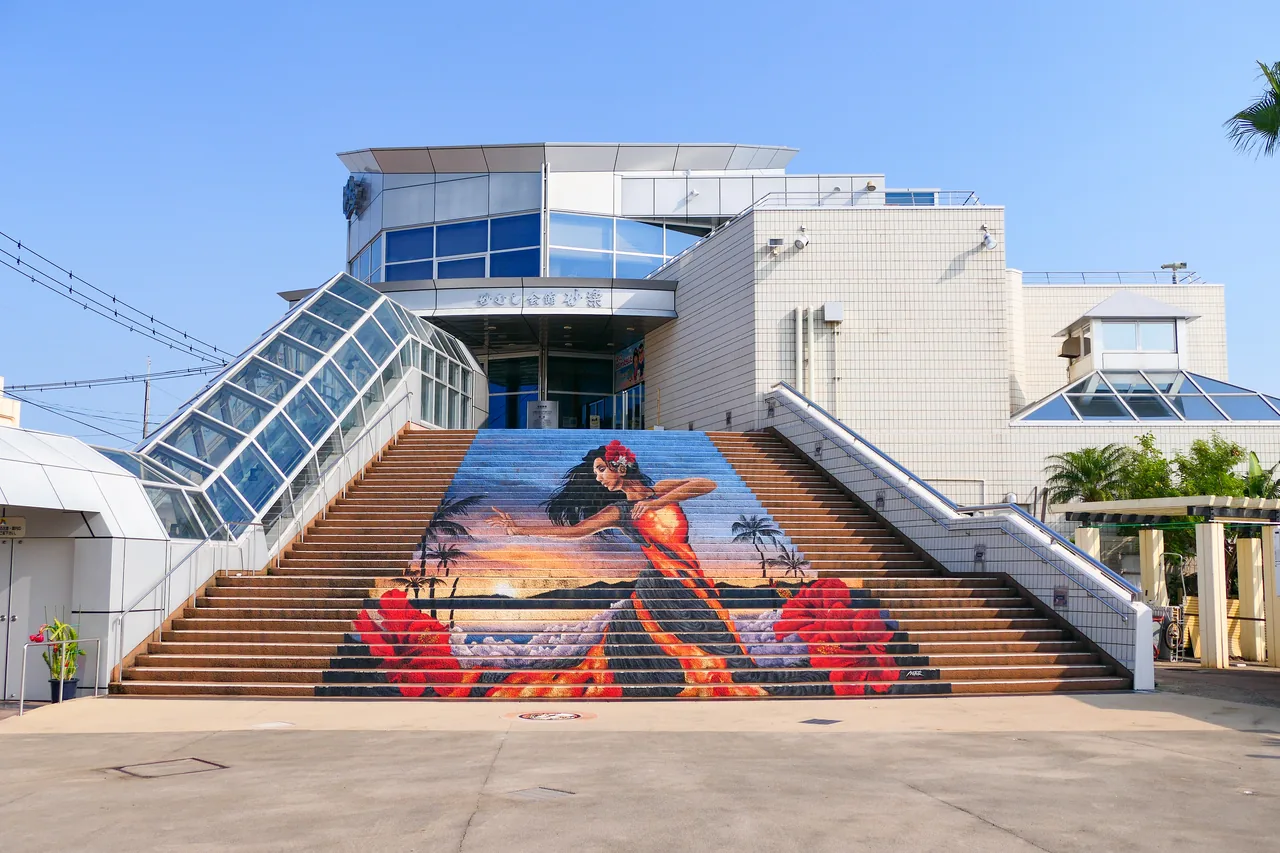
The Chiran Peace Museum holds the letters and belongings of the men who flew from this airfield at the end of the Pacific War. It opens 9am to 5pm with last admission at 4:30pm, costs 500 yen for adults and 300 yen for school students, and opens every day of the year apart from typhoon closures. Map
Museum Chiran, a local history museum, stands next door. A combined ticket for both is 600 yen against 800 yen bought separately.
Wednesdays remove the reason to buy it
Museum Chiran closes every Wednesday. The Peace Museum does not close, so on a Wednesday there is only one to see and the single admission is what you want.
There is also a combined ticket with the aquarium at 2,000 yen for an adult, even though the two sit far apart. Most people use it across two days.
A street of samurai houses
Chiran has a run of Edo period samurai residences with their gardens intact, along a lane of stone walls and clipped hedges. It is walkable from the Peace Museum.
Seven of the gardens are nationally designated places of scenic beauty. Some houses can be entered and some are viewed from the lane.
Walls and hedges together
Each garden behind the walls is arranged slightly differently. One sets stones upright to stand for mountains, another clips shrubs into a ridge line. A single combined ticket covers a run of houses.
The street itself is a nationally designated preservation district. Walking it is free and the ticket applies when you enter a garden.
Getting there
Buses run from Kagoshima-Chuo and take around an hour and ten minutes, with limited frequency, so check the return before you go. By car it is about an hour.
Ibusuki and Chiran are both on the Satsuma Peninsula but the roads there diverge. Seeing both in a day needs a car.
26. The main hall at Kirishima Shrine is a national treasure
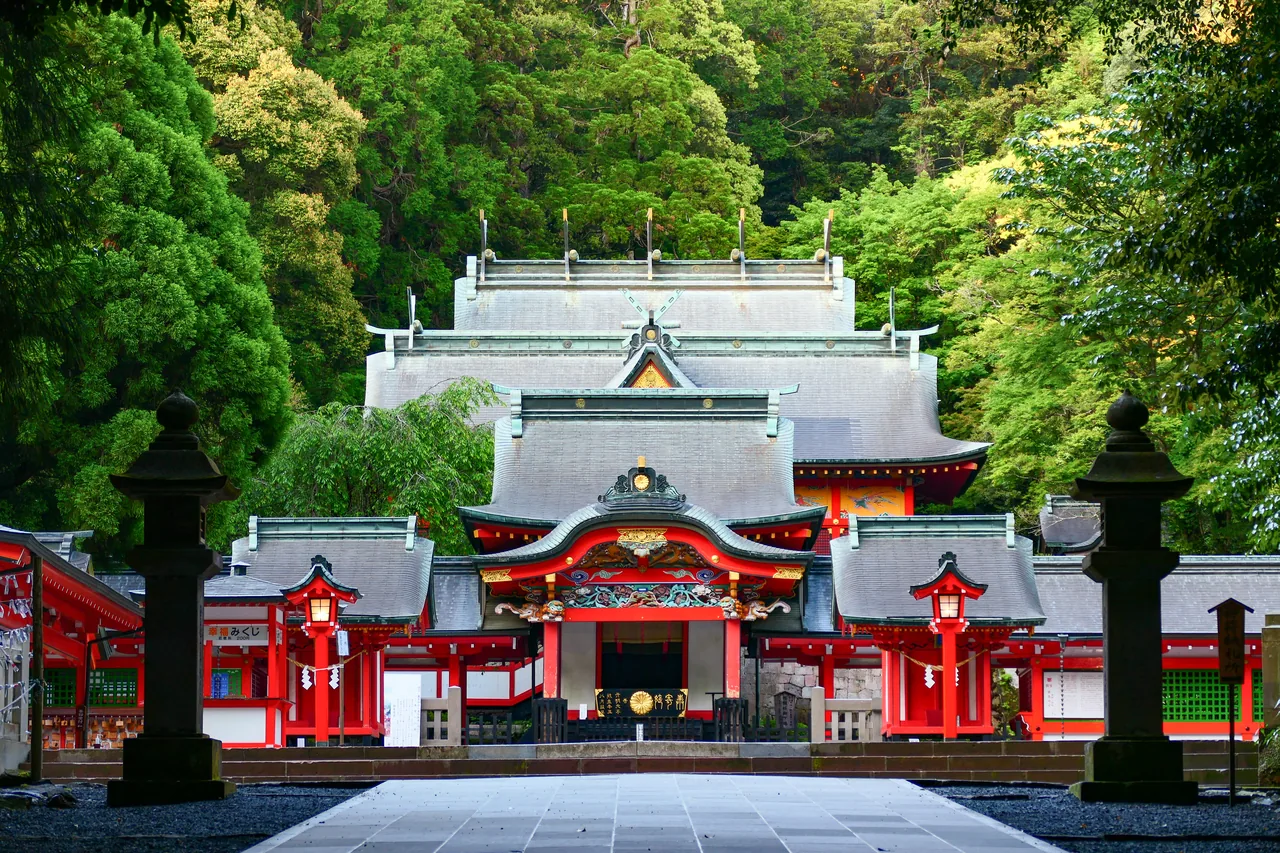
The honden, heiden and haiden of Kirishima Shrine were designated national treasures in 2022. It is the largest shrine of its kind in southern Kyushu, with a founding tradition going back to around the sixth century. Grounds are open at any hour and there is no admission charge. Map
The covered corridor and the imperial messenger hall are designated important cultural properties. The vermilion buildings stand in a stand of cedar.
It takes over an hour to reach
From Kagoshima-Chuo it is about an hour and twenty minutes by car, and closer from the airport. Fitting it in on an arrival or departure day works well.
The office issuing goshuin seals opens 8am to 5pm. You can visit at any time, but the counter keeps those hours.
The shrine moved to this site
Kirishima Shrine originally stood higher up the mountain and was burned repeatedly by eruptions, which is why it sits where it does. The present buildings were rebuilt by the Satsuma lords in the Edo period. Living beside a volcano has left its mark here too.
A large cedar stands on the approach. At close to eight hundred years old it is regarded as the ancestor of the cedars in this district.
Hot springs surround it
Hot springs are scattered across the Kirishima area. Being volcanic country the waters vary, and there are inns up in the hills. Staying a night and pairing the shrine with a bath is the usual pattern.
To compare with the other Kyushu hot spring towns, see our Beppu and Yufuin guide.
Spring and autumn fill the car park
Kirishima is cooler than the city and colours earlier in autumn. In spring the mountain azaleas flower. The car park fills early in those weeks, so arrive in the morning.
Sections of the hiking trails are sometimes closed for volcanic activity, so check before planning a walk.
27. Yakushima costs a different order of money to reach
The jetfoil from Kagoshima to Yakushima is 14,000 yen one way for an adult. A return discount brings it to 25,900 yen, valid for seven days. Children pay half. Against the cost of moving around the city these are different figures altogether, so decide early whether the island is in the plan.
Boats leave from the south pier at Kagoshima’s main port. Direct services take an hour and thirty five minutes to two hours.
| Route | Adult one way | Return discount |
|---|---|---|
| Kagoshima to Yakushima | 14,000 yen | 25,900 yen |
| Kagoshima to Tanegashima | 12,000 yen | 22,200 yen |
| Tanegashima to Yakushima | 6,200 yen | 11,400 yen |
The same boat can take an hour longer
Sailings routed via Tanegashima take two hours forty five minutes to three hours. The timetable marks which services call there, so check when booking.
Some departures run on set days of the week only, and the timetable changes with the season, so confirm once your dates are fixed.
Flying is an option
There are flights from Kagoshima Airport to Yakushima taking under forty minutes. Faster than the boat, with fewer departures and more weather sensitivity.
Getting around the island without a car is difficult. Buses exist but run infrequently.
A day trip does not work
Reaching the best known cedar means eight to ten hours of walking, starting before dawn. That does not fit inside a return sailing on the same day.
Shorter walks do exist. Two or three hours through moss covered forest is manageable with one night on the island. Treat it as separate from your Kagoshima city days.
28. Two days splits like this
Two days covers the city and Sakurajima. One day on the island and one on foot in town is the arrangement that gives least trouble. Add the southern peninsula and it becomes three, add Kirishima or Yakushima and it becomes four or more.
Fix the island day first. Some city attractions close on Mondays, while Sakurajima runs the same on any day of the week.
Day one on the island
Go to the ferry terminal in the morning and cross. From Sakurajima Port take in the Visitor Centre, ride the loop bus up to the Yunohira Observatory, and drop into the lava park foot bath on the way back to the boat.
That fills half a day. The afternoon can go to the aquarium or a walk through Tenmonkan. A single CUTE day ticket covers the whole of it.
Day two in the city
Take the City View from the Ishin Furusato-kan through the Saigo statue and Shiroyama, and on to Senganen. Two hours in the garden puts you back in town by evening.
On a Saturday the night route is there in the evening, with fifteen minutes standing at Shiroyama for the view.
A third day goes south
| Length | Reaches | Needs |
|---|---|---|
| Two days | City and Sakurajima | CUTE one or two day ticket |
| Three days | Adds Ibusuki or Chiran | Train reservation or bus times |
| Four days | Adds Kirishima | Car or the airport bus route |
| Five days or more | Adds Yakushima | Return jetfoil and a room on the island |
Ibusuki and Chiran sit on the same peninsula but do not combine well in one day on public transport. One each per day is the workable version.
Arrival and departure days
The airport is forty minutes out. If you land with an afternoon free, Kirishima Shrine on the way in works, since buses run that way from the terminal.
Going home, traffic can hold the bus up, so take an earlier one. The foot bath and observation deck at the airport fill any time left over.