
Skiing and Snowboarding in Japan for the First Time: A Beginner’s Guide
A first trip to the snow is a series of small decisions, and most of them are made before you leave home. Here is the order to make them in, and the two places where beginners quietly lose money.
| Best window | Mid-December to the end of February is when the snow is a sure thing almost everywhere. |
|---|---|
| Weeks to skip | Japanese New Year (28 Dec 2026 to 4 Jan 2027) and 4 to 11 February 2027, when Lunar New Year and the Sapporo Snow Festival land on top of each other. |
| Pass prices | Buying online instead of at the window saves 300 yen at Sapporo Kokusai and 4,200 yen at Rusutsu, for exactly the same ticket. |
| Rental trap | Jacket and trousers rent for 5,500 yen a day at GALA Yuzawa, against 6,500 yen for the skis, boots and poles together. |
| Day cost | A complete beginner day trip from Tokyo, renting everything and taking a group lesson, comes to about 39,800 yen. |
1. Six decisions, in this order
2. The months when the snow is a sure thing
3. Three weeks to keep off the calendar
4. Your arrival airport picks your shortlist
5. Eight resorts, side by side
6. Where you buy the pass is worth up to 4,200 yen
7. If you are not going to ski all day
8. A day trip from Tokyo
9. Starting from Sapporo or New Chitose
10. Renting gear, and the outerwear surprise
11. Put a lesson in the first half day
12. Skis or a snowboard for a first trip
13. What a day actually costs
14. Going with children
15. How cold it really gets, and what to wear
16. Insurance, and the number that should scare you
17. The ropes are not a suggestion
18. The last check before you book
1. Six decisions, in this order
Most ski articles start by telling you which resort is best. That is the wrong end of the problem. If you grew up somewhere with little or no snow, the resort is roughly the fifth thing you decide, and by then several of the other choices have already made it for you.
Here is the order that actually works. Each row depends on the one above it, so answer them top to bottom and the trip more or less assembles itself. If you are still deciding whether a winter trip makes sense at all, our full Japan travel guide covers the rest of the country in the same season.
| Order | What you are deciding |
|---|---|
| 1 | Are you going in a month when the snow is certain? |
| 2 | Have you accidentally booked one of the three worst weeks? |
| 3 | Which airport are you flying into? That decides your shortlist. |
| 4 | Are you buying lift passes at the window or online? |
| 5 | Are you putting a lesson in the first half day? |
| 6 | Are you renting outerwear as well as gear? |
Decisions four and six are the ones nobody writes about, and they are where the money goes. The gap between a window ticket and the same ticket bought online can be 4,200 yen a day. Renting a jacket and trousers can cost nearly as much as renting the skis. Neither of those shows up in a resort ranking.
2. The months when the snow is a sure thing
Mid-December to the end of February. That is the honest answer, and it holds across Hokkaido and the Japan Alps alike. Resorts open earlier and close much later, but the outer edges of the season are a gamble on cover and a gamble on weather, and a first trip is not the time to gamble. Our guide to when to visit Japan sets the ski window against everything else the calendar offers.
Niseko gets 14 to 15 metres of snow in a season. That number sounds like marketing until you stand in it. It is also why Niseko prices its calendar in bands rather than a flat rate: early season 28 November to 11 December, regular 12 to 23 December and again 1 to 22 March 2027, peak 24 December to 28 February, spring 23 March to 4 April, and a final stretch to 5 May. The peak band and the guaranteed-snow window are the same thing, which is not a coincidence.
| Resort | Season | Dates |
|---|---|---|
| Nozawa Onsen | 2025-26 | 29 Nov to 6 May, early-season rate until 19 Dec |
| Furano | 2025-26 | 29 Nov to 6 May |
| GALA Yuzawa | 2025-26 | Regular 13 Dec to 5 Apr, spring 6 Apr to 6 May |
| Sapporo Teine | 2025-26 | Regular 20 Dec to 8 Mar, spring from 9 Mar |
If your dates are fixed and they fall in early December, that is not a disaster. Nozawa Onsen charges 5,400 yen for a day pass during its early-season stretch instead of 7,500, and the runs that are open are the groomed ones anyway. Just go in expecting fewer lifts. If December is your only option, our December in Japan guide covers what else the month is good for.
3. Three weeks to keep off the calendar
Japan has a small number of weeks when everyone tries to be in the same place. In the 2026-27 season, three of them fall inside the good-snow window, and two of them fall on the same days.
| Period | Dates | Why it hurts |
|---|---|---|
| Japanese New Year | 28 Dec 2026 to 4 Jan 2027 | Peak domestic demand. 1 January is the quietest day inside it |
| Lunar New Year | 6 Feb 2027, with a seven-day Taiwan holiday 4 to 10 Feb | Peak demand from Taiwan and Hong Kong |
| Sapporo Snow Festival | 4 to 11 Feb 2027, 77th edition | Overlaps Lunar New Year completely. Sapporo rooms and flights spike together |
Look at those dates against Niseko’s peak band, 24 December to 28 February, and you can see the shape of the problem. All three periods sit inside the most expensive fare band of the year. If you can move your trip to mid-January, you get the same snow at the regular rate and a lift queue you can live with.
None of this means you should skip the Snow Festival if you happen to be there. The main sites are Odori Park from West 1 to West 11, plus Tsudome and Susukino, and there is a linked event, Sapporo Snow Sports Park 2027, running 12 to 14 February, just after the festival ends. Go and look at it. Just do not plan to also be on a lift that week without booking well ahead.
If your dates are locked into one of those three windows, the room is the thing to secure first. Lift passes will still be there in January. A bed near the lifts on 3 January will not.
4. Your arrival airport picks your shortlist
This is the decision that quietly settles everything else. Fly into Tokyo and you can be on snow before lunch without ever changing hotels. Fly into New Chitose AirportMap and you are in Hokkaido, where the snow is better and the transfers are longer.
From Tokyo Station, the Joetsu Shinkansen reaches GALA Yuzawa in 77 minutes, and the station building connects straight into the ski centre. No transfer, no bus. From New Chitose, nothing is that close: Niseko is two and a half hours by bus, Rusutsu about two hours, Furano two and a half to three and a half.
The practical rule: if you have four or five days, base yourself in Tokyo and take a day trip or two. If you have a week, go to Hokkaido and stay there. Trying to do both in a short trip means you spend the good days on trains.
5. Eight resorts, side by side
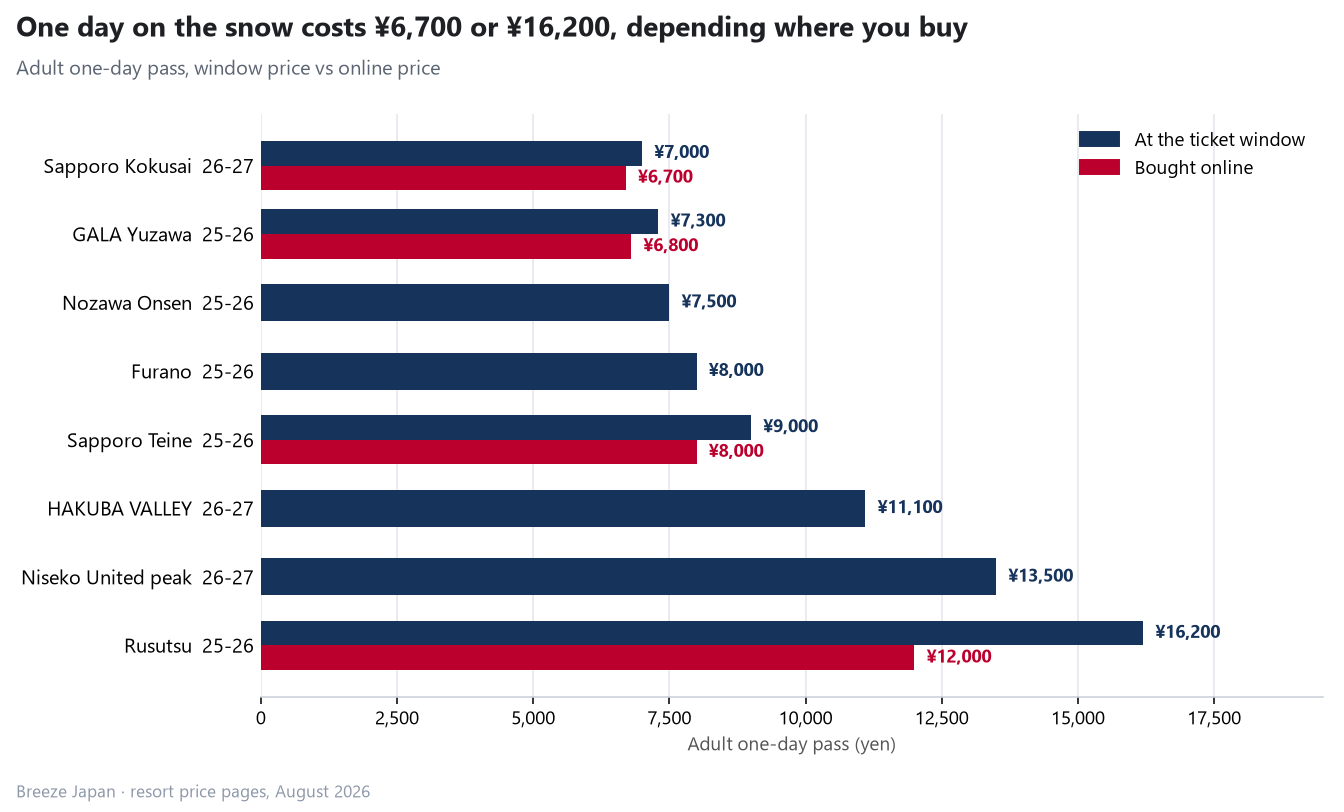
These are the eight that come up most for a first trip, with the adult one-day pass and the season each price is from. Prices for the 2026-27 season are only published at some resorts so far, so the rest are the 2025-26 rates that were actually sold. Read the season column before you budget.
| Resort | Adult 1-day | Season | Worth knowing |
|---|---|---|---|
| Sapporo Kokusai | 7,000 window / 6,700 online | 2026-27 | Junior and senior high 4,000, elementary 2,800 |
| GALA Yuzawa | 7,300 window / 6,800 web | 2025-26 | Elementary 3,000 / 2,800 |
| Nozawa Onsen | 7,500 | 2025-26 | Early season 5,400 |
| Furano | 8,000 | 2025-26 | Early and spring 6,500. Lifts free for elementary age and under |
| Sapporo Teine | 9,000 window / 8,000 online | 2025-26 early season | Night pass 3,800, or 2,800 online. Regular season is a little higher |
| Hakuba Valley common | 10,400, then 11,100 | 2025-26, then 2026-27 | Ten ski areas on one pass. Child 6-12: 6,400 |
| Rusutsu | 16,200 window / 12,000 online | 2025-26 | Child 4-12: 8,000 / 5,800. Under 3 free |
| Niseko all-mountain | 13,500 peak | 2026-27 | Regular 12,600, early and spring 8,800 |
Two of those passes cover more than one mountain. The Niseko all-mountain pass covers four linked areas, Annupuri, Niseko Village, Grand HirafuMap and Hanazono, and night skiing runs from 12 December 2026 to 22 March 2027. The Hakuba Valley common pass covers ten: Jiigatake, Kashimayari, Sanosaka, Goryu, Hakuba47, Happo-oneMap, Iwatake, Tsugaike, Norikura and Cortina, with free shuttle buses between them outside night hours.
Worth noticing what Niseko’s price has done: 10,500 in 2024-25, 12,000 in 2025-26, 13,500 at peak for 2026-27. The Hakuba Valley common pass has done the same thing more gently, 10,400 last season and 11,100 now. That is three straight climbs at Niseko, and it is the single biggest reason a first-timer might look at Sapporo KokusaiMap or FuranoMap instead. For a beginner spending the day on gentle groomed runs, the extra 6,800 yen buys terrain you are not going to use yet.
6. Where you buy the pass is worth up to 4,200 yen
Same ticket, same day, same lift. The only difference is whether you bought it standing at the window or on your phone the night before. At Rusutsu that difference is 4,200 yen for a one-day pass, which is more than a full day’s ski rental.
| Pass | Window | Online | You save |
|---|---|---|---|
| Rusutsu 1-day | 16,200 | 12,000 | 4,200 |
| Rusutsu 5-hour | 14,000 | 10,500 | 3,500 |
| Sapporo Teine 1-day, early season | 9,000 | 8,000 | 1,000 |
| Sapporo Teine night, early season | 3,800 | 2,800 | 1,000 |
| GALA Yuzawa 1-day | 7,300 | 6,800 | 500 |
| Sapporo Kokusai 1-day | 7,000 | 6,700 | 300 |
The catch is timing. Next-season online sales do not all open at once. Kiroro opens in September, the Hakuba Valley common pass around November, and most of the others through October and November. If you book flights in August, the pass you want to buy may not be on sale yet, so put a reminder in your calendar rather than assuming you can buy it whenever. You will need working data on your phone at the gate to show a QR code, which is one more argument for sorting out an eSIM before you land.
For a first trip you are almost certainly buying single days rather than a season pass. Buy them online, and buy the exact days you plan to ski rather than a block you hope to use up.
7. If you are not going to ski all day
Be realistic about this. A beginner who has never been on snow is usually finished after three or four hours, and the second half of the day is spent sitting in the cafeteria holding a ticket you paid full price for. Most resorts sell shorter tickets precisely because this is so common.
| Resort | Ticket | Window | Online |
|---|---|---|---|
| Sapporo Kokusai | 4-hour | 6,500 | 6,200 |
| Sapporo Teine, early season | 5-hour | 6,900 | 5,900 |
| Rusutsu | 5-hour | 14,000 | 10,500 |
There is also a format that suits nervous beginners very well: the 25-hour ticket, which you spend across several days instead of in one go. Rusutsu sells one at 34,700 yen, or 33,100 online, and Sapporo TeineMap at 27,000. Three short mornings out of it beats one exhausting day, and you get three chances at good weather instead of one.
Night skiing is the other cheap way in. Teine, Niseko and Nozawa Onsen all run floodlit evenings, and a Teine night pass, 16:00 to 20:00, is 2,800 yen bought online in the early season. The slopes are quiet, the light is flat but the pitch under the floodlights is usually mellow, and two hours is about right for a beginner. If the weather turns and you end up in the city instead, the winter illuminations are the equivalent evening in Tokyo.
8. A day trip from Tokyo
GALA YuzawaMap exists for exactly this. Seventy-seven minutes from Tokyo Station on the Joetsu Shinkansen, and the station is the ski centre. You walk off the train, up an escalator, and you are at the rental counter. The station only opens for the winter and spring season. Round-trip shinkansen fare runs about 14,000 yen. If you are still working out how the rail system fits together, start with our shinkansen and rail pass guide.
If you hold a foreign passport, look hard at the JR TOKYO Wide Pass before you buy individual tickets. It is 16,000 yen for three consecutive days of unlimited reserved seats, it includes GALA Yuzawa, and it comes with discounts on lift passes, rental and onsen entry. One ski day plus one other day trip already justifies it. Children aged 6 to 11 pay half. Getting into the city from the airport first is a separate puzzle, covered in our guide to Narita and Haneda transfers.
| GALA Yuzawa | 13 Dec to 5 Apr | 6 Apr to 6 May |
|---|---|---|
| Ski centre | 7:00 to 19:15 | 7:30 to 17:10 |
| Ticket counter | 7:30 to 17:30 | 8:00 to 17:00 |
| Gondola | 8:00 to 16:30 | 8:30 to 16:30 |
| Sightseeing lift | 8:40 to 16:00 | 8:40 to 16:00 |
Nagano prefecture is the other direction. Nozawa OnsenMap is the Hokuriku Shinkansen from Tokyo to Iiyama in 1 hour 45 minutes, 8,780 yen in a reserved seat, then the Nozawa Onsen Liner for 25 minutes at 600 yen, so about 9,400 yen each way. For Hakuba, take the express bus from Nagano Station: 1 hour 10 minutes and 3,500 yen, or 1,750 for a child, and 1 hour 35 minutes and 3,800 yen to Tsugaike Kogen. There is also a highway bus from Shinjuku to Nagano that takes about 3 hours 41 minutes, which is slow but cheap. Where you sleep in the city matters more than people expect on a ski day trip, so check our notes on where to stay in Tokyo and pick something near a shinkansen station.
Driving is possible at GALA, which has about 400 free parking spaces and sits 3 km from the Yuzawa interchange on the Kan-Etsu Expressway. For a first-timer arriving from a country with no snow, do not do this. Winter road driving is a skill of its own, and the train drops you at the door. There is plenty else to do with a rental car in our Tokyo travel guide instead.
9. Starting from Sapporo or New Chitose
Hokkaido is the better snow and the longer travel day. Here is what each leg actually takes.
| Route | Time | Fare | Notes |
|---|---|---|---|
| Sapporo city to Sapporo Teine | 40 min by car, 25 by expressway | – | Bus from Teine Station |
| Sapporo to Sapporo Kokusai | About 90 min | – | – |
| New Chitose to Niseko (Hirafu car park 1) | 2 hr 30 min | 6,000 one way / 10,000 return | Child 3,000 / 5,000 |
| New Chitose to Rusutsu | About 2 hr | – | 7 to 8 departures a day |
| New Chitose to Furano | 2 hr 30 min to 3 hr 30 min | 2,260 to 3,850 | Highway bus |
Ski buses run on a fixed seasonal calendar and take reservations. In the previous season they ran from 2 December to 31 March, which is a good guide to the shape of the timetable. The operators to know are White Liner, run by Good Sports, Hokkaido Resort Liner and Chuo Bus. White Liner gives 15 percent off if you book online by 16:00 the day before, which is worth setting an alarm for.
Sapporo Teine and Sapporo Kokusai are the ones you can do while sleeping in Sapporo. That is a genuinely good structure for a first trip: city hotel, city food, and a mountain 40 to 90 minutes away. RusutsuMap and Niseko work better if you stay out there, which usually means a village where the evening is an onsen rather than a bar. Our onsen and ryokan guide explains the etiquette before you walk in with tired legs.
Book the bus at the same time as the room. Seats on the airport transfers sell out on peak weekends long before the lifts do.
10. Renting gear, and the outerwear surprise
You are not buying skis for one trip. Everything rents, and the counters at big resorts are used to people who have never clipped into a binding. What catches people out is the price of the clothes. Here are GALA Yuzawa’s published 2025-26 rates, which are typical.
| Item | 1 day, 13+ | 1 day, 12 and under | 2 days, 13+ |
|---|---|---|---|
| Ski set (skis, boots, poles) | 6,500 | 3,500 | 13,000 |
| Snowboard set (board, boots) | 6,500 | 3,500 | 13,000 |
| Jacket and trousers | 5,500 | 3,000 | 11,000 |
| Helmet | 2,000 | – | – |
| Goggles | 1,500 | – | – |
| Snow boots | 1,500 | – | – |
| Board or boots only | 4,000 | 2,000 | – |
| Premium skis or board | 9,000 | – | – |
Look at those two lines together. The skis, boots and poles are 6,500. The jacket and trousers are 5,500. The clothes cost nearly as much as the equipment, and unlike the skis, it is something you might already own or could buy cheaply at home. A waterproof shell and waterproof trousers do the job. They do not have to be ski-branded.
There are things nobody rents: gloves, the thin inner layers you wear under goggles, waterproof socks and base layers. Bring those or buy them on arrival. Wet cotton gloves will end your day faster than sore legs will.
11. Put a lesson in the first half day
Two hours with an instructor on day one saves you the entire first day of flailing. That is the single highest-value thing a first-timer can book. You learn to stop and to turn in one direction, which is enough to spend the rest of the trip enjoying yourself instead of sliding backwards into a fence.
| School | Format | Price |
|---|---|---|
| GALA Yuzawa ski school | Group, 2 hr (10:00 or 13:15 start) | 7,000 beginner |
| GALA Yuzawa kids school (4-12) | Group, 90 min | 8,500 |
| GALA Yuzawa private | 1 / 2 / 4 hours, one person | 21,000 / 31,000 / 36,000 |
| GALA Yuzawa CANYONS | Private 2 hr, English, Chinese, Thai | 33,000 |
| Niseko GoSnow | Group, 2 hr / 4 hr | 9,000 / 15,000 |
| Hakuba47 Ski Academy | Group, half day | 10,000 |
| Hakuba Evergreen | Group, half day | From 12,500 |
| Hakuba, various schools | Group, 2 hr, max 8 people | From 10,000 |
Book ahead where you can. GALA takes group bookings in person at the counter in the Cheers building at the top of the gondola, while private lessons open for email reservation from 1 December. Niseko’s GoSnow runs its group programme over a set window, 5 January to 31 March in one recent season, so check the dates rather than assuming lessons run whenever the lifts do. English-language instruction is normal in Niseko and Hakuba and available at GALA through CANYONS.
12. Skis or a snowboard for a first trip
The old rule still holds. Skiing is easier on day one, because your feet move independently and you can stand up and shuffle around from the moment you clip in. Snowboarding is harder on day one and day two, because both feet are strapped to the same board and everything depends on an edge you cannot feel yet. After that the two even out.
So the question is really how long your trip is. Two days on snow, take skis. You will spend the second day actually skiing. Five days, take whichever you actually want to learn, because you have enough time to get through the hard part. Children are a separate case: ski schools generally start ski lessons at four and snowboard lessons at six, so for a small child the choice is made for you.
Now the part that sells trips to Japan and confuses beginners. Japan is famous for deep, dry powder, and Niseko’s 14 to 15 metres a season is real. But fifteen to thirty centimetres of fresh snow is genuinely difficult if you cannot turn yet. The board or skis sink, they do not respond the way they did yesterday, and you fall in snow deep enough that standing up is exhausting.
13. What a day actually costs
Here is the full number for a beginner doing a Tokyo day trip to GALA Yuzawa, renting absolutely everything and taking a group lesson, at 2025-26 rates.
| Item | Yen |
|---|---|
| Shinkansen round trip | 14,000 |
| 1-day lift pass, web rate | 6,800 |
| Ski or board set | 6,500 |
| Jacket and trousers | 5,500 |
| Group lesson, 2 hours | 7,000 |
| Total | 39,800 |
Drop the lesson and bring your own outerwear and the same day costs 27,300. Add a helmet at 2,000 and goggles at 1,500 if you want them, and I would take the helmet. Nearly all of this is payable by card, but small mountain restaurants and bus fares are still happier with cash, so read our notes on cash and cards in Japan before you go.
For a Hokkaido trip, the resort you choose is the biggest single lever. Two days of lift passes: 13,400 at Sapporo Kokusai, 24,000 at Rusutsu bought online, 27,000 at Niseko in the peak band. Add 10,000 for a return airport bus to Niseko. That is a 13,600 yen swing between the cheapest and the most expensive, on terrain a beginner will use the same way. Keep a topped-up Suica or ICOCA for the trains and city buses either side of it.
14. Going with children
Children are cheap on Japanese lifts, and at one resort they are free. Furano does not charge for lifts for elementary school age and under, with the single condition that preschoolers cannot ride alone. Rusutsu is free for three and under. Nothing else on the list comes close to that.
Furano is worth a second look for a family for one more reason. Its adult day pass drops to 6,500 in the early and spring windows, 29 November to 5 December and 23 March to 6 May. Free lifts for the children and 6,500 for the adults is the largest saving available anywhere in this article, and late March still has plenty of snow on the ground.
| Resort | Child pass | Ages |
|---|---|---|
| Furano | Free | Elementary age and under |
| Rusutsu | Free / 5,800 online | Under 3 free, 4-12 paid |
| Hakuba Valley | 6,400 | 6-12 |
| Niseko | 8,100 peak | 4-12 |
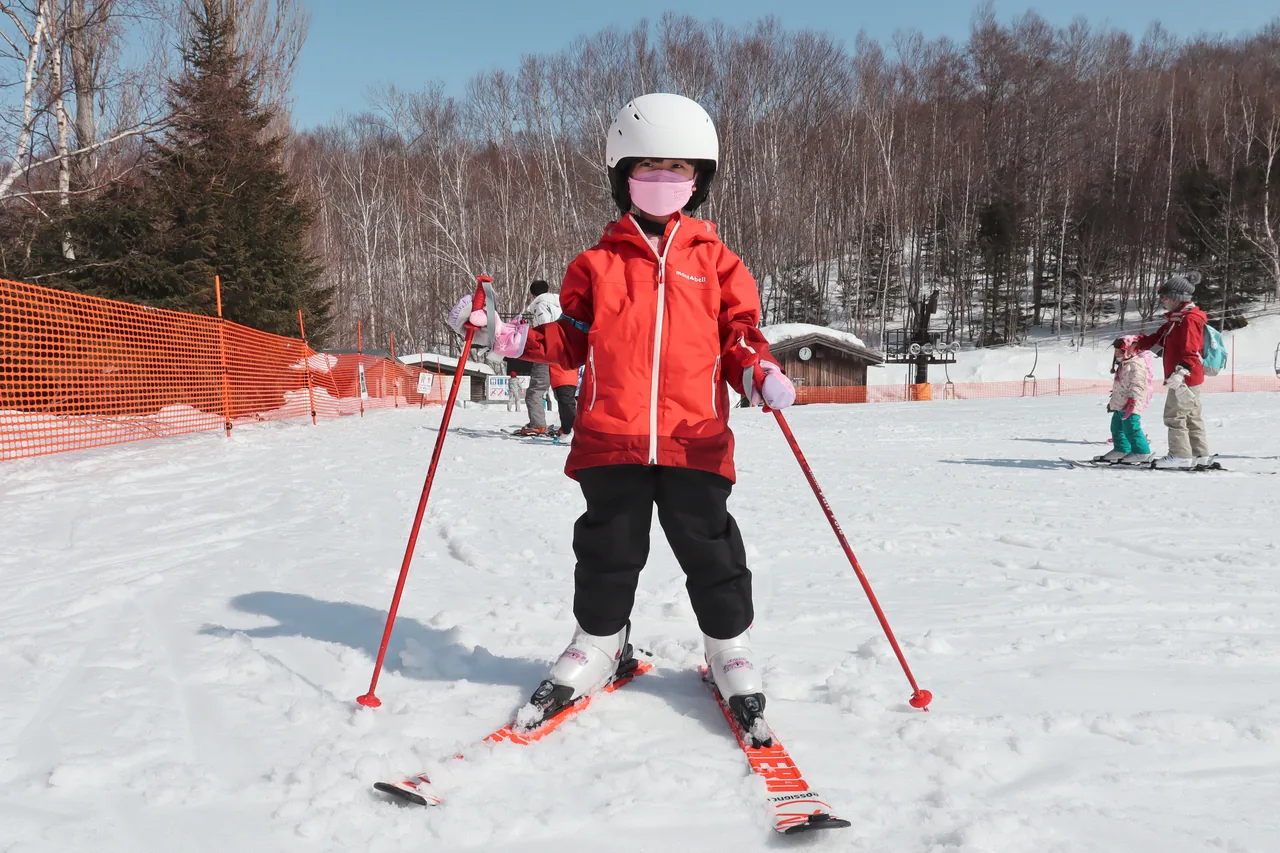
Watch the age bands, because a teenager is not always a child on a Japanese price list. Sapporo Kokusai charges 4,000 for junior and senior high school students and 2,800 for elementary school, which are two different tickets rather than one youth rate. Rental is roughly half price for the under-13s: 3,500 for a ski or board set and 3,000 for jacket and trousers. Lessons have age floors you should check before booking, because they are stricter than you might expect. At GALA, the kids school takes skiers from four and snowboarders from six, private ski lessons start at four, and the general adult group lessons only take children from age nine, which is fourth grade in the Japanese system.
Practical version: a family with a six-year-old and a ten-year-old cannot put them in the same class at most schools. Book the younger one into a kids programme and the older one into the group lesson, and plan your own skiing around the pickup times rather than the other way round.
15. How cold it really gets, and what to wear
Numbers help here. In Niseko, Hirafu village sits around minus 2 to minus 11. At the top of the mountain it is minus 15 to minus 25. That is not a difference you can ignore, and it is why people who dressed for the village end up going back down after one run.
Layers, not thickness. A thin base layer, a fleece or light insulated mid layer, and a waterproof shell on top. The rental jacket and trousers only replace the outer layer, so everything underneath is on you. And remember what nobody rents: gloves, goggle inner layers, waterproof socks and base layers.
If you land without the right kit, buying it in Japan is easy and often cheaper than renting it twice. Outdoor chains carry base layers, gloves and socks at sensible prices, and visitors can often claim the consumption tax back, which our tax-free shopping guide explains.
16. Insurance, and the number that should scare you
Check that your travel policy actually covers skiing and snowboarding. Many do not by default, and several treat winter sports as an activity you have to add on. Read the wording rather than assuming, because the wording is where the exclusion lives.
The number that makes this concrete: a backcountry search and rescue operation in Niseko is billed at a minimum of 100,000 yen. That is the floor, not the average. It is charged to the person who needed rescuing.
If you arrive and realise you are not covered, there is a fix. Tokio Marine and Nichido sells travel insurance online that includes skiing, and it can be bought within five days of entering Japan. That is a genuinely unusual option, and it is worth knowing about before you need it.
17. The ropes are not a suggestion
Japanese resorts manage their boundaries seriously, and Niseko has the clearest system. There are eleven gates in the resort boundary. When a gate is open you may pass through it. When it is closed you may not, and that is a rule rather than advice.
Duck under a rope and you lose your lift pass. Not for the run, not for the day: confiscated, and with it your access to that resort’s facilities entirely. Three areas, Yunosawa, Mizuno-no-sawa and Haru-no-taki, are closed permanently and are never inside a gate.
The reason is simple. Outside the resort boundary there is no patrol and no avalanche control. Nobody is watching that slope, and nobody knows you are on it. Avalanche information comes from the Niseko Avalanche Research Institute and is posted at lift stations, at the gates themselves and online, and the gates open and close based on it.
For a first-timer none of this should ever come up, because you have no business outside the boundary. Mentioning it because the rope looks casual and the consequence is not. The same instinct that keeps you out of trouble on a mountain applies everywhere else in the country, which our etiquette guide covers in more everyday situations.
18. The last check before you book
Run through this once with your dates in front of you. If any line makes you pause, that is the thing to fix.
| Check | What good looks like |
|---|---|
| Dates | Mid-December to end of February, and outside 28 Dec to 4 Jan and 4 to 11 Feb |
| Airport | Tokyo for day trips, New Chitose for a full Hokkaido week |
| Lift pass | Bought online, for the exact days you will ski |
| Lesson | Booked for the first half day, with pass and rental budgeted separately |
| Outerwear | Brought from home if you own a waterproof shell |
| Insurance | Confirmed in writing that it covers skiing |
One more thing. Do not plan four ski days into a five-day trip on your first go. Two days on snow and a rest day is a better trip than three days of aching legs, and it leaves room for a train ride somewhere else. If you want to build the rest of the week around the snow, the Golden Route itinerary slots in neatly either side of a Yuzawa or Nagano trip.
Book the room and the airport bus first, the pass second, the lesson third. The gear can wait until you are standing at the counter.