
Japan Cherry Blossom Trip Planning When the Rooms Sell Out Before the Forecast
Japan publishes blossom forecasts from mid-December and gives them to the day, which sounds generous until you notice that spring is the busiest travel season in the country and the beds are already booked. The peak at any one place lasts about a week, so being seven days out costs the whole trip.
| Peak length | roughly seven days in any one place, half of what autumn colour gives you. |
|---|---|
| Forecasts | first releases from mid-December to late January, given as calendar dates and revised repeatedly after that. |
| Book by | three to six months out, which for spring 2027 means through autumn 2026, before any forecast for that season exists. |
| Normals only | every date here is a 1991 to 2020 Japan Meteorological Agency average or a stated average site peak, never a prediction for 2027. |
| Tokyo | first bloom 24 March, full bloom 31 March on the normals. Kyoto follows on 26 March and 4 April. |
| North to south | Naha on 16 January to Sapporo on 1 May, three and a half months of continuous season. |
| Check it yourself | add daily mean temperatures from 1 February and expect first bloom near 400°C. |
1. The peak lasts about a week, so the date is the harder half of the decision
2. The forecast is published in December and the beds are already gone
3. The flowers you will see next April were made last summer
4. A mild winter delays the blossom rather than hurrying it
5. Add up the daily temperatures from the first of February and you can check the forecast yourself
6. First bloom to full bloom is a week, and the week after that is the whole season
7. From Naha in mid-January to Sapporo in early May
8. The further north you go, the less room you have to be wrong
9. If your dates are already fixed, the map does the choosing
10. If your city is already fixed, prepare for a week early and a week late
11. Change the variety and the season stretches from January to May
12. Kyushu, Shikoku and the western end open the country
13. Kansai reaches full bloom in the first days of April and books out first
14. Kanto turns in the last week of March
15. Chubu and Hokuriku hold the longest spread of any region
16. Tohoku and Hokkaido carry the season into May
17. Kyoto and Tokyo are the two hardest places to get right
18. Blossom season sets record room rates and you book before the forecast exists
19. The crowds are a time-of-day problem before they are anything else
20. What to change when the December forecast lands
21. If you get it wrong, you are either early or late, and they are different problems
1. The peak lasts about a week, so the date is the harder half of the decision
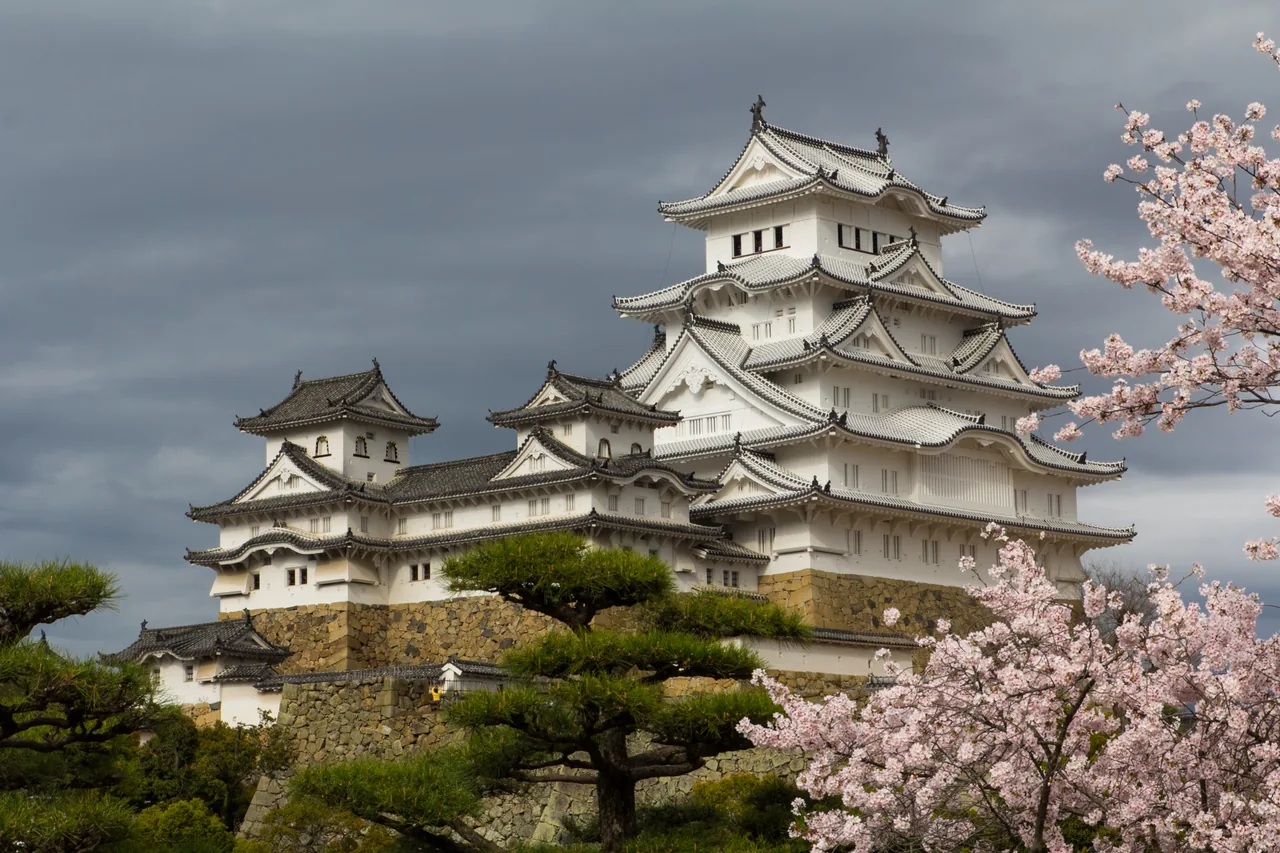
Choose the week first and the city second, because at any one spot in Japan the cherry blossom is only worth crossing the world for about seven days. That is the single fact the rest of this guide is built on, and it is what separates a blossom trip from any other kind of trip to Japan.
Autumn colour gives you roughly a fortnight in a given place. Cherry blossom gives you half that, and the second half of it is already past its best. Being seven days out does not mean a slightly quieter version of the trip you booked, it means bare branches or tight green buds.
The good news is that Japan tells you the dates earlier and more precisely than almost any country tells you anything about nature. Forecast companies publish first-bloom and full-bloom dates to the calendar day, and the first releases now appear in mid-December. The difficulty is that by mid-December the rooms for the following spring are largely spoken for.
| Your situation | What this guide gives you |
|---|---|
| Dates already fixed by leave or by a cheap fare | Keep the dates and move north or south. The country blooms continuously from mid-January to early May, so something is at its best in whatever week you already own. |
| City already fixed by family, a wedding or a conference | Keep the city and prepare for both failures. Know what you would do if you are a week early and what you would do if you are a week late, and know it before you land. |
| Both still open | Aim at the places where several varieties overlap, so that the trip survives a shift of several days in either direction. |
If you have not yet settled on spring at all, our comparison of the best time of year to visit Japan weighs it against the other three seasons. If you are choosing between blossom and leaves, the companion article on planning a Japan autumn foliage trip runs the opposite problem, because autumn forecasts arrive late and vague while the season itself is long and forgiving.
What follows is arranged so you can stop reading at the point where your own question is answered. The first six sections explain why the dates behave the way they do, sections seven to eleven turn that into a choice of place and week, and the regional sections give you the normals for fourteen cities plus the named sites that go with them.
2. The forecast is published in December and the beds are already gone
Japan publishes cherry blossom forecasts far earlier and far more precisely than most travellers expect, and it still does not help, because spring is the busiest travel season of the Japanese year and the inventory moves before the forecast does. The shortage is rooms, not information.
For the 2026 season, Japan Meteorological Corporation issued its first forecast on 18 December 2025. That was earlier than the company had traditionally managed, and the shift was made possible by bringing long-range AI prediction into the model, which pulled the first release forward from January. Two more companies followed within six weeks, so the season’s opening numbers arrive in three waves rather than one.
| Forecaster | First release for the 2026 season | What it covered |
|---|---|---|
| Japan Meteorological Corporation | 18 December 2025 | Brought forward from January by long-range AI prediction, and revised repeatedly afterwards |
| Weathernews | 8 January 2026 | The middle release, three weeks behind the first |
| Japan Weather Association, publisher of tenki.jp | 29 January 2026 | Fifty-three observation points, led by Fukuoka and Tokyo on 21 March in that year’s numbers |
All three then revise. Japan Meteorological Corporation carried its 2026 series through fourteen separate releases as the season approached, covering roughly a thousand observation points from Hokkaido to Kagoshima, all keyed to the Somei-Yoshino variety. By the final revisions the numbers are sharp. By the final revisions you also cannot book anything.
| What you decide | When you really decide it | What was published by then |
|---|---|---|
| Long-haul flights and any open-jaw routing | Three to six months out, so roughly October to January for a spring trip | Nothing, or a first release with no revisions behind it |
| Rooms in Kyoto, Tokyo, Hirosaki, Kawazu | Six to three months out | Normals only, for most of that period |
| Rail passes and reserved seats | One to two months out | Several revisions, accurate to a few days |
| Which river you walk on day five | Two weeks to two days out | Final revisions plus daily bloom reports from the sites themselves |
Read that table as a sequence rather than a list. The decisions forced on you first are the coarse ones, region and half-month, and the 1991 to 2020 normals answer those adequately. The decisions that genuinely require a forecast are all fine-grained, and all of them can still be made after you arrive.
This is the exact opposite of the autumn problem. In autumn the forecast is late and imprecise but the season is long, so you can afford to be approximately right. In spring the forecast is early and exact but the season at any one place is short, so approximately right is not good enough, and the thing standing between you and precision is a hotel booking page rather than a meteorologist.
| Autumn foliage | Cherry blossom | |
|---|---|---|
| First forecast published | Around September, which is late | Mid-December to late January, which is early |
| Precision | Ten-day bands, such as early to mid-October | First bloom and full bloom given as calendar dates |
| Length of the peak | About two weeks | About one week |
| How you adjust | Height above sea level | Latitude, meaning how far north or south you travel, plus the variety of tree |
| The real difficulty | You cannot wait for the forecast | By the time the forecast arrives there is nowhere to sleep |
One thing worth saying plainly. The forecasts are for Somei-Yoshino, the cloned variety planted across most of Japan, and they say nothing about the earlier and later varieties covered further down this article. If your dates fall outside the Somei-Yoshino period, the headline forecast is not the number you should be reading.
3. The flowers you will see next April were made last summer
A cherry tree finishes building its flower buds during the summer before they open, then shuts them down for the winter, and the timing of the following spring depends on how thoroughly that shutdown is broken. Almost everything counter-intuitive about blossom dates comes from this one sequence.
The buds form in the heat of the previous summer, which means that by the time autumn colour is being photographed, next spring’s flowers already physically exist on the branch. Through autumn the tree pushes them into dormancy, a protective state that stops them opening during a mild spell in November and then being destroyed by January.
Coming out of dormancy is not automatic. The buds need sustained exposure to low temperatures, in the region of 5°C, over a period of weeks. Only after that exposure does the tree become responsive to warmth again, and only then does rising spring temperature start to grow the bud towards opening.
| Stage | When | What decides it |
|---|---|---|
| Flower buds are formed | The previous summer | Growing conditions of the year before, not of your travel year |
| Buds enter dormancy | Autumn into early winter | Shortening days and falling temperature |
| Dormancy is broken | Mid-winter | Enough hours near 5°C, accumulated over weeks |
| Buds grow and open | Late winter into spring | Accumulated warmth from around the start of February |
Two of those four stages are already settled before you start watching the weather. That is why a single warm week in March moves the date by a couple of days rather than a fortnight, and why the answer to how the season will go is never contained in the temperature of any one month.
It also explains why the Japanese forecast is possible at all. Once dormancy has broken, the remaining process is close to a straightforward accumulation of heat, and accumulation is the kind of thing a model handles well. That is the basis of the arithmetic in the next few sections.
4. A mild winter delays the blossom rather than hurrying it
The common assumption that a warm winter produces an early spring is often wrong for cherry blossom, and can be exactly backwards. A winter that never gets properly cold fails to give the buds the low temperatures they need, dormancy breaks late, and the bloom slips later even though the following spring feels warm.
This is the piece of the subject most travellers have upside down. Reading a mild December in the news and concluding that you should move your April trip forward a week is a reasonable-sounding inference and a poor one.
| Kind of winter and spring | Effect on dormancy | Likely effect on the bloom date |
|---|---|---|
| Properly cold winter, then a warm February and March | Dormancy breaks cleanly and early | The classic early season |
| Properly cold winter, then a cold February and March | Dormancy breaks cleanly, then heat accumulates slowly | Late, but usually even and long-lasting |
| Unusually mild winter | Chilling is insufficient, so dormancy breaks late | Can be later than normal despite the warmth, and the bloom can be uneven |
There is a visible version of the same effect inside the normals table further down. Kagoshima sits at the southern end of Kyushu and yet its normal first bloom, 26 March, falls four days after Fukuoka’s on 22 March, several hundred kilometres to the north. The mildest winters in mainland Japan are not the ones that produce the earliest blossom.
For a traveller the practical use is narrow but real. When you read Japanese weather coverage in December and January, the question that matters is not whether the winter has been warm, it is whether the cold spell arrived at all. Warm-winter years are the ones in which you should trust the normals less and the December forecast revisions more.
5. Add up the daily temperatures from the first of February and you can check the forecast yourself
Two rules of thumb let you estimate the first bloom from an ordinary temperature forecast: start on 1 February and add up daily mean temperatures until the total reaches about 400°C, or add up daily maximum temperatures until the total reaches about 600°C. Either way, first bloom tends to arrive within a few days of that point.
The rules exist because, once dormancy has broken, bud growth is close to a straight accumulation of warmth. It does not matter greatly whether the heat arrives as one mild fortnight or as a scattering of warm afternoons, only that the total gets there.
| Rule | What you add up, starting 1 February | Threshold |
|---|---|---|
| The 400°C rule | Daily mean temperature | First bloom around the time the running total reaches 400°C |
| The 600°C rule | Daily maximum temperature | First bloom around the time the running total reaches 600°C |
These are not folklore. Checked against Tokyo observations across the sixty years from 1966 to 2025, the accumulation from 1 February to the declared first bloom averaged 408.6°C of daily means and 633.1°C of daily maxima. The round numbers are slightly conservative and remarkably close.
| Rule of thumb | Tokyo measured average, 1966 to 2025 | How far the shortcut is off |
|---|---|---|
| 400°C of daily means | 408.6°C | About 2% low, so the rule tends to call the bloom a touch early |
| 600°C of daily maxima | 633.1°C | About 5% low, same direction |
To run it yourself you need nothing but a fifteen-day forecast for the city you are visiting, which any Japanese weather site publishes. Take the daily figures, add them onto the running total for the season so far, and see which day crosses the line. In February the total is small and the estimate is loose; by the second week of March a fortnight of forecast covers most of the remaining gap and the estimate tightens quickly.
Two limits are worth stating. The rules are calibrated on Somei-Yoshino and on cities with long observation records, so they travel badly to the earlier and later varieties. And they are approximations rather than predictions, which is precisely why the forecast companies run proper models over a thousand points instead of a spreadsheet.
6. First bloom to full bloom is a week, and the week after that is the whole season
Reckon on about seven days from first bloom to full bloom in Kanto, eight to ten days across western Japan and only four or five in the north, then about another week before the petals start coming down in earnest. That gives one to two weeks in which the trees are worth seeing, and realistically about seven days in which they are worth a long-haul flight.
Japanese reporting uses fractions of opening rather than percentages of a peak. Thirty per cent open is the point at which a street starts to look different, fifty per cent is the point at which it starts to look like the photographs, and full bloom is the target.
Full bloom has an exact official meaning that almost no travel writing quotes. The Japan Meteorological Agency declares it when 80% or more of the buds on the observed tree have opened, not when every last one has, which is why a street can be declared at full bloom and still visibly thicken over the next day or two.
| Stage | How long it takes | What you actually see |
|---|---|---|
| First bloom to full bloom, Kanto | About seven days, which is Tokyo’s normal interval | Rapid change day by day, with 30% and 50% open passing in the middle of it |
| First bloom to full bloom, western Japan | Eight to ten days across Kyushu, Kansai and Chugoku | The most forgiving arrival in the country, and the reason a late flight west still works |
| First bloom to full bloom, Tohoku and Hokuriku | About five days | Noticeably faster, so the same trip needs tighter timing in the north |
| First bloom to full bloom, Hokkaido | About four days, although Sapporo’s own normal is five | The least margin anywhere, with Golden Week sitting on top of it |
| Full bloom to the start of the fall | About a week | The best days, and the ones every camera in Japan is pointed at |
| Whole viewable period | Broadly one to two weeks around full bloom | Anything from tight buds at one end to bare branches at the other |
The comparison with autumn is stark and worth internalising before you book. Maples hold their colour for roughly a fortnight and fade gradually, so arriving four days late costs you some intensity. Cherry blossom arriving four days late after a windy night costs you the reason you came.
This is also why the advice to spend a blossom trip moving constantly is usually wrong. If the peak in your chosen band lasts a week, the sensible shape of a trip is a base plus day trips rather than a new city every night, because the trees within an hour of your base are at almost exactly the same stage as the ones you would be chasing.
7. From Naha in mid-January to Sapporo in early May
Across the length of Japan the blossom season runs about three and a half months, from a normal first bloom of 16 January in Naha to 1 May in Sapporo. That span is the reason a fixed set of dates is not a problem: it is a question of where you point yourself, not whether you can go.
The table below is the backbone of everything that follows. These are Japan Meteorological Agency normals, the 1991 to 2020 averages, and they are the correct thing to plan against months in advance precisely because they are not trying to predict any particular year.
| City | First bloom, normal | Full bloom, normal | Days between |
|---|---|---|---|
| NahaNaha, Okinawa | 16 January | 4 February | 19 |
| Fukuoka | 22 March | 31 March | 9 |
| Kochi | 22 March | 30 March | 8 |
| Tokyo Tokyo | 24 March | 31 March | 7 |
| Nagoya | 24 March | 2 April | 9 |
| Hiroshima | 25 March | 3 April | 9 |
| Kyoto Kyoto | 26 March | 4 April | 9 |
| Kagoshima | 26 March | 5 April | 10 |
| Osaka | 27 March | 4 April | 8 |
| Kanazawa | 3 April | 8 April | 5 |
| Sendai | 8 April | 13 April | 5 |
| Niigata | 8 April | 13 April | 5 |
| Aomori | 22 April | 26 April | 4 |
| Sapporo Sapporo | 1 May | 6 May | 5 |
Naha needs its own footnote. Its normals of 16 January and 4 February are Kanhi-zakura, a deep pink bell-shaped cherry, not the pale Somei-Yoshino that the mainland forecasts track, and the same holds for Ishigaki, Miyako, Naze and Minami-Daito. Nineteen days from first bloom to full bloom is also unlike anything on the mainland. It is a genuine cherry blossom season and it looks nothing like the photographs that made you want to come.
Sapporo and Aomori do not need the footnote they are usually given. The Japan Meteorological Agency names a substitute species only where one is observed, and the column is blank for both stations, which means both observe Somei-Yoshino exactly as the mainland cities do. Their normals of 1 May and 22 April are true Somei-Yoshino dates.
The Ezo-yamazakura caveat is real, but it belongs elsewhere in Hokkaido. Wakkanai, Asahikawa, Abashiri, Obihiro, Kushiro, Muroran, Monbetsu and Hiroo all observe Ezo-yamazakura, a deeper pink flower that opens with its leaves, so a bloom date quoted for one of those places is not describing the same tree as a Sapporo date.
Notice how tightly the middle of the table is packed. Between Fukuoka on 22 March and Osaka on 27 March there are five days and most of western Japan. Between Osaka and Sapporo there are five weeks. The season crawls across the warm half of the country and then sprints up the cold half.
8. The further north you go, the less room you have to be wrong
Northern Japan runs through first bloom to full bloom faster than the south, so the same seven-day trip is a tighter fit in Aomori than it is in Tokyo. Aomori averages four days between the two, against seven in Tokyo and nine or ten in several western cities.
The pattern is consistent across the normals. Warm-region cities take eight to ten days to go from the first flowers to full bloom, while everything from Kanazawa northwards takes four or five. In the north the spring temperature rise is abrupt, and the trees respond in one movement rather than over a week.
| City | Days from first bloom to full bloom, normals | What that means for a visit |
|---|---|---|
| Kagoshima | 10 | The most forgiving arrival date in the country |
| Fukuoka, Nagoya, Hiroshima, Kyoto | 9 | A late arrival still lands inside the rise |
| Kochi, Osaka | 8 | Comfortable |
| Tokyo | 7 | A week of visible improvement, then the fall |
| Kanazawa, Sendai, Niigata, Sapporo | 5 | Half the trip is either side of the good days |
| Aomori | 4 | Being three days early means seeing almost nothing |
The instruction that falls out of that table is simple. In the west and the south you can afford to book a week and accept whatever part of the curve you land on. In Tohoku and Hokkaido you should be aiming your dates at full bloom itself rather than at first bloom, and you should be treating the last forecast revisions as decisive rather than interesting.
There is one compensation. Northern sites are far more likely to hold their flowers than southern city streets, because the cool air slows the fall once full bloom has arrived. The risk in the north is arriving early, and the risk in the south is a warm windy week finishing the display sooner than the normals suggest.
The other compensation is scenic rather than statistical. In late April and early May the northern trees flower against snow still lying on the mountains behind them, which is not available anywhere in the country in March.
9. If your dates are already fixed, the map does the choosing
Pick the week you can travel, then read straight down this table to the region that is normally at its best in it. Because the country blooms continuously from mid-January to early May, there is no week in that span with nothing in it.
The regions below are ordered by date rather than by geography. Each row assumes the 1991 to 2020 normals hold, which in any real year they will not exactly, so treat the neighbouring rows as your alternatives rather than as different trips.
| Your week | Where to point yourself | What is normally happening |
|---|---|---|
| Mid-January | Okinawa | Kanhi-zakura, deep pink and bell-shaped. Naha’s normal first bloom is 16 January |
| Early February to early March | The Izu Peninsula in Shizuoka | Kawazu-zakura, which normally opens in early February and holds its peak from mid-February into early March |
| The last week of March | Kyushu, Shikoku, Hiroshima, Tokyo, Nagoya | First bloom across most of western and central Japan, with Tokyo reaching full bloom on 31 March in a normal year |
| The first week of April | Kyoto, Osaka, Nara, Nagoya, Hiroshima | Full bloom in Kansai, Kyoto’s normal being 4 April, and the last of Tokyo |
| The second week of April | Hokuriku, Niigata, southern Tohoku | Kanazawa full bloom around 8 April, Sendai and Niigata around 13 April |
| The third and fourth weeks of April | Northern Tohoku | Aomori first bloom around 22 April and full bloom around 26 April |
| Late April into the first half of May | Hokkaido | Sapporo first bloom around 1 May and full bloom around 6 May, with the Hidaka region following |
If your fixed week falls between the rows, for instance the middle of March, you are in the one genuine gap in the calendar, after the Kawazu-zakura and before the mainland Somei-Yoshino. That is the week to go to Japan for something other than blossom, and our Golden Route itinerary is built for exactly that kind of trip.
Moving between these bands is a matter of one or two shinkansen legs rather than internal flights, with the exception of Hokkaido and Okinawa. A north-south blossom trip is the one situation in which a rail pass genuinely earns its price, because the whole point is covering distance in a short time. Our guide to the JR Pass and the shinkansen network sets out which pass covers which of these moves.
One further note on shape. If you have ten days or more and no fixed city, the strongest version of this trip is to start south and move north at roughly the speed of the season, which is the single arrangement in which a shifted forecast helps you rather than hurting you.
10. If your city is already fixed, prepare for a week early and a week late
When the destination is settled and only the trees are uncertain, decide in advance what you will do in each of the two ways it can go wrong. Being early and being late are different problems with different answers, and neither is solved by improvising on the day.
Being early is the easier of the two. Buds that are not yet open will open, so the answer is usually to travel south for a day or wait, and to fill the interval with something that was worth doing anyway.
Being late is harder, because what has fallen does not come back. The answers there are to travel north, to move to a later variety, or to accept the version of the scene that has petals on the water rather than on the branches.
| Your fixed base | If you are about a week early | If you are about a week late |
|---|---|---|
| Tokyo | Day trip west or south. In February the Izu Peninsula is a different season entirely | Double-flowered cherry, which in Tokyo runs from early to late April, well after Somei-Yoshino has gone |
| Kyoto or Osaka | Weeping cherries open at a similar time or slightly earlier than Somei-Yoshino, so Kyoto has something before the streets do | Mount Yoshino in Nara, where the lower groves finish before the upper ones start |
| Nagoya | The Izu Peninsula and the Kawazu-zakura, or Kyoto and Osaka two or three days behind you | Kanazawa, roughly ten days later than Nagoya on the normals |
| Sendai | Tokyo, a full fortnight ahead of you on the normals | Aomori, two weeks behind you, or Hirosaki Park where the peak runs from mid-April to early May |
| Sapporo | Northern Tohoku, about a week ahead | The Hidaka region, where the Nijukken Road trees normally peak from early to mid-May |
There is a version of this that costs nothing. When you book internal transport, book the flexible product for the middle days of the trip and the cheap product for the fixed ends, because the middle days are the ones you will want to redirect.
The one arrangement to avoid is a different city every night through the peak. It maximises the number of places where you can be wrong by a week, and since neighbouring cities are usually only two or three days apart on the normals, it does not actually broaden your chances.
11. Change the variety and the season stretches from January to May
Somei-Yoshino gives you about a week; the other varieties give you four months. Anyone whose dates cannot be moved should be reading this table before they read the forecast, because it is the difference between one chance and several.
Somei-Yoshino dominates the coverage because it is a clone, so every tree of it in a given city opens within days of every other, which is what makes a national forecast possible in the first place. That uniformity is also why its season is so short.
| Variety | When | Where it is best known |
|---|---|---|
| Kanhi-zakura | January | Okinawa. Deep pink, bell-shaped, hanging downwards rather than facing out |
| Kawazu-zakura | Normally opens in early February, with the peak running from mid-February into early March | Kawazu on the Izu Peninsula in Shizuoka. Kawazu Cherry Blossom Trees, Shizuoka Early to open and unusually long-lasting |
| Somei-Yoshino | From late March, following the city normals given above | The whole country, and the subject of every forecast you will read |
| Weeping cherry | Similar to Somei-Yoshino or a little earlier | Kyoto in particular, where several of the famous trees are of this kind |
| Double-flowered cherry | Early to late April on Tokyo timing | Nationwide, opening after Somei-Yoshino has finished |
Read the first and last rows together and the practical point appears. In Tokyo, the double-flowered cherry is still going at the end of April, three or four weeks after the Somei-Yoshino has gone, and it is a heavier, rounder, more pompom-like flower that photographs completely differently.
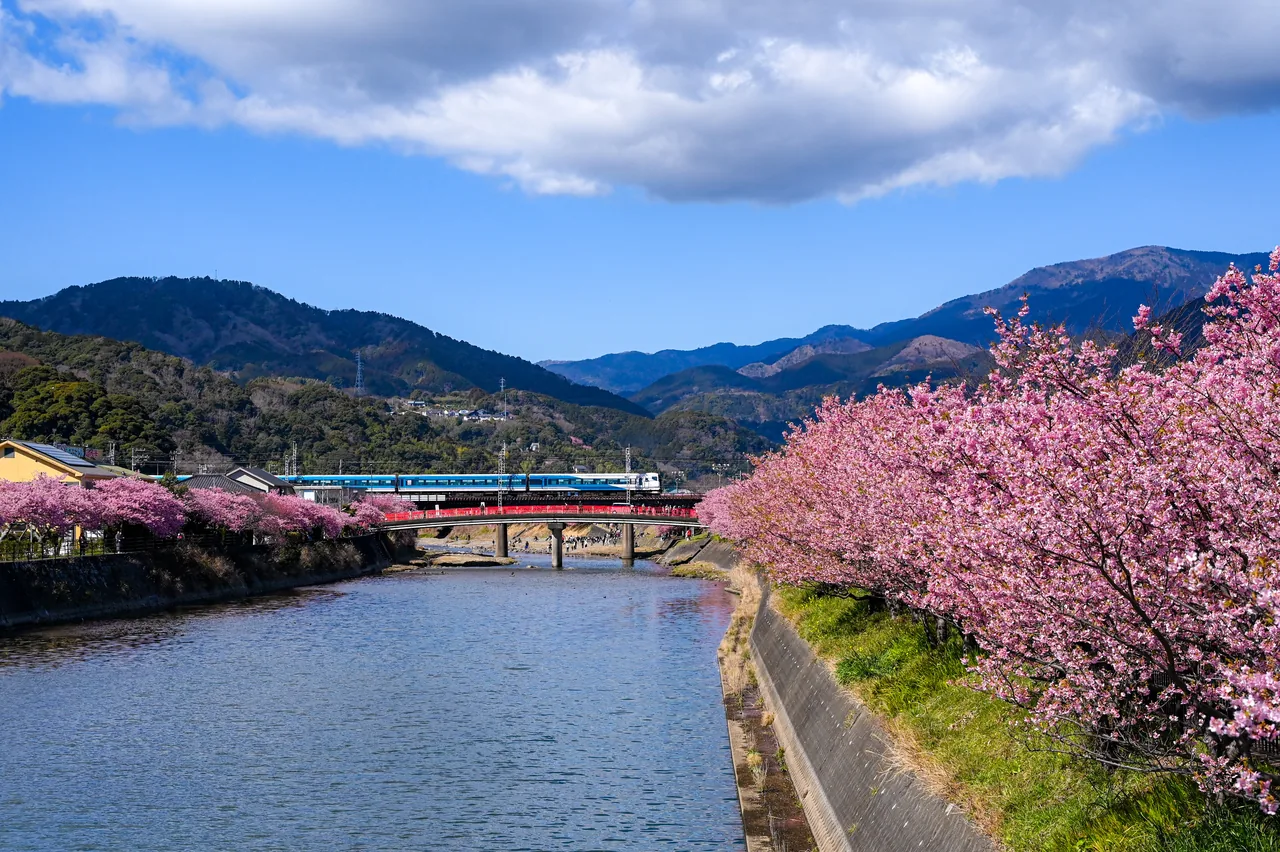
Kawazu-zakura deserves particular attention from anyone travelling in February. The trees line the Kawazu River on the Izu Peninsula, they open when the rest of Japan is still bare, and unlike Somei-Yoshino they hold their peak for weeks rather than days.
One caution about the earlier and later varieties. The national forecasts do not cover them, so their timing comes from local reporting and from the sites themselves, which means checking a specific park’s own bloom updates rather than a national map.
If your trip is February, you should also know what you are not getting. Kawazu-zakura is a fine sight and a quiet one, but the mass of pale blossom over a Kyoto canal or a Tokyo river is a different experience, and no February trip substitutes for it.
12. Kyushu, Shikoku and the western end open the country
Mainland Japan starts in the west, with Fukuoka and Kochi both reaching first bloom on 22 March in a normal year and full bloom in the last days of the month. If your dates land in the last third of March, this is where the blossom is most reliably out.
The west is also the most forgiving part of the country to time. Fukuoka, Hiroshima and Kagoshima all take nine or ten days from first bloom to full bloom, so an arrival that would be a disaster in Aomori is merely early here.
| City or site | Normal timing | Notes |
|---|---|---|
| Fukuoka | First bloom 22 March, full bloom 31 March | Joint earliest of the fourteen mainland cities in the normals |
| Nishi Park, Fukuoka Nishi Park, Fukuoka | Late March to early April | The city’s best-known blossom hill |
| Kochi | First bloom 22 March, full bloom 30 March | The fastest western city to reach full bloom, at eight days |
| Matsuyama Castle, Ehime Matsuyama Castle, Ehime | Late March to early April | Hilltop castle with the blossom below and around it |
| Hiroshima | First bloom 25 March, full bloom 3 April | Three days behind Fukuoka on the normals |
| Peace Memorial Park, Hiroshima Hiroshima Peace Memorial Park | Late March to early April | Riverside trees through the centre of the city |
| Kagoshima | First bloom 26 March, full bloom 5 April | Ten days between the two, the longest of any city in the normals |
Kagoshima is the row worth pausing on. It is the southernmost city in the table apart from Naha, and it is four days later to first bloom than Fukuoka. Warmth alone does not produce an early season, because the buds need their cold weeks first, and the far south is where that requirement is least reliably met.
The western cities are also where a blossom trip is least likely to be ruined by accommodation. They are large enough to have real hotel capacity, they are not the first place an overseas visitor books, and they sit on the shinkansen so a change of plan costs a couple of hours rather than a day.
Two practical notes. Hiroshima and Fukuoka are both easy to reach without a Tokyo transfer if you fly into a western airport, and both are close enough to Kansai that a bloom running late in Kyoto can be met by going west for two days and coming back.
13. Kansai reaches full bloom in the first days of April and books out first
Kyoto’s normal first bloom is 26 March and its normal full bloom is 4 April, with Osaka a day behind on the first and level on the second. The first week of April is therefore the single most contested week for accommodation anywhere in Japan.
Kansai concentrates almost everything that makes the season famous. Temple gardens, a castle park, a river valley of thirty thousand trees, and night illuminations, all within an hour or so of each other, and all peaking in the same few days.
| Site | Normal peak | What it is |
|---|---|---|
| Daigo-ji, Kyoto Daigo-ji Temple, Kyoto | Late March to early April | Temple grounds long associated with blossom viewing, including weeping cherries |
| Osaka Castle Park Osaka Castle Park | Late March to mid-April | The broadest peak of the three, running well into the month |
| Kami Senbon, Mount Yoshino, Nara Mount Yoshino, Nara | Early to mid-April | The third of the mountain’s four great groves, counting up from the valley |
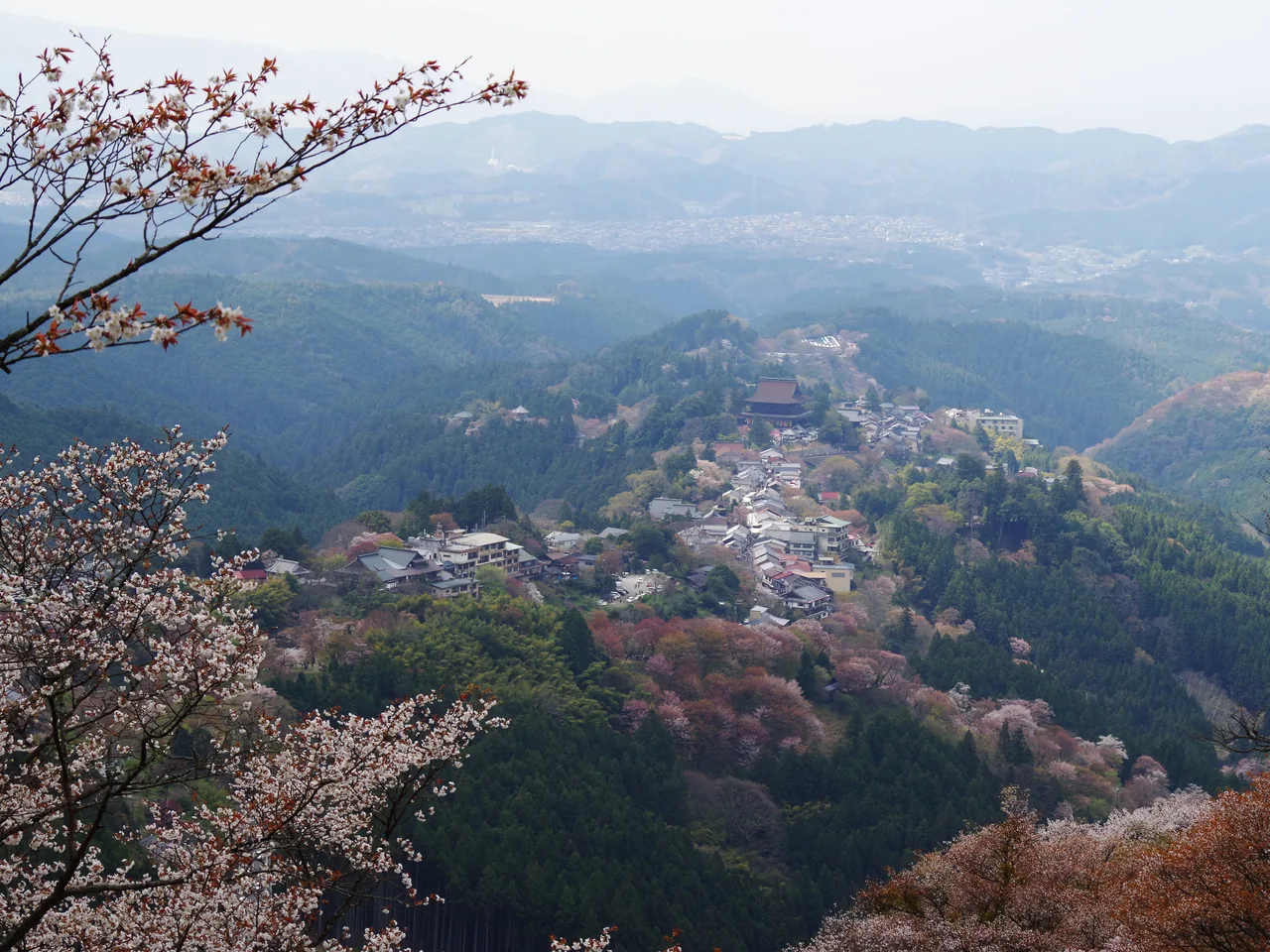
Mount Yoshino is the most valuable single destination in this article, because it stretches the seven-day problem further than any other single place. The groves are arranged up the mountain and open in sequence from the lowest to the highest, and the published peaks run about ten days from the bottom to the top.
| Grove | Position on the mountain | Approximate peak |
|---|---|---|
| Shimo Senbon | Lowest | Around 6 April |
| Naka Senbon | Middle slopes | Around 8 April |
| Kami Senbon | Upper slopes | Around 10 April |
| Oku Senbon | Innermost and highest | Around 15 April |
Ten days is a good deal more than a single city gives you and a good deal less than the three weeks Yoshino is often credited with. The mountain as a whole has trees in flower from early to late April, but no traveller should plan around three weeks of peak. These are approximate dates, so read the mountain’s own bloom reports during the season.
Do not underestimate what full bloom does to Kansai’s transport. The first weekend of April puts every domestic day-tripper in Japan onto the same trains as every overseas visitor, and Kyoto’s bus network is the part of the system that fails first. Our Kyoto travel guide covers the workarounds, and the Nara day trip guide covers the approach to Yoshino’s part of the prefecture.
If you are basing yourself in Osaka rather than Kyoto, which in blossom season is often the cheaper and more available choice, our Osaka guide sets out how the two cities connect. Osaka Castle Park’s longer peak also makes it the most reliable single site in the region for a trip whose dates cannot move.
14. Kanto turns in the last week of March
Tokyo’s normal first bloom is 24 March and full bloom follows seven days later on 31 March, which makes the last week of March the single most predictable target in the country. It is also the week the whole world has worked this out about.
Tokyo’s advantage is density rather than drama. The trees are along rivers, moats and streets rather than in one great park, so the city offers dozens of separate scenes within the same few days, and none of them requires a train out of town.
| Site | Normal peak | Character |
|---|---|---|
| Meguro River Meguro River, Tokyo | Late March to early April | Several kilometres of trees leaning over a narrow canal, and the most photographed blossom in the city |
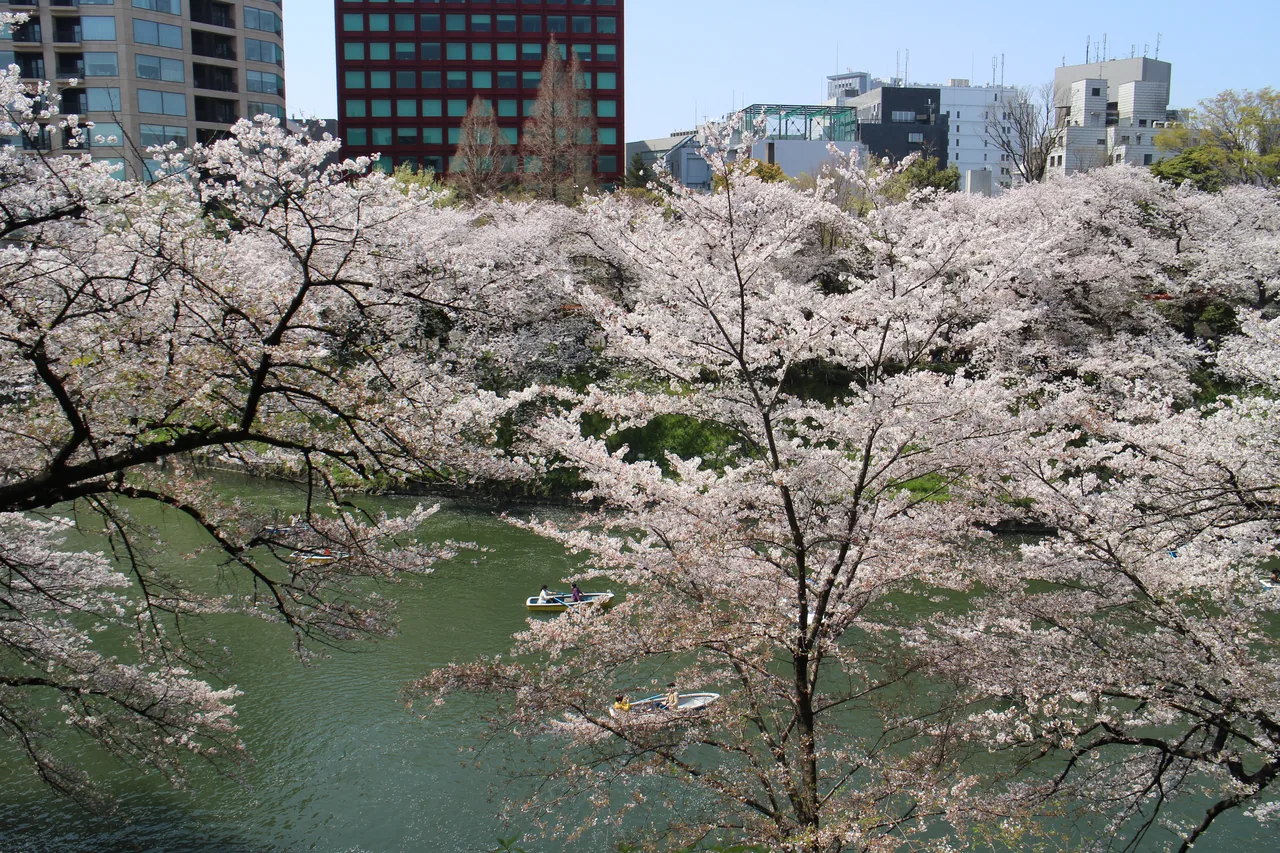
| Chidorigafuchi Chidorigafuchi, Tokyo | Late March to early April | The moat on the north-west side of the Imperial Palace, with rowing boats under the branches |
Both of those are evening as well as daytime destinations, and both are considerably more crowded after dark than they are at seven in the morning. The gap in crowd levels between dawn and dusk at Meguro River in the first days of April is larger than the gap between a weekday and a weekend.
Kanto also gives you the longest tail of any region, because Tokyo’s double-flowered cherries run from early to late April. A trip that arrives in mid-April having missed the Somei-Yoshino entirely still has flowers in Tokyo, which is not true of Kyoto to anything like the same degree.
For day trips out of the city in blossom season, both the Fuji area and Hakone are cooler than central Tokyo and therefore later, which is useful if you have arrived a few days after the city has peaked. Our Tokyo travel guide covers how the districts connect.
One structural point about Kanto. Because Tokyo peaks a few days before Kansai in a normal year, a trip that runs Tokyo first and Kyoto second is following the season, while the reverse order is running against it. In a week-long trip that ordering is worth more than any individual site choice.
15. Chubu and Hokuriku hold the longest spread of any region
No other region covers as much of the calendar: the Kawazu-zakura on the Izu Peninsula are at their peak in February, and Niigata does not reach full bloom until 13 April. That is a span of more than two months inside one broad region.
The reason is that Chubu and Hokuriku contain both the mildest Pacific coast and the snow country on the Sea of Japan side, and they contain the earliest flowering variety in mainland Japan alongside cities that bloom a fortnight after Tokyo.
| Site or city | Normal timing | Notes |
|---|---|---|
| Kawazu River cherry trees, Shizuoka | Early to late February | Kawazu-zakura, the earliest mainland blossom of the season |
| Nagoya | First bloom 24 March, full bloom 2 April | Same first bloom as Tokyo, but two days slower to full bloom |
| Nagoya Castle, Aichi Nagoya Castle | Late March to early April | Castle grounds, and the most convenient blossom site in the city |
| Kanazawa | First bloom 3 April, full bloom 8 April | Ten days behind Nagoya on the normals |
| Kenrokuen, Ishikawa Kenrokuen Garden, Kanazawa | Early to mid-April | One of Japan’s three great landscape gardens, with the blossom inside it |
| Niigata | First bloom 8 April, full bloom 13 April | Level with Sendai despite being on the opposite coast |
| Takada Castle Park, Niigata Takada Castle Park, Joetsu | Early to mid-April | Castle moats and grounds, in step with Niigata’s own normals rather than behind them |
Nagoya’s position on the normals is a small oddity worth noticing. It shares Tokyo’s first bloom date of 24 March but takes nine days to reach full bloom against Tokyo’s seven, which means that in the first days of April Nagoya is often slightly better than Tokyo rather than slightly worse.
Kanazawa is where the region changes character. At a normal 3 April first bloom it sits ten days behind Nagoya, and it belongs to the group of cities that go from first bloom to full bloom in five days rather than nine. Our Nagoya guide covers the rail connections that make both of these reachable from one base.
Takada Castle Park is regularly quoted with a longer season than it has. Its peak runs from early to mid-April, in step with Niigata’s own normals of 8 and 13 April rather than a week behind them, so a booking aimed at the last week of April is late rather than safe. For dates locked to the middle of the month it remains one of the surest choices in the region.
16. Tohoku and Hokkaido carry the season into May
When Kyoto has finished, northern Japan has not started: Sendai’s normal first bloom is 8 April, Aomori’s is 22 April, and Sapporo’s is 1 May. Anyone whose only possible travel dates fall after the middle of April should stop looking at Kansai entirely.
The north also gives you the season in a different setting. Castles with snow on the mountains behind them, riverbanks running for kilometres, and a single enormous tree standing in a field are all northern propositions rather than city-street ones.
| Site or city | Normal timing | Notes |
|---|---|---|
| Miharu Takizakura, Fukushima Miharu Takizakura | Early April | A single ancient weeping cherry, seen for the tree rather than for the setting |
| Hitome Senbonzakura, Shiroishi River, Miyagi Shiroishigawa Tsutsumi Hitome Senbonzakura | Early to mid-April | Kilometres of trees along a river embankment |
| Funaoka Castle Park, Miyagi Funaoka Castle Ruins Park, Miyagi | Early to mid-April | Hillside park overlooking the same river valley |
| Sendai | First bloom 8 April, full bloom 13 April | Five days between the two, half the Kagoshima interval |
| Aomori | First bloom 22 April, full bloom 26 April | Four days, the shortest interval in the normals |
| Hirosaki Park, Aomori Hirosaki Park, Aomori | Mid-April to early May | Castle moats and grounds, and the best-known blossom site in the north |
| Sapporo | First bloom 1 May, full bloom 6 May | Somei-Yoshino, the same tree the mainland forecasts track, and full bloom inside Golden Week |
| Nijukken Road cherry trees, Hidaka, Hokkaido Nijukken Road Cherry Tree Avenue, Hokkaido | Early to mid-May | An avenue of Ezo-yamazakura through horse country, and the last of the season |
The Hirosaki reschedule is the plainest evidence in this article that spring dates cannot be pinned in advance. A festival with a printed programme, staffing rotas and a town’s worth of reservations behind it still moved its opening because the trees were ahead of schedule. If the organisers cannot commit to a start date, a visitor booking six months out has no business expecting to either.
Sendai and its two Miyagi sites make the strongest single-base northern trip, because Hitome Senbonzakura and Funaoka Castle Park sit on the same river and peak together in early to mid-April, and Miharu Takizakura in Fukushima is reachable in the same few days.
Aomori is the hardest timing in the country and the most rewarding when it works. Four days from first bloom to full bloom leaves no margin at all, and Hirosaki Park’s quoted peak of mid-April to early May is broad precisely because it covers several years of variation rather than promising a fortnight in any one of them.
Hokkaido has a complication that has nothing to do with trees. The normal Sapporo full bloom of 6 May falls inside Japan’s Golden Week holiday, when the whole country is travelling, so northern rooms in that period are competing with domestic demand as well as international.
17. Kyoto and Tokyo are the two hardest places to get right
These are the two cities most people mean when they say they want to see Japan in blossom, and they are eight days apart on the normals: Tokyo full bloom on 31 March, Kyoto on 4 April. A single trip can catch both, but only in that order and only if the year behaves.
The two cities fail differently. Tokyo’s blossom is a city-wide event that goes from first bloom to full bloom in seven days and is over quickly. Kyoto’s is a garden and temple event that takes nine days to build, includes varieties that open at different times, and holds on a little longer.
| Tokyo | Kyoto | |
|---|---|---|
| First bloom, normal | 24 March | 26 March |
| Full bloom, normal | 31 March | 4 April |
| Days between | 7 | 9 |
| Where the trees are | Rivers, moats and streets across the whole city | Temple grounds, canals and gardens |
| What extends the season | Double-flowered cherry from early to late April | Weeping cherries, which open at a similar time or slightly earlier |
| The main practical problem | Crowd density at a handful of famous spots | Accommodation supply and the bus network |
If you only have one of the two, the answer depends on when your dates fall rather than on which city you prefer. Dates in the last week of March point to Tokyo, dates in the first week of April point to Kyoto, and there is no version of the argument in which a preference beats the calendar.
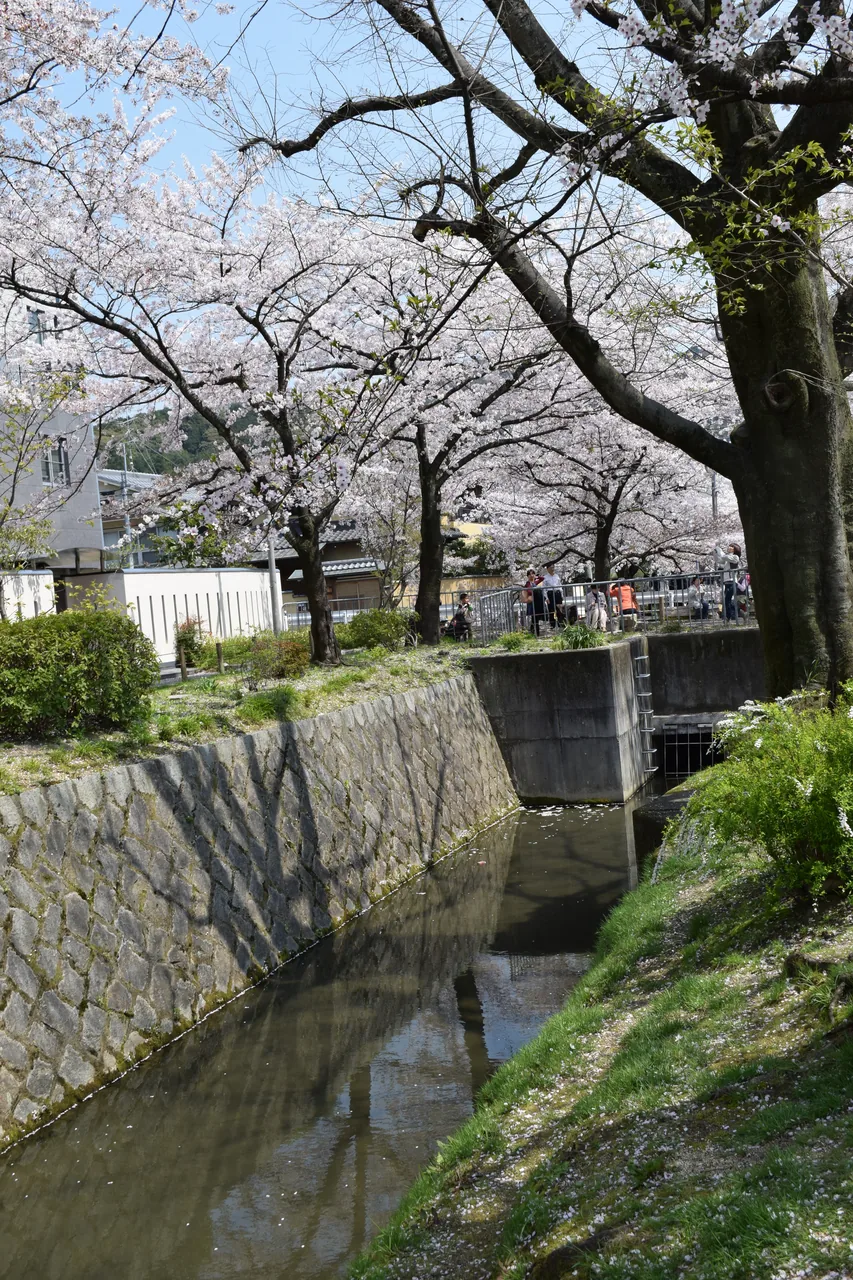
Kyoto’s accommodation problem in the first week of April is worse than its transport problem, and it is worse than anything Tokyo experiences. The city is small, its supply is finite, and the same week is peak season for domestic travel as well. Booking six months out is normal rather than cautious, and our guide to where to stay in Kyoto explains which districts stay reachable when the buses stop working.
Tokyo has more rooms and therefore more choice, but the same principle applies to the districts near the famous riverside stretches. Staying within walking distance of your dawn destination is worth more in blossom season than in any other week of the year, and our Tokyo accommodation guide sets out which areas those are.
One combined-trip note. Because Tokyo normally peaks first, a Tokyo-then-Kyoto trip has a genuine chance of two full blooms in one week, while Kyoto-then-Tokyo has almost none. If a forecast in February shows the two cities unusually close together, the case for the combined trip gets stronger rather than weaker.
18. Blossom season sets record room rates and you book before the forecast exists
Commit to accommodation three to six months before you travel, which for a spring 2027 trip means booking through the autumn of 2026, well before any forecast for that season exists. There is no version of this in which waiting for information is the cheaper strategy.
The reason spring is so tight is that three separate kinds of demand land on the same fortnight. Overseas visitors arrive for the blossom, Japanese domestic travel peaks for the same reason, and the Japanese business and school year begins on 1 April, which fills hotels in every major city with people who are not tourists at all.
The pressure shows up in published figures rather than only in anecdote. Japanese hotel rates run at the top of the annual range through March and April, and Japanese reporting has tied the March rise directly to blossom-season inbound demand.
| Month | What the national figures show |
|---|---|
| March 2025 | Average daily room rate ¥20,243, up 10% year on year, attributed in Japanese coverage to blossom-season visitor numbers |
| April 2025 | Average daily room rate up 19% year on year |
| March 2026 | Average daily room rate ¥20,388, up 6.5% year on year |
| April 2026 | A national record high room rate, and 3,692,200 foreign visitors, the busiest single month of the year |
Two things those numbers do not say. April 2026 was the busiest month of that year but not of all time, and it was 5.5% below April 2025, so the picture is a plateau at a high level rather than a straight climb. And nothing published compares blossom season with New Year or Golden Week on price, so treat spring as sitting at the top of the annual range rather than above every other peak.
| What you book | When | Why then |
|---|---|---|
| International flights | Six to three months out | Spring fares to Japan rise steadily rather than dropping late, and the useful arrival airports fill first |
| Kyoto accommodation for the first week of April | Six months out, and earlier for anything well reviewed | The smallest supply against the largest demand of the year |
| Tokyo accommodation for the last week of March | Four to six months out | More supply, but the same week as the fiscal year change |
| Hirosaki, Kawazu and other single-site destinations | As early as possible | Small towns with very few rooms and a very short season |
| Rail passes and reserved seats | One to two months out | Reserved seats open a month ahead and the popular services fill on the first morning |
There is a second peak immediately after the first. The last days of April and the first days of May are Golden Week, when domestic travel is at its annual maximum and northern Japan is in bloom. A Hokkaido blossom trip is therefore competing with the entire country for beds, which is a different and harder problem than the Kyoto one.
Early April also coincides with the Qingming holiday in Taiwan and the surrounding region, which puts additional pressure on flights into Kansai and Kanto in exactly the week that Kyoto reaches full bloom. If your dates are flexible by a few days, moving away from that overlap is worth more than any amount of comparison shopping.
Two smaller cost points. Cash is still useful at rural blossom sites, food stalls and small-town festivals, and our guide to money, cash and cards in Japan covers where cards stop working. And if you are travelling on a passport that requires a visa, sort that out before you book anything at all, because it is the one part of the trip that no forecast revision can rescue.
19. The crowds are a time-of-day problem before they are anything else
The difference between an unusable famous site and a pleasant one is usually about three hours, not a different destination. At the most photographed spots in Tokyo and Kyoto during full bloom week, before eight in the morning is a different place from midday.
This matters more in blossom season than in any other because the crowd is not spread out. Autumn colour lasts a fortnight and the visitors spread across it. Blossom peaks for a week, everybody knows the same week, and half of them are Japanese day-trippers with the same information you have.
| Time | What the famous sites are like | Best used for |
|---|---|---|
| Before 08:00 | Quiet even at full bloom, and the light is at its best | The single site you most want photographs of |
| 10:00 to 16:00 | Peak density, and at the narrowest sites the crowd controls the pace | Larger parks and castle grounds, which absorb people far better than canals do |
| After dark | Illuminated sites are busy but the ordinary ones empty out | Either a lit site you have chosen deliberately, or an unlit one you want to yourself |
Weekdays beat weekends by a wide margin, and the gap is largest at the sites that domestic visitors reach on a day trip. If your trip contains a weekend inside full bloom week, spend it in a large park and save the narrow riverside stretches for a Tuesday morning.
Night illuminations are worth planning around rather than stumbling into. Yoshino runs one in the season, in recent years from around 20 March to 19 April between 18:00 and 22:00, and the annual dates are announced by the organisers. Illumination periods elsewhere are set the same way, which means the schedule is published in the weeks before the season rather than months ahead.
Transport is the part that surprises people. In Kyoto during the first week of April the buses are the failure point rather than the temples, and in Tokyo the stations nearest the famous riversides become slow rather than the riversides themselves. Carrying a charged transport card and using rail rather than road solves most of it, and our guide to Suica, ICOCA and the IC card system covers the setup.
One last note on behaviour. Hanami is a domestic tradition long before it is a tourist activity, and the groups sitting under the trees with food and drink are the ordinary way Japanese people mark the season. Joining in is entirely normal, and doing it quietly, taking your rubbish with you and not reserving space you are not using are the whole of the etiquette.
20. What to change when the December forecast lands
When the first forecasts for spring 2027 appear, which on the previous year’s timing should be from around December 2026, change the fine detail and leave the structure alone. By then your flights and your main accommodation are booked, and the things still genuinely adjustable are the order of your days and which city you sleep in at each end.
No company has announced a 2027 schedule, so this is an expectation rather than a date. On the 2026 pattern the first release comes from Japan Meteorological Corporation, which published on 18 December 2025, then Weathernews on 8 January and the Japan Weather Association on 29 January. Then expect revisions, more than a dozen of them in the corporation’s case, right up to the season itself.
| What the forecast says | What to change | What to leave alone |
|---|---|---|
| Bloom several days earlier than the normals | Move the north-heavy part of the trip earlier, or add a northern day at the end | Flights, and any non-refundable accommodation |
| Bloom close to the normals | Nothing structural. Confirm reserved seats and book the illumination tickets that need it | Everything |
| Bloom several days later than the normals | Reverse the order of your cities so that you finish in the place blooming latest | The overall region, which almost never needs changing by a week |
| Forecasts disagree between providers | Plan for the later of the two, since arriving before the flowers is recoverable and arriving after is not | Everything else |
The single most valuable adjustment is the order of cities. A trip that visits Tokyo before Kyoto follows a normal year, and a trip that visits them in the other order is running against the season, so a forecast that shifts the two cities apart makes the ordering decision more important rather than less.
The second most valuable is the day-by-day plan inside a city, and that should not exist until you are in Japan. Every major site publishes its own bloom status during the season, in far more detail than any national forecast, and that is the information that tells you which morning to spend where.
Our guide to eSIMs and mobile data in Japan covers the options, including which ones can be set up before you fly.
One thing not to do. Do not rebook a refundable room the moment the first December forecast appears, because the first release has no revisions behind it and the numbers move. The right moment to act on a forecast is late February or early March, when several revisions agree with each other and the accumulated temperature arithmetic from February can be checked against them.
21. If you get it wrong, you are either early or late, and they are different problems
Arriving early is a delay and arriving late is a loss, so if you have to choose which risk to carry, carry the early one. Buds that have not opened will open within days. Petals that have fallen do not return, and one windy night is enough to end a street.
This asymmetry should shape the booking rather than the recovery. When two candidate weeks look equally plausible against the normals, take the earlier one, because the failure it produces is the one you can still do something about.
| What went wrong | What you can still do | What it costs you |
|---|---|---|
| Several days early in Kansai or Kanto | Go west or south for a day or two. Fukuoka and Kochi are normally three to five days ahead of Kyoto | A day of travel, and it usually works |
| Several days early in the north | Go south. Tokyo is a fortnight ahead of Sendai and a month ahead of Aomori on the normals | A long day, but the difference is genuinely large |
| Several days late in Tokyo | Double-flowered cherry, which runs from early to late April in the city | A different flower, heavier and rounder, and far fewer people looking at it |
| Several days late in Kansai | Mount Yoshino, where the upper groves open after the lower ones | A long day trip, and no guarantee about which grove is at its best |
| Several days late anywhere | Go north. Every fortnight of April moves the front several hundred kilometres up the country | The most expensive fix, and the most reliable |
| A storm during full bloom week | Almost nothing, in that city | The reason to have a second region within reach |
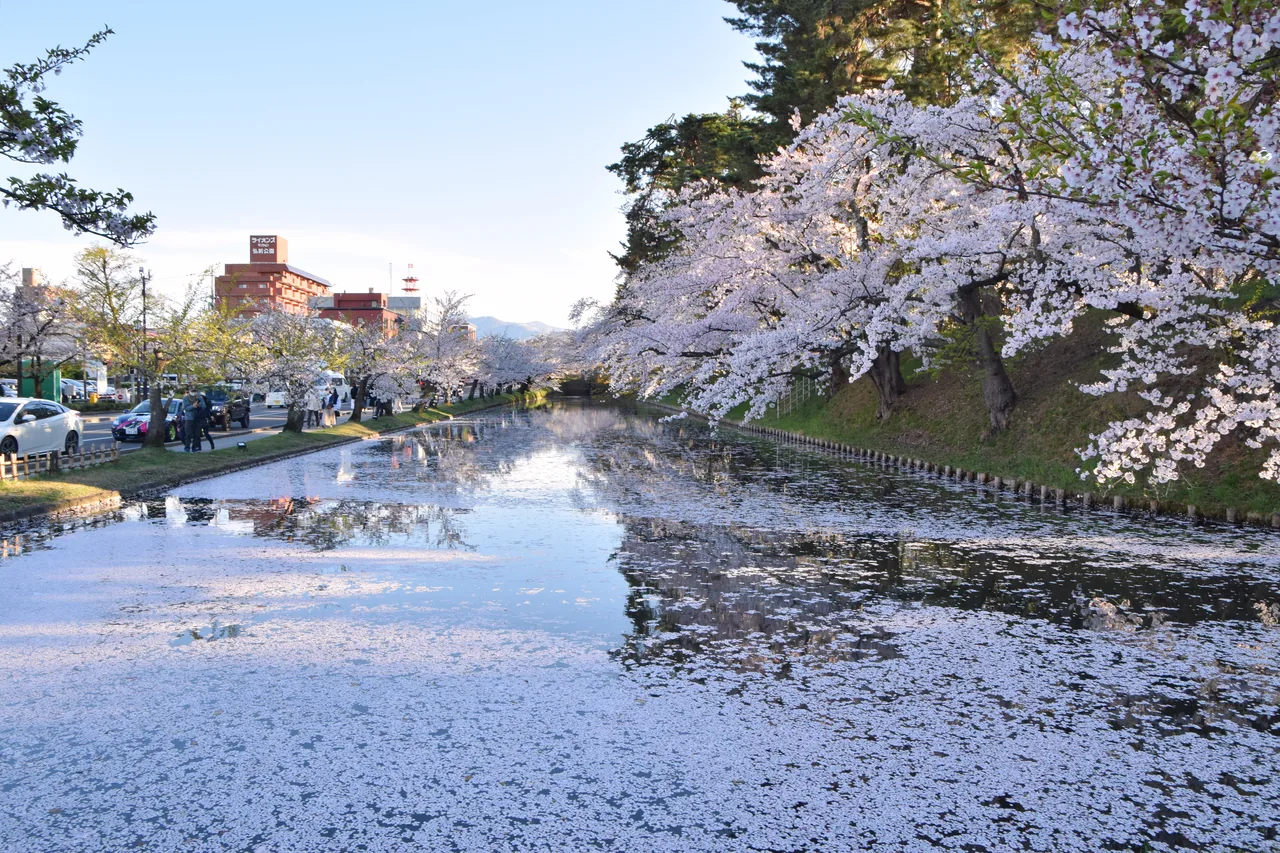
There is also a version of late that is worth seeking out rather than avoiding. Petals on the surface of a canal or a moat, drifting in a slow line, is one of the specific sights of the Japanese spring and it only exists after full bloom has passed. Kyoto’s canals and Tokyo’s moats both do it well.
If the season has genuinely gone and no amount of moving north will fix it, the honest answer is to change what the trip is about. Japan in the second half of April has fresh green on the mountains, empty temples in the week after everyone leaves, and prices that fall sharply once the blossom is finished.
For the wider planning that any of those recovery trips needs, our complete Japan travel guide is the place to start, and the autumn foliage planner is the article to read if this year’s spring has taught you to prefer a season with a longer peak.