
Ueno Travel Guide: Park, Museums and Ameyoko Market
Ueno Station splits the district in two, and the halves close on different days. The park museums shut on Mondays while Ameyoko trades; on Wednesdays the market thins out and the park is fine.
| Park side | almost every museum, gallery and the zoo close on Mondays. |
|---|---|
| Market side | 78 of the 220 shops in the official directory close on Wednesdays. |
| Hours | the park opens 9:00–9:30 and shuts at 17:00; Ameyoko runs 10:00 to 19:00. |
| Order | the park closes first, so museums go in the morning and Ameyoko after. |
| From Narita | the Skyliner reaches Ueno in 41 minutes and the N’EX does not stop here. |
| Pandas | Ueno Zoo currently keeps no giant pandas at all. |
1. The station cuts the district in two
2. The day of the week decides what you can see
3. Getting in from Narita Airport
4. Which exit to use at Ueno Station
5. Luggage will keep you out of one museum
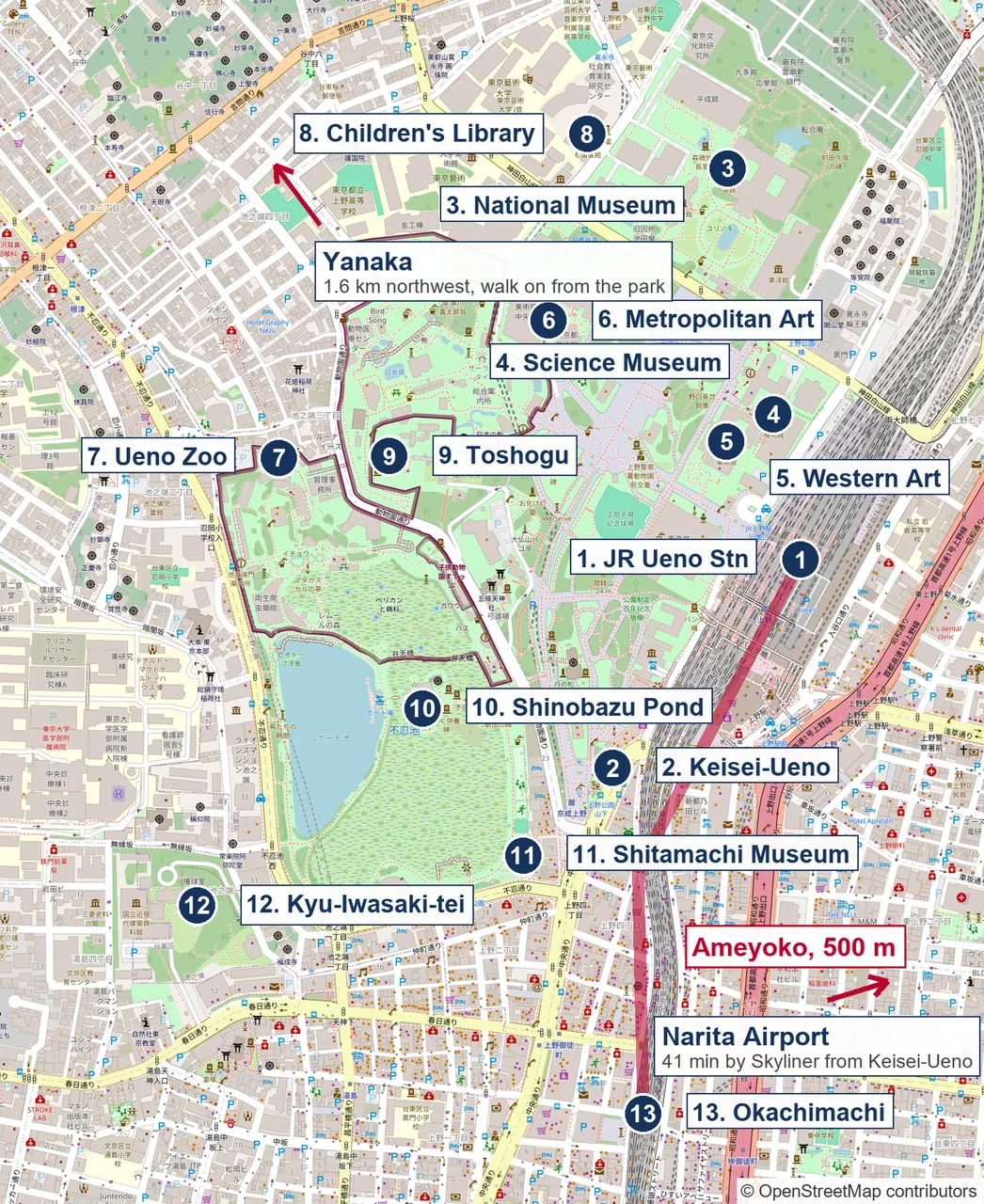
6. What sits where inside Ueno Park
7. Somewhere to sit inside the park
8. The three national museums: tickets and hours
9. The metropolitan gallery costs nothing to enter
10. The children’s library closes on public holidays
11. The Shitamachi Museum has a new name
12. There are no pandas at Ueno Zoo
13. Shinobazu Pond: boats and lotus
14. The whole park used to be a temple
15. Three shrines in the park
16. Kyu-Iwasaki-tei Gardens, open on Mondays
17. Visiting with a pushchair or a wheelchair
18. How the park changes through the year
19. Ameyoko: 400 shops in 500 metres
20. We counted when Ameyoko actually opens and closes
21. What to eat along Ameyoko
22. How far to push on price
23. Walking on to Yanaka
24. Where to go next from Ueno
25. Half-day and full-day routes
26. Is Ueno a good base
27. What to sort before you go
1. The station cuts the district in two
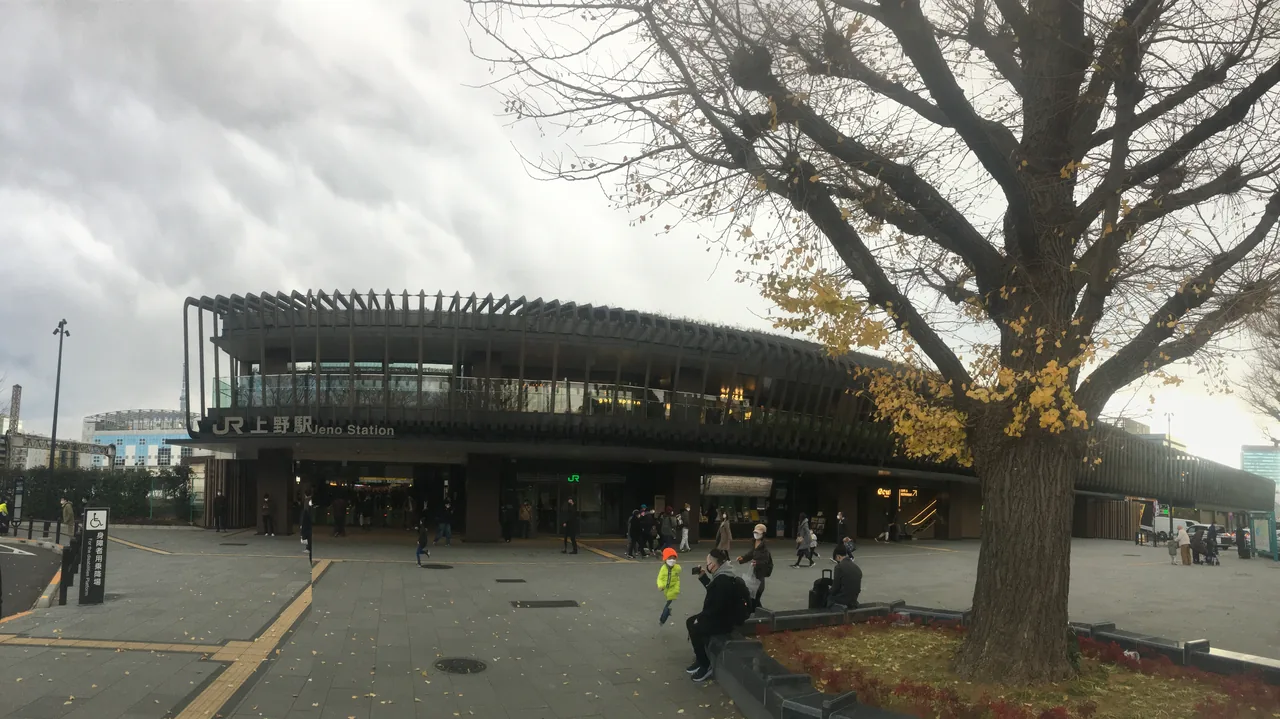
Leave Ueno Station by the Park Exit and you are among museums and a zoo. Leave by the Shinobazu Exit and you are in Ameyoko, a market street. The two sides are five minutes apart and they close on different days.
This is where day plans go wrong. The park institutions shut on Mondays while Ameyoko trades as usual. Come on a Wednesday instead and the market is the side with shutters down.
| Park side | Ameyoko side | |
|---|---|---|
| Exit | JR Ueno Park Exit | JR Ueno Shinobazu Exit |
| What is there | Three national museums, a metropolitan gallery, the zoo, a pond, shrines | Around 400 shops along 500 metres |
| Closed | Mondays, almost without exception | Wednesdays for 78 of 220 listed shops |
| Opens | 9:00 or 9:30 | 10:00 for most shops |
| Closes | Around 17:00 | 19:00 for most shops |
| Cost | Park entry free, venues 300–1,000 yen | Walking it costs nothing |
Because the park closes two hours earlier, the running order decides itself. Museums first, market afterwards, and both fit in one day. Reverse it and you will stand in front of locked doors.
Two halves with two histories
The split is not an accident of town planning. The high ground west of the tracks was temple land for most of the Edo period, then became one of Japan’s first public parks, which is why the museums, the zoo and the shrines all sit together up there.
The strip below the tracks has the opposite origin. It grew out of a black market in the years right after the war and never stopped trading, so it is narrow, loud and packed with small independent shops.
Walking between them takes about five minutes and the change is abrupt. One side is wide gravel avenues and ticket windows; the other is awnings, boxes stacked on the pavement and stallholders calling prices.
Ueno is also the way in from Narita
The Keisei Skyliner covers Ueno to Narita Airport Terminal 2·3 in 41 minutes, which is the operator’s own figure. Most Tokyo districts need one more change from the airport; Ueno is the terminus. That makes it a district you can use on arrival day or departure day. For how the neighbourhoods compare, see our Tokyo travel guide.
2. The day of the week decides what you can see
Monday closing is the rule in Ueno Park, but each venue writes its own exception. The differences show up when a public holiday lands on a Monday.
The museums open on a holiday Monday and close the next weekday instead. The International Library of Children’s Literature does the opposite: public holidays are closing days there, so it is shut on the very days everything else is open.
| Venue | Closed | If a holiday falls on it |
|---|---|---|
| Tokyo National Museum | Mondays | Opens, closes the next weekday |
| National Museum of Nature and Science | Mondays | Closes Tuesday if Sunday or Monday is a holiday |
| National Museum of Western Art | Mondays | Opens, closes the next weekday |
| Tokyo Metropolitan Art Museum | First and third Mondays only | Special exhibition rooms close every Monday |
| Ueno Zoo | Mondays | Opens, closes the following day |
| Shitamachi Museum | Mondays | Opens, closes the next weekday |
| International Library of Children’s Literature | Mondays, public holidays, third Wednesdays | It closes on holidays |
| Kyu-Iwasaki-tei Gardens | New Year period only | Open on Mondays |
| Ueno Toshogu | Never | Open every day |
| Hanazono Inari Shrine | Never | Worship from 6:00 |
| Shinobazu boat house | Wednesdays in winter | No closing day the rest of the year |
| Ameyoko | Varies by shop | Wednesday is the common closing day |
Why Monday
Monday closing is close to a national convention for Japanese museums. It exists so that galleries can be cleaned, works rotated and conservation carried out on the day when demand is lowest, and once the major museums set the pattern the smaller ones follow it.
The substitution rule is the part that catches visitors. When a public holiday falls on a Monday the museum opens for the holiday and takes the following weekday off instead, so a long weekend pushes the closure to Tuesday. During Golden Week in spring or the Obon week in August, that shifting can move a closure two or three days from where you expected it.
Every venue publishes a calendar for the year ahead on its own site. With a fixed date in mind, that calendar is the only reliable check, because the general rule carries too many exceptions to trust on its own.
If you are in Ueno on a Monday
Write off the indoor venues. The market, the shrines, Shinobazu Pond and Kyu-Iwasaki-tei Gardens all trade, and the park itself is open from 5:00 to 23:00, so a walk still works.
If you need a roof over you, change districts. Our rainy day indoor guide sets out the Roppongi and Shibuya routes that stay under cover.
Second and fourth Mondays are different
The Tokyo Metropolitan Art Museum runs two rules at once. The whole building closes only on first and third Mondays. On other Mondays the building is open but the special exhibition rooms are not, so what you can see is the open-call shows.
The third Wednesday is the worst single day
That is the children’s library’s stock-taking closure. It is also the most common Wednesday closing date in Ameyoko, with 28 shops listing it. Two closures land together, so it is a day worth avoiding.
3. Getting in from Narita Airport
The Narita Express does not stop at Ueno. The airport’s own list of stations runs Narita, Chiba, Tokyo, Shinagawa, Shibuya, Shinjuku, Yokohama. For Ueno you take Keisei.
Keisei runs three services and all of them terminate at Keisei-Ueno. They differ in how many stations they call at and whether a limited express charge applies.
| Service | What it is | Express charge |
|---|---|---|
| Skyliner | 41 minutes to the airport, all seats reserved | Yes |
| Access Express | More stops, so a longer run | No |
| Keisei Main Line | Most stops, cheapest fare | No |
The Access Express charges the ordinary fare only. It also runs through onto the Toei Asakusa Line, so Nihombashi, Shimbashi and Shinagawa are reachable without changing. With light luggage and time to spare it is a real option.
Skyliner fares
An adult single is 2,580 yen. Buy online, through an appointed agent or on board certain flights and it drops 270 yen to 2,310. The return falls from 5,160 to 4,500 yen, a saving of 660.
| Ticket | Standard | Bought ahead |
|---|---|---|
| Adult single | 2,580 yen | 2,310 yen |
| Child single (6–11) | 1,290 yen | 1,150 yen |
| Adult return | 5,160 yen | 4,500 yen |
| Child return | 2,580 yen | 2,240 yen |
Nippori is the useful transfer
The Skyliner calls at Nippori one stop before its Keisei-Ueno terminus, and Nippori is on the JR Yamanote and Keihin-Tohoku lines. If your hotel sits anywhere on the Yamanote loop, getting off there rather than riding to the end usually saves a change.
Staying on to Keisei-Ueno makes sense when Ueno itself is the destination, or when you are heading for the shrines and the Shitamachi Museum, both of which are closer to the Keisei station than to the JR one.
Return tickets are exchanged at the airport, not in town
Keisei states it plainly: a Skyliner return voucher can only be exchanged at Narita Airport Terminal 1 or Terminal 2·3 stations. Ueno and Nippori cannot do it. People discover this on the morning they fly out.
The ticket sold in Tokyo runs one way only
The Skyliner Value Ticket bought in the city covers Ueno or Nippori to the airport, in that direction only. You exchange it and take a seat assignment at the Keisei-Ueno same-day counter or the JR transfer counter at Nippori, and it is valid on the day of issue only.
Every seat on the Skyliner is reserved. Seat pitch is 1,050 mm and there is a socket under every seat, so the run out to the airport doubles as a charging stop.
For the other airport routes into the city, see our Narita and Haneda airport transfer guide.
4. Which exit to use at Ueno Station
Park Exit for the park, Shinobazu Exit for the market. Those two gates cover almost everything you will want.
What complicates it is that three companies run a station here. Keisei-Ueno sits in a separate building, and the subway station is separate again, so each venue quotes a different nearest station.
| Exit | Leads to | Walk |
|---|---|---|
| JR Ueno Park Exit | National Museum of Nature and Science | 5 min |
| JR Ueno Park Exit | Zoo Main Gate | 5 min |
| JR Ueno Park Exit | Tokyo Metropolitan Art Museum | 7 min |
| JR Ueno Park Exit | Tokyo National Museum, children’s library | 10 min |
| JR Ueno Shinobazu Exit | Ameyoko entrance | Immediate |
| JR Ueno Shinobazu Exit | Shitamachi Museum, zoo Benten Gate | 5 min |
| Keisei-Ueno | Shitamachi Museum | 3 min |
| Keisei-Ueno | Zoo Benten Gate | 4 min |
| Keisei-Ueno | Hanazono Inari Shrine | 5 min |
| Subway Ueno Exit 7 | Ameyoko | 2 min |
| Chiyoda Line Nezu | Zoo Ikenohata Gate | 5 min |
| Chiyoda Line Yushima | Kyu-Iwasaki-tei Gardens | 3 min |
| JR Uguisudani south exit | Tokyo National Museum | 10 min |
Moving between the Keisei and JR stations
They are separate buildings a short walk apart, with the Keisei platforms below ground and the JR concourse at street level. Allow a few minutes and a flight of stairs or a lift, especially with a case.
The shinkansen platforms sit inside the JR station on their own concourse with dedicated gates. Changing from the Skyliner to a shinkansen means leaving one company’s station and entering another’s rather than walking a single corridor, so leave more time than a same-station transfer would need.
Six stations line the market
Ameyoko is 500 metres long and has that many ways in. The north end is served by the JR Shinobazu Exit and the Keisei-Ueno main entrance, the south end by the north exit of JR Okachimachi. Underground, Ueno-hirokoji on the Ginza Line and Naka-okachimachi on the Hibiya Line surface at the same crossing.
Any of them works. If you plan to walk through to the park afterwards, start at Okachimachi in the south and work north, which saves doubling back.
Keisei-Ueno is closer for some things
The name misleads people into aiming for the JR station. The Shitamachi Museum, the zoo’s Benten Gate and Hanazono Inari are all nearer to Keisei-Ueno. If you came in on the Skyliner there is no reason to drag a case across to the JR side.
Shinkansen call here too
Ueno is the next stop north of Tokyo Station, so northbound shinkansen serve it. If you are heading to the regions afterwards you do not need to backtrack. It is also a calmer station to handle luggage in than Tokyo.
5. Luggage will keep you out of one museum
Tokyo National Museum does not allow suitcases inside. The museum bars them to protect the works on display and keep the galleries usable. Tokyo National MuseumMap
This matters more in Ueno than elsewhere. It is a district people visit straight off a flight or on the way to one, so a lot of visitors arrive wheeling something. Lock the bag away first.
| Where | Location | Note |
|---|---|---|
| Station coin lockers | JR Ueno and Keisei-Ueno | The large sizes fill early |
| Zoo coin lockers | Inside the Main and Benten gates | Paid, and only once you are through the gate |
| Gallery lockers | At each entrance | Sized for bags and wet umbrellas, not cases |
| Left luggage services | Shops along the market | The Ameyoko association points visitors to them |
The Ameyoko merchants’ association asks visitors on its own site to drop their bags before shopping. Its reasoning is practical: a crowded 500-metre lane is hard to pass with a case, and the trains and buses are easier for everyone without them.
Lockers fill from the largest size down
Coin lockers stand at both stations, but the compartments big enough for a full suitcase go first, usually well before the middle of the morning. If you arrive on an early Skyliner with a large case, find a locker before committing to a museum plan rather than after.
The alternative is a staffed left-luggage service. Shops along the market take bags for a fee through a booking platform, and the merchants’ association links to it from its own pages, which is a fair sign that it is used and expected.
Shinkansen add a second luggage rule
A case measuring more than 160 cm across its three sides needs an oversized baggage seat reservation, and boarding without one costs extra. The thresholds are in our shinkansen luggage guide.
6. What sits where inside Ueno Park
The park is free and open from 5:00 to 23:00. It was designated in 1873, which makes it one of the oldest public parks in Japan. Ueno ParkMap
Its full name is Ueno Onshi Park. Onshi means granted as a gift, and it dates from 1924, when the imperial household passed the land to the city. The Tokyo Metropolitan Government’s Bureau of Construction runs it now.
The park begins directly outside the JR Park Exit, widens northward, and drops away on the southwest side to Shinobazu Pond. Everything sits inside that footprint, so venue to venue is a five to ten minute walk.
| Where in the park | What | Cost |
|---|---|---|
| North end | Tokyo National Museum | 1,000 yen |
| North | International Library of Children’s Literature | Free |
| Northeast | Ueno Zoo | 600 yen |
| Beside the central plaza | Tokyo Metropolitan Art Museum | Free to enter |
| Centre | National Museum of Nature and Science | 630 yen |
| Near the Park Exit | National Museum of Western Art | 500 yen |
| Western slope | Ueno Toshogu | Free to worship |
| West | Hanazono Inari and Gojo Tenjin shrines | Free |
| On the rise | Kiyomizu Kannon-do, Ueno Daibutsu | Free |
| Southwest | Shinobazu Pond and Bentendo | Free |
| South | Shitamachi Museum | 300 yen |
The statue of Saigo Takamori stands on the rise at the southern entrance. He is shown with his dog, which makes it easy to describe, and it is the standard meeting point.
The park opens at five in the morning
Nothing inside it does, but the paths, the pond and the shrine approaches are open from 5:00 until 23:00. In summer that is well before sunrise heat and well before the crowds, and it is the only way to photograph the central avenue in blossom season without people in the frame.
The same hours make the park usable at the end of a day when every ticketed venue has shut. A walk down to the pond after dinner in the market costs nothing and needs no planning.
There is a battle behind the park
The hill was the precinct of Kaneiji, the Tokugawa family temple, and at the end of the shogunate it became a battlefield. A force loyal to the shogun made its stand here, and most of the temple buildings burned in the fighting.
The cleared ground was designated a public park in 1873, among the first group of parks created in Japan. That is how a temple precinct, a zoo, three national museums and a metropolitan gallery came to share one hill: the land fell vacant at the moment the new government was looking for places to put civic institutions.
The bronze figure of Saigo Takamori on the southern rise belongs to the same period. He led the government forces in that war and later died in a revolt against the government he had helped to install.
Other buildings on the hill
Three more venues stand inside the park and open only when something is on. The Tokyo Metropolitan Festival Hall is a concert hall facing the Park Exit, the University of the Arts keeps a museum on the northern edge, and the Ueno Royal Museum opens for exhibitions and closes between them.
Between shows the Royal Museum is dark, and its own front page says so on the day. If it was on your list, check rather than walk.
No cars come into the park
Neither the museums nor the zoo has its own car park. Drivers use the lots around the station and walk in. Ueno Parking Center is the largest at 400 spaces and connects to the park by lift; the Keisei-Ueno car park is a minute from the zoo’s Benten Gate.
The Keisei lot has limits of 2.1 m height, 6.0 m length and 2.0 tonnes. Larger vehicles are better off at Ueno Parking Center or the Ueno Chuo-dori underground car park, both open around the clock.
7. Somewhere to sit inside the park
Two cafes in the park stay open until 21:00, four hours after the museums shut. Neither has a closing day.
The park is large enough that the walk between venues leaves you looking for a seat. The park authority publishes what is available.
| Where | Hours | Closed |
|---|---|---|
| Starbucks Ueno Onshi Park | 8:00–21:00 | Never |
| EVERYONEs CAFE | Weekdays 10:00–21:00, weekends 9:00–21:00 | Never |
| Parks Ueno (kiosk) | 9:00–19:00 in the warm months, 9:00–17:00 in the cold | New Year period |
| Children’s library cafeteria | 9:30–17:00 | Library closing days |
Both cafes sit on the central Takenodai plaza. EVERYONEs CAFE has 86 seats inside and 80 on the terrace, so it absorbs a crowd; Starbucks opens at 8:00, which is useful if you are waiting for a museum to unlock.
Benches, toilets and the fountain plaza
The middle of the park is an open plaza with a long rectangular fountain, benches down its sides and public toilets near the cafes. It is the one part of the park where you can sit for a while without buying anything.
The paths from the science museum, the national museum and the metropolitan gallery all converge here. If a group splits up to see different collections, this is the sensible place to agree to meet again.
The kiosk still sells pandas
Parks Ueno, just outside the Park Exit, leads with panda goods and Tokyo-only souvenirs, and still does with no pandas in the zoo. If you only want the souvenir, you do not need a zoo ticket.
On Mondays it closes at 17:00 even in summer, following the zoo’s closing day. Arrive late on a Monday and the kiosk is shut as well.
8. The three national museums: tickets and hours
All three permanent collections come to 2,130 yen, and all three close on Mondays. Our rainy day indoor guide covers the galleries themselves; this section is about getting through the door.
| Museum | Permanent collection | Hours | Free entry |
|---|---|---|---|
| Tokyo National Museum | 1,000 yen, students 500 | 9:30–17:00, to 20:00 Fri and Sat | Under 18, high school students, 70 and over |
| National Museum of Nature and Science | 630 yen, students the same | 9:00–17:00 | Under 18, school pupils, 65 and over |
| National Museum of Western Art | 500 yen, students 250 | 9:30–17:30, to 20:00 Fri and Sat | Under 18, high school students, 65 and over |
Last admission is 30 minutes before closing at all three. The science museum has no late opening and finishes at 17:00; the other two run to 20:00 on Fridays and Saturdays. Those two evenings are the only way to use Ueno after work. National Museum of Nature and ScienceMap
National Museum of Western ArtMapBags, coats and photography
All three keep lockers at the entrance for bags and wet umbrellas, and all three ask you to leave bulky items there rather than carry them through the galleries. Photography rules change by room and by exhibition, with special exhibitions the most restricted, and the notice at each room entrance is the rule that applies.
A special exhibition ticket covers the permanent one
At the Tokyo National Museum and the Museum of Western Art, a special exhibition ticket admits you to the permanent collection on the same day. It does not work the other way round. If a special show is your reason for going, do not buy the permanent ticket separately.
Free entry by age is granted on sight of proof, so carry something showing a date of birth if you intend to claim it. Student rates work the same way with a student card.
If you only have time for one
The three cover completely different ground. With two hours, pick one rather than rushing all of them.
| If you want | Go to | Why |
|---|---|---|
| Japanese art and history | Tokyo National Museum | The largest and oldest museum in the country |
| Something for children | Nature and Science | School pupils enter free and the halls are big |
| European painting | Museum of Western Art | The building itself is a World Heritage site |
| To spend nothing | Tokyo Metropolitan Art Museum | There is no admission charge |
Free days are fixed
The Museum of Western Art opens its permanent collection free on the second Sunday of every month. All three are free on 18 May, International Museum Day, and on 3 November, Culture Day. When 18 May falls on a Monday the museums are closed and the offer is lost.
| Free day | Where |
|---|---|
| Second Sunday monthly | Museum of Western Art, permanent collection |
| 18 May, International Museum Day | All three |
| 3 November, Culture Day | All three |
| Respect for the Aged Day in September | Tokyo National Museum |
The ticket queue can run past half an hour
The Tokyo National Museum warns that the main gate window can take more than 30 minutes when it is busy. Buying online skips it. Online tickets carry no timed entry and stay valid for two months from purchase, so you can buy before your plans are firm.
The window takes credit cards, transport IC cards and UnionPay, so there is no need to carry cash for it.
Whole rooms close for months at a time
Refurbishment takes galleries out of use for long stretches. Parts of the main building and the Asian gallery are scheduled to close from winter through spring. If a particular object is your reason for visiting, check that museum’s site for the rooms open on the day.
9. The metropolitan gallery costs nothing to enter
The Tokyo Metropolitan Art Museum charges no admission. You pay per exhibition, and walking into the building, the lobby, the shop and the open-call galleries is free. Tokyo Metropolitan Art MuseumMap
Open-call exhibitions run almost continuously. Art societies take the rooms in turn, so there is usually something on without a ticket. Some people come for the brick building alone.
| Admission | Free |
| Hours | 9:30–17:30, Fridays to 20:00 during special exhibitions |
| Last entry | 30 minutes before closing |
| Building closed | First and third Mondays |
| Special exhibition rooms closed | Every Monday |
| Access | 7 min from the JR Park Exit, 10 from subway Exit 7 or Keisei |
What an open-call exhibition is
Japanese art societies hold annual juried shows, and this gallery is where a great many of them take place. Members and applicants submit work, a panel selects, and the accepted pieces hang for a week or two before the next society moves in.
For a visitor the practical points are that these shows are usually free, that they change constantly, and that they are full of work by living artists who are often standing in the room. It is a different experience from a curated blockbuster, and looking costs nothing.
Use the main gate
The main gate has an escalator and a lift; the east gate has steps. The museum recommends the main gate for that reason, and it makes a real difference with a pushchair or a walking difficulty.
It is also the nearest place to duck into if a shower catches you between venues, since you do not need a ticket to be inside.
10. The children’s library closes on public holidays
It is a branch of the National Diet Library, it is free, and there is no registration to enter. Adults walk in the same as children. International Library of Children’s LiteratureMap
It stands at the north end of the park beside the Tokyo National Museum, in the brick building it occupied in its years as the Imperial Library, with a glass arch wing added in 2015. Some visitors come for the architecture alone. Nothing circulates to individuals; you read on site.
| Cost | Free, no entry procedure |
| Hours | 9:30–17:00 |
| Closed | Mondays, public holidays, third Wednesdays, New Year period |
| Exception | Open on 5 May, Children’s Day, though it is a holiday |
| Inside | Children’s reading rooms, a world literature room, a cafeteria |
| Access | 10 minutes from the JR Park Exit |
What is inside
The ground floor holds the children’s reading room, where the books sit on open shelves and anyone may take one down, along with a room of books from around the world arranged by country. Upstairs there is a gallery of children’s literature and a research room for people working on the subject, which needs a separate procedure.
Nothing is lent to individuals. You read what you take off the shelf and leave it behind, which makes this a place to spend an hour rather than a library to join.
The holiday rule runs backwards here
Everything else in the park opens on a holiday Monday and takes the following weekday off. This library treats the holiday itself as the closing day. Visitors touring Ueno over a long weekend lose a stop to that difference.
The cafeteria keeps the same 9:30 to 17:00. With free entry, it is a place to sit with a child in the middle of the park without spending anything.
11. The Shitamachi Museum has a new name
It used to be the Shitamachi Museum of Downtown Life, and it reopened after a major refit as the Shitamachi Museum. Older guides and maps still carry the previous name, which is why people fail to find it. Shitamachi MuseumMap
It sits at the southern tip of Shinobazu Pond. The displays recreate ordinary working life in mid-century downtown Tokyo, so it works as a change of pace from the national collections.
| Admission | 300 yen, school pupils 100 |
| Hours | 9:30–16:30, last entry 16:00 |
| Closed | Mondays, New Year period |
| Ground floor | Recreated street, museum shop, lockers |
| First floor | Permanent display |
| Second floor | Temporary exhibitions and a research corner |
What has been recreated
The ground floor is built as a street: shopfronts you walk into, a tenement interior, tools and packaging left where they would have been used. What is recreated is an ordinary working district in the middle decades of the last century, not anything grand.
The rename came with the rebuilding. The museum closed for a major refit, gained lifts, a nursing room and step-free access, and reopened under a shorter name. Building, displays and name changed at once, which is why older references no longer match what you find.
The top floor looks over the pond
The refit created it. From the information corner on the top floor, Shinobazu Pond fills the window. In summer, when the lotus covers the water, this is close to the only indoor view of it.
It is three minutes from Keisei-Ueno and five from the JR Shinobazu Exit. At 300 yen it is the right size for a spare half hour.
12. There are no pandas at Ueno Zoo
Ueno Zoo currently keeps no giant pandas. The zoo says so on its own site. Ueno ZooMap
The last of them returned to China, leaving the zoo without a panda for the first time since 1972. The kiosks in the park still lead with panda merchandise, and visitors read that as evidence the animals are there, so it is worth stating plainly.
Plenty remains. It opened in 1882, making it the oldest zoo in Japan, and it holds around 300 species and more than 2,500 animals.
| Admission | 600 yen, 65 and over 300, junior high 200 |
| Free | Children through the sixth year of primary school |
| Hours | 9:30–17:00 |
| Last admission | 16:00, an hour before closing |
| Closed | Mondays, New Year period |
| Annual pass | 2,400 yen, worth it from the fourth visit |
What the zoo is known for now
The shoebill is the animal people queue for in the pandas’ absence: a large, still, prehistoric-looking stork that the zoo has turned into something of a mascot, and it lives in the west garden. Sumatran tigers, western lowland gorillas, a polar bear and the elephant house are in the east garden, while the west adds giraffes, rhinoceros, hippopotamus and a small-mammal house.
Allow two hours to walk it without hurrying, three with children who stop at everything. The two gardens are far enough apart that a full circuit is a proper walk rather than a stroll.
The gate you choose changes what you see first
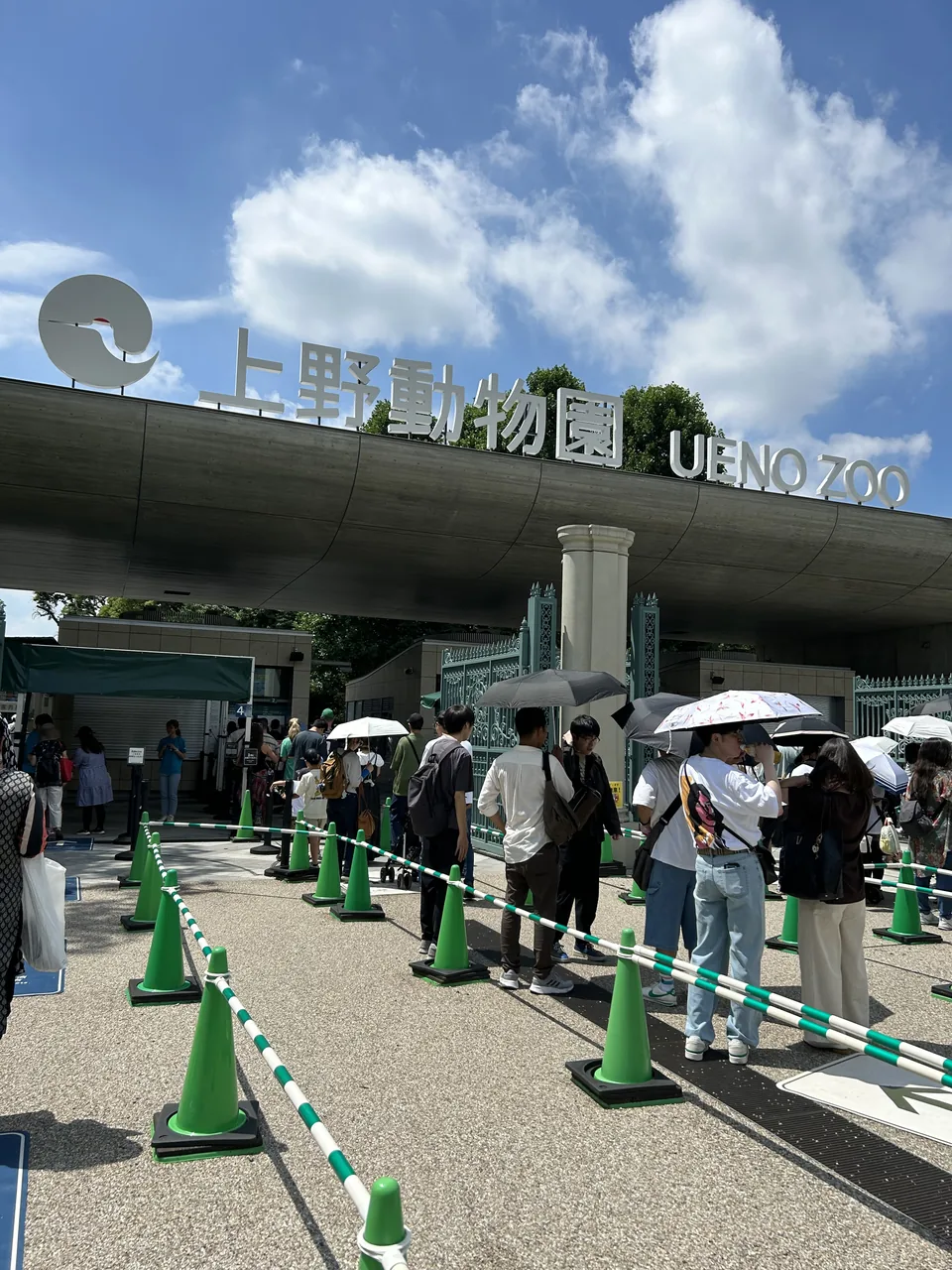
There are three, and they are a long way apart. The grounds divide into an east and a west garden, so the entrance decides which animals you meet first.
| Gate | Nearest station | Animals nearby | Queues |
|---|---|---|---|
| Main Gate (east garden) | JR Park Exit, 5 min | Elephants, polar bear, tigers, gorillas | Long at weekends and holidays |
| Benten Gate (east garden) | Keisei 4 min, JR Shinobazu 5 min | The children’s zoo | Long at weekends and holidays |
| Ikenohata Gate (west garden) | Nezu on the Chiyoda Line, 5 min | Giraffes, rhinoceros, hippos, shoebill | Only the ticket queue |
With children at a weekend, use Ikenohata. It avoids the two busy gates, and the west garden holds the children’s zoo and the reptile house. One catch: pushchair hire at Ikenohata operates on weekends and holidays only.
A bridge links the two gardens and a shuttle runs between them. Coin lockers are inside the Main and Benten gates.
The pagoda is inside the zoo
Kaneiji’s old five-storey pagoda stands within the east garden. It is a nationally designated Important Cultural Property and rises about 36 metres to the finial. You can see it over the fence, but to stand under it you need a zoo ticket.
A seventeenth-century tea house survives in the same garden. It is viewed from outside only.
Free entry in the week of Respect for the Aged Day
For a week around the September holiday, visitors aged 60 and over enter free along with one companion. If your dates fall in that week, two people save 1,200 yen.
13. Shinobazu Pond: boats and lotus
A rowing boat is 800 yen for 30 minutes; swan and pedal boats are 1,000. Several travel sites quote 700, which does not match the park’s own price list. Shinobazu PondMap
The pond divides into three parts: the boating water, the stretch that fills with lotus in summer, and a cormorant habitat that falls inside the zoo’s west garden. Boats go on the first of those only.
| Boat | Capacity | Per 30 minutes |
|---|---|---|
| Rowing boat | Up to three adults | 800 yen |
| Pedal boat | Two adults and a child | 1,000 yen |
| Swan boat | Two adults and a child | 1,000 yen |
Hours move with the season
Longer in summer, shorter in winter, and the desk stops taking bookings an hour before the boats come off the water.
| Season | Operating | Last booking |
|---|---|---|
| April to September | 10:00–17:50 | 16:50 |
| Peak summer weeks | 10:00–18:20 | 17:20 |
| March and October | 9:30–17:20 | 16:20 |
| November to February | 9:30–16:50 | 15:50 |
Wednesdays are closing days in winter. There is no weekly closure the rest of the year.
The cormorant water sits inside the zoo
One arm of the pond falls within the zoo’s west garden and holds a cormorant colony, so it is only reachable with a zoo ticket. From the public path you see the birds crossing the water without getting to the nesting side.
The full loop around the pond runs a little over a kilometre on the flat, with the Shitamachi Museum at the southern end and the zoo’s Ikenohata Gate at the northern one. It is the easiest walk in the district, and one of the few things here that stays open on a Monday.
Lotus flowers open in the morning
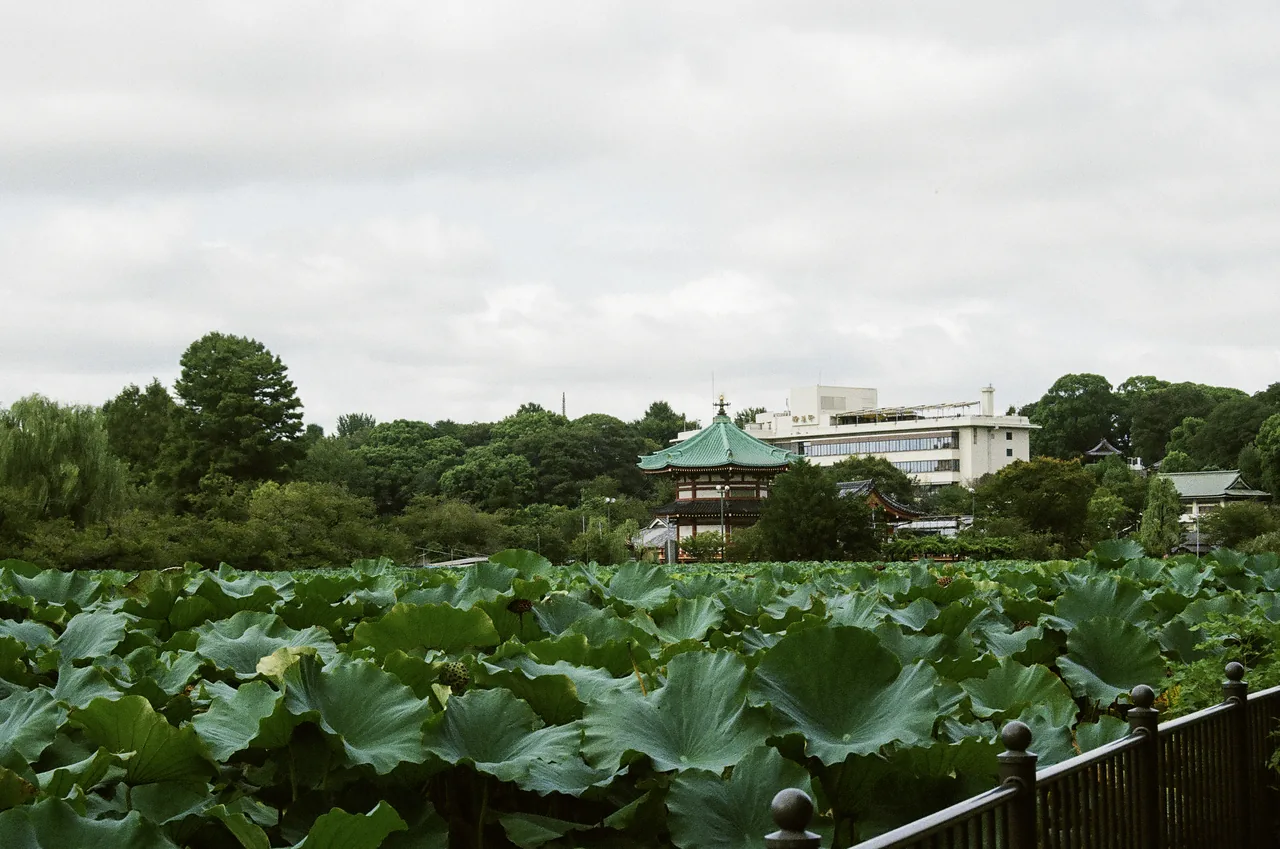
One arm of the pond disappears under lotus leaves in summer. The flowers open early and fold by midday, so an afternoon visit shows you leaves. For a view down onto the water, the top floor of the Shitamachi Museum is the closest indoor vantage point.
Bentendo stands on the island
A causeway runs out to an island in the middle of the pond, where an octagonal hall called Bentendo sits. It belongs to Kaneiji and costs nothing to visit. The path around the pond takes you past it anyway.
14. The whole park used to be a temple
What is now Ueno Park was the precinct of Kaneiji, a temple founded in 1625. It is the head temple of the Tendai school for the Kanto region, and six of the fifteen Tokugawa shoguns are buried there. Kaneiji Konpon ChudoMap
That explains why its buildings are scattered. Most of the precinct burned in the Battle of Ueno at the end of the shogunate, and only fragments survive, spread across the modern park. The temple buildings that appear as you walk are what was left. Ueno DaibutsuMap
| What survives | Where | Cost |
|---|---|---|
| Konpon Chudo, the main hall | North of the park, 7 min from JR Uguisudani | Grounds free |
| Kiyomizu Kannon-do | On the rise in the park | Free |
| Bentendo | Island in Shinobazu Pond | Free |
| Ueno Daibutsu and pagoda | On the rise in the park | Free |
| Old five-storey pagoda | Inside the zoo’s east garden | Zoo admission |
| Former main gate | On the Tokyo National Museum site | Free |
Konpon Chudo stands outside the park to the north, with gates open 9:00 to 17:00. For the temple’s 400th anniversary a ceiling painting went on public view, 6 metres by 12, among the largest in the country. Viewing is suspended on certain days, so check the temple’s site before making the walk.
Why a Tokugawa temple stands here
Kaneiji was founded by the priest Tenkai to guard the northeast approach to the shogun’s city, and its mountain name, Toeizan, means the Hiei of the east: a direct reference to Enryakuji, the great temple above Kyoto. The halls on this hill were built to echo famous buildings around Kyoto, which is why a small Kiyomizu and an island hall in the manner of a lake shrine both turn up in the same park.
Six of the fifteen Tokugawa shoguns are buried in the temple’s mausoleum: Ietsuna, Tsunayoshi, Yoshimune, Ieharu, Ienari and Iesada. Most of the mausoleum buildings burned in the Second World War, and an imperially inscribed gate and a water pavilion survive as Important Cultural Properties. The interior is not open to visitors.
The dragons on the ceiling
The anniversary painting in the main hall was made by the Japanese-style painter Tezuka Yuji on ceiling boards from the temple’s own founding era, worked in ink, white clay, gold and platinum. It shows two dragons, one with its mouth open and one closed, the pair that stands for beginning and end.
At six metres by twelve it ranks among the largest ceiling paintings in the country, and it is the reason to make the extra walk north out of the park to the main hall.
A Great Buddha was cast here in 1631 and knocked down repeatedly by earthquake and fire. The head came off in the Great Kanto Earthquake and the body was requisitioned during the war, so what remains is the face, mounted in the open.
Because it cannot fall any further, students come to pray before examinations. A 15-metre pagoda built in 1967 stands where the body was. The site is open 10:00 to 16:00 and costs nothing.
The round pine at Kiyomizu Kannon-do
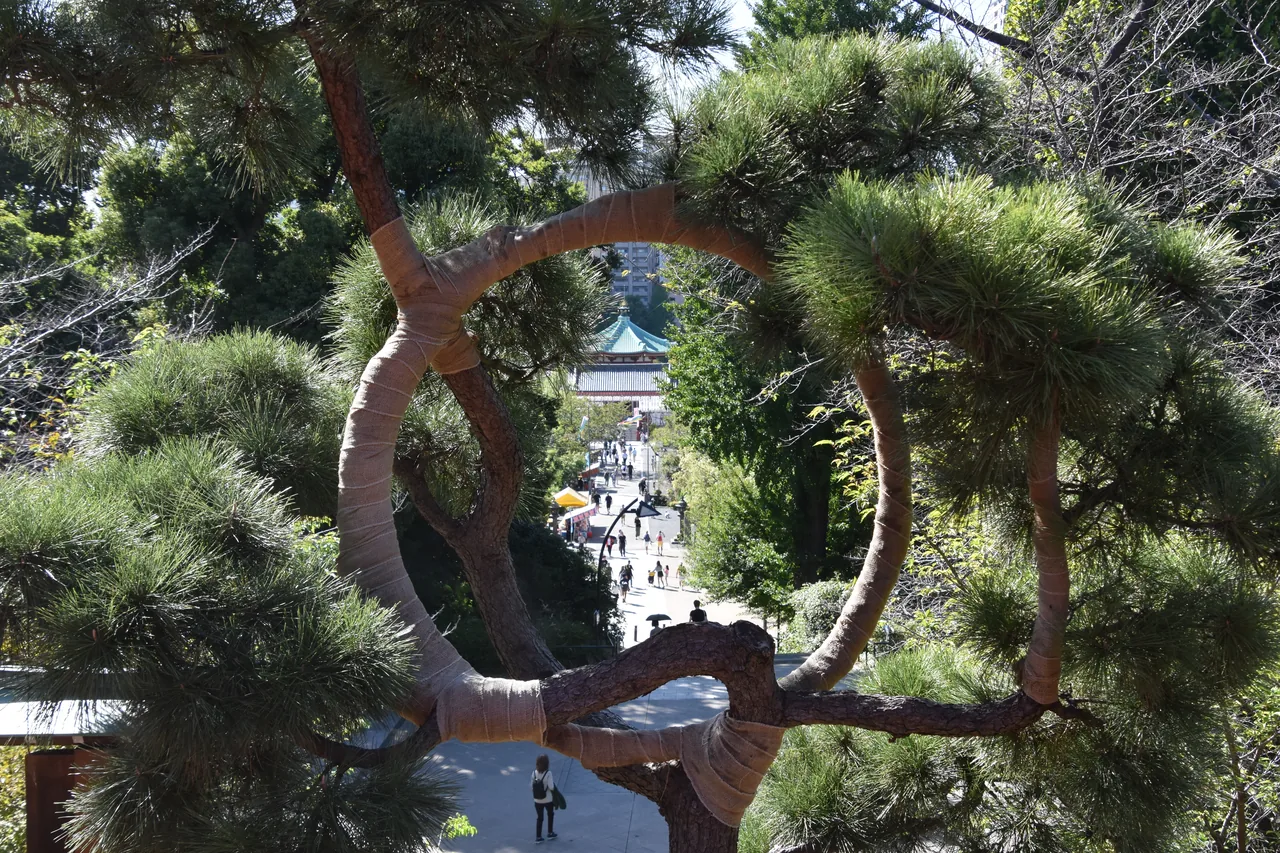
The hall was built in 1631 in imitation of Kiyomizu-dera in Kyoto and is an Important Cultural Property. In front of its platform stands a restored pine trained into a circle, the Moon Pine that Utagawa Hiroshige drew in his One Hundred Famous Views of Edo.
Stand so that Bentendo sits inside the circle of the pine and you have Hiroshige’s composition. If you take one photograph in Ueno Park, take it here.
The special viewing cannot be done on impulse
A special visit takes in the shogun mausoleum and the Aoi Room, but places are limited and booked in advance. The temple’s notices show months already full. Going means working to the date bookings open, not turning up.
15. Three shrines in the park
Worship at Ueno Toshogu costs nothing; the 700 yen ticket takes you inside the fence, close to the shrine hall. It was founded in 1627 and enshrines Tokugawa Ieyasu. Ueno ToshoguMap
The gilded hall came through both war and earthquake and is a nationally designated Important Cultural Property. From the free part you still see the approach lined with stone lanterns and the gate.
| October to February | March to September | |
|---|---|---|
| Worship | 9:00–16:30, free | 9:00–17:30, free |
| Inside the fence | 9:30–16:00, 700 yen | 9:30–17:00, 700 yen |
| Primary school children | 300 yen | |
| Closing days | None | |
What the paid section gets you
The fence around the shrine hall is pierced with carved panels, and the ticket puts you inside it, close enough to see the gold leaf and the carving on the doors. The hall interior itself is not open, so what you are buying is proximity rather than access. Hanazono Inari ShrineMap
The free approach is worth walking either way. Stone lanterns line it in ranks, donated by feudal lords, and the gate at the end is part of the same seventeenth-century group that survived the fires.
The peony garden runs in seasons
The garden beside the shrine does not open year-round. Winter peonies run from the new year into late winter, the spring peony festival takes the spring, and dahlias fill early autumn. Entry is 700 yen and free for primary school children and under.
Winter peonies are each given a straw cap against the cold, which is the reason to see them rather than the spring flowering. If your dates line up, it gives Ueno something to offer in the coldest weeks.
Inari and Tenjin, briefly
An Inari shrine is dedicated to a deity associated with rice, food and by extension trade and household prosperity, and the ranks of vermilion gates are donations from people and businesses who asked for something. A Tenjin shrine enshrines the scholar Sugawara no Michizane, which is why students turn up before examinations.
Goshuin are the inked and stamped records of a visit, written by hand in a book you buy at any shrine or temple. Both shrines here issue theirs from the one office, which saves a second queue.
A tunnel of red gates stands in the park
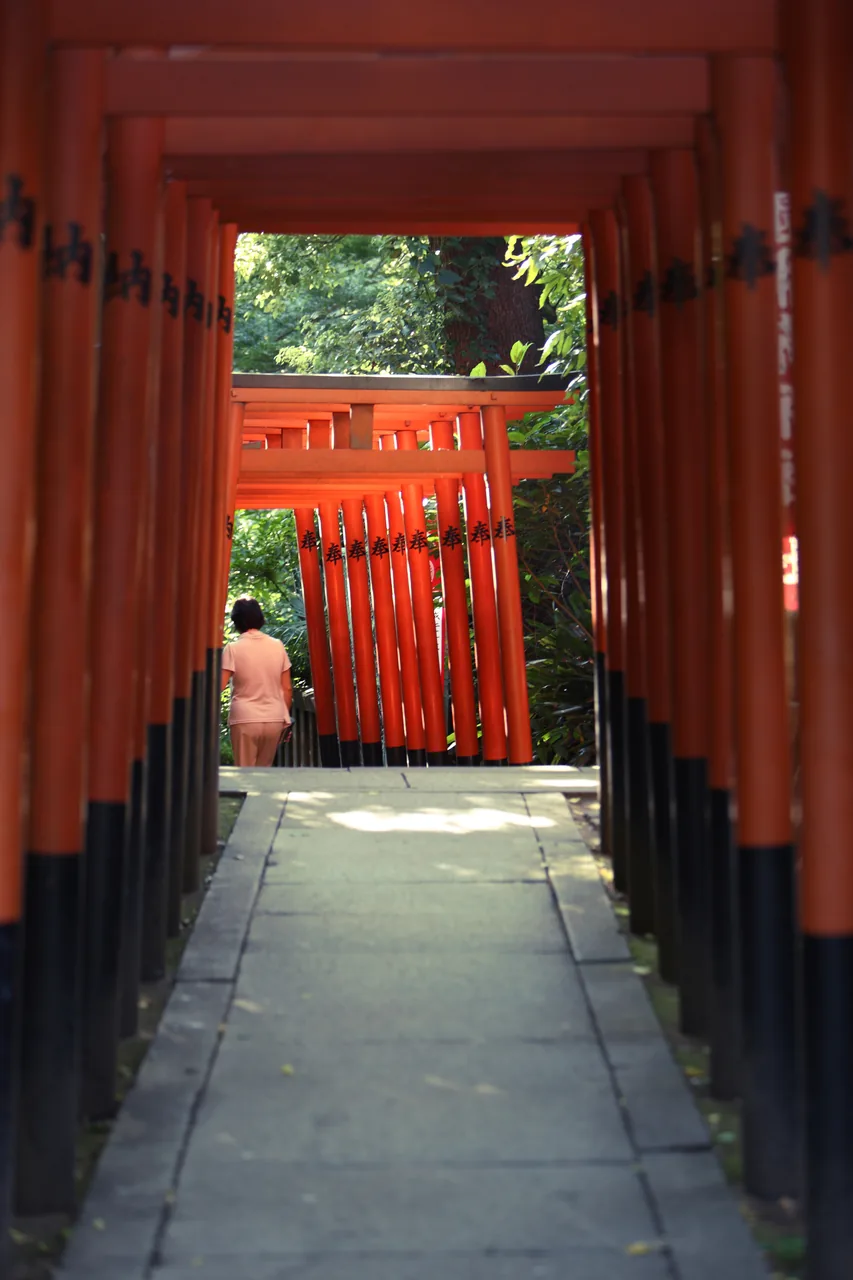
Hanazono Inari Shrine has a line of vermilion torii along its eastern approach. It is free and open for worship from 6:00 to 17:00, so it can be visited before anything else opens.
Gojo Tenjin adjoins it. The two precincts run together and read as one shrine, but they are separate foundations with separate histories. Goshuin stamps for both are issued at the office inside Gojo Tenjin.
Hanazono Inari was the site of the last fighting in the Battle of Ueno. Gojo Tenjin enshrines deities of medicine, so people come to pray over health. Both are five minutes from Keisei-Ueno, which puts them first on the route if you arrive on the Skyliner.
16. Kyu-Iwasaki-tei Gardens, open on Mondays
West of Shinobazu Pond stands the Mitsubishi founding family’s mansion, and entry is 400 yen. It opens on Mondays, when the park venues do not. Kyu-Iwasaki-tei GardensMap
The house dates from 1896. Josiah Conder, the architect of the Rokumeikan, designed the western wing and the billiard room; a Japanese wing survives alongside them, and the whole site including the brick wall is an Important Cultural Property.
| Admission | 400 yen, 65 and over 200 |
| Free | Primary school children and Tokyo junior high students |
| Hours | 9:00–17:00, last entry 16:30 |
| Closed | New Year period only |
| Free days | 4 May and 1 October |
| Access | 3 minutes from Yushima on the Chiyoda Line |
What Conder built
Josiah Conder was the British architect who trained the first generation of Japanese architects and designed much of the country’s early Western-style public building. The western wing here is his, with Jacobean detailing worked through the interiors, and the billiard room is a separate structure in the manner of a Swiss chalet, which was highly unusual in Japan at the time.
The house has shrunk. The grounds once ran to some fifteen thousand tsubo with around twenty buildings on them; a third of the land and three buildings survive. The Japanese wing that remains is the great hall, once the smaller part of a residence that dwarfed the western wing.
The billiard room opens on the 15th of the month
It connects to the house by an underground passage and is otherwise closed. On the 15th, guided groups go in at 10:00 and 13:00, ten people per group. Places go first come at the window on the day, in person only, with no booking for others or for a group.
Both sessions are allocated when the gate opens at 9:00. To see it, be there at opening.
General tours run daily at 11:00 and 14:00 and last about 45 minutes. Those need no reservation.
17. Visiting with a pushchair or a wheelchair
Ueno Park sits on high ground, so the way up from the station is a slope. Once you are on top the ground is level.
Each venue publishes its own access notes, and they differ enough to be worth reading before you go.
| Where | What to know |
|---|---|
| Tokyo Metropolitan Art Museum | Escalator and lift at the main gate; steps at the east gate |
| Ueno Zoo | Pushchairs for hire, for a fee |
| Ueno Zoo nursing room | Men may use it apart from the women-only section |
| Shitamachi Museum | Accessible toilet on the ground floor, nursing room on the first |
| Kyu-Iwasaki-tei Gardens | Wheelchair route covers the lawn garden, the ground floor of the western wing and the Japanese wing |
| Children’s library | Free, no procedure, a place to stop |
Pushchair hire depends on the gate
The zoo hires pushchairs at Ikenohata Gate on weekends and public holidays only. If you planned to pick one up on a weekday while entering the west garden, use another gate.
Choose the car park carefully
The unstaffed lot in front of Ueno Station has a steep ramp and the park authority states it is not usable in a wheelchair. Ueno Parking Center has designated accessible spaces and a lift up to the park.
Six accessible spaces sit inside the park itself, at the coach park, allocated first come.
18. How the park changes through the year
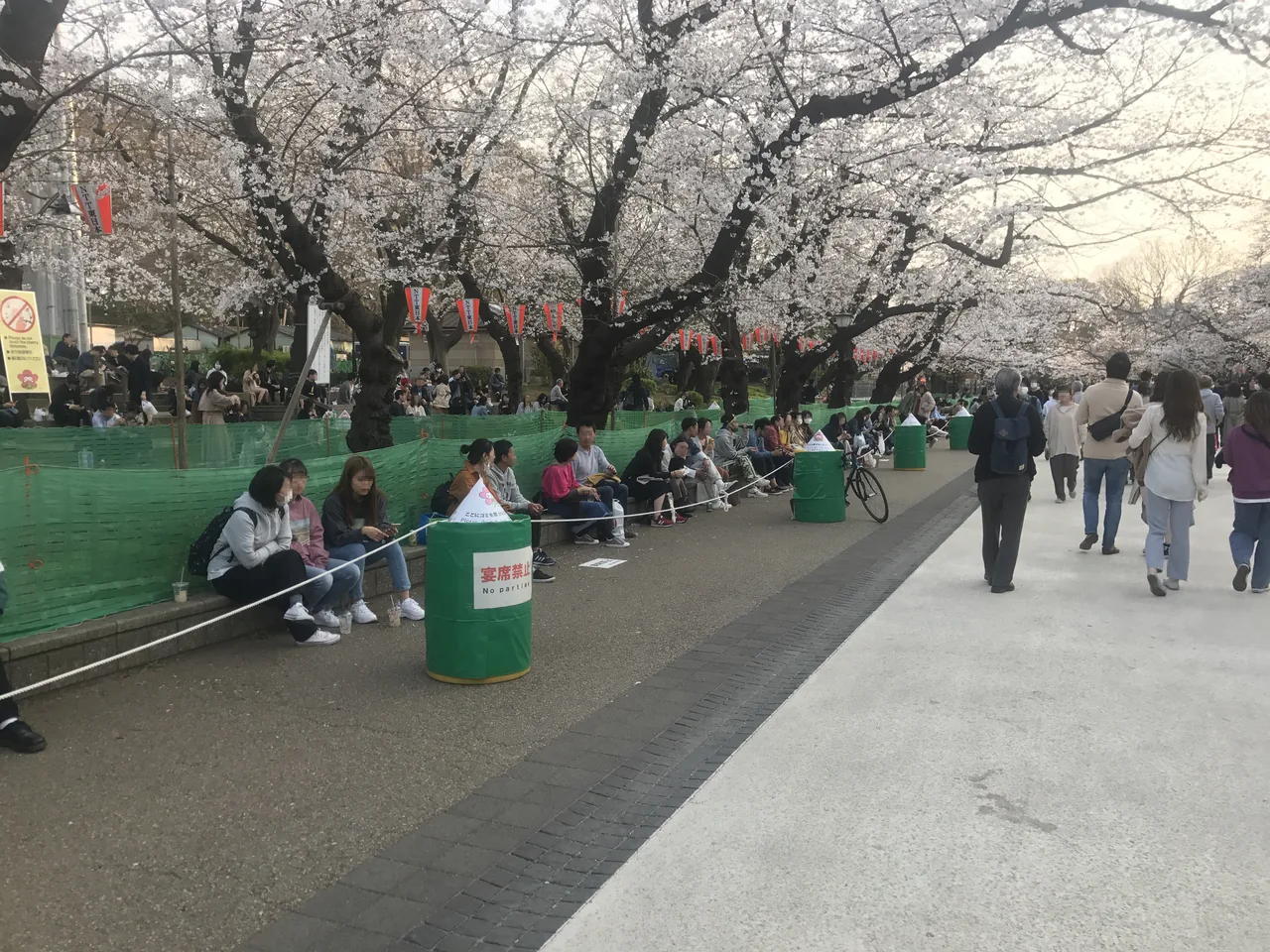
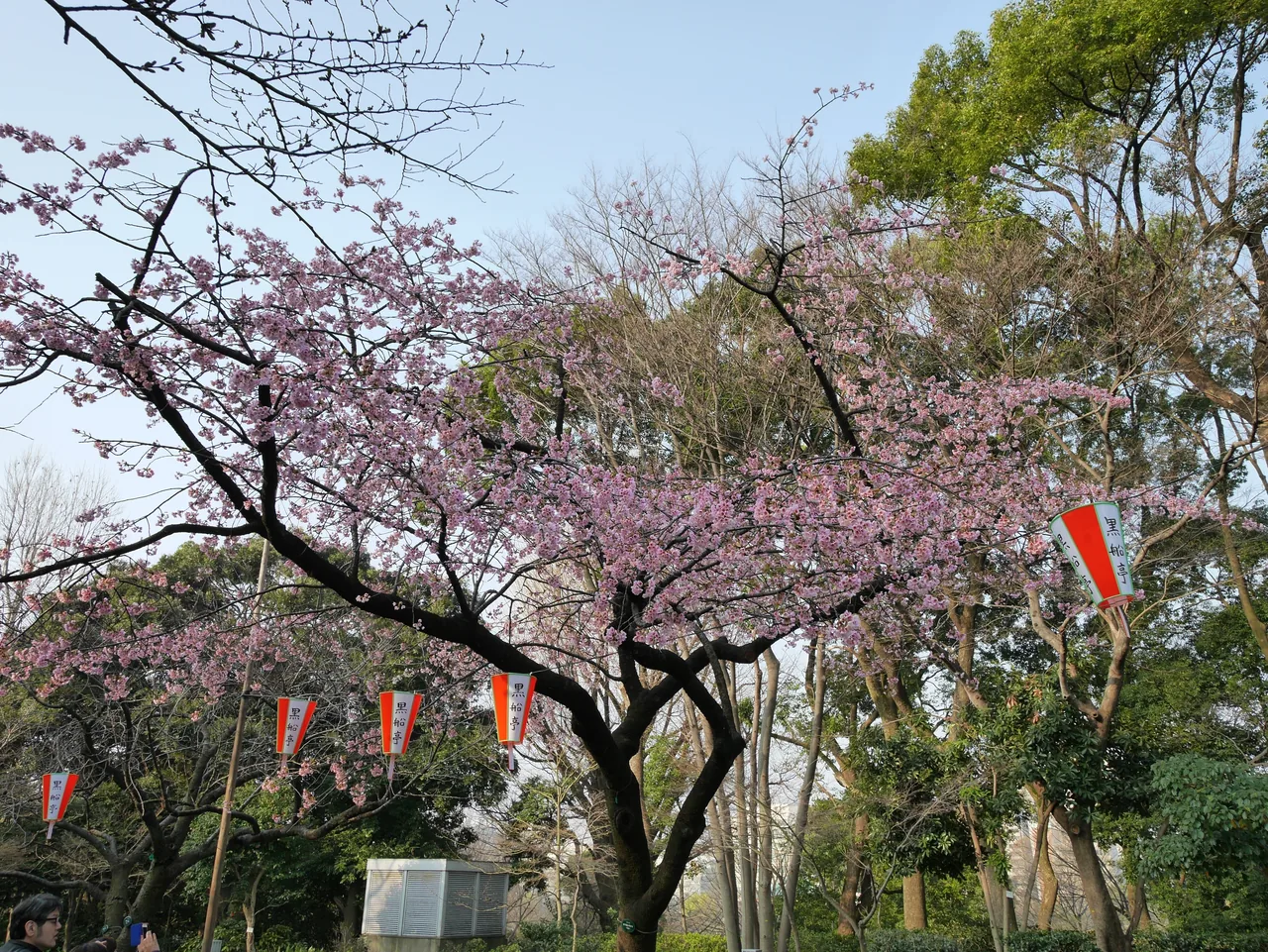
Eight hundred Somei-Yoshino cherry trees line the central avenue. When they open, the whole avenue is under blossom.
So is everyone else. Hundreds of thousands of people pass through on a spring day, and the festival hangs a thousand paper lanterns, which keeps the avenue lit after dark.
| Season | What is on | Note |
|---|---|---|
| Spring | 800 cherry trees | The central avenue takes the crowd |
| Summer | Lotus on Shinobazu Pond | Flowers open early and fold by midday |
| Autumn | Ginkgo and maple | The Kaneiji grounds turn yellow |
| Winter | Winter peonies at Toshogu | Boats close on Wednesdays |
What the crowd is actually like
The central avenue during blossom is shoulder to shoulder and slow, and it stays that way from late morning until well after dark. The quieter blossom is around Shinobazu Pond and along the approach to Toshogu, where the trees are fewer but you can stop and look at them.
Autumn is the opposite. The ginkgo and maple in the Kaneiji grounds and around the pond turn without drawing a crowd, and the same paths that were impassable in spring are close to empty.
Blossom season comes with rules
The park sets them each year and publishes them. Open flames are banned, so are tables, chairs and tents, and holding a spot for long periods is not allowed. In some years parties are barred from stretches of the avenue altogether.
That year’s rules appear shortly before the season. If you are bringing a sheet to sit on, check before you set out.
Bloom timing for the country as a whole is in our Japan cherry blossom guide, and autumn colour in the autumn foliage guide.
19. Ameyoko: 400 shops in 500 metres
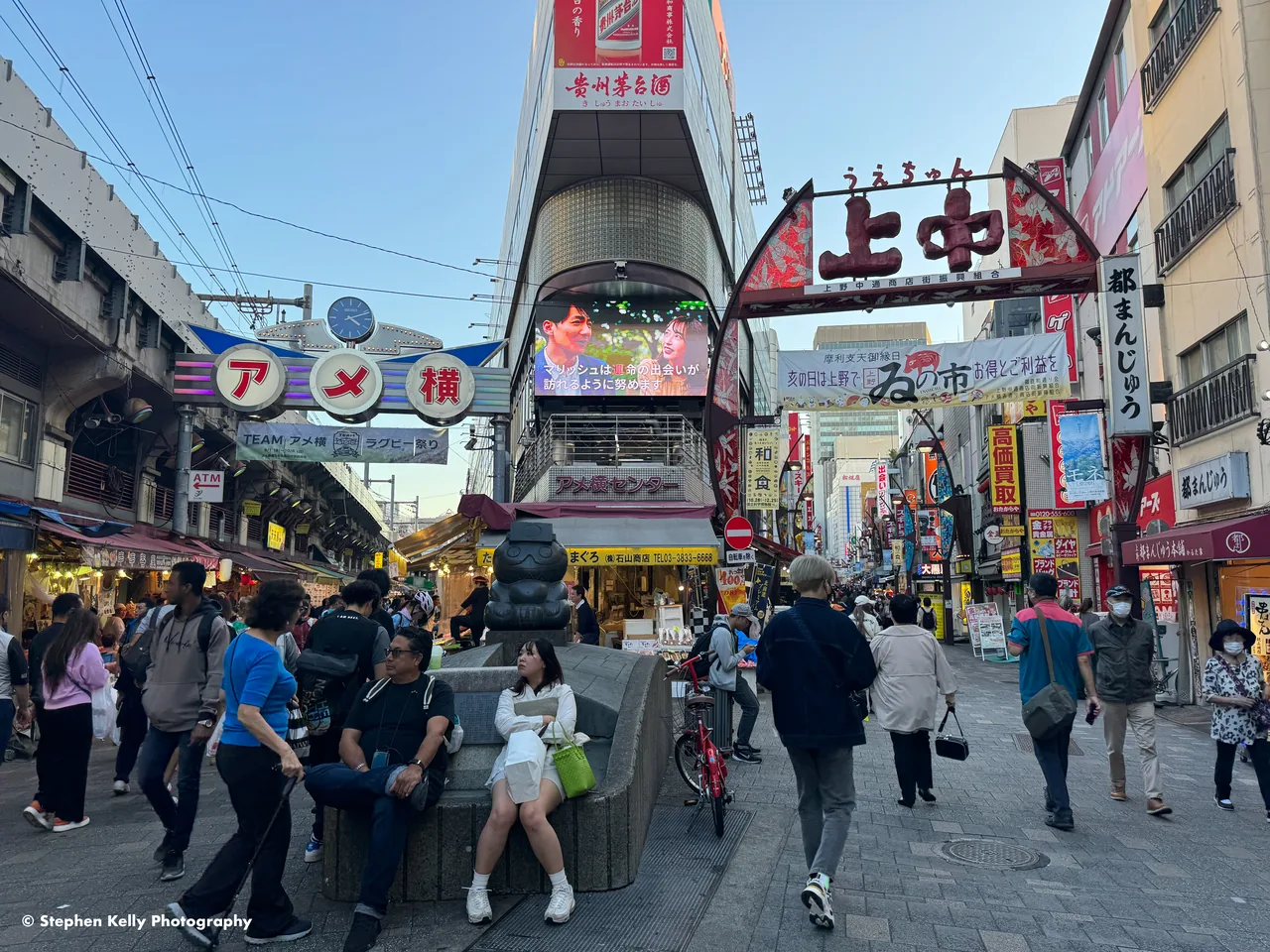
More than 400 businesses trade in the 500 metres between Ueno and Okachimachi stations. That is the merchants’ association’s own count. AmeyokoMap
The street began as a black market immediately after the war. Most of Tokyo’s black markets were run by stallholder syndicates; Ameyoko was organised by around 400 soldiers repatriated from Manchuria, who formed an association and regulated the pitches themselves. It is one of the few that carried on as a shopping street.
The name has two explanations. One traces it to the sweet shops, ame-ya, that clustered here. The other traces it to the American goods that filled the stalls.
How the street survived
Most postwar black markets in Tokyo were cleared or absorbed into redevelopment within a decade. This one had an association with the authority to allocate pitches, collect dues and hold traders to rules, and that structure let it convert from a market into a permanent shopping street rather than be swept away.
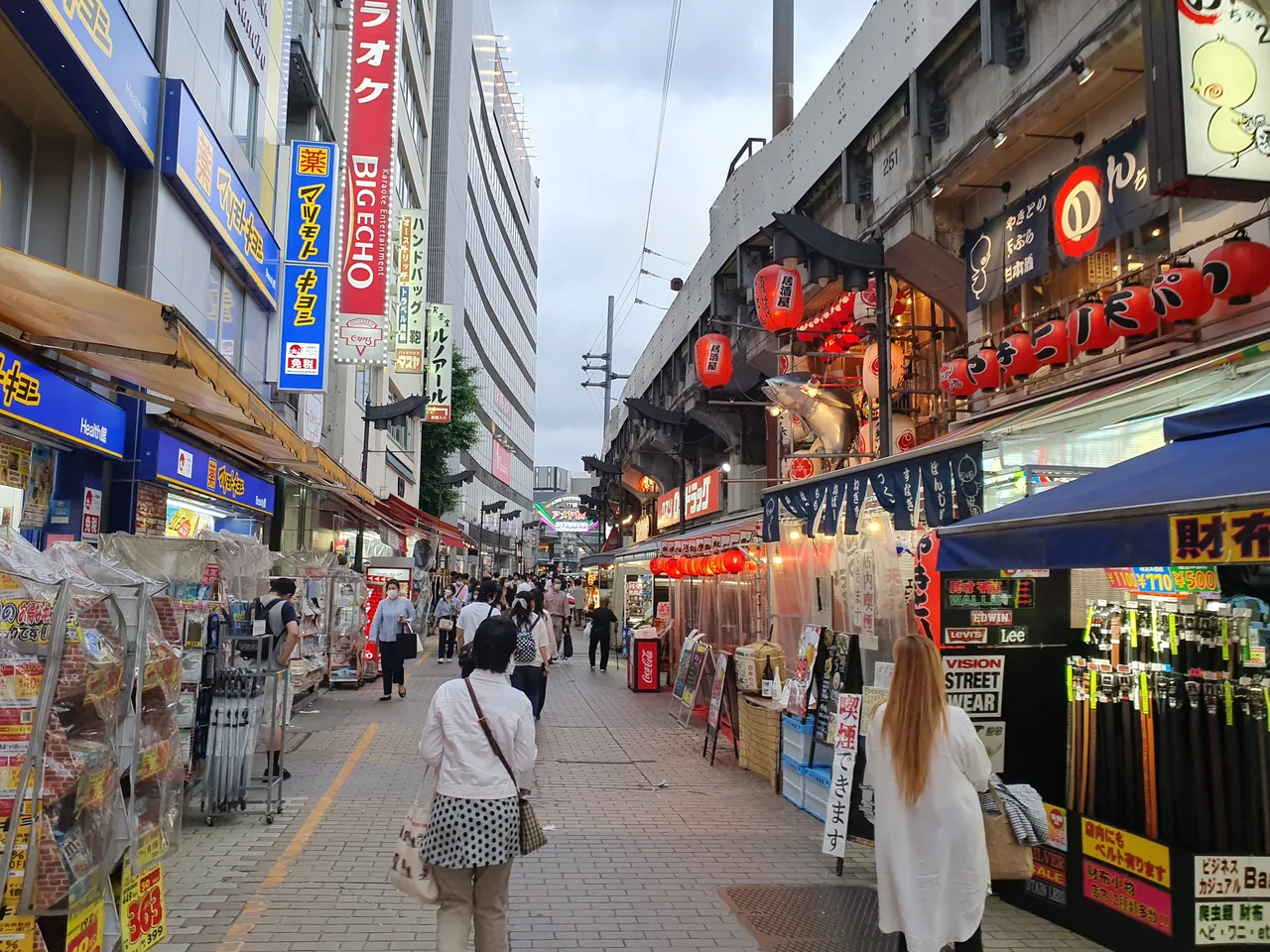
The result is still visible in the buildings. Shops occupy narrow frontages under the elevated railway and along the lane beside it, many of them one room deep, with goods stacked out onto the pavement because there is no room for them inside.
Count the official directory by category and food is not the largest group. Fashion leads with 61 shops and shoes, bags and accessories follow with 39. Food shops and restaurants together come to 69, fewer than the 100 selling clothes and footwear.
| Category | Shops |
|---|---|
| Fashion | 61 |
| Shoes, bags, accessories | 39 |
| Food shops | 36 |
| Restaurants and stalls | 33 |
| Leisure and other | 29 |
| Cosmetics and pharmacy | 17 |
| General goods | 9 |
The year-end footage of dried fish stalls is so familiar that visitors expect a food market and find clothes and trainers instead. One of Japan’s largest shoe chains has its flagship here.
What is actually on sale
| What | Note |
|---|---|
| Drugstores | Several large chains, some trading until 22:00 |
| Dried fish and preserved food | The stretch that makes the year-end news |
| Imported groceries | Shops carrying ingredients from across Asia have multiplied |
| Street food | A kebab stand opens at 8:00 |
| Standing bars | Open from midday, some past 23:00 |
Duty-free thresholds and paperwork are set out in our Japan tax-free shopping guide. Cash-only shops still exist along the lane, so read money and payment in Japan as well.
20. We counted when Ameyoko actually opens and closes
Going through all 220 shops in the official directory, Wednesday is the most common closing day, with 78 of them shut. The number of closed shutters changes noticeably with the day of the week.
| Regular closing day | Shops |
|---|---|
| Some Wednesday | 78 — third Wednesday 28, every Wednesday 27, second Wednesday 22 |
| Never closes | 52 |
| Some Sunday | 23 |
| New Year only | 9 |
| Irregular | 7 |
| Not stated | 27 |
A Wednesday does not shut the street. It is roughly one shop in five, which does not spoil a walk. It does matter if you are going for a particular shop, so check that one first.
How we counted
The merchants’ association publishes a shop directory with opening hours and a regular closing day for each business. We took every entry in it, removed duplicate listings, and tallied the closing days and the hours as written. That leaves 220 individual shops, of which 194 state their hours.
The association also says the street has more than 400 businesses, so the directory is not the whole lane. It is, though, the only list published by the people who run the street, and the pattern in it is strong enough to plan around.
Ten in the morning, seven at night
Of the 194 shops that publish hours, 10:00 is the most common opening and 19:00 the most common close. Arrive early or late and you will be looking at shutters.
| Most common | Next | |
|---|---|---|
| Opening | 10:00 at 119 shops | 11:00 at 36, 9:00 at 23, 8:00 at 3 |
| Closing | 19:00 at 75 shops | 20:00 at 40, 18:00 at 25 |
The park and the market overlap, but not for long
The park venues run 9:30 to 17:00 and the market 10:00 to 19:00. The overlap is wide enough to fit both into a day, but the park shuts two hours earlier. Take them in the wrong order and you lose one of them.
Two kinds of business stay open past nine
Only 24 shops run past 21:00, and they sort into drugstores and bars. A large drugstore chain trades until 22:00, while the offal grills and standing bars go to 23:00 or midnight.
After 19:00 the street turns into a place to drink. Shop in daylight; drink in the evening.
21. What to eat along Ameyoko
The earliest food on the street is a kebab stand that opens at 8:00. The official directory lists Oskar Kebabu from 8:00 to 19:00.
What the lane offers depends entirely on the hour. Daytime is food eaten standing up; evening is drinking.
| Place | What | Hours |
|---|---|---|
| Oskar Kebabu | Kebabs | 8:00–19:00 |
| Marion Crepes Ueno Ameyoko | Crepes | 12:00–21:00 |
| Ameyoko Horumon 611 | Grilled offal | 11:00–23:00, closed Mondays |
| Motsuyaki Sakaba Tonbo | Grilled offal and drinks | 16:00–23:00 |
| Kutora Sakaba | Izakaya | 10:00–24:00 |
Kutora opens at ten in the morning, which tells you the street serves drinkers from early. The crepe stand, by contrast, does not open until noon, so there is little sweet food first thing.
Two words worth knowing before you order
Horumon means offal, grilled over charcoal and served by the piece, and it is what several of the busiest places on the lane sell. Tachinomi means a standing bar: no seats, drinks and small plates at a counter, and a bill you settle as you go.
Neither takes long and neither needs a reservation. They are built around people stopping for twenty minutes on the way somewhere else, which suits a visitor breaking up an afternoon.
Dried fish and sweets come from the old shops
This is the stretch that appears on the news in late December. Shops such as Kaneue Sanko trade from 9:00 to 19:00 and close only for the four days of the new year.
Much of it is sold loose from boxes without price tags. You say how much you want and it is weighed out, so decide your budget before you start.
Drugstores are the last to close
Most of the street shuts at seven, but not the pharmacies. Matsumoto Kiyoshi Ueno Ameyoko Beauty runs 9:30 to 22:00 and Kokumin Drug Okachimachi 9:00 to 21:00.
If medicine or cosmetics are on your list for after dinner, those two are still trading. For shoes, ABC-Mart’s flagship runs 10:00 to 20:00 with no closing day.
22. How far to push on price
The merchants’ association’s own advice is not to press a discount too hard. Bargaining happens, within limits.
The same page suggests talking to the shopkeeper before talking about price, and says you will be surprised how much they know about what they sell. These are specialists: shops here have handled one product line for decades.
| Kind of shop | Bargaining |
|---|---|
| Loose dried fish and sweets on the stalls | Buy several and the price moves |
| Chain drugstores and shoe shops | Fixed prices |
| Restaurants and bars | Menu prices |
Tax-free and cash
The chain drugstores and the larger shops run tax-free counters and will process the paperwork against your passport. The stalls and the small independents generally do not, and some of them take cash only, so a purse of coins and notes still matters here in a way it no longer does in central Tokyo.
Prices on the food stalls are often quoted for a quantity rather than a unit, and the total is worked out as it is weighed. Agreeing the amount before it goes into the bag avoids the awkward part.
Late December is a different street
For a few days before the new year the lane fills with people buying ingredients for the holiday, and it makes the national news. If you want to see stallholders calling out prices, come then. If you want to choose things calmly, do not.
General points of etiquette are in our Japan etiquette guide.
23. Walking on to Yanaka
You can walk from the north end of the park into Yanaka. Pass the children’s library and bear west. Yanaka GinzaMap
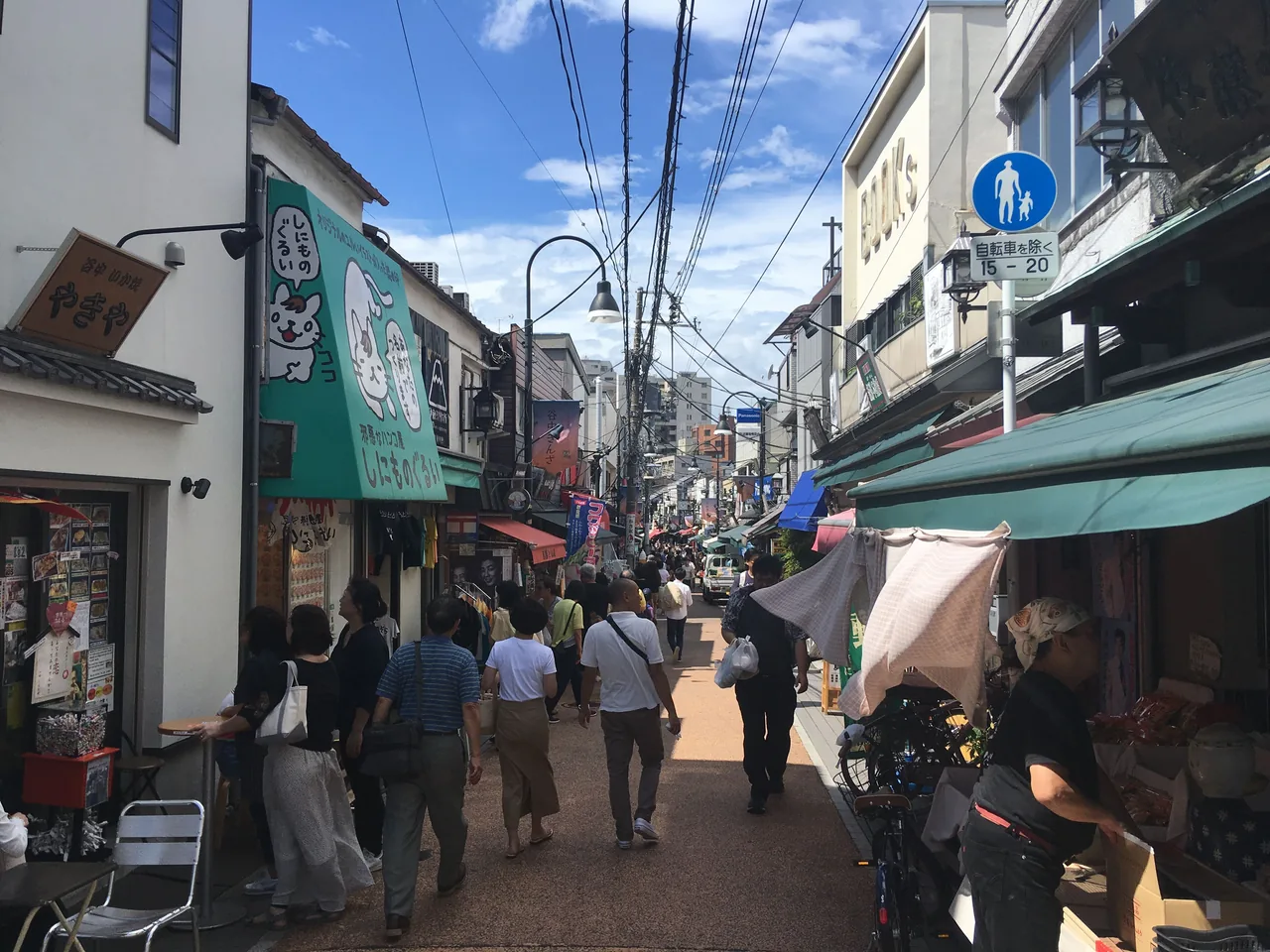
Yanaka has none of Ueno’s scale. It is low houses and lanes with a shopping street, Yanaka Ginza, at its centre. The traders’ association runs its own events, which is part of why it still reads as a place people live.
| How | Detail |
|---|---|
| On foot | Continues from the north of the park |
| Toei bus | Ueno Park to Kameido route, Yanaka stop, then 5 minutes |
| Loop bus | Taito ward’s Megurin service |
| Train | JR Nippori or Sendagi on the Chiyoda Line |
What is in Yanaka
Yanaka Ginza itself is a short shopping street of about sixty small businesses reached down a flight of steps, with butchers, tea shops, sweet shops and a few places to eat standing among them. It is known for cats, both the ones that live there and the ones sold in every form as souvenirs.
The district around it survived the wartime bombing largely intact, which is unusual in this part of Tokyo. Wooden houses, small temples and a large cemetery fill the blocks between the shopping street and the park, and the walk between the two is the point rather than any single sight.
The loop bus runs one way only
Taito ward’s east–west Megurin leaves from Ueno Station and circles in a single direction. The outward and return routes are therefore different. Waiting at the same stop for the way back means riding most of the loop.
Yanaka’s events are seasonal: a seven-deities pilgrimage in early January, a summer festival run by the shopping street, and a year-end market in December.
24. Where to go next from Ueno
Asakusa is three subway stops away and Akihabara two stops on JR. Neither is a walk, but both take under ten minutes.
Three subway lines serve the district. The Ginza and Hibiya lines call at Ueno, and the Chiyoda Line at Nezu and Yushima. Half a day in Ueno slots easily into a wider plan.
| To | How | Why pair it |
|---|---|---|
| Asakusa | Ginza Line, three stops | Sensoji and Nakamise-dori |
| Akihabara | JR, two stops | Electronics and subculture |
| Nippori | JR, one stop | Yanaka and the Skyliner |
| Tokyo Station | JR, two stops | Shinkansen connections |
| Ginza | Ginza Line, direct | Department stores and dinner |
Our Asakusa guide covers the temple, the approach street and the Kappabashi kitchenware road.
Ueno also faces out of Tokyo
Northbound shinkansen call at Ueno Station and the Keisei line begins here, so the district works as a departure point for trips out of the city as well as around it. Nikko is reached from this side of Tokyo, and you board the shinkansen without going down to Tokyo Station first.
Count your subway rides before buying a pass
Using Ueno as a base runs the ride count up quickly. Subway passes come in 24, 48 and 72 hour versions, and the arithmetic starts to work from about four rides a day.
If you would rather tap one card everywhere, our Suica and ICOCA guide covers buying and topping up.
25. Half-day and full-day routes
Ueno alone is half a day; add Yanaka or Asakusa and it fills one. Remember that the park venues close around 17:00 and the order arranges itself.
Half a day: one museum plus the market
| When | What |
|---|---|
| Morning | Out of the Park Exit to one national museum |
| Lunch | A park cafe or the station concourse |
| Afternoon | Toshogu, Kiyomizu Kannon-do, Shinobazu Pond |
| Late afternoon | Down to the Shinobazu Exit for Ameyoko |
A full day: zoo, park, Yanaka
| When | What |
|---|---|
| Early | Into the zoo by Ikenohata Gate |
| Morning | West garden through to the east |
| Lunch | Inside the park |
| Afternoon | The metropolitan gallery or one national museum |
| Late afternoon | North and west into Yanaka Ginza |
| Evening | Back down for dinner in Ameyoko |
If you only have two hours
Take the Park Exit, walk to whichever of the museums matches your interest, and give it the whole two hours. The temptation is to sample three and see none of them, and the walk between them will eat a third of your time.
If two hours is what you have in the evening instead, the choice is different: the market until seven, then a standing bar. Nothing on the park side will still be open.
Rain changes the order
The venues are five to ten minutes apart, which in rain is five to ten minutes of exposure each time. Staying longer in one building beats hopping. Our rainy day indoor guide includes Ueno among the routes that keep you inside.
If it is your arrival or departure day
The luggage decides it. Lock the case away and take half a day. Since the Tokyo National Museum will not admit a suitcase, travelling with one leaves you the market and a walk in the park.
26. Is Ueno a good base
Ueno is one of the better value locations in central Tokyo. The Yamanote Line stops here, three subway lines run in, and the Skyliner arrives from Narita.
Our Tokyo accommodation guide groups Asakusa and Ueno together as the old-city, good-value choice. It is quieter than Shinjuku or Shibuya, and fewer places stay open late.
| If you are | Verdict |
|---|---|
| Flying in and out of Narita | The Skyliner terminates here |
| Travelling with children | Zoo and science museum on foot |
| Taking a shinkansen onward | They stop at Ueno Station |
| Out for nightlife | The district quietens after 19:00 |
| Here to shop | Ameyoko and its drugstores are downstairs |
What the hotels here are like
The stock around Ueno is dominated by business hotels: compact rooms, a moulded bathroom unit, a dependable breakfast and a position a few minutes from the station. There are hostels and a few larger hotels, but this is not where Tokyo’s luxury inventory sits.
That is what makes the arithmetic work. You are paying for a position on the Yamanote Line and a direct airport link rather than for the room itself, which suits a trip built around leaving early and moving every day.
The cost of that shows at night. Once the market closes at seven the streets empty quickly, and the choice of late restaurants is thin next to Shinjuku or Shibuya. If dinner at ten is part of your idea of a trip, this is the wrong base.
Tokyo levies an accommodation tax. The bands by room rate are set out in our Japan accommodation tax guide.
27. What to sort before you go
Ueno still has places that take cash only. The national museums accept cards and transport IC, but small shops along the market do not always.
| Item | Why |
|---|---|
| Cash | Stalls and small shops in the market |
| Transport IC card | Museum ticket windows take it too |
| Luggage plan | No suitcases inside the national museum |
| Walking shoes | Everything inside the park is on foot |
| Umbrella | The gaps between venues are outdoors |
| The day itself | Mondays weaken the park, Wednesdays the market |
Where the toilets and the water are
Public toilets stand near the fountain plaza and at intervals along the main paths, and every venue has its own inside the gates. In summer the zoo marks out shaded, cooled spots across the grounds and publishes them, which is worth knowing if you are walking it with children in August.
Tokyo tap water is drinkable and vending machines are everywhere in the park, so there is no need to carry a day’s supply up the hill.
Everything runs through your phone
Online museum tickets, shop hours, maps: all of it happens on a handset. Sorting out a Japan eSIM before departure means you are online the moment you land rather than queuing at the airport.
If this is a first trip to Japan, our Japan travel guide pulls entry, payment and connectivity into one place.
🎡Things to Do21
🏨Where to Stay2
🚇Getting Around3
🗾Japan trip essentials22
Ueno travel FAQ
One museum and the market fill half a day. Adding the zoo takes a full one. The park venues shut around 17:00, so start in the morning.
Most of the park closes. The three national museums, the zoo and the Shitamachi Museum are all shut. Ameyoko, the shrines and Kyu-Iwasaki-tei Gardens stay open, so build the day around those.
Not at present. The zoo states on its own site that it currently keeps no giant pandas. The park kiosks still sell panda souvenirs.
600 yen for adults, 300 for over-65s and 200 for junior high pupils. Children through the sixth year of primary school enter free. Ticket sales and admission stop at 16:00, an hour before closing.
1,000 yen at the Tokyo National Museum, 630 at the science museum and 500 at the Museum of Western Art, so 2,130 for all three permanent collections. Special exhibitions are separate, and a special ticket also covers the permanent collection that day.
The Museum of Western Art opens its permanent collection free on the second Sunday of each month. All three national museums are free on 18 May and 3 November. The Tokyo Metropolitan Art Museum never charges for entry.
Between 10:00 and 19:00, when the most shops are trading. After seven only drugstores and bars are left. Shop in daylight.
At some stalls, within limits. The merchants’ association asks visitors not to press for heavy discounts. Chain shops sell at fixed prices.
The street never closes as a whole, but 78 of the 220 shops in the official directory take a Wednesday off. If you are going for one particular shop, avoid Wednesdays.
The Keisei Skyliner takes 41 minutes. The Narita Express does not stop at Ueno, so Keisei is the route. An adult single is 2,580 yen, or 2,310 bought ahead.
Park Exit for the park and museums, Shinobazu Exit for Ameyoko. Arriving on the Skyliner, leaving from Keisei-Ueno puts you closer to the Shitamachi Museum and the zoo’s Benten Gate.
Not into the Tokyo National Museum, which does not admit them. Use the station coin lockers or the left luggage services along the market.
800 yen for 30 minutes in a rowing boat, 1,000 for a swan or pedal boat. Bookings close an hour before the boats come off, and Wednesdays are closing days in winter.
The zoo and the science museum are within walking distance of each other, both free for primary school pupils, and the children’s library is free as well. At weekends, enter the zoo by Ikenohata Gate for the shorter queue.
Yes, three stops apart on the Ginza Line. Ueno’s venues close first, so take Ueno in the morning and Asakusa afterwards.
The Tokyo Metropolitan Art Museum charges nothing to enter, and worship at Toshogu, Hanazono Inari, Kiyomizu Kannon-do, the Great Buddha and the children’s library are all free. The park itself is free and open 5:00 to 23:00.
Only on the 15th of the month, with guided groups at 10:00 and 13:00 and ten places in each. They are allocated at the window on the day, in person, from the 9:00 opening.
If you have any interest in museums, yes: three national collections and a metropolitan gallery stand within ten minutes of each other, alongside the oldest zoo in Japan. If museums are not your thing, half a day for the park, the shrines and the market is the right allocation.
It began as a postwar black market and is now a shopping street of more than 400 businesses. It is best known abroad for dried fish, sweets and the crowds that fill it before the new year, though the official directory shows fashion and footwear outnumber food shops.
The park itself is open from 5:00 to 23:00, so the paths, the pond and the shrine approaches can be walked after dark. Every ticketed venue inside it closes by about 17:00, apart from Friday and Saturday late openings at two of the museums.
In front of Kiyomizu Kannon-do, where a pine is trained into a circle. Line it up so that Bentendo sits inside the ring and you have Hiroshige’s view. It costs nothing.