
Okinawa Churaumi Aquarium: The Complete Guide to the Whale-Shark Tank
One of the world’s great aquariums sits at the far north of Okinawa, built around a tank so big that whale sharks and manta rays cruise it together. Here’s what’s actually inside, what it costs, when the feedings are, and how to get there from Naha.
| What it is | Okinawa Churaumi Aquarium is the headline attraction of northern Okinawa — famous for the Kuroshio Sea tank, where whale sharks and manta rays swim behind a giant acrylic wall. |
|---|---|
| Don’t miss | the whale-shark feeding at 15:00 and 17:00 (they feed standing upright), and the free dolphin show at Okichan Theater just outside. |
| Tickets | ¥2,180 adult, ¥1,440 high-schooler, ¥710 child, under 6 free. Booking online is a little cheaper and lets you skip the ticket counter. |
| Hours | usually 8:30–18:30 (later in summer). No regular closing days through March 2027. |
| Getting there | it’s far north — about 2 hours by car from Naha. A rental car is by far the easiest way, and parking is free. |
1. What is Churaumi Aquarium, and why the fuss?
2. Quick facts (location, hours, price, time needed)
3. The Kuroshio Sea tank: the main event
4. Whale sharks and manta rays, up close
5. The other tanks worth your time
6. The free outdoor area: turtles, manatees and the touch pool
7. Ocean Expo Park and the free dolphin show
8. Tickets and prices (and where to buy)
9. Hours, feeding times and when to go
10. Getting there from Naha (rent a car)
11. Make a day of it: what to combine nearby
12. Practical tips for a smooth visit
13. So, is it worth the drive?
1. What is Churaumi Aquarium, and why the fuss?
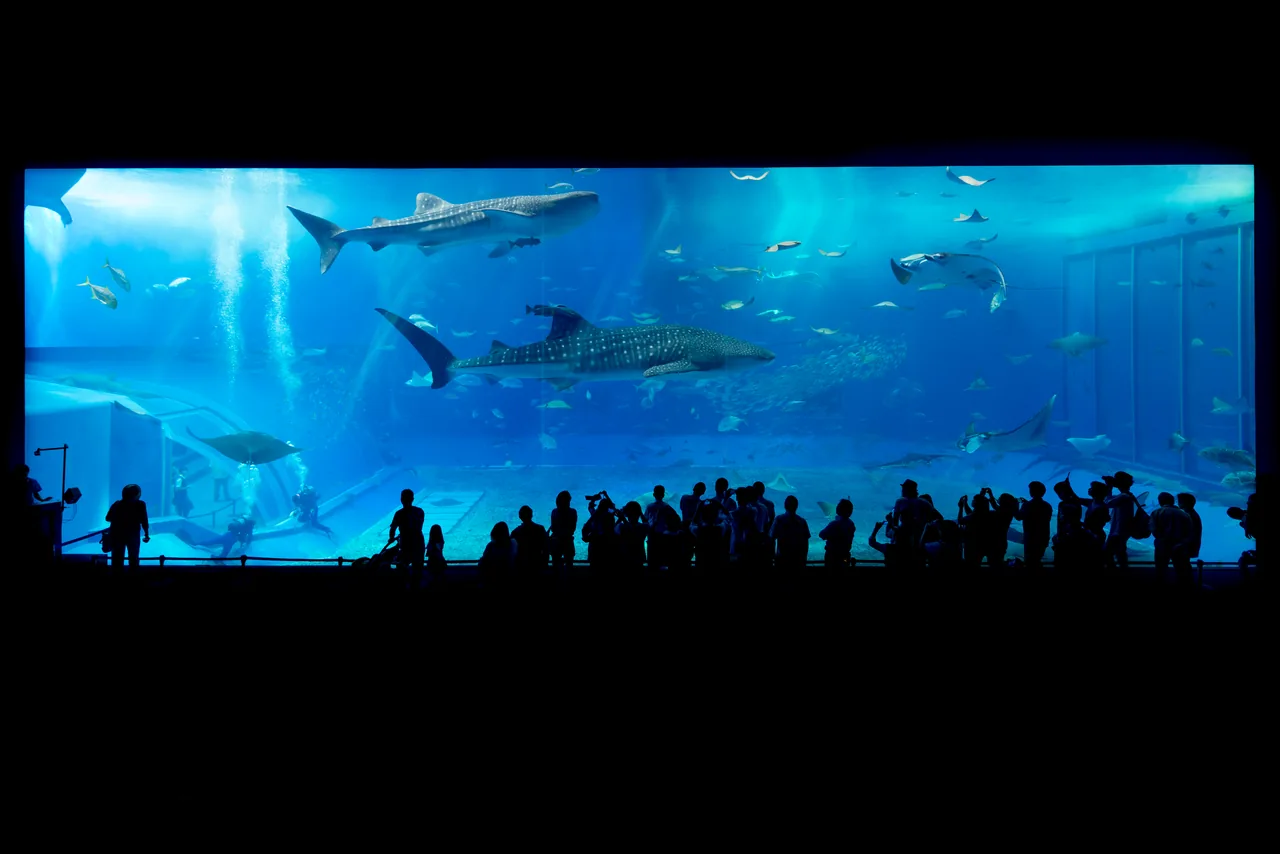
Okinawa Churaumi AquariumMap is the single most visited attraction in Okinawa, and it earns it. The name comes from Okinawan dialect — chura (beautiful) plus umi (sea) — and the whole place is a tribute to the warm, coral-rich water off these islands.
The reason people travel two hours north to see it is one tank: the Kuroshio Sea, a wall of water so large that whale sharks — the biggest fish in the ocean — share it with manta rays and shoals of tuna. Standing in front of it, with a whale shark sliding overhead, is the kind of thing you remember for years. But the aquarium is much more than one tank, and the surrounding Ocean Expo Park throws in a free dolphin show and a beach on top.
2. Quick facts (location, hours, price, time needed)
Everything you need at a glance before the deep dive.
| Full name | Okinawa Churaumi Aquarium (沖縄美ら海水族館) |
|---|---|
| Where | Inside Ocean Expo Park, Motobu, northern Okinawa (the Motobu Peninsula) |
| The star | The Kuroshio Sea tank — whale sharks & manta rays |
| Hours | Usually 8:30–18:30 (last entry 17:30); later in summer |
| Closed | No regular closing days through March 2027 (typhoons aside) |
| Admission | ¥2,180 adult · ¥1,440 high school · ¥710 child · under 6 free |
| Time needed | 2–3 hours for the aquarium; half a day with the park |
| From Naha | ~2 hours by car (rental car recommended) · free parking |
3. The Kuroshio Sea tank: the main event
Almost everything you’ve seen in photos is this one tank. The Kuroshio Sea holds 7,500 cubic metres of water (that’s 7.5 million litres) and measures 35 m long, 27 m wide and 10 m deep. You view it through a single acrylic panel 8.2 m tall and 22.5 m wide — over half a metre thick — which was the largest in the world when the aquarium opened.
What lives in it is the point. Whale sharks — gentle, spotted giants that are the largest fish on Earth — cruise the tank alongside several species of manta ray, mobula rays, and big schools of trevally and tuna that wheel in silver clouds. It recreates the Kuroshio Current, the warm stream that runs past Okinawa, so the whole tank is one moving ecosystem rather than a row of small displays.
| Tank volume | 7,500 m³ (7.5 million litres) |
|---|---|
| Acrylic panel | 8.2 m × 22.5 m, ~60 cm thick |
| Headline residents | Whale sharks, manta rays, mobula rays, tuna & trevally schools |
| Best moment | Whale-shark feeding at 15:00 & 17:00 |
4. Whale sharks and manta rays, up close
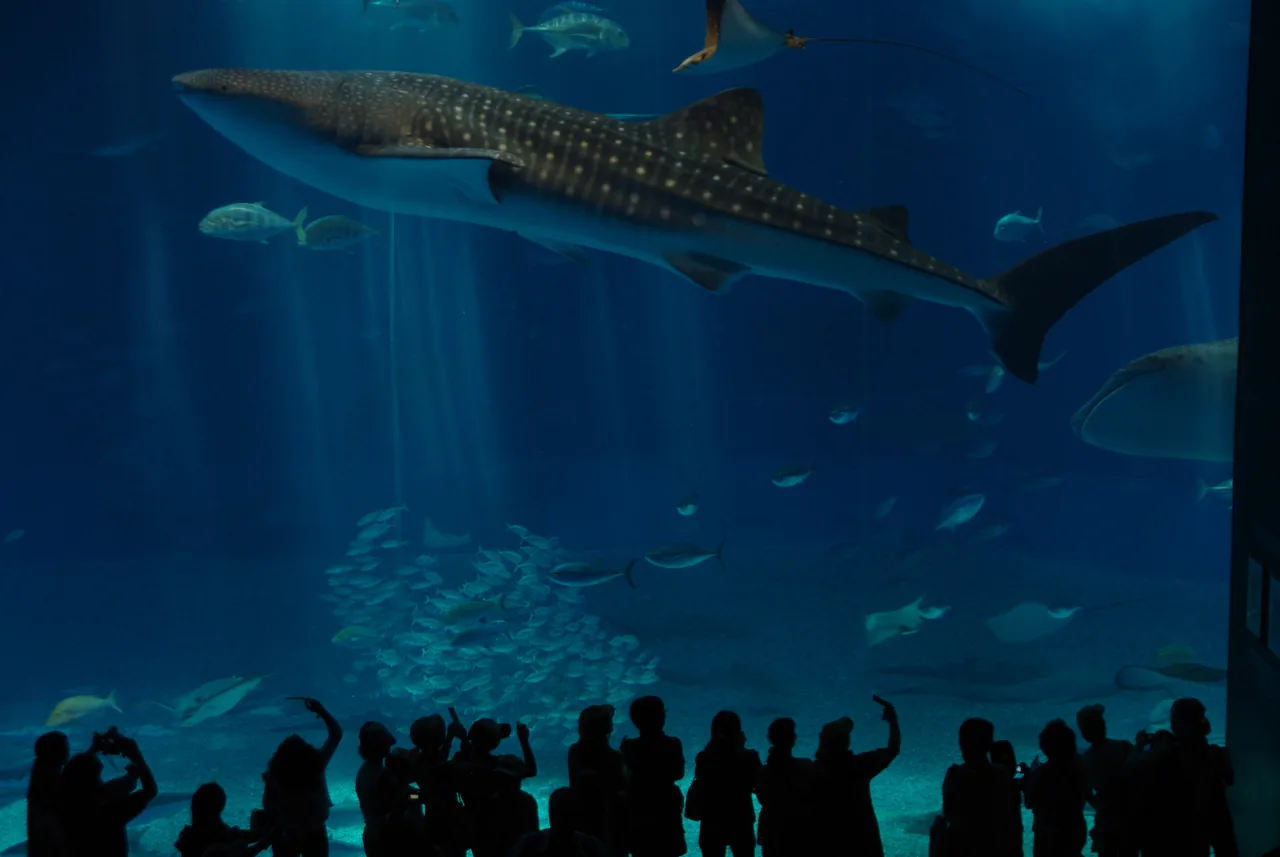
Churaumi isn’t just showing you these animals — it’s a research aquarium that has done things no one else has. It holds the world record for the longest-kept whale shark, a programme running since the 1990s, and it was the first place to successfully breed manta rays. In 2024 it went one better and raised a world-first all-black (melanistic) manta pup.
The feeding sessions are the moment to be there. At 15:00 and 17:00, keepers feed the whale sharks — and instead of skimming the surface, the sharks tip up vertically and “stand” in the water, gulping krill in great mouthfuls. It’s a genuinely jaw-dropping bit of behaviour, and the tank gets busy just before, so claim a spot early.
5. The other tanks worth your time
Plenty of people make a beeline for the whale sharks and miss the rest. Don’t — a few of the other exhibits are world-class in their own right.
| Exhibit | What’s special |
|---|---|
| Coral Sea | An open-air tank under natural sunlight growing ~70 species of live coral — a real, breathing reef, not a model |
| Tropical Fish Sea | The colour overload: clownfish, angelfish and the dazzling reef species of Okinawa’s shallows |
| Deep Sea | Eerie creatures from below 200 m, kept in cold, dark tanks that mimic the deep |
| Shark Research Lab | A “dangerous shark” tank with tiger sharks and bull sharks, plus jaws and specimens to study |
Start at the top floor with the coral and tropical fish in daylight, work down toward the Kuroshio tank, and finish in the deep-sea gloom — that’s the route the building is designed around, and it builds nicely toward the big tank.
6. The free outdoor area: turtles, manatees and the touch pool
Here’s a detail that surprises people: some of the best bits are free. The outdoor pools below the aquarium don’t need an aquarium ticket at all.
- Sea Turtle Pool: several species of sea turtle, with an underwater window so you can watch them swim.
- Manatee Pool: gentle, slow West Indian manatees — endlessly watchable, especially for kids.
- “Life in the Inoh” touch pool: a recreated Okinawan tidal flat where you can gently touch starfish and sea cucumbers. (Inoh is the Okinawan word for the shallow lagoon inside the reef.)
7. Ocean Expo Park and the free dolphin show
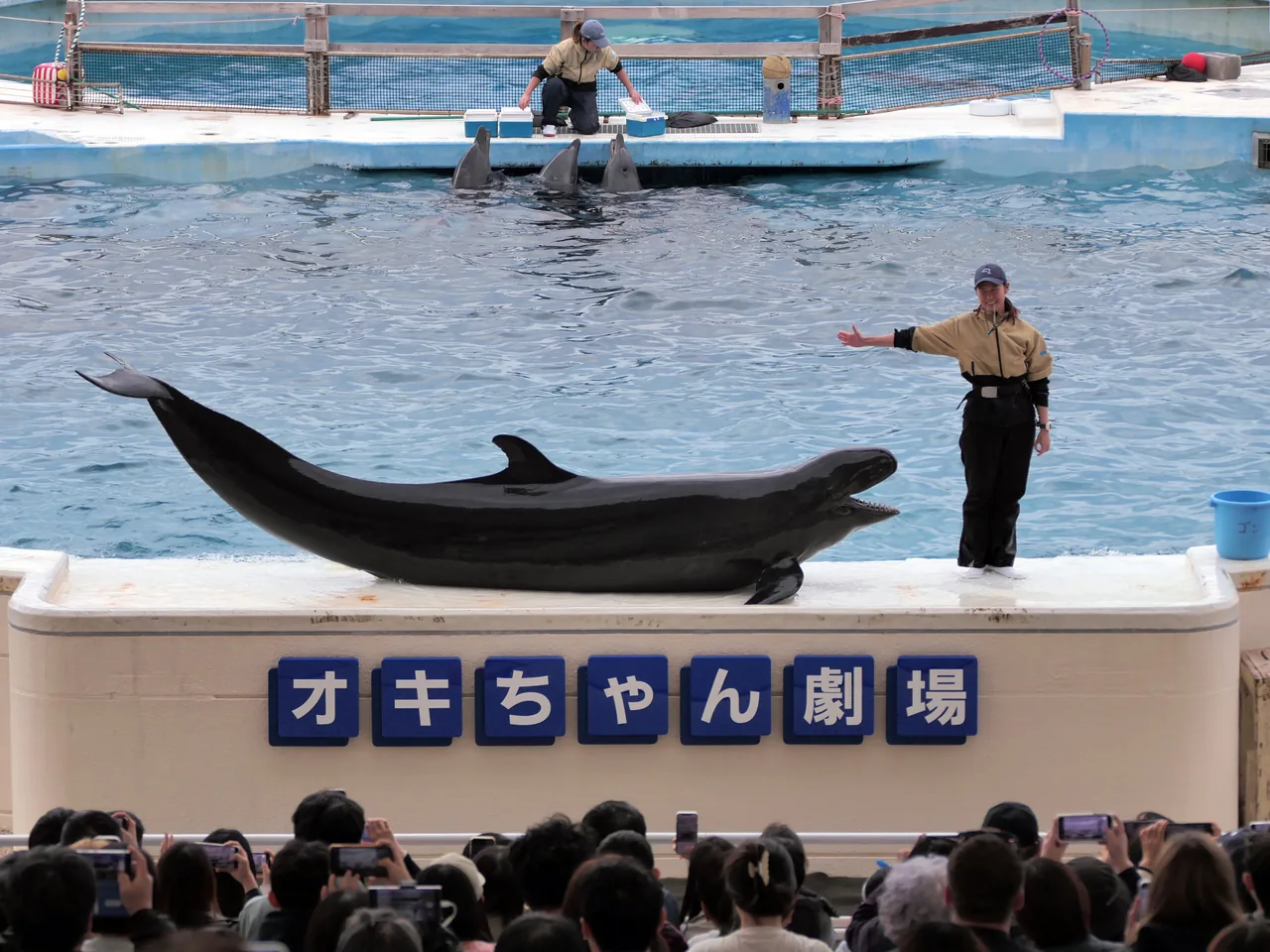
The aquarium sits inside Ocean Expo ParkMap, a big seaside park left over from a 1975 world expo — and the park is free to enter. The headliner is the dolphin show at Okichan Theater, an open-air pool with the blue sea behind it, where bottlenose dolphins (and a false killer whale) jump and play. It costs nothing.
The show runs several times a day — typically around 10:30, 11:30, 13:00, 15:00 and 17:00 — and lasts about 20 minutes. Check the board on the day, as times shift seasonally. While you’re in the park, you can also wander to:
| In the park (free or cheap) | What it is |
|---|---|
| Emerald Beach | A pretty, sheltered swimming beach (free), a short walk from the aquarium |
| Tropical Dream Center | Greenhouses of orchids and tropical fruit (small fee) |
| Oceanic Culture Museum | Pacific island canoes and culture, plus a planetarium (small fee) |
8. Tickets and prices (and where to buy)
Admission is straightforward and, by big-attraction standards, very fair.
| Ticket | Price |
|---|---|
| Adult | ¥2,180 |
| High school student | ¥1,440 |
| Child (elementary / junior high) | ¥710 |
| Under 6 | Free |
| Annual passport (adult) | ¥4,360 (pays off in two visits) |
You can buy at the gate, but two things are worth knowing. Booking online is usually a little cheaper, and an e-ticket lets you walk past the ticket counter and straight in — which matters on a busy holiday when the line is long. Resellers like Klook and KKday sell the standard ticket plus combo passes (aquarium + bus, or multi-attraction).
9. Hours, feeding times and when to go
Opening hours stretch in summer, which is worth knowing if you’re planning an evening visit.
| Season | Hours (last entry) |
|---|---|
| Most of the year | 8:30–18:30 (17:30) |
| Golden Week & late July (peak) | 8:30–20:00 (19:00) |
| August (peak) | 8:30–21:00 (20:00) |
For the animals, plan your day around the feeding schedule: manta rays around 9:30, whale sharks at 15:00 and 17:00 (the big one). For crowds, the tour buses pour in late morning, so the tank is busiest from about 11:00 to 14:00. Arrive at opening, or come after 15:00 and pair it with the late whale-shark feeding and a sunset drive back.
10. Getting there from Naha (rent a car)
This is the part to get right, because Churaumi is about 90 km north of Naha and the airport, and Okinawa’s monorail doesn’t go anywhere near it.
| How | Time & cost | Notes |
|---|---|---|
| Rental car | ~2 hr / tolls + fuel | By far the easiest. Take the Okinawa Expressway to Kyoda IC, then the coast road. Free parking |
| Express / highway bus | ~2.5–3 hr / ~¥2,000+ | Yanbaru Express or airport shuttle to “Kinen-koen-mae” (Memorial Park), then a 10-min walk |
| Bus tour | Full day | A coach day-tour that bundles Churaumi with other northern stops — no driving |
Honestly, rent a car if you can. It turns a long bus haul into a gorgeous coastal drive, and it lets you fold in the spots below. For how transport works across the island, see our Okinawa travel guide.
11. Make a day of it: what to combine nearby
Since you’ve driven all the way north, don’t make Churaumi a there-and-back. The Motobu area has some of Okinawa’s prettiest stops within 30 minutes.
Kouri Island
A tiny island reached by a long sea-bridge over impossibly blue waterMap. The drive across is the attraction.
Bise Fukugi Tree Road
A village lane tunnelled by old fukugi treesMap, minutes from the aquarium. Quiet and lovely.
Nakijin Castle
A Ryukyu-era stone fortressMap with sweeping sea views — a piece of the kingdom’s history.
Cape Manzamo
The famous “elephant trunk” cliffMap, roughly on the way back toward Naha.
A common, relaxed plan: aquarium in the morning, lunch in Motobu, Bise and Kouri in the afternoon, sunset somewhere on the drive south. For the bigger picture of an Okinawa trip — beaches, food, where to stay — start with our Okinawa travel guide.
12. Practical tips for a smooth visit
- Get your hand stamped. Ask for a re-entry stamp so you can leave for the free dolphin show or lunch and come back to the tanks.
- Go top-down. Start on the upper floor (coral, tropical fish in daylight) and work down to the Kuroshio tank and the deep sea — it’s the intended flow and avoids backtracking.
- Build the day around 15:00. The 15:00 whale-shark feeding is the highlight; arriving mid-afternoon also dodges the late-morning bus crowds.
- Bring a little cash anyway. Cards work, but small park kiosks and some buses prefer cash or an IC card.
- It’s all indoors and outdoors. The aquarium is air-conditioned, but the dolphin show, beach and park are in the open — sun hat and water in summer.
13. So, is it worth the drive?
First-timers in Okinawa
Yes — it’s the island’s signature sight. The whale-shark tank alone justifies the trip north.
Families with kids
One of the best family days in Okinawa. Touch pool, manatees, the dolphin show and the big tank — all in one place.
Short on time / no car
Be honest about the distance. If you only have a couple of days near Naha and won’t drive, a guided bus tour may suit you better.
Aquarium lovers
A genuine world-tier aquarium. The live coral and the breeding records make it more than a pretty tank.
Bottom line: Churaumi deserves its reputation — just treat it as a half-day, northern trip, ideally by car, and time it for the 15:00 feeding. Combine it with Kouri and Bise and you have one of the best days on the island. Start planning with our Okinawa travel guide.