
Japan in December: Weather by Region, Illuminations & Best Dates
December splits Japan in two: the first three weeks are the best value of the year, and the last week is the most expensive. Here is the date-by-date breakdown.
| Verdict | December 1 to 20 is the best value window of the year. December 26 to January 3 is the most expensive and crowded stretch in Japan. |
|---|---|
| Weather | Tokyo averages 12.0°C by day and 3.8°C at night, Kyoto 11.6°C, Sapporo just 2.0°C with lying snow. The Pacific side stays dry and sunny. |
| Holidays | December is the only month with no public holiday in Japan, which is exactly why the first three weeks are so quiet. |
| Highlights | Illuminations peak, and late foliage holds in Kyoto and Kamakura into the first week. |
| Watch out | Many central Tokyo illuminations switch off on December 25. Kobe Luminarie and the Shirakawa-go light-up are not December events at all. |
| Booking | Western holiday dates collide with Japan’s priciest week. Shift earlier and the same trip costs far less. |
1. Is December a good time to visit Japan?
2. December weather city by city, in numbers
3. Two Decembers: the cheap 20 days and the brutal 8
4. Three real December itineraries
5. Why Tokyo is sunny while Kanazawa is buried in snow
6. The shortest days of the year, and how to plan around them
7. Winter illuminations: what ends on December 25 and what does not
8. There is still autumn colour in December
9. Christmas in Japan is not the holiday you know
10. The New Year period (Dec 26 to Jan 3), handled properly
11. December festival calendar
12. Snow and skiing: what December really delivers
13. The best month for an onsen
14. What to eat in December: crab, fugu and oysters
15. The month Mount Fuji is most likely to show up
16. December region by region
17. What to wear and pack for December
18. Tax-free shopping changed in November 2026
19. Before you go: the December checklist
20. So when should you actually go?
1. Is December a good time to visit Japan?
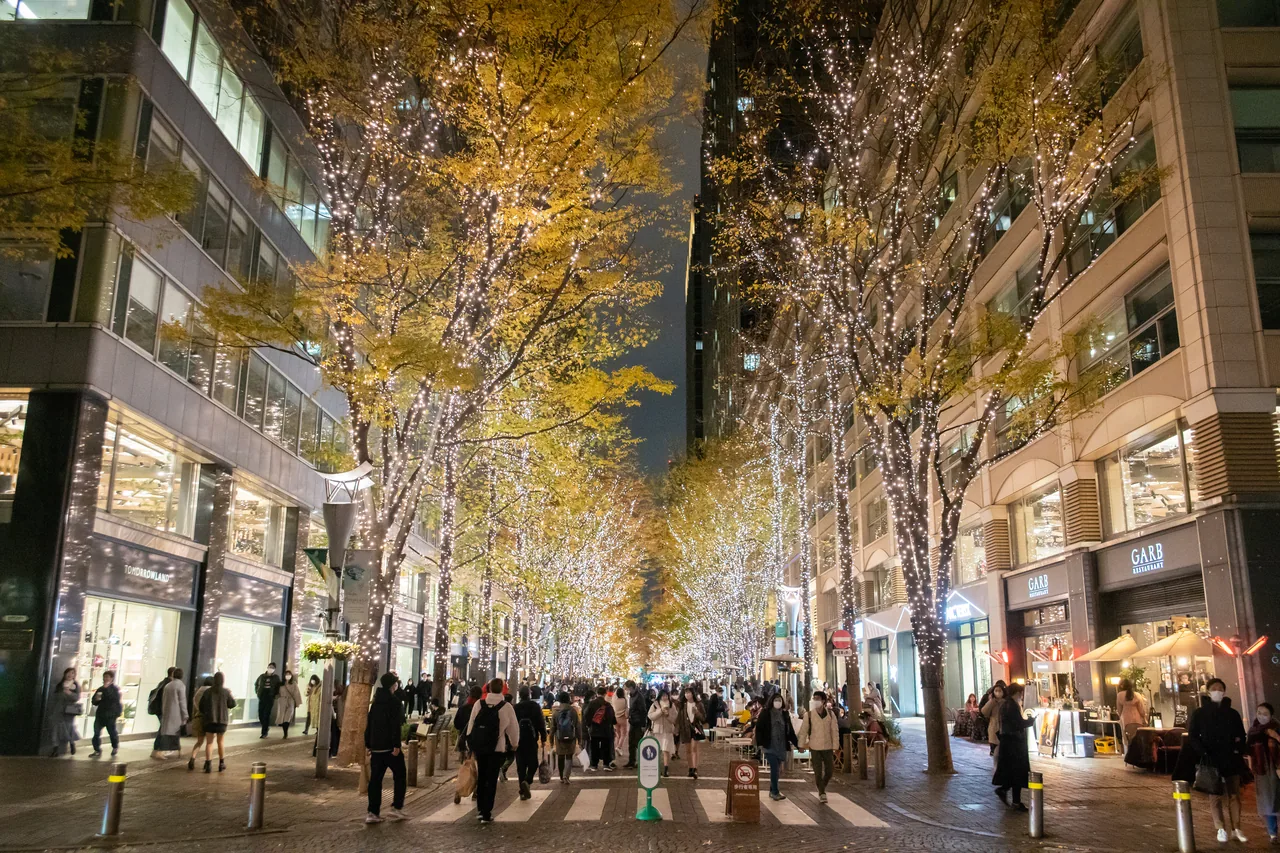
Yes, and it is quietly one of the smartest months to book, as long as you are back home before the Japanese New Year rush starts. Christmas Day is a normal working day here. The real shutdown runs from December 31 to January 3.
That gap between what visitors expect and how Japan actually works is where the value sits. December is the only month in the Japanese calendar with no public holiday at all. December 23 was the Emperor’s Birthday until 2018; the current one falls on February 23.
So domestic travel demand stays low until Christmas, then explodes when offices close on December 29 and roughly the entire country moves at once.
Three things worth knowing before you commit.
- Daylight is short. Sunset in Tokyo is 16:28 in early December, so outdoor plans need to wrap by mid-afternoon.
- Tokyo does not get snow. The average date of the city’s first snowfall is January 3. Snow means Hokkaido, Tohoku or the Sea of Japan coast.
- Ski season is only opening. You can ride in December, but the legendary powder arrives in January and February.
2. December weather city by city, in numbers
December stretches Japan further apart than any other month: 19.5°C separates daytime Naha from daytime Sapporo. These are Japan Meteorological Agency normals for 1991 to 2020.
| City | Avg high °C | Avg low °C | Rain mm | Sunshine h |
|---|---|---|---|---|
| Tokyo | 12.0 | 3.8 | 57.9 | 174.4 |
| Kyoto | 11.6 | 3.5 | 57.3 | 134.4 |
| Osaka | 12.3 | 5.3 | 55.5 | 152.1 |
| Nagoya | 11.7 | 3.4 | 56.6 | 170.3 |
| Fukuoka | 12.6 | 5.8 | 67.5 | 112.2 |
| Sapporo | 2.0 | -4.0 | 114.5 | 82.7 |
| Naha (Okinawa) | 21.5 | 16.8 | 110.0 | 107.4 |
Source: JMA climate normals, 1991 to 2020. Kyoto figures come from the Kyoto station record.
The number that surprises people
Tokyo gets 57.9mm of rain in December, its second driest month of the year, alongside 174.4 hours of sunshine. Winter here looks nothing like winter in London or Chicago.
Sapporo tells the opposite story: 82.7 sunshine hours, less than half of Tokyo’s, under a permanent grey lid of snow cloud.
Early December and late December are different trips
Tokyo runs 14 to 15°C in the first week, which still reads as late autumn, then drops to 10 to 11°C by the end of the month. Pack for the half of the month you are actually there.
Grouped roughly: Hokkaido and Tohoku are in winter, Kanto, Kansai and Kyushu are in late autumn, and Okinawa is in early autumn.
3. Two Decembers: the cheap 20 days and the brutal 8
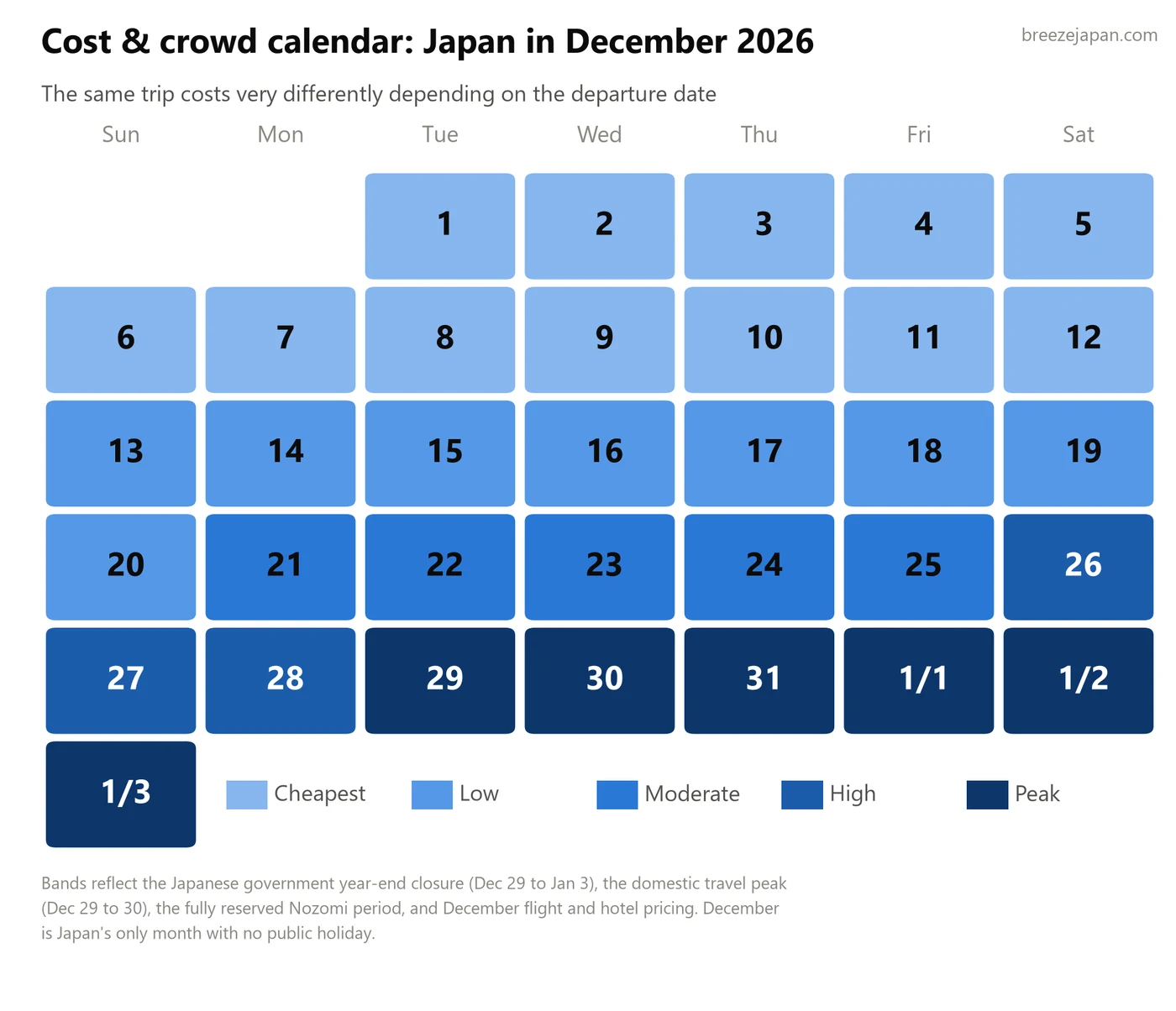
Prices in December do not rise gradually. They step. Flights in the December 1 to 20 window typically run 10 to 15% under the annual average, while hotel rates in popular areas routinely double from December 29 to January 3.
| Dates | Crowds and price | What it feels like |
|---|---|---|
| Dec 1 to 12 | Lowest of the year | Illuminations are already lit and late foliage is still hanging on. The best value fortnight in Japan. |
| Dec 13 to 20 | Low | Still cheap, and the seasonal decorations are fully up. Arguably the sweet spot. |
| Dec 21 to 25 | Moderate | City hotels climb on Christmas demand, but locals are at work, so sights stay manageable. |
| Dec 26 to 28 | High | The domestic exodus begins and reserved shinkansen seats disappear fast. |
| Dec 29 to Jan 3 | Peak of the year | Mass domestic travel, widespread closures and top rates all at once. A rough first visit to Japan. |
The trap for overseas visitors
Most of us get time off between Christmas and New Year, which is precisely the fortnight Japan charges the most for. Moving the same trip two weeks earlier changes the price bracket, not the experience.
If your dates are fixed to the holidays, book flights and hotels two to three months out and treat reserved train seats as non-optional. If your dates are flexible, the first three weeks win on every measure except New Year atmosphere.
For a wider view across the calendar, see our month-by-month guide to the best time to visit Japan.
4. Three real December itineraries
Four days in December is a different holiday depending on which week you pick. These three take the price bands above and turn them into actual plans.
A. Early December (Dec 3 to 6): value and the last of the colour
- Day 1 Afternoon landing, then straight to the Marunouchi lights. Sunset at 16:28 means the evening programme starts before you have unpacked.
- Day 2 Shinkansen to Kyoto. The late maples around Tofuku-ji are in their final week. Temples in the afternoon, Nishiki Market for dinner.
- Day 3 Kyoto temples at opening time (9am is the quiet hour), then Osaka for the Midosuji illumination.
- Day 4 Fly out of Kansai, with a morning raid on a department store food hall.
What this week buys you is price: flights and hotels at their floor, leaves still on the trees, and November’s crowds gone.
B. Mid December (Dec 17 to 20): lights at full strength
- Day 1 Tokyo. Hagoita-ichi at Senso-ji runs December 17 to 19, a proper year-end market rather than a tourist set piece.
- Day 2 Early start for Mount Fuji. Winter mornings are when the mountain is sharpest, and it clouds over as the day warms.
- Day 3 Shinkansen to Nagoya, bus to Nabana no Sato. The scale is a different category from a city street display.
- Day 4 Out of Nagoya or back to Tokyo.
What this week buys you is completeness: every display is running and New Year pricing has not started.
C. New Year (Dec 29 to Jan 1): go for the ritual, not the sightseeing
- Day 1 Land in Tokyo and move as little as possible. Airport trains and shinkansen are at their worst.
- Day 2 Stay in one city. Museums are closed, so build the day around shrines, parks and the big retail complexes.
- Day 3 Omisoka: soba in the evening, temple bells at midnight.
- Day 4 Hatsumode, before 8am to beat the worst of it.
5. Why Tokyo is sunny while Kanazawa is buried in snow
Japanese winter is split down the middle by the mountains, and December is when the split is at its sharpest. A blue-sky day in Tokyo and a heavy snow warning in Kanazawa are the same weather system, not different ones.
Cold Siberian air picks up moisture crossing the Sea of Japan, dumps it as snow against the mountain spine, then arrives on the Pacific side wrung dry. That is why the Tokyo side of the country is so clear in midwinter.
| Side | Cities | December weather |
|---|---|---|
| Pacific side | Tokyo, Yokohama, Nagoya, Osaka, Shizuoka | Clear and dry. Tokyo records just 57.9mm of rain, its second driest month. |
| Sea of Japan side | Kanazawa, Niigata, Tottori, Akita | Grey skies and steady snowfall. This is where you go for snow scenery and crab. |
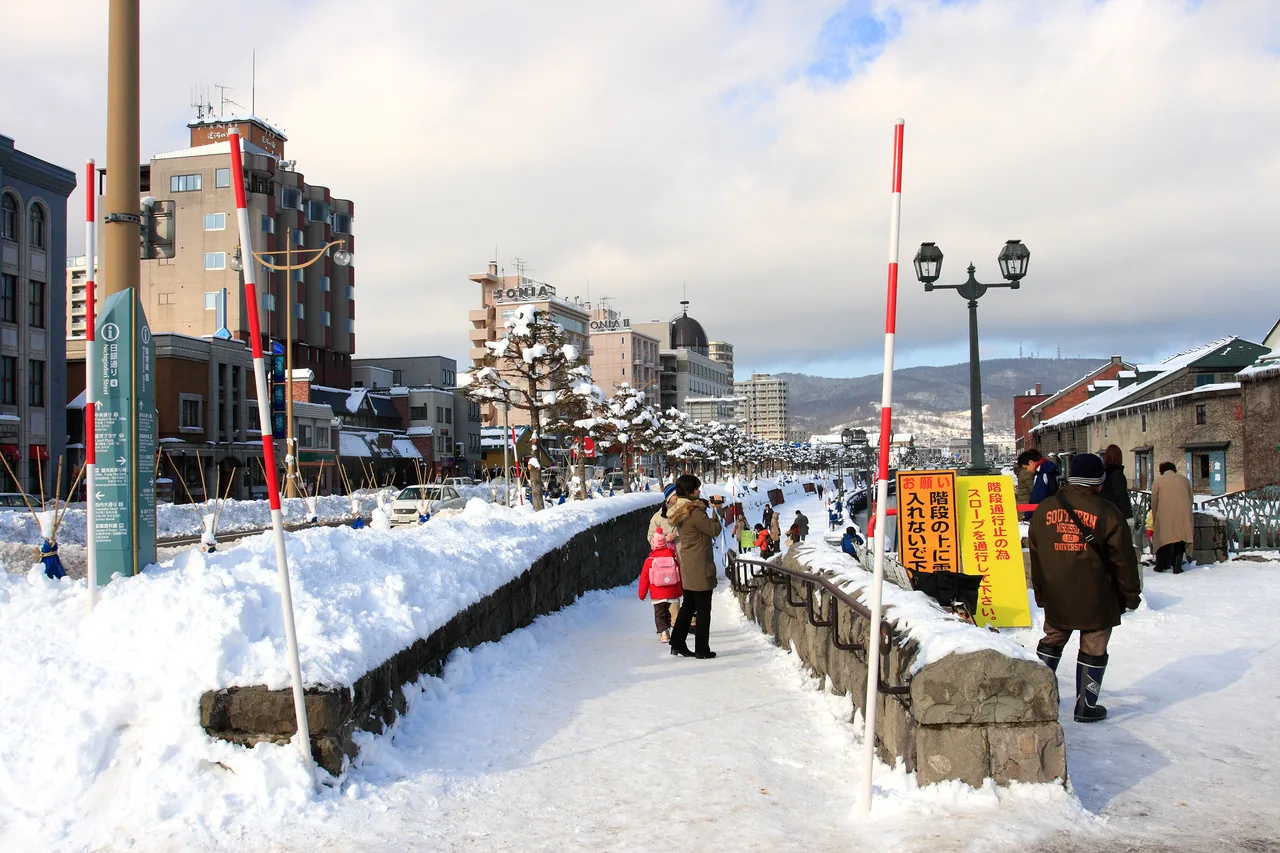
| Hokkaido | Sapporo, Otaru | Snow settles for good around December 6. Only 82.7 sunshine hours, under half of Tokyo’s. |
How dry the Pacific side really is
Tokyo records 57.9mm of rain in December against 234.8mm in October. That is under a quarter, and second only to February for the driest month of its year.
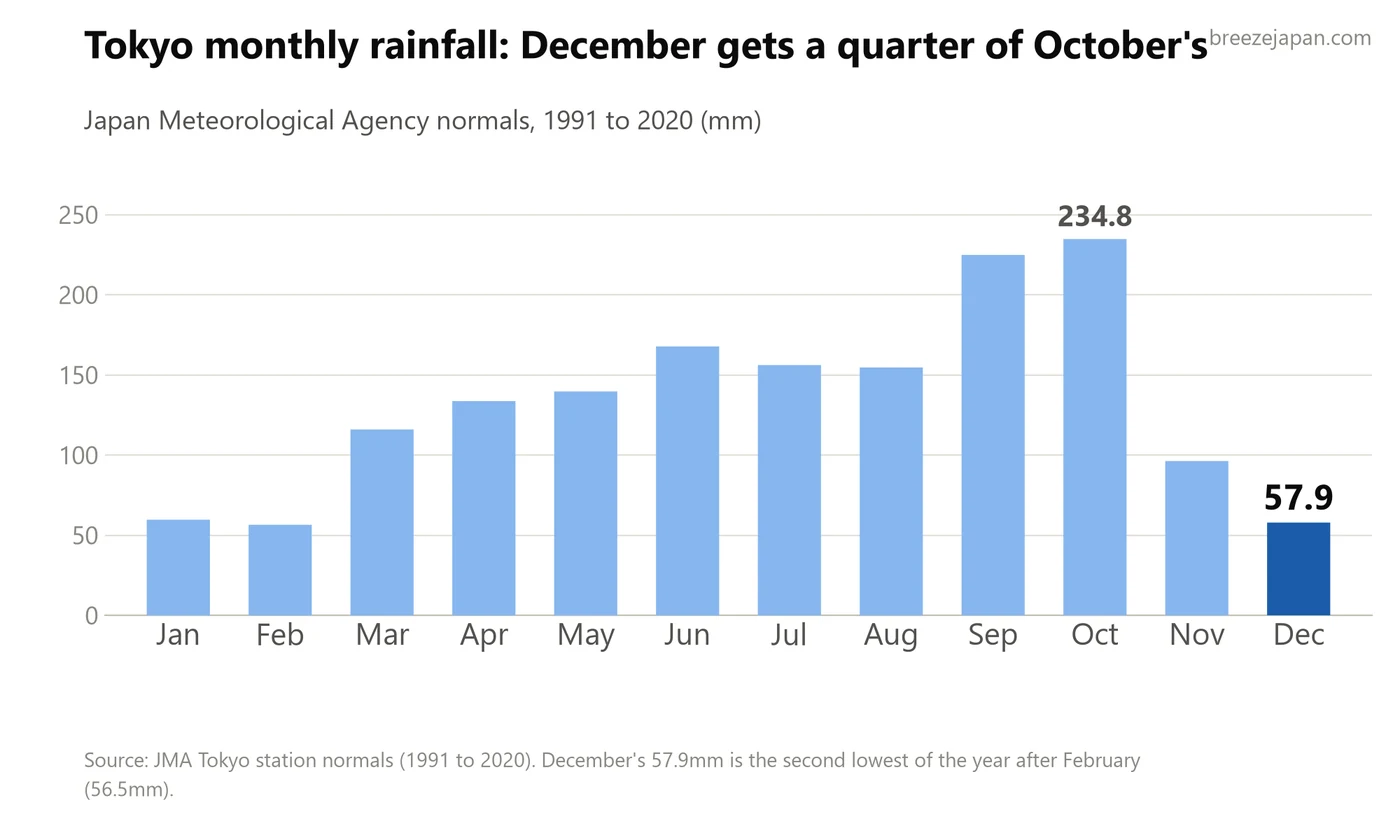
In practice, a December day in Tokyo or Osaka is about as unlikely to be rained off as any day in the Japanese year. The cost is dry air: scratchy throat, static, chapped lips.
Turned into an itinerary rule: blue skies and city views mean the Pacific side, snow and hot springs mean the Sea of Japan side or Hokkaido. Trying to get both in one short trip usually costs you a travel day.
6. The shortest days of the year, and how to plan around them
The sun sets at 16:28 in Tokyo, and it does so every day from December 1 to December 13. The earliest sunsets come before the solstice, not on it, which catches most visitors out.
| Date (Tokyo) | Sunrise | Sunset |
|---|---|---|
| December 1 | 6:32 | 16:28 |
| December 10 | 6:39 | 16:28 |
| December 22 (solstice) | 6:47 | 16:32 |
| December 31 | 6:50 | 16:37 |
Source: National Astronomical Observatory of Japan, Tokyo, December 2026.
The further north, the earlier it goes dark
On the same December 1, sunset varies by more than 90 minutes across the country. This matters most when you plan a Hokkaido trip.
| City | Sunset, December 1 |
|---|---|
| Nemuro (eastern Hokkaido) | 15:43 |
| Aomori | 16:10 |
| Tokyo | 16:28 |
| Kochi (Shikoku) | 16:58 |
| Kagoshima | 17:14 |
Source: National Astronomical Observatory of Japan, December 2026.
Eastern Hokkaido goes dark before 15:45. Stack your outdoor plans in the afternoon there and you will spend the trip walking around in the dark.
Build the day around the light
- 09:00 to 15:00 anything that needs daylight: temples, gardens, viewpoints. Kyoto temples usually stop admitting visitors around 16:30.
- 15:00 to 17:00 move indoors: coffee, covered shopping streets, department store food halls. Spend the sunset under a roof.
- 17:00 to 21:00 illuminations. Night views start at five in December, which effectively lengthens the day rather than shortening it.
7. Winter illuminations: what ends on December 25 and what does not
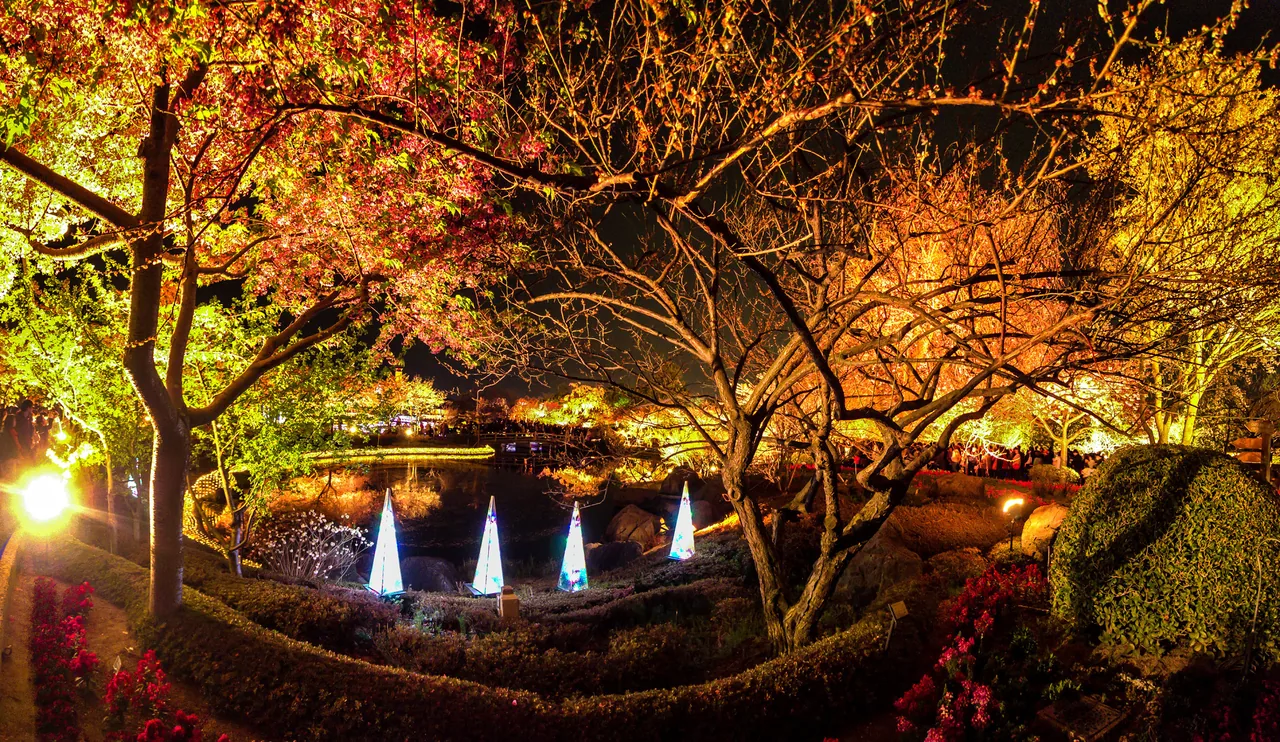
Illuminations are the headline attraction of a Japanese December, and the most common mistake is arriving on December 26. A large share of central Tokyo displays are built around Christmas and go dark that night.
| Display | Where | 2026 to 2027 season |
|---|---|---|
| Sapporo White Illumination | Odori Park, Sapporo | Nov 20, 2026 to Mar 14, 2027 |
| Munich Christmas Market in Sapporo | Odori Park block 2 | Late Nov to Dec 25 |
| Osaka Festival of the Lights (Midosuji and more) | Osaka | Nov 3, 2026 to Jan 31, 2027 |
| OSAKA Hikari Renaissance | Nakanoshima, Osaka | Usually mid-Dec to Dec 25 |
| Nabana no Sato | Kuwana, Mie | Usually mid-Oct to late May |
| Marunouchi Illumination | By Tokyo Station | Mid-Nov to mid-Feb (the Gyoko-dori stretch only to Dec 25) |
| Roppongi Hills Keyakizaka | Roppongi, Tokyo | Early Nov to Dec 25 |
| Yomiuriland Jewellumination | Inagi, Tokyo | Oct to early Apr |
Dates shift slightly each year, so confirm on the official site before you build a day around one.
If you only see one, make it Nabana no Sato in Mie.Nabana no Sato It runs all winter, so it survives a post-Christmas arrival, and the scale is on a completely different level to a city street display.
Three things people get wrong
8. There is still autumn colour in December
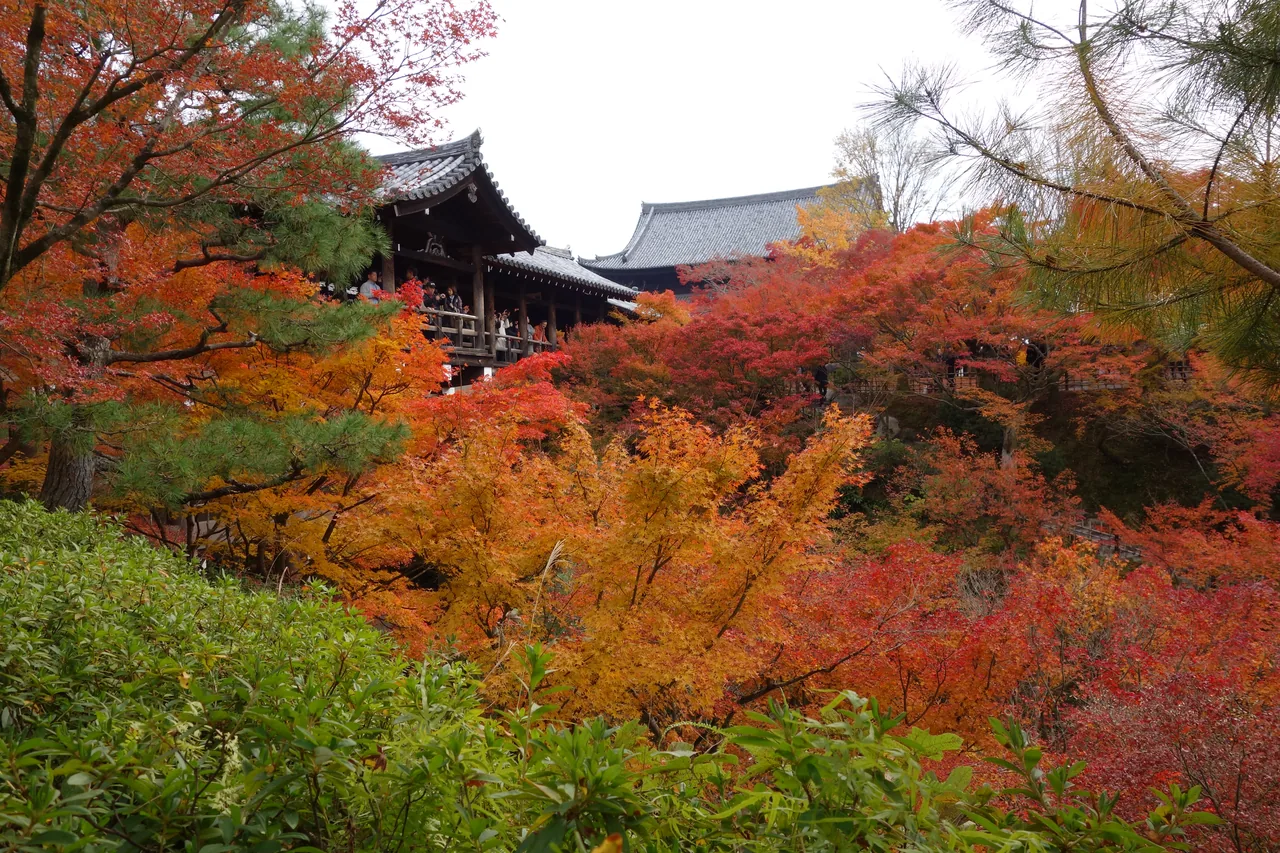
The first week of December is the most underrated foliage window in Japan. The late-turning spots are still holding while November prices and November queues have already gone.
| Where | December colour | Notes |
|---|---|---|
| Tofuku-ji and around, Kyoto | Into early December | The maple valley seen from the Tsutenkyo bridge, with a fraction of the late-November crush. |
| Kamakura | Late Nov to mid-Dec | The latest colour in the Kanto region, and an easy day trip from Tokyo. |
| Southern Kyushu | Early Dec, sometimes mid-Dec | The mildest corner of the main islands, so it finishes last. |
Kamakura pairs foliage with the coast in a single day, which is hard to beat in December. Hase-dera Kamakura The route is laid out in our Kamakura day trip guide.
For the peak of the season, see our guide to Japan in November.
9. Christmas in Japan is not the holiday you know
December 25 is a working day. Offices open, schools run, and shops and restaurants trade normally. Nothing shuts.
Culturally it lands closer to Valentine’s Day than to a family holiday. It is an evening for couples and friends, which is why restaurant tables on December 24 are hard to get while the sights on the 25th are calm.
Three local details
🍗 Fried chicken
Christmas fried chicken is a genuine national tradition, ordered weeks ahead. Turn up on the day and you queue.
🍰 Strawberry cake
The standard Christmas cake is a strawberry and cream sponge, which is part of why greenhouse strawberries hit the shops in December.
🎍 Overnight switch
By the morning of the 26th, Christmas decorations are gone and New Year pine and rope decorations are up. The turnaround is astonishing.
10. The New Year period (Dec 26 to Jan 3), handled properly
If you have to travel in this window, change how you prepare rather than what you expect. It is the one stretch of the Japanese year where turning up and deciding on the spot does not work.
1. Shinkansen non-reserved cars disappear
Every Nozomi on the Tokaido and Sanyo Shinkansen becomes fully reserved during the New Year period. In the 2025 to 2026 season that ran December 26 to January 4, and a similar window is expected for 2026 to 2027.
Reserved seats go on sale one month before departure at 10:00 Japan time. For a December 30 train, that means 10:00 on November 30. Popular departures sell out the same day.
2. More closes than you would guess
- Independent restaurants and small shops often close from December 31 to January 3.
- Museums and galleries almost all take a New Year break.
- Toyosu Market shuts after its final trading day of the year. Toyosu Market
- Open as normal: convenience stores, chain restaurants, malls and department stores (some close January 1). New Year sales and lucky bags start January 2.
3. Hatsumode and New Year’s Eve
Meiji Jingu draws around three million visitors over January 1 to 3. Meiji Jingu The worst crush is 22:00 on the 31st through 03:00 on the 1st, then after 10:00 each morning.
At midnight, temples across the country ring their bells 108 times. Some let visitors take a turn, usually by handing out numbered tickets earlier in the evening.
11. December festival calendar
December looks like a quiet month on paper, and it is not. These are the fixed dates for December 2026.
| Date | Event | Where |
|---|---|---|
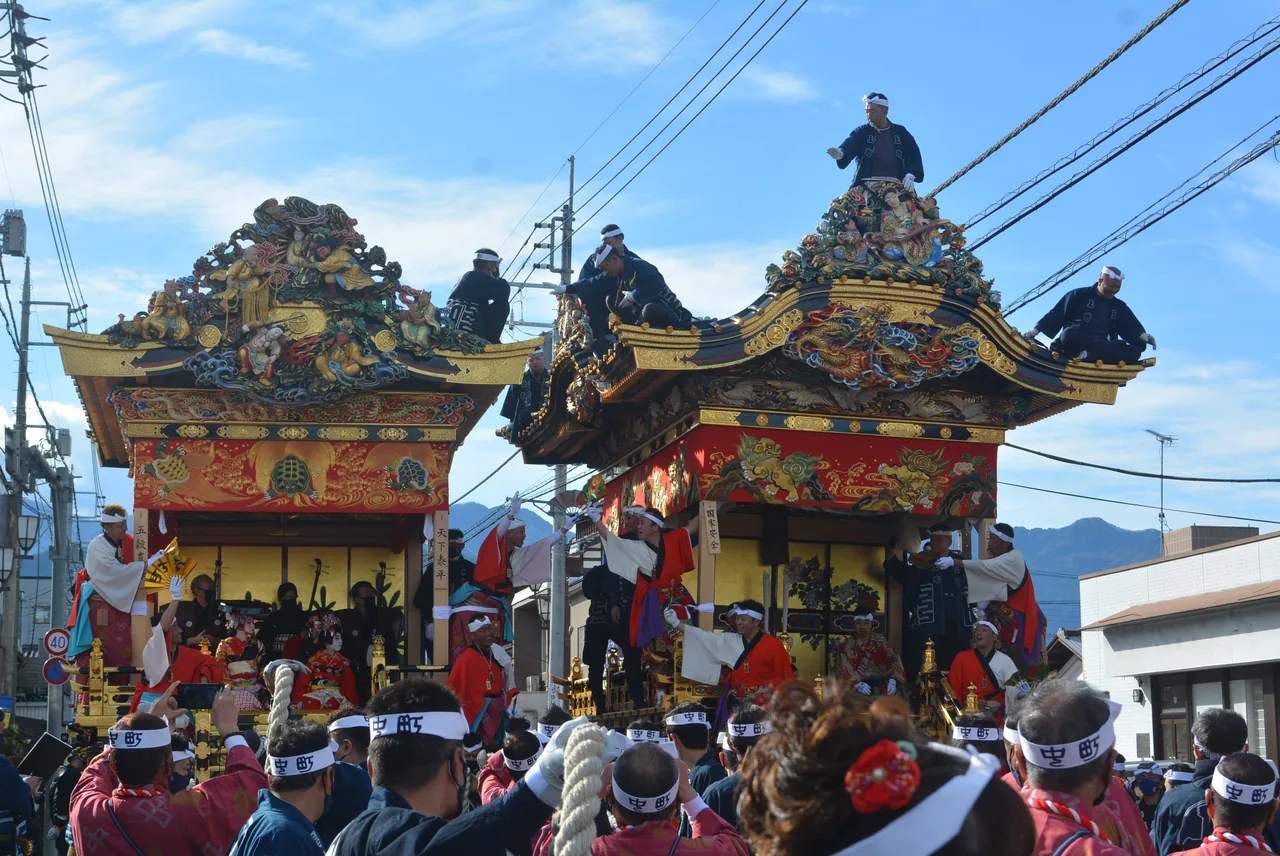
| Dec 2 to 3 | Chichibu Night Festival, a UNESCO-listed float festival with winter fireworks. | Chichibu, Saitama |
| All month | Minamiza Kaomise, Kyoto’s year-end kabuki season. | Kyoto |
| Dec 13 to 14 | Geminid meteor shower peak, helped by clear winter skies. | Nationwide |
| Dec 14 | Ako Gishisai, a costumed parade retelling the 47 ronin story. | Ako, Hyogo and Sengaku-ji, Tokyo |
| Dec 15 to 18 | Kasuga Wakamiya On-Matsuri. The main procession leaves the prefectural office at noon on the 17th. | Nara |
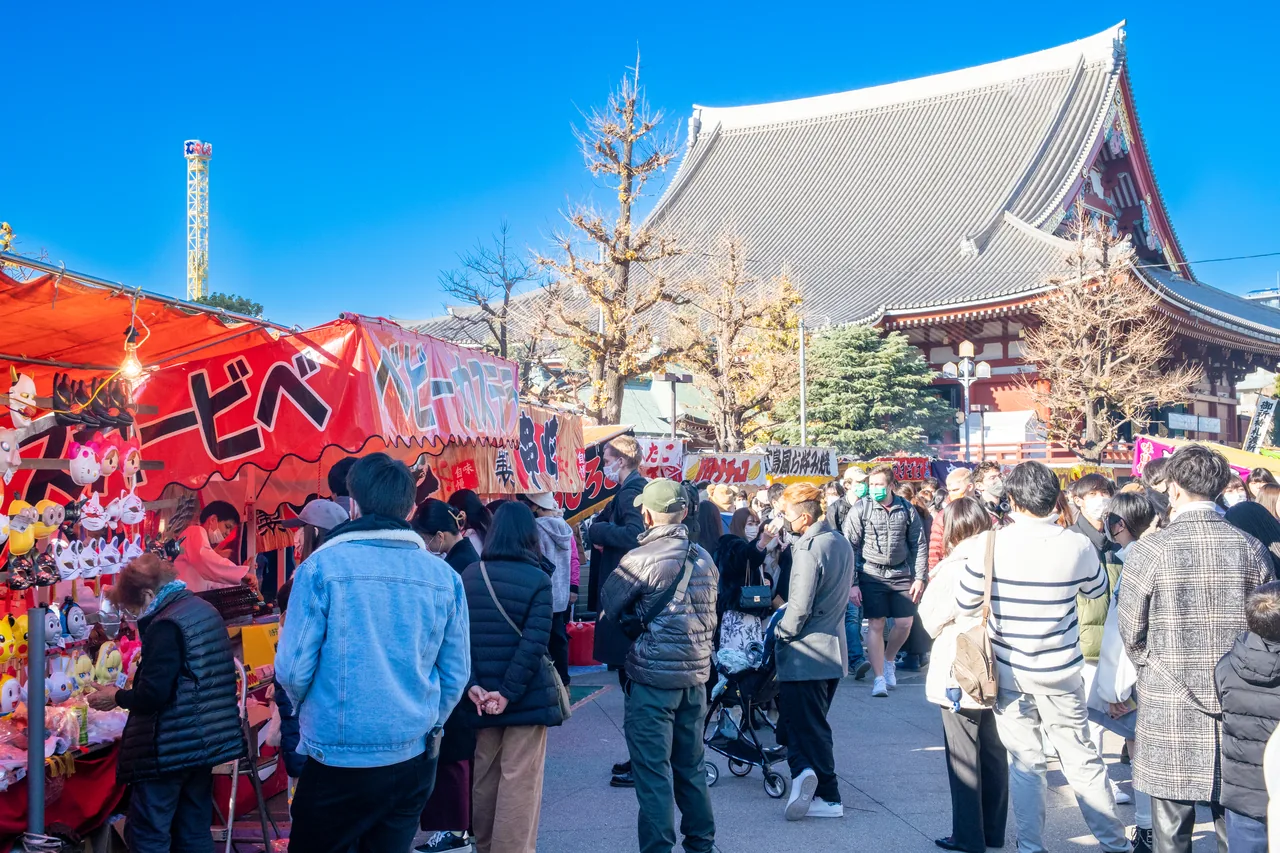
| Dec 17 to 19 | Hagoita-ichi, the ornamental battledore market. | Senso-ji, Asakusa, Tokyo |
| Dec 22 | Winter solstice, marked with yuzu baths and pumpkin. | Nationwide |
| Dec 31 | Omisoka: temple bells and buckwheat noodles. | Nationwide |
Chichibu is a day trip from Tokyo. Chichibu Shrine Fireworks in December, over floats hauled up a slope by teams of shouting locals, is not an experience the summer festivals can match.
Nara’s On-Matsuri has run for close to 900 years without a break. Kasuga Taisha Add a day to a Kyoto or Osaka trip and you can see it.
12. Snow and skiing: what December really delivers
December opens the ski season. It does not deliver the season everyone talks about. Booking early December expecting Japanese powder is the classic first-timer mistake.
| Resort | 2026 to 2027 opening | Notes |
|---|---|---|
| Niseko United | All four areas from November 28, 2026 | Night skiing runs December 12 to March 22, 2027. |
| Hakuba | Lifts usually start in early December | 2026 to 2027 dates not yet published. The valley is normally fully open by mid-month. |
| Gala Yuzawa | Usually mid-December to early May | Shinkansen from Tokyo Station straight into the base station. |
In the first half of the month, lower runs may still be closed and cover can be thin. From mid-December, Hokkaido and Nagano are often genuinely good, and the base builds quickly.
If you just want snow scenery without the lift pass, Hokkaido is the safe bet: Sapporo holds continuous cover from around December 6. Niseko
13. The best month for an onsen
An outdoor bath is worth exactly as much as the air around it is cold. December is when Japanese hot springs finally make sense.
Yuzu baths at the solstice
The 2026 winter solstice falls on December 22. Tradition says you soak in a bath scattered with yuzu citrus and eat pumpkin, and many baths and onsen run a one-day yuzu-yu.
If your trip includes December 22, put the onsen on that evening rather than any other. The scent and the colour of the water are genuinely different.
Snow monkeys
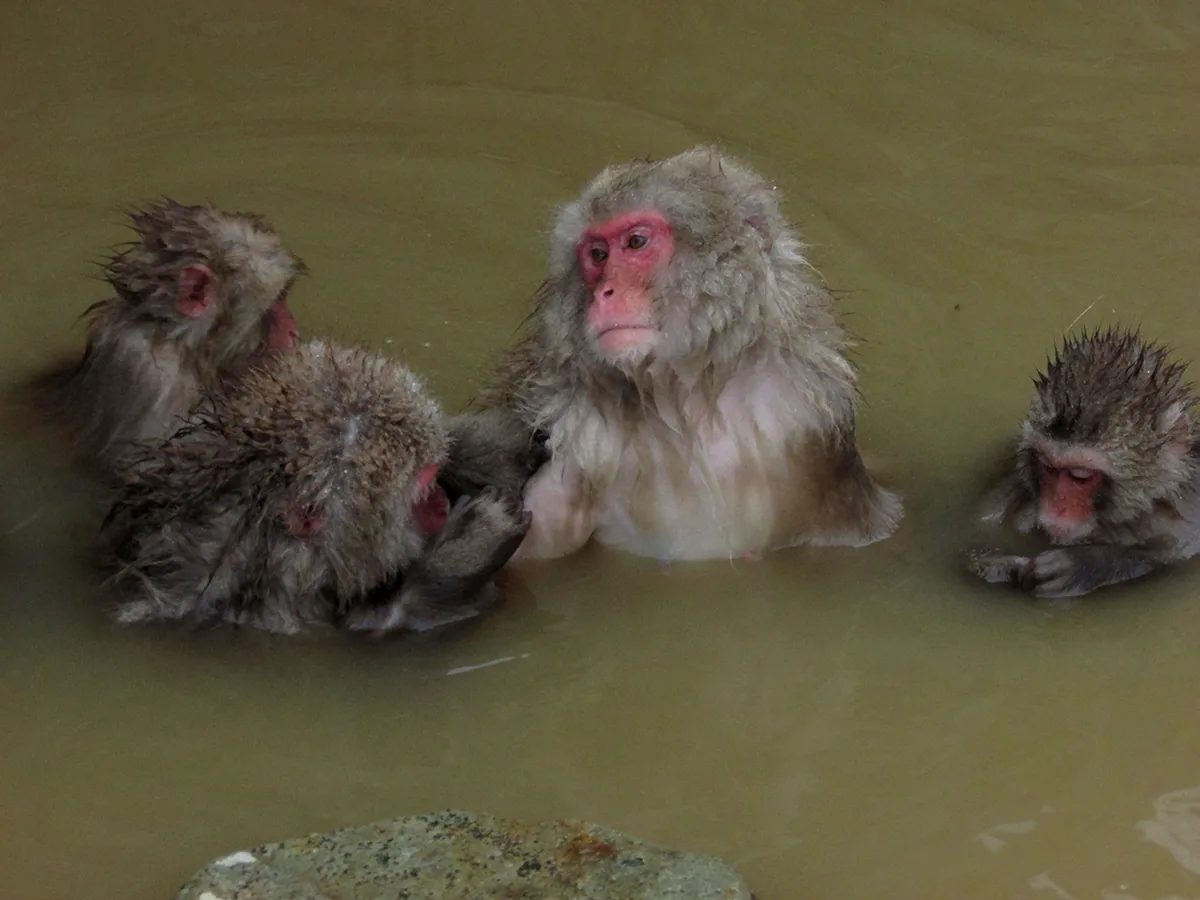
Jigokudani Monkey Park in Nagano is the one with macaques sitting in a hot spring. Jigokudani Monkey Park Snow starts settling in December, which is what turns a decent photo into the famous one.
14. What to eat in December: crab, fugu and oysters
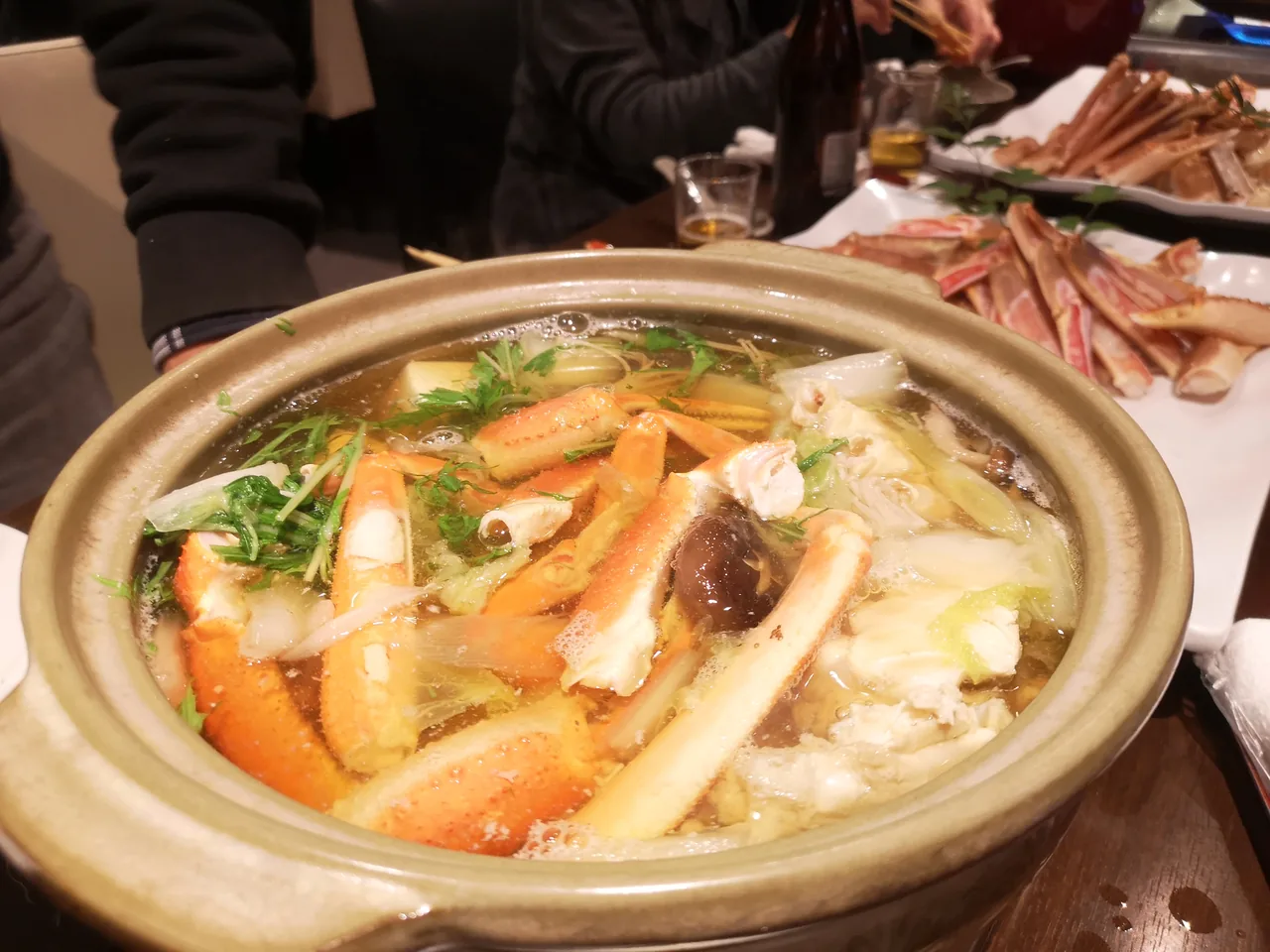
December is one of the best seafood months in Japan, and prices have not yet climbed to New Year levels. The same snow crab costs noticeably less in the first week than in the last.
| Ingredient | How it is served | Where it is best |
|---|---|---|
| Snow crab | Hotpot, grilled, raw | Tottori, Fukui, Hyogo and the Sea of Japan coast |
| Fugu (pufferfish) | Paper-thin sashimi, hotpot | Shimonoseki and Fukuoka |
| Oysters | Grilled, fried, in hotpot | Hiroshima and Miyagi |
| Winter yellowtail | Sashimi, simmered, shabu-shabu | Toyama and Ishikawa |
| Strawberries | Desserts and Christmas cake | Tochigi and Fukuoka |
The cheaper pleasure is oden from the pot by the convenience store counter, next to a shelf of hot canned drinks. Both appear only in the cold months.
From mid-December, department store food halls take orders for osechi, the lacquered boxes of New Year food. Worth a look even if you never buy one.
15. The month Mount Fuji is most likely to show up
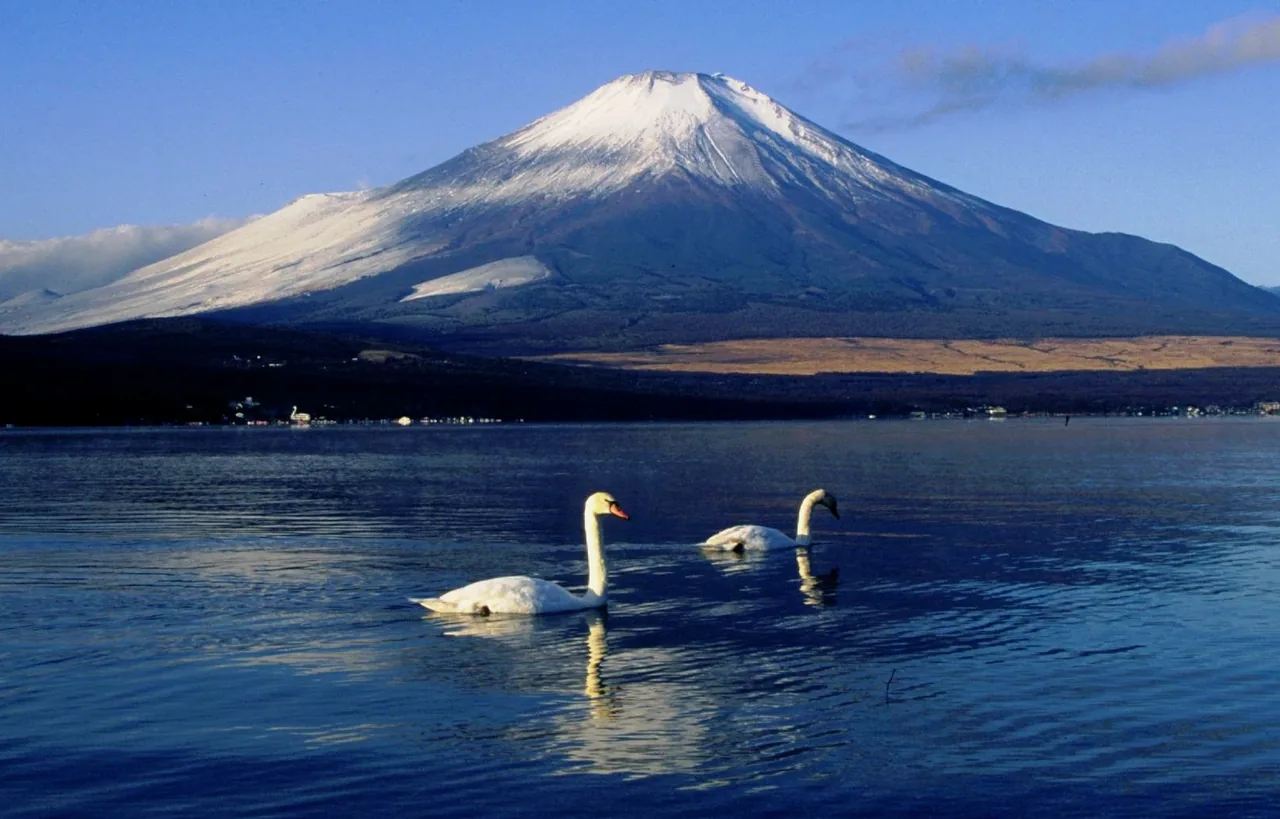
Your best statistical odds of actually seeing Fuji fall in December. In the city of Fuji’s long-running records, December 26 sits near the top of the year at roughly a 70% chance of visibility.
Cold air holds less water vapour, so distant outlines sharpen, and the Pacific side has its clearest skies of the year in midwinter. Add a full snow cap and December is peak Fuji.
Where to look
- Lake Kawaguchi for the classic reflected view. Early morning is sharpest. Lake Kawaguchi
- The shinkansen heading west from Tokyo: sit on the right, seat E, and watch near Shin-Fuji.
- Tokyo observation decks on a clear winter morning. It is visible from the city itself, which is not true most of the year.
16. December region by region
In December, changing region changes the entire holiday. Decide what you want first, then pick where.
| Region | Weather | What December means here | Go if |
|---|---|---|---|
| Hokkaido | Sapporo 2.0 / -4.0, 82.7 sunshine h | Continuous snow from about Dec 6, ski season opens | You want snow, skiing and crab in one trip |
| Tohoku | Heavy snow on the west coast, clear on the east | Onsen and snow country season | Hot springs are the point, but check Ginzan’s entry rules |
| Kanto | Tokyo 12.0 / 3.8, 174.4 sunshine h | Dry, sunny, the densest illuminations in Japan | It is your first visit or a city-based trip |
| Chubu and the Alps | Nagoya 11.7 / 3.4, heavy mountain snow | Ski season opening, Nabana no Sato | You want skiing and illuminations together |
| Kansai | Kyoto 11.6 / 3.5, Osaka 12.3 / 5.3 | Late foliage, kaomise kabuki, Osaka lights | You are chasing early-December Kyoto colour |
| Chugoku and Shikoku | Snow on the north coast, clear on the Inland Sea | Peak snow crab season | You would plan a trip around a meal |
| Kyushu | Fukuoka 12.6 / 5.8, 112.2 sunshine h | Foliage lingers into early December | You want the mildest of the main islands |
| Okinawa | Naha 21.5 / 16.8 | Light jacket weather, swimming season over | You are escaping winter rather than seeking it |
If you are moving between regions, sort transport before anything else. In late December that means reserved seats first; in early December you have room to improvise.
City detail lives in our Tokyo guide, our Kyoto guide and our Osaka guide. For the warm option, see our Okinawa guide.
17. What to wear and pack for December
Tokyo in December is roughly a mild northern European winter, and Sapporo is a proper one. Pack for the specific half of the country you are visiting.
| Where | Day / night | What works |
|---|---|---|
| Tokyo, Kyoto, Osaka | 12°C / 4°C | A warm coat over a knit, with a scarf and gloves for the evening. |
| Sapporo | 2°C / -4°C | A proper winter jacket and grippy soles. Pavements ice over. |
| Fukuoka | 12.6°C / 5.8°C | Standard winter layers are plenty. |
| Okinawa | 21.5°C / 16.8°C | Long sleeves and a light jacket. |
Things you only learn on the ground
- Indoors is hot. Trains and shops run the heating hard, so layers you can strip off beat one thick coat.
- It is very dry. Tokyo gets 57.9mm of rain all month. Lip balm and moisturiser earn their place.
- Buy heat pads locally. Stick-on warmers cost almost nothing at any convenience store or drugstore.
- Shoes: normal trainers are fine outside Hokkaido, where you want something with grip.
18. Tax-free shopping changed in November 2026
From sales made on November 1, 2026, Japan switched to a refund system for tax-free shopping. You now pay the full tax-inclusive price in the shop and reclaim the consumption tax at the airport once customs confirms you are taking the goods out.
A December 2026 trip lands in the first year-end peak under the new rules, while shops and airports are still finding their rhythm. Build in extra time.
| Stage | What you do |
|---|---|
| In the shop | Show your passport and pay the tax-inclusive price. The shop records the purchase. |
| During the trip | Keep the goods and the purchase record. You must leave Japan within 90 days of buying. |
| At the airport | Present your passport at the customs terminal for export confirmation, then receive the consumption tax refund. |
More detail sits in our Japan tax-free shopping guide and our guide to cash and cards in Japan.
19. Before you go: the December checklist
Six things that are easy now and impossible later.
| When | Do this |
|---|---|
| 2 to 3 months out | Book flights and hotels if any part of your trip touches December 26 to January 3. Kyoto and central Tokyo sell out at double rates. |
| 1 month out, 10:00 JST | Reserve shinkansen seats the moment they open, one month ahead to the day. Nozomi runs fully reserved over the New Year period. |
| 3 weeks out | Check the official pages for any illumination you are building a day around. Several end on December 25 and the dates move each year. |
| 1 week out | Complete Visit Japan Web for immigration and customs. Sort a data plan so you can check live train status in snow country. |
| Packing | Layers you can shed indoors, a scarf, thin gloves, lip balm. Shoes with grip only if you are going north. |
| On the day you fly home | Add at least 30 minutes at the airport if you shopped tax-free. The refund is now processed at customs on departure. |
20. So when should you actually go?
Whatever you are after, December 1 to 20 is the answer. After that the price rises faster than the experience improves.
| If you want | Target dates | Why |
|---|---|---|
| Best value | Dec 1 to 12 | Flights and hotels at their yearly floor with the lights already on. |
| Autumn colour | Dec 1 to 7 | Kyoto and Kamakura still have leaves and November’s crowds have gone. |
| Illuminations | Dec 13 to 25 | The only stretch when every display is running at once. |
| Snow and skiing | Dec 15 to 23 | The base has built and New Year pricing has not started. |
| Japanese New Year | Dec 29 to Jan 3 | You pay for it in money and crowds, but hatsumode and Omisoka only exist now. |
Practical combinations
- One week, first visit: fly in around December 5, base in Tokyo and Kyoto, and you get sun, late foliage and lights at the cheapest rate of the year.
- Ten days with snow: Tokyo in the first week, then north from around December 15 once the cover is reliable.
- Fixed to the holidays: book two to three months out, reserve every train seat, and expect closures from December 31.
- New Year on purpose: stay in one city rather than moving. Watching one neighbourhood shift into New Year mode beats fighting for train seats.
To compare against January and February, see the best time to visit Japan. For everything else about planning a trip, start with our complete Japan travel guide.