
Shinkansen Luggage Rules: The 160cm Limit and Why It Bars You From Unreserved Cars
Most suitcases are well inside the limit. Cross it and the way you buy your ticket changes, so here are the measurements, the seat counts and the reservation steps straight from JR’s own notices.
| The threshold | Length plus width plus height over 160cm makes a bag oversized. |
|---|---|
| How to measure | Wheels and handle are included, so measure the outer frame. |
| The real constraint | Oversized baggage cannot be taken into an unreserved car at all. |
| Seat supply | A Nozomi has only 57 of these seats out of 1,323. |
| Without a reservation | ¥1,000 is collected on board and the crew decides where the bag goes. |
1. One measurement decides whether any of this applies to you
2. Oversized baggage is barred from unreserved cars
3. Reserving is free, but a Nozomi has only 57 of these seats
4. Which car you get changes the walk
5. There is now a baggage corner that needs no reservation
6. Boarding without a reservation costs ¥1,000
7. Where a normal suitcase goes
8. Above 250cm the answer is no, at any price
9. Sports gear, instruments, strollers and wheelchairs
10. Lines where the rule does not exist
11. A station locker holds it for three days, not longer
12. Sending your bags ahead instead
13. Courier limits are calculated differently
14. Sending it from the airport to the hotel
15. Coming home heavier
1. One measurement decides whether any of this applies to you
Add the length, width and height of your case together. Over 160cm and JR classifies it as oversized baggage, which has to travel in a reserved seat with a baggage space behind it. Under 160cm and there is nothing to do.
Measure the outer frame with the wheels and the retracted handle included. The inch figure printed on a suitcase describes the shell, and the frame around it adds a few centimetres, so anything close to the line is worth checking with a tape measure rather than assuming.
| Three sides added | Classification | Reservation |
|---|---|---|
| 160cm or less | Normal baggage | Not needed |
| Over 160cm up to 250cm | Oversized baggage | A seat with baggage space is required |
| Over 250cm | Not permitted on board | Must be shipped separately |
There is a shortcut for working out where you sit. Most international airlines cap free checked baggage at 158cm across the three dimensions, which is within two centimetres of JR’s threshold. A case that flies as standard checked baggage is almost never oversized on the shinkansen. A case that attracts an oversize fee at the airport probably will be.
2. Oversized baggage is barred from unreserved cars
This is the part of the rule that changes how you travel, and it has nothing to do with money. JR’s notice states that oversized baggage may not be brought into unreserved cars or into reserved cars that have no oversized baggage space.
The reason is equipment rather than money. Unreserved cars were never built with the baggage space behind the last row, and every seat that has one is sold as a reserved seat.
Offering to pay more therefore changes nothing. There is physically nowhere in those cars to put the case.
Rail pass holders feel this most. A Japan Rail Pass lets you walk onto any Nozomi-excluded service and sit in an unreserved car without booking anything, which is exactly how many visitors travel. With a case over 160cm that option closes. You have to go to a ticket office or machine and take a reserved seat, and specifically one of the seats with a baggage space.
| Your bag | Unreserved car | Ordinary reserved seat | Seat with baggage space |
|---|---|---|---|
| 160cm or less | Allowed | Allowed | Allowed |
| Over 160cm up to 250cm | Not allowed | Not allowed | Allowed |
| Over 250cm | Not allowed | Not allowed | Not allowed |
Reserving costs a pass holder nothing, so the practical loss is flexibility rather than money. Instead of turning up at the station and taking the next departure, you are committed to a specific train, and on busy days that specific train may not have one of these seats left.
3. Reserving is free, but a Nozomi has only 57 of these seats
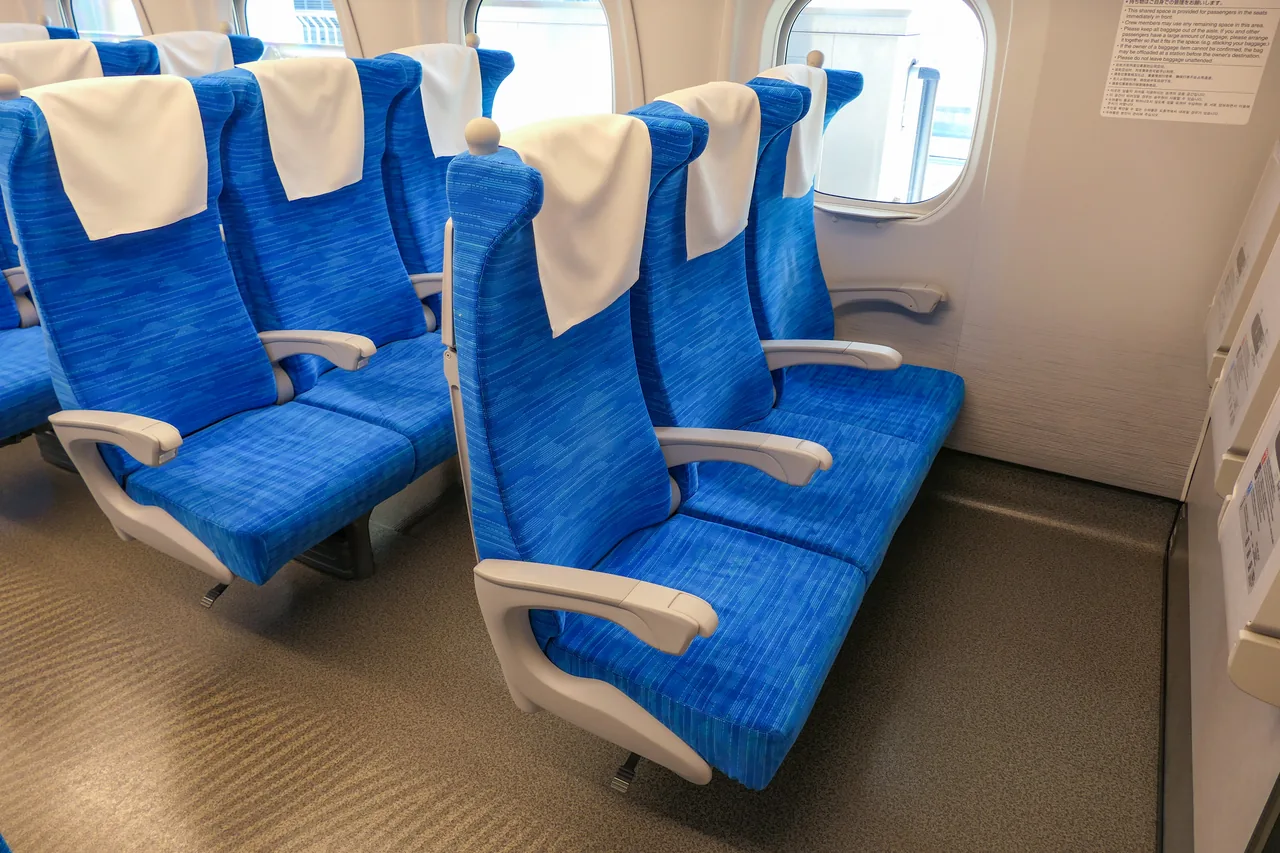
You book a seat with an oversized baggage space exactly as you book any reserved seat, and it costs the same. Station counters, reserved-seat ticket machines and the online systems all handle it; you simply choose one of the marked seats. The seat itself is the last row of the car, and the space behind the seat backs belongs to whoever is sitting there.
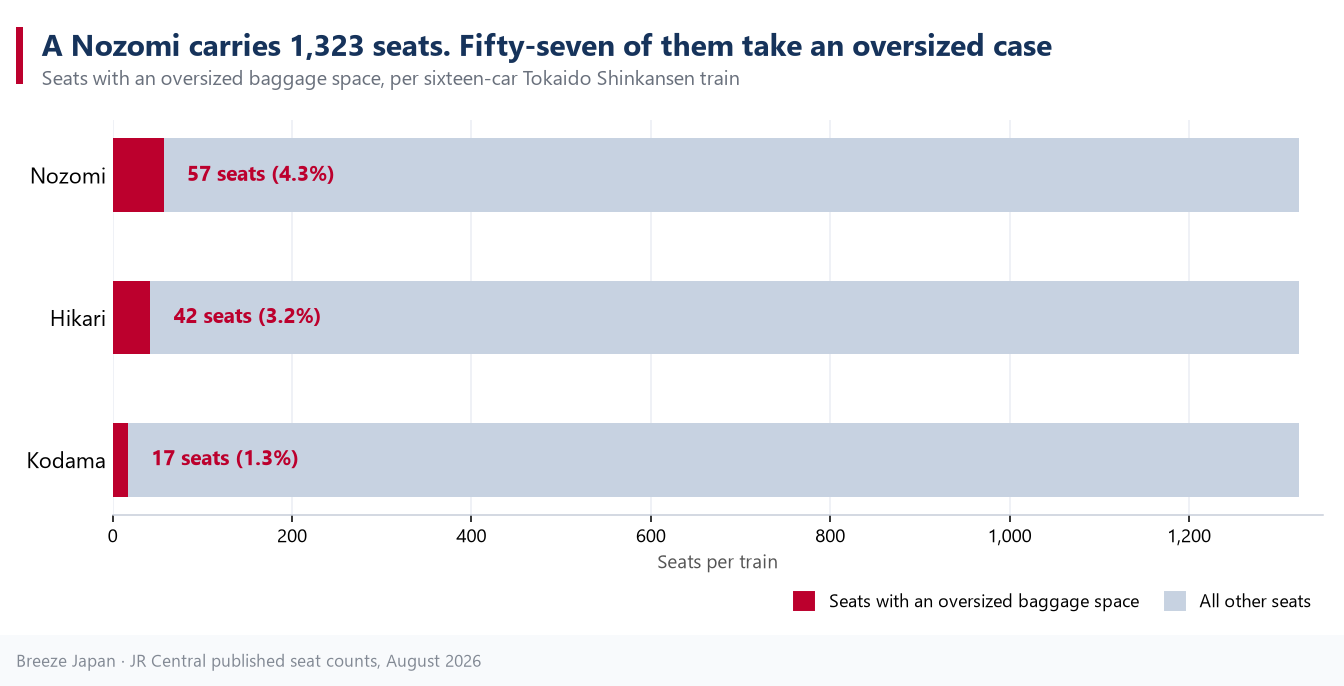
Supply is the part worth planning around. On the sixteen-car sets that run the Tokaido Shinkansen the counts are these.
| Service | Seats per train | Where they are |
|---|---|---|
| Nozomi | 57 | Green cars 8 to 10, four each; ordinary cars 3 to 6 and 12 to 16, five each |
| Hikari | 42 | Green cars 8 to 10, four each; ordinary cars 6 and 12 to 16, five each |
| Kodama | 17 | Green cars 8 to 10, four each; ordinary car 12, five seats |
A sixteen-car set seats 1,323 people, so the 57 seats on a Nozomi are about 4.3 percent of the train, and a Kodama has seventeen of them in total. That ratio explains the booking behaviour: during Golden Week, the cherry blossom weeks and the autumn colour season these sell out before ordinary reserved seats do. Booking them the day before departure rarely works.
Choosing the car also chooses your spot on the platform
Because these seats exist only in specific cars, picking one fixes where you will step onto the platform at the far end. If you are travelling with something heavy, check which end of your arrival platform has the lift and the escalator before you choose, since dragging an oversized case the length of a shinkansen platform is an avoidable ten minutes.
4. Which car you get changes the walk
The oversized baggage seats on a Nozomi are spread across cars 3 to 6, cars 12 to 16, and cars 8 to 10 in Green class. They are not interchangeable: where the car stops decides how far you push the case.
| Cars | What they are |
|---|---|
| 3 to 6 | Ordinary class, nearer the gates at Tokyo |
| 8 to 10 | Green class, at Green class prices |
| 12 to 16 | Ordinary class, towards the back of the train |
Pushing a large case the length of a platform is the real cost of this whole exercise. Stairs and escalators sit where the station put them, so a car number can be worth more than a hundred metres of walking.
What is left over is at the back
Reservations fill from the front, so booking late routinely leaves only cars 12 to 16. The later you buy, the further you walk with the luggage.
Which argues for booking the moment the date is fixed. The seat costs the same as any other reserved seat, so there is nothing to gain by waiting.
In peak weeks there are no seats at all
Over New Year, Obon and Golden Week the 57 seats go on the day they are released. Travelling with a large case in those weeks, sending it ahead is the realistic plan and the reservation is not.
Release is 10:00, one month before travel. Miss that and it is safest to assume the oversized seats are gone.
5. There is now a baggage corner that needs no reservation
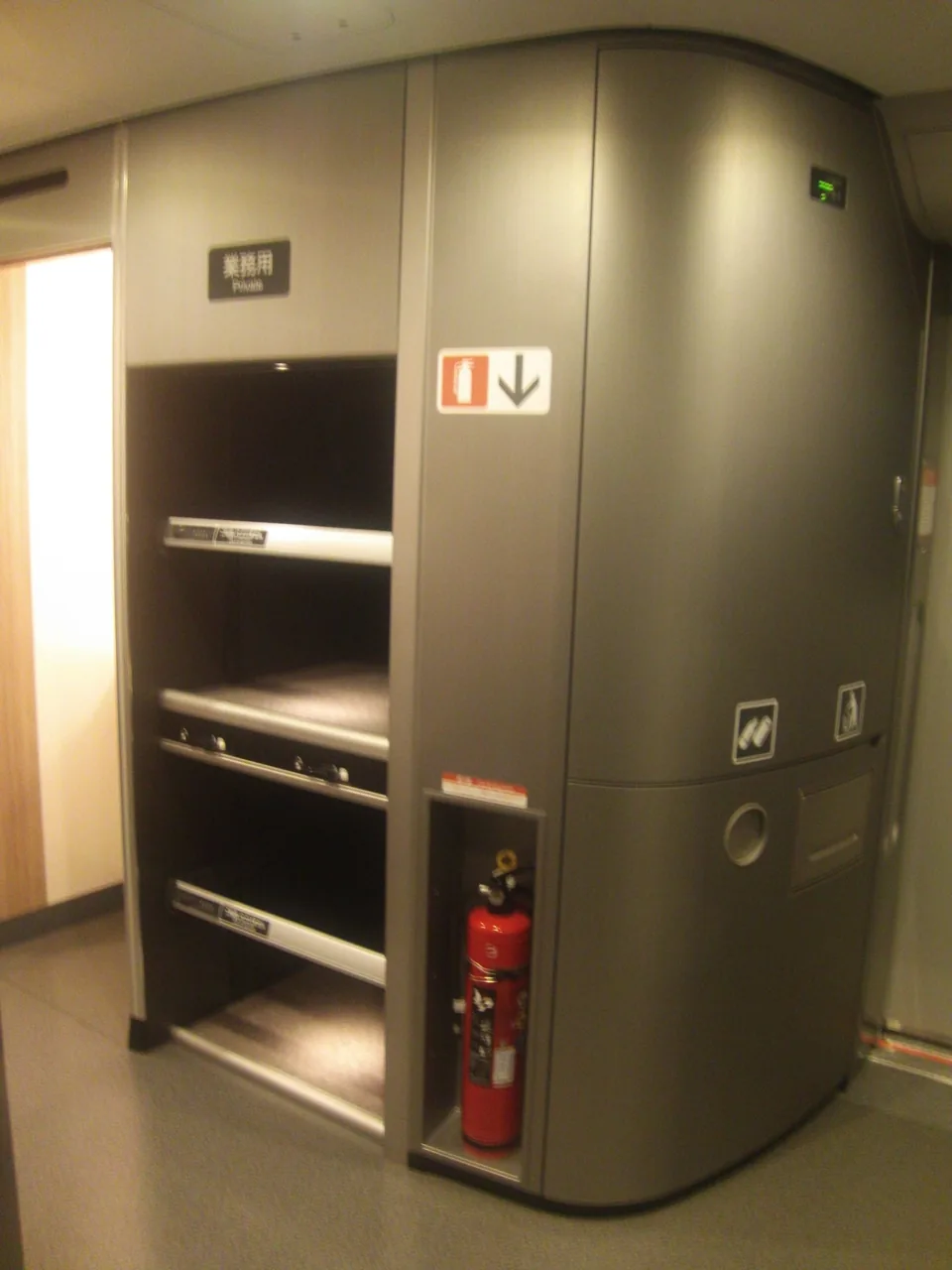
Alongside the seats that come with a reserved baggage space, a separate baggage corner has been introduced on a trial basis, and it needs no booking. It sits in the deck area between cars rather than behind a row of seats.
| Type | Reservation | Where it is |
|---|---|---|
| Seat with oversized baggage space | Required | Behind the last row of the car |
| Seat with oversized baggage corner | Not required | A separate area by the deck |
Being a trial, it is not on every formation, and which trains have it shows up on the booking screen. Catching one takes you out of the competition for those 57 seats entirely.
An answer to the back-row problem
Seats with a baggage space are always the last row of the car. The backrest does not recline fully and the door traffic is right there, so as a seat it is not a good one.
Where the corner is available you keep the baggage capacity and choose your seat freely. On a two-and-a-half hour run that difference is not small.
6. Boarding without a reservation costs ¥1,000
Bring oversized baggage on board without a reservation and the crew collects ¥1,000 including tax, then puts the bag wherever they have room.
The amount is modest, but the charge buys nothing extra. The identical seat booked in advance carries no fee at all, and paying on board also means you have no say in where the case ends up, which can be a different car entirely.
| Situation | Extra charge | Where the bag goes |
|---|---|---|
| Seat with baggage space booked in advance | None | Directly behind your seat |
| Brought on with no reservation | ¥1,000 | Wherever the crew directs |
7. Where a normal suitcase goes
There are five places to put luggage on a shinkansen, and size determines which are open to you. Most travellers use the overhead rack or the luggage area in the vestibule between cars.
| Location | Fits | Reservation |
|---|---|---|
| Overhead rack | Roughly 80 × 50 × 30cm | Not needed |
| Vestibule luggage area | Up to 160cm across three sides | Not needed |
| Oversized baggage compartment | 80 × 60 × 40cm, upper shelf to 50cm | Not needed during the trial |
| Behind the last row of seats | Up to 250cm across three sides | Required |
| At your feet | Roughly 40 × 25cm | Not needed |
The overhead rack takes more than people expect, and a 24 inch case usually goes up without trouble. Whether you can lift it there is the real question. If you cannot, the vestibule luggage areas added to Tokaido and Sanyo trains from 2020 are the sensible alternative, used first come first served with no booking.
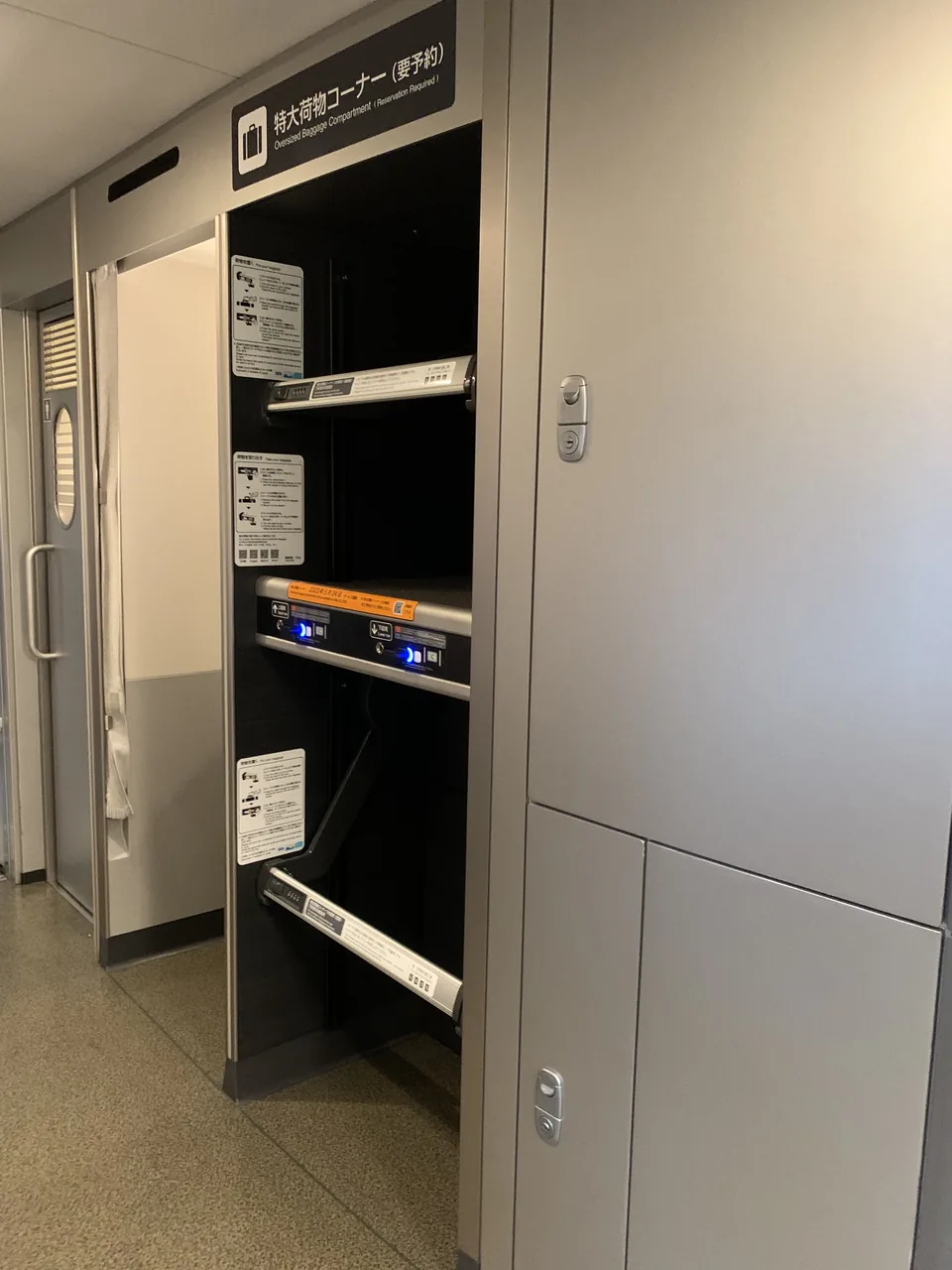
The compartments stopped needing a reservation in July 2025
Sixteen-car Tokaido and Sanyo sets have oversized baggage compartments in some vestibules. These used to be sold bundled with a specific seat. For journeys from 1 July 2025 JR began operating them as free-to-use luggage areas with no advance reservation, and stopped selling the paired seats.
Note the dimensions rather than the total. A compartment slot takes 80 × 60 × 40cm, or 50cm on the upper shelf, so it suits a bag whose three sides add up to more than 160cm without any single side being long. A genuinely large suitcase still needs the space behind a last-row seat.
8. Above 250cm the answer is no, at any price
The oversized baggage system has a ceiling as well as a floor. Anything over 250cm in total dimensions cannot go on a Shinkansen at all, reservation or no reservation, fee or no fee. 160cm is where booking starts; 250cm is where carriage stops.
| Three sides added | What happens |
|---|---|
| Up to 160cm | Board with no reservation |
| Over 160cm, up to 250cm | Oversized. A seat reservation is required |
| Over 250cm | Not carried |
Weight and count are capped too
JR’s general conditions add two more limits beyond size: 30kg per item, and a maximum of two items per passenger. Length is separately capped at 2 metres regardless of the three-side total.
Travel suitcases rarely reach 250cm. A large case runs around 190cm, and even the ones bought deliberately past the 158cm airline threshold sit in the low 200s.
What actually hits this ceiling is not luggage. Surfboards, large framed artwork and flat-packed furniture are the objects that run into it.
When the 2 metre rule bites first
An item can be inside 250cm in total and still be refused for having one side over 2 metres. Fishing rods and long poster tubes fail on that clause before they fail on anything else.
Sports equipment and musical instruments fall under the exemptions covered later, so a rod in its case is a different conversation. When it is borderline, the station counter settles it faster than guessing.
9. Sports gear, instruments, strollers and wheelchairs
Sports equipment, musical instruments, wheelchairs and strollers need no advance reservation whatever their size. JR states this as an explicit exception to the measurement.
| Item | Reservation | Note |
|---|---|---|
| Ski and snowboard bags | Not required | JR still recommends booking if you want the baggage space |
| Golf bags | Not required | As above |
| Large instruments such as a cello | Not required | As above |
| Strollers | Not required | Fold and use the rack or the floor space |
| Wheelchairs | Not required | Wheelchair-accessible seats can be reserved separately |
Skiers heading for Hokkaido or Nagano often assume their board bag will be blocked by the size rule. It will not be. JR does recommend booking anyway if you want to use the dedicated space, because without a reservation you can only use whatever happens to be free, and in February that is not much.
10. Lines where the rule does not exist
The reservation requirement applies only to the Tokaido, Sanyo, Kyushu and Nishi Kyushu Shinkansen. No other shinkansen has it.
| Line | Main section | Oversized baggage rule |
|---|---|---|
| Tokaido Shinkansen | Tokyo to Shin-Osaka | Applies |
| Sanyo Shinkansen | Shin-Osaka to Hakata | Applies |
| Kyushu Shinkansen | Hakata to Kagoshima-Chuo | Applies |
| Nishi Kyushu Shinkansen | Takeo-Onsen to Nagasaki | Applies |
| Tohoku Shinkansen | Tokyo to Shin-Aomori | Does not apply |
| Hokkaido Shinkansen | Shin-Aomori to Shin-Hakodate-Hokuto | Does not apply |
| Joetsu Shinkansen | Tokyo to Niigata | Does not apply |
| Hokuriku Shinkansen | Tokyo to Tsuruga | Does not apply |
That split maps neatly onto how most first trips run. Tokyo to Kyoto, Osaka, Hiroshima and Hakata all fall under the rule, while Tokyo to Sendai, Kanazawa, Karuizawa and Hakodate do not. The absence of a rule is not the same as an abundance of space, though. The newer trains on those lines have their own luggage areas, used first come first served.
11. A station locker holds it for three days, not longer
Coin lockers are not open-ended storage. The permitted period is three days including the day you start, after which the station opens the locker and moves your bag to a holding office. From there it is kept for one month counted from the first day.
| Item | Detail |
|---|---|
| Usage period | Three days including the first |
| After three days | Opened and moved to a holding office |
| Held for | One month from the first day |
| Price band | A few hundred yen, small through extra-large |
Three days matters because of the workaround it rules out. Some travellers skip the oversized seat entirely by leaving the case at a station, which works for a two-night side trip and stops working on the fourth day.
The lockers that fit a big case are scarce
Large and extra-large doors are a handful per station and they are frequently gone by mid-morning. Tokyo and Shin-Osaka are no exception in season, for all their size.
A few stations have doors deep enough for skis or a snowboard, but those are rarer again. If a big case is going into storage, have a staffed left-luggage counter in mind rather than relying on finding a door.
What actually fits on the overhead shelf
The shelf above the seats takes something around cabin-bag size. A case can be inside 160cm in total and still be too deep for it, which sends you looking for floor space or the gap behind the last row anyway.
So 160cm is not the end of the question, only the end of the paperwork. Deciding which of the five places covered later you are aiming for before you board makes the boarding itself much quicker.
12. Sending your bags ahead instead
Luggage forwarding is routine in Japan, hotel front desks handle it, and next-day delivery is standard. Moving a large case through a station change and onto a rush-hour shinkansen is work you can simply skip.
| Method | Suits | Price level |
|---|---|---|
| Hotel to hotel forwarding | Changing cities when you do not need the bag until tomorrow | Mid |
| Airport to hotel forwarding | Going straight out on arrival day | Mid |
| Station coin lockers | A few hours on a day trip | Low |
| Private transfer | Larger groups, or travelling with children or older relatives | High |
Because forwarding is usually next-day, keep an overnight bag with toiletries, medication and chargers. Large coin lockers fill early in peak season, particularly at Kyoto Station and Tokyo Station, so treat them as a bonus rather than a plan.
13. Courier limits are calculated differently
Deciding to send the bag ahead changes the arithmetic. The Shinkansen looks only at the three sides added together; a courier looks at that and the weight, and its ceiling is lower.
| Item | Shinkansen | Courier |
|---|---|---|
| What is measured | Three sides added | The larger of size or actual weight |
| Ceiling | 250cm | 200cm |
| Weight | 30kg | 30kg |
| Pieces | Two per passenger | No limit |
There is a band the train takes and the courier will not
That band is 200cm to 250cm. Reserve the seat and the Shinkansen carries it; take the same object to a courier counter and it is over the limit and refused.
Ordinary suitcases almost never land there. Sports equipment and bulky souvenirs do. If sending ahead is the plan, measure against 200cm rather than the 250cm the railway uses.
Weight pushes you up a bracket
Courier pricing runs in size brackets, and the bracket is set by whichever is larger, the dimensions or the actual weight. A parcel inside 80cm in total still counts as a 100 if it weighs more than 5kg.
On a trip home the things that trigger this are bottles and ceramics. Small, heavy, and priced a bracket or two above what the volume suggested.
14. Sending it from the airport to the hotel
The large-bag problem can be closed before you reach a Shinkansen at all. Courier counters sit in the arrivals hall at the major airports, and the case can go straight to your accommodation while you travel unencumbered.
| Route | Typical time |
|---|---|
| Airport to a hotel in the same city | Same day or next day |
| Airport to another region | One to two days |
| Hotel to the next hotel | Usually next day |
It does not work if you need the contents on arrival day. Packing what the first night requires into a cabin bag is the precondition for the whole approach.
Hotel to hotel is the more useful version
Sending between cities helps more often than sending from the airport. Handing the case to one front desk and collecting it at the next removes the oversized seat requirement completely.
You check out with a day bag, travel light, and pick everything up that evening. Being free to choose any seat on the train is a side effect worth having.
Convenience stores take parcels too
Courier counters exist inside convenience stores, which covers you when the accommodation offers no service or the desk is unstaffed.
Their size limits can be tighter, though, and some branches will not take a full-size suitcase. For a large case, a courier depot or a hotel front desk is the reliable route.
15. Coming home heavier
A case that measured fine on the way out can cross the line on the way back. Packing a case to bursting pushes the zip open and genuinely changes the outer measurement.
If you buy a second case to spread the load, that second case is measured on its own. Two cases of 160cm each do not combine into one oversized item; the rule looks at each piece separately.
| Situation | How it is assessed |
|---|---|
| Two cases at 150cm each | Both normal baggage, no reservation needed |
| One case at 170cm | Oversized, reservation required |
| A case plus a cardboard box | Each measured on its own |
Boxes deserve attention. Retail packaging for electronics frequently exceeds 160cm across three sides, and a boxed rice cooker or camera lens set can put you over without any suitcase being involved. Many shops will ship a bulky purchase to your hotel or the airport, so ask at the till before you carry it out.