
Nagoya to Takayama Day Trip: Riding the Hida Express to Japan’s Little Kyoto
Catch the first morning Limited Express Hida and you are walking a preserved Edo merchant town in the Japan Alps by 10:15, back in Nagoya by evening.
| It is an easy, rewarding day trip. The Limited Express Hida runs Nagoya to Takayama in about 2 hours 30 minutes, and everything worth seeing sits within a flat 15 to 20 minute walk of the station. | |
| Take the first train out. Hida 1 leaves Nagoya at 07:43 and arrives 10:16, which gets you into the riverside morning markets before they close at noon. | |
| Fares are fixed and reasonable. One way is ¥5,610 non-reserved or ¥6,140 reserved, so a round trip runs about ¥12,280. If you hold a nationwide JR Pass, the ride is free. | |
| The town is the point, not the logistics. Sanmachi Suji is Japan’s best-preserved Edo merchant quarter, with seven historic sake breweries, Hida beef street food and the signature Takayama Jinya government house. | |
| Shirakawa-go is better as an overnight. You can bus out in 50 minutes, but doing Takayama and the thatched village in one round trip from Nagoya is a rush. Add a night if it matters to you. | |
| Carry cash and travel light. Market stalls and small vendors are often cash-only, and station coin lockers let you explore hands-free. |
1. Why Takayama is worth the day trip
2. The Limited Express Hida: how to ride it
3. The exact timetable and planning your day
4. Tickets and passes: which is right for you
5. Takayama old town: Sanmachi Suji and sake
6. The morning markets: go first, they close at noon
7. Takayama Jinya: the signature indoor sight
8. Hida beef and local food
9. More sights if you have time
10. A realistic hour-by-hour itinerary
11. Extending to Shirakawa-go: add a night
12. When to go: seasons
13. Practical tips and budget
14. The verdict, and planning the rest of your trip
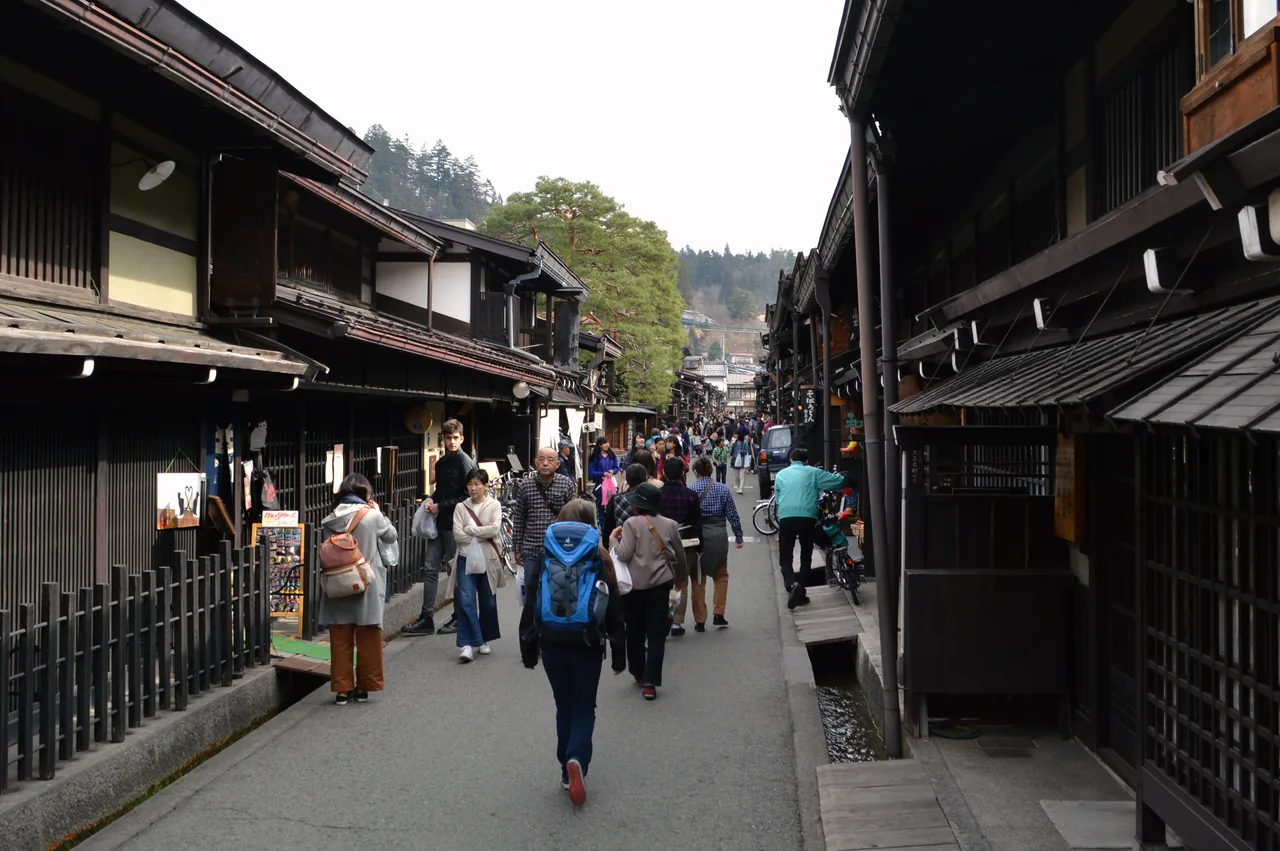
1. Why Takayama is worth the day trip
Takayama is the quintessential “old Japan in the mountains” day trip out of Nagoya: a preserved Edo townscape, riverside morning markets, melt-in-the-mouth Hida beef and the Japan Alps, all on one scenic train. What sets it apart from the many towns that market themselves as “Little Kyoto” is how much of the real thing survived.
Tucked high in northern Gifu Prefecture, Takayama was spared the fires, the wartime bombing and the postwar redevelopment that flattened old quarters elsewhere, so its merchant lanes, sake breweries and shogunate government house still stand where they did in the 1700s. This is no reconstruction; it is the town the Hida timber merchants actually built.
This guide is a spoke of our Nagoya travel guide and slots into any wider rail itinerary from the Japan travel guide, especially if you are already lining up Kyoto on the same trip.
2. The Limited Express Hida: how to ride it
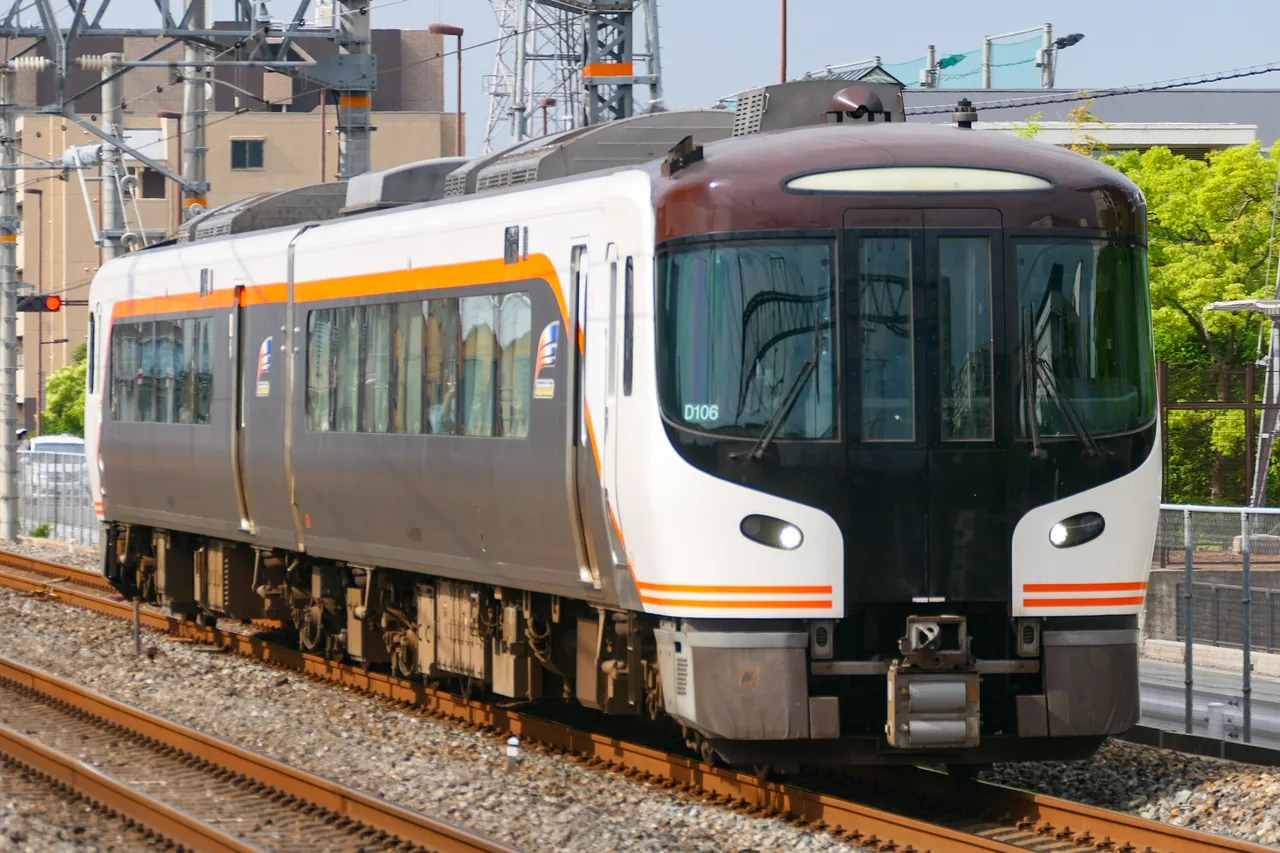
One train does the whole job: the Limited Express Hida (特急ひだ), a JR Central service that runs Nagoya to Takayama in about 2 hours 30 minutes on the scenic Takayama Main Line. No changes, no connections, just one comfortable ride each way.
Since the March 2023 timetable revision, every Hida runs on the new HC85 series hybrid trains (diesel plus battery), the successor to the old “Wide View Hida.” Expect floor-to-ceiling panoramic windows, power outlets at every seat, free onboard Wi-Fi and proper luggage space. The line runs north out of Nagoya via Gifu, Mino-Ota and Gero Onsen, then threads the narrowing Hida River valley into the mountains (some services continue to Toyama).
Fares, Nagoya to Takayama (one way, adult)
The price you pay combines the base fare and the limited-express surcharge, and the ticket machine works it out for you automatically. These are the current verified 2026 fares.
| Seat type | Japanese | One-way fare |
|---|---|---|
| Non-reserved seat | 自由席 | ¥5,610 |
| Reserved seat | 指定席 | ¥6,140 |
| Green (first class) car | グリーン車 | ¥8,410 |
Child fares are roughly half, and a round trip in a reserved seat comes to about ¥12,280. In other words, the train is the single biggest line in your day-trip budget, but it is far from expensive for what you get.
Reserved or non-reserved?
Most of the year you can ride non-reserved and pocket the ¥530 difference. The catch is that seats sell out on weekends, holidays and foliage or festival days, so reserve on those. During two peak blocks in 2026 the whole train is reserved-only, with no non-reserved cars at all:
- Golden Week: April 24 to May 6, 2026
- Obon: August 7 to 16, 2026
Which side for the best scenery?
The prettiest stretch is the Hida River gorge between Gero and Takayama, where the line hugs the water and the valley narrows. Both sides of the HC85 have the same huge windows and there is no real consensus on left versus right, so grab any window seat and do not overthink it. Plenty of riders simply take one side up and the other side back.
How to buy and reserve
At Nagoya Station you have three options: the green ticket machines, the JR ticket office (Midori-no-madoguchi), or online in advance through JR Central’s smartEX or e5489. You need a base-fare ticket plus a limited-express ticket, and the machine combines them into one transaction. If you hold a rail pass, you can grab a reserved seat for free at any JR station counter.
3. The exact timetable and planning your day
For a day trip, ride out on the first departure and come back late afternoon or evening. Hida 1 leaves Nagoya at 07:43 and arrives Takayama at 10:16, which is the sweet spot. Roughly one Hida runs every one to two hours, about ten Nagoya departures a day, and the times are not on the hour, so always check your exact train.
Nagoya to Takayama (take the first one)
| Train | Depart Nagoya | Arrive Takayama |
|---|---|---|
| Hida 1 | 07:43 | 10:16 |
| Hida 3 | 08:43 | 11:03 |
| Hida 5 | 09:39 | 12:20 |
| Hida 7 | 10:48 | 13:17 |
Takayama to Nagoya (take a late one back)
| Train | Depart Takayama | Arrive Nagoya |
|---|---|---|
| Hida 14 | 14:46 | 17:04 |
| Hida 16 | 15:34 | 18:06 |
| Hida 18 | 16:33 | 19:06 |
| Hida 20 (last) | 18:48 | 21:03 |
The day-trip sweet spot is out on Hida 1 (07:43) and back on Hida 18 (16:33) or the last Hida 20 (18:48), which gives you about 6 to 8.5 hours on the ground. That is plenty for the core town and enough to add one sight further out.
4. Tickets and passes: which is right for you
No pass? Just buy a point-to-point reserved ticket. Have a nationwide JR Pass? The ride is free. Doing Takayama plus Shirakawa-go plus Kanazawa over a few days? Then the regional pass earns its keep. Here is the decision laid out plainly.
| Your situation | What to do | Why |
|---|---|---|
| No rail pass, single day trip | Buy a point-to-point ticket, reserved on busy days | Round trip is only about ¥12,280, so a pass does not pay off |
| Hold a nationwide Japan Rail Pass | Ride free, reserve a seat at the counter | The Hida is a non-Nozomi limited express, so it is fully covered |
| Takayama + Shirakawa-go + Kanazawa over several days | Consider the Takayama-Hokuriku pass | It bundles trains and the Nohi bus across the whole loop |
If you already hold a nationwide Japan Rail Pass, this is the easy case: the Hida is included in full (ordinary car), and you can reserve a seat for free at any JR station, so the day trip’s train cost is effectively zero. For most international visitors touring Japan by rail, that alone makes Takayama a no-brainer detour.
The Takayama-Hokuriku Area Tourist Pass is a different animal, aimed at people doing the wider loop. It costs ¥19,800 adult (¥9,900 for children age 6 to 11), runs 5 consecutive days, and is for foreign-passport temporary visitors only. It covers JR between Nagoya, Takayama and Toyama including the Hida, the Hokuriku Shinkansen from Tsuruga to Toyama, Osaka to Tsuruga, and crucially the Nohi bus linking Takayama, Shirakawa-go and Kanazawa, with 6 free reserved seats.
5. Takayama old town: Sanmachi Suji and sake
Sanmachi Suji is Japan’s best-preserved Edo-period merchant quarter: three narrow lanes of dark-wood latticed townhouses, sake breweries, craft shops and snack stalls along the east bank of the Miyagawa River. It is a 10 to 15 minute flat walk (about 1 km) from the station, and it is the reason most people come.
The name San-machi means “three streets,” and the reason the quarter still feels lived-in rather than staged is that the families never left: those latticed merchant fronts now hold working cafes, sake shops and lacquerware galleries. The ground is dead flat, so the pleasure is in drifting slowly, ducking into a mossy courtyard here or a woodcraft studio there.
Sake culture and the sugidama
Takayama’s cold mountain water and rice made it a sake town, and seven historic breweries operate in and around the old town, most more than a century old. Each hangs a sugidama (杉玉) under its eaves, a ball of cedar branches that signals the brewing cycle: it is bright green when the new season’s sake is freshly pressed, and it slowly browns as the sake matures through the year. Once you know to look up for it, you will spot them all over the old town.
Most breweries will lend you an o-choko cup to taste for a few hundred yen. In deep winter the town runs rotating brewery-tasting events, roughly mid-January to early March, with one brewery opening its doors at a time. The dates rotate each season, so check the current schedule rather than relying on fixed ones. Takayama Old Town (Sanmachi Suji)Map
6. The morning markets: go first, they close at noon
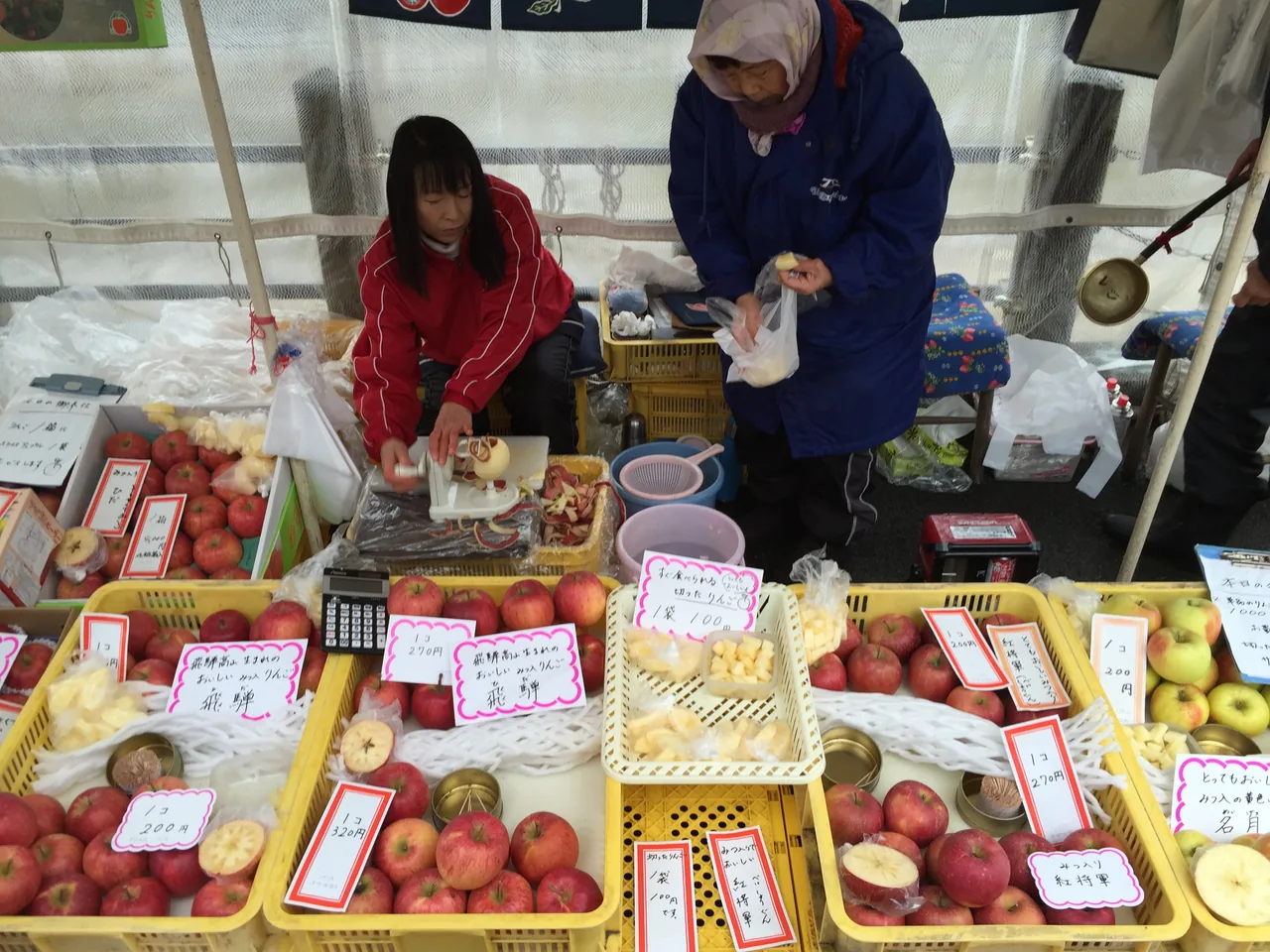
Takayama has run daily morning markets for centuries, and they shut at noon, so make them your first stop straight off the train. They are on the flat riverfront a short walk from the station, and they are where the town wakes up.
There are two, both daily and year-round:
- Miyagawa Morning Market (宮川朝市): the bigger and more famous of the two, about 350 m of stalls strung along the Miyagawa riverfront between the Kaji-bashi and Yayoi-bashi bridges, on the edge of the old town (roughly 10 to 12 minutes from the station). You will find local produce, pickles, flowers, sarubobo dolls, crafts, coffee and snacks. Reckon on about 60 stalls in summer, thinning to around 10 in the depths of winter.
- Jinya-mae Morning Market (陣屋前朝市): smaller and more focused on farm produce, held in the plaza in front of the Takayama Jinya. Easy to pair with a visit to the Jinya itself.
Hours are 07:00 to 12:00 from April to November, and 08:00 to 12:00 from December to March. Either way, noon is the hard stop.
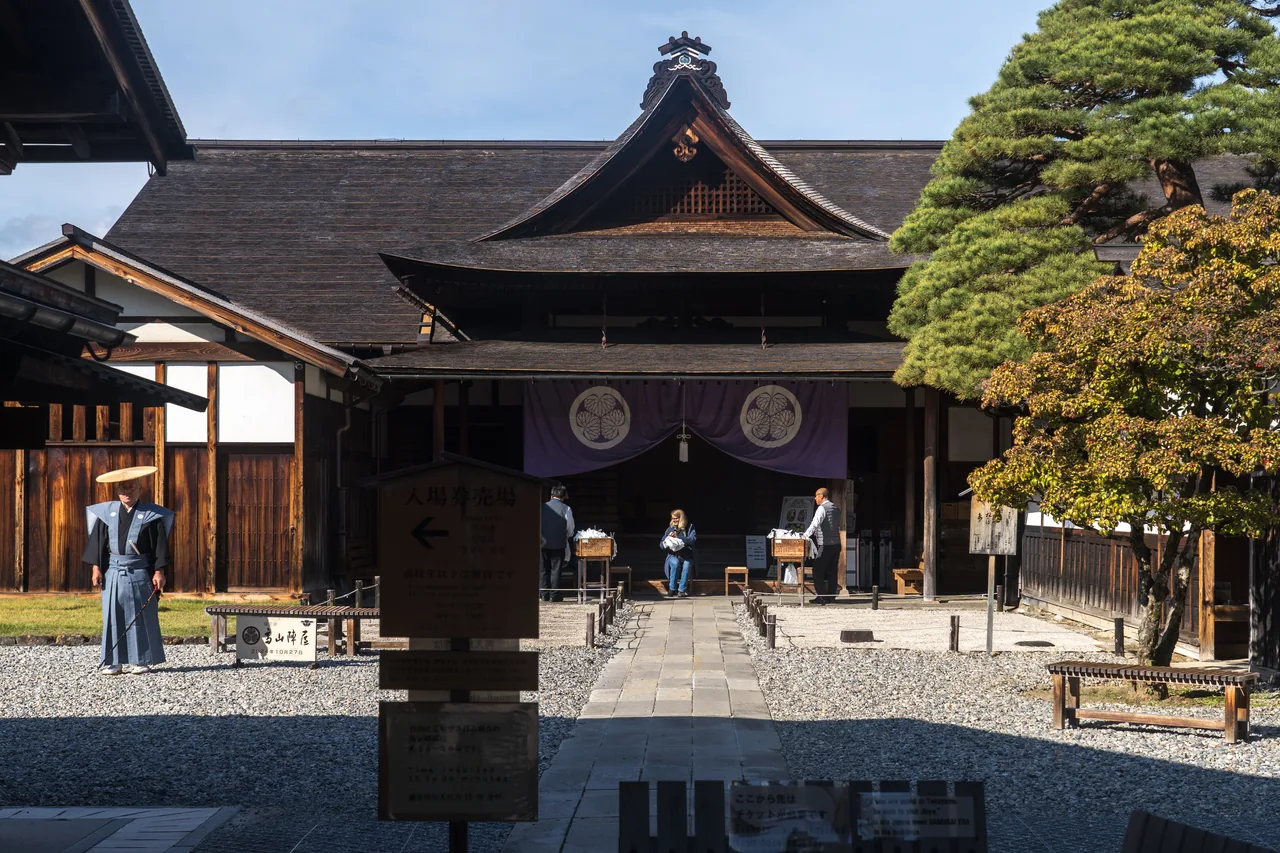
7. Takayama Jinya: the signature indoor sight
Takayama Jinya (高山陣屋) is the only surviving Edo-period provincial government house in Japan, and at ¥500 it is the one indoor sight worth prioritizing. It was the local headquarters of the Tokugawa shogunate after Hida came under direct shogunal control in 1692.
A little context makes it click. In the Edo period, most of Japan was carved into domains run by feudal lords, but a few strategically valuable regions, Hida among them for its timber and minerals, were placed under the shogunate’s direct rule. The Jinya was where the shogun’s appointed officials governed, collected the rice tax and dispensed justice. Walking through it, you pass the administrative offices, tatami audience rooms where officials received locals, a large rice granary, and even an interrogation room, which spells out how power actually worked here.
| Detail | Information |
|---|---|
| Admission | Adults ¥500 (¥450 for groups of 30+), free for age 18 and under |
| Hours (Apr to Oct) | 08:45 to 17:00 |
| Hours (Nov to Mar) | 08:45 to 16:30 |
| Last entry | 30 minutes before closing |
| Closed | December 29 to January 3 |
It sits right by the Jinya-mae morning market and a short walk from the old town, so the market, the Jinya and Sanmachi Suji form a tidy cluster you can do on foot without backtracking. Takayama JinyaMap
8. Hida beef and local food
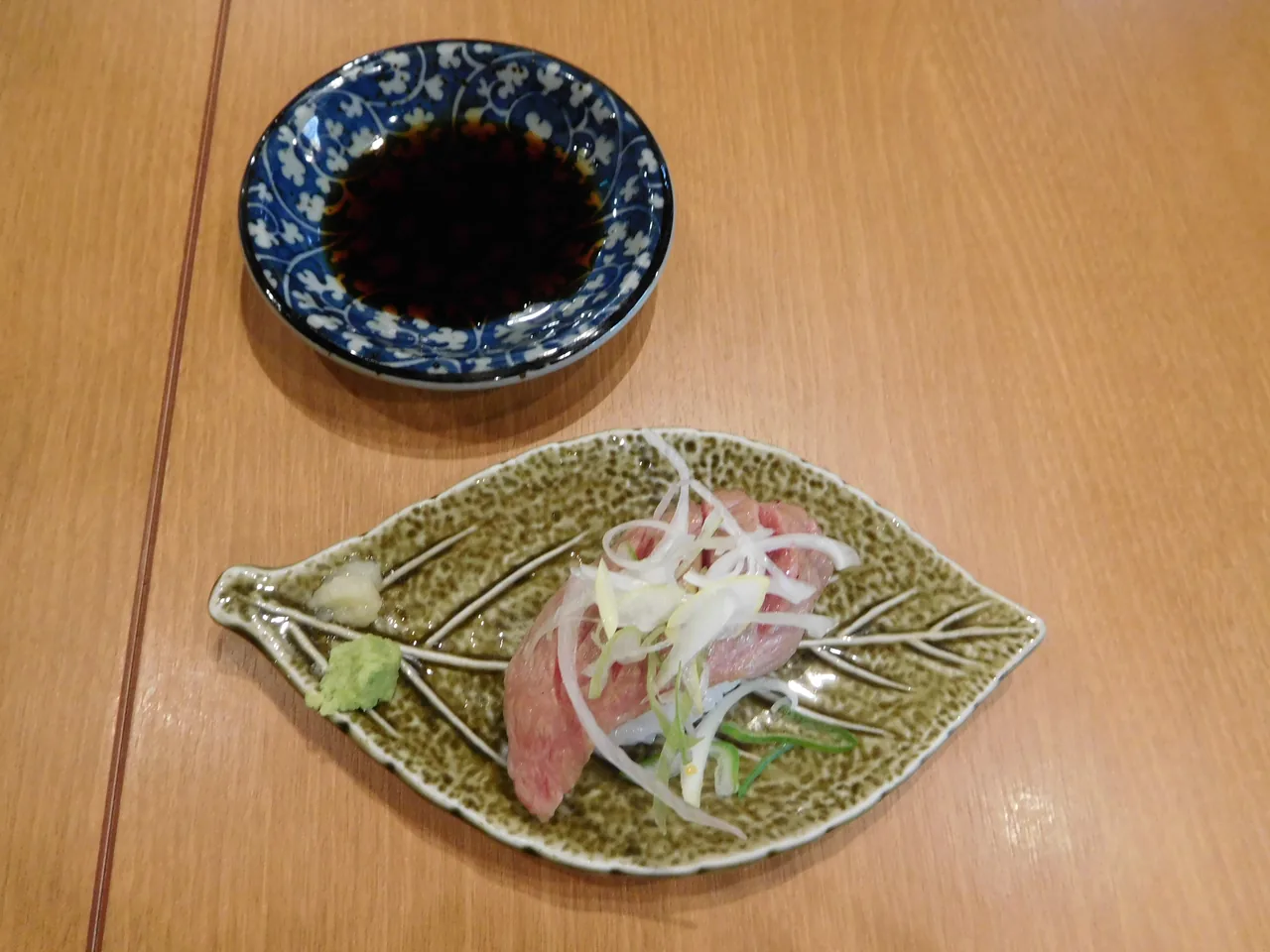
Hida beef (飛騨牛) is the reason to come hungry: premium Kuroge Wagyu that melts in the mouth and costs less here than in the big cities. The joy of a day trip is that you can eat it as street food all day rather than sitting down for one expensive meal.
Hida beef is black-haired Wagyu raised at least 14 months in Gifu Prefecture, graded by yield (A to C) and by marbling (1 to 5), with A4 and A5 the premium tiers. In the old town it comes in wonderfully casual forms:
| Dish | What it is | Rough price (2026) |
|---|---|---|
| Hida-beef nigiri / sushi | Seared slices over rice, often 2 pieces served on a senbei cracker | ~¥600 to 800 a set |
| Skewers (串焼き) | Grilled beef on a stick, eaten as you walk | ~¥500 to 800 |
| Croquette / menchi-katsu | Deep-fried beef croquette or minced-beef cutlet | ~¥200 to 350 |
| Sit-down sets | Steak, sukiyaki or a hoba-miso set meal | ~¥2,000 to 5,000+ |
The upshot is that you can eat very well all day on old-town street food plus a bowl of ramen for under ¥3,000. Graze rather than commit, and you get to try more.
The other local specialties
- Mitarashi dango (みたらし団子), Takayama style: grilled rice dumplings glazed with soy sauce only, so they are savory, not sweet. This trips up first-timers, because the Tokyo and Kansai version is sweet. At about ¥80 to 100 a skewer, it is the signature Takayama snack.
- Takayama ramen (高山ラーメン): thin curly noodles in a light soy broth, locally called chuka soba, with the broth and tare seasoning pre-blended. A comforting, no-fuss lunch.
- Hoba-miso (朴葉味噌): miso mixed with green onion and grilled on a dried magnolia leaf right at your table, a regional classic that shows up in breakfast and lunch sets.
Sarubobo, the souvenir to look for
The sarubobo (さるぼぼ) is the faceless red good-luck baby-monkey talisman that is the Hida region’s signature souvenir and mascot. Traditionally handmade by grandmothers for their daughters and grandchildren as a charm for safe childbirth and a happy marriage, it is now everywhere in charm, keychain and doll form. A red one is the classic, though modern colors carry their own meanings.
9. More sights if you have time
If the core cluster leaves you time, a handful of sights sit just beyond the old town, all near the station. Pick one rather than trying to cram them all, because a day trip rewards a relaxed pace over a checklist sprint.
Takayama Festival Floats Exhibition Hall (Yatai Kaikan)
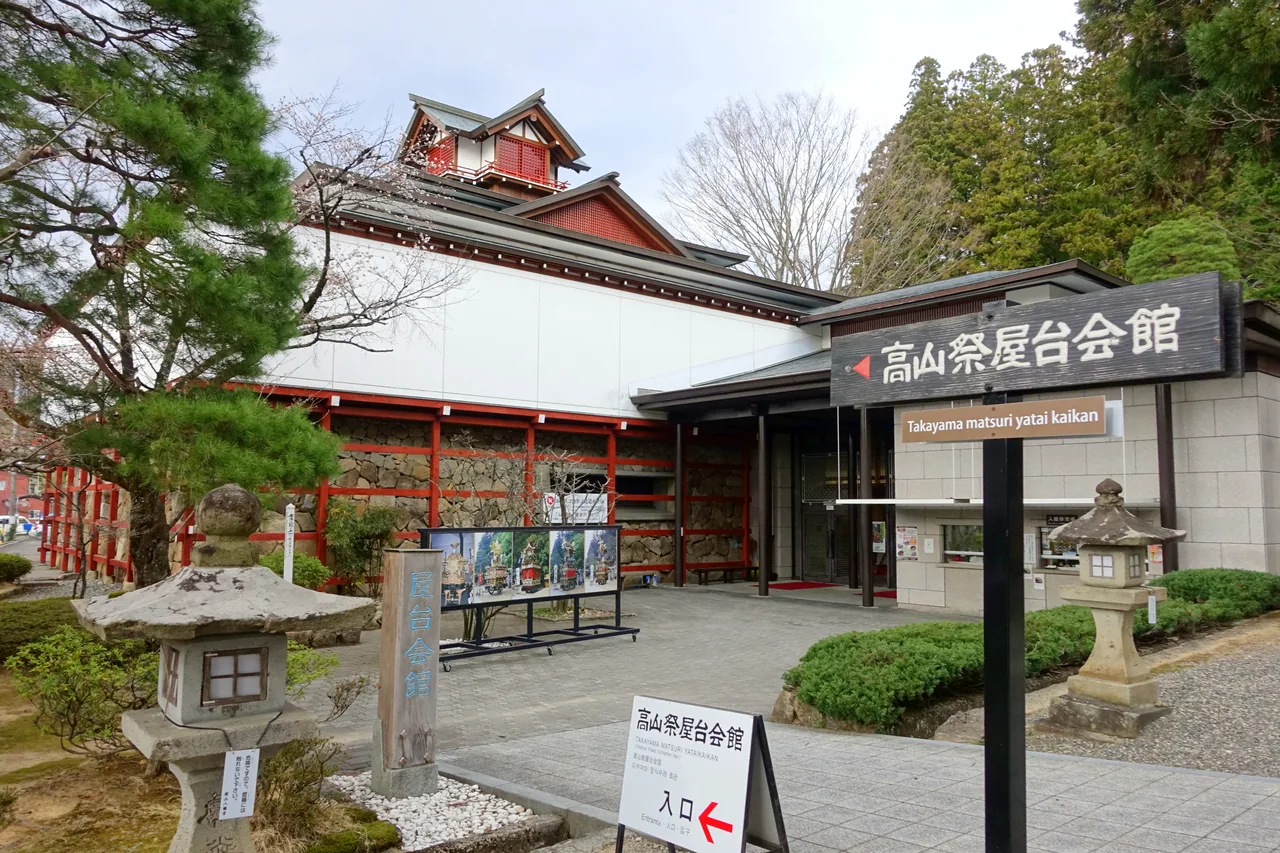
The Yatai Kaikan (屋台会館) displays 4 of the 11 real autumn-festival floats, rotated about three times a year, beside Sakurayama Hachimangu at the north end of the old town (a 15 to 20 minute walk). These yatai are staggering pieces of lacquer, gilt and carving, and seeing them up close is the next best thing to catching the festival itself. Admission is ¥1,000 for adults, open 09:00 to 17:00 (March to November) and 09:00 to 16:30 (December to February).
Sakurayama Hachimangu
The shrine (櫻山八幡宮) adjoins the float hall, with quiet, wooded grounds that make a calm quick stop while you are up at the north end. Ten minutes here pairs naturally with the Yatai Kaikan.
Hida Folk Village (Hida no Sato)
Hida no Sato (飛騨の里) is an open-air museum of relocated gassho-zukuri and Hida farmhouses, giving you a taste of the steep-thatched architecture that makes Shirakawa-go famous. Gassho-zukuri means “praying hands,” a nod to the way the vast, steeply pitched thatched roofs meet like two palms pressed together, an ingenious design that sheds the region’s heavy snow. Admission is ¥700 adults / ¥200 children, open 08:30 to 17:00 year-round.
It is reached by the Sarubobo Bus from the Nohi Bus Center next to the station (about 10 minutes, ¥100 a ride or ¥500 for a day pass) or a roughly 30 minute walk. The best value is the “Hida-no-Sato Set Ticket” at ¥1,000, which bundles the round-trip bus and admission. Allow 1.5 to 2 hours on site.
Higashiyama Walking Course
The Higashiyama Walking Course (東山遊歩道) is a roughly 3.5 km temple-town trail past temples, shrines and the old castle ruins, taking about 2 hours to walk in full. It is lovely with extra time, but probably too long for a tight day trip, so treat it as an option only if you have skipped other sights.
10. A realistic hour-by-hour itinerary
Here is a comfortable day built on arriving at 10:15 on Hida 1 and heading back on an evening train. Everything below is within a 15 to 20 minute flat walk of the station.
- 10:15 Arrive. Stash your bag in a station coin locker and grab a map at the tourist information center by the east exit.
- 10:30 to 12:00 Markets and old town. Go straight to the Miyagawa Morning Market (it closes at noon), then drift into Sanmachi Suji. Snack on Hida-beef nigiri, a skewer and a mitarashi dango, and look up for a sake brewery’s sugidama.
- 12:00 to 13:00 Hida beef lunch. A set meal in or near the old town, or simply more street snacks if you would rather keep grazing.
- 13:00 to 13:40 Takayama Jinya (¥500). The signature indoor sight and the historical heart of the day.
- 13:40 to 14:30 North end. The Yatai Kaikan float hall (¥1,000) and Sakurayama Hachimangu shrine.
- 14:30 to 15:30 Loose time. Souvenir shopping, a cafe, or a short stretch of the Higashiyama temple walk. Alternatively, skip the float hall and bus out to Hida no Sato instead, which pairs tidily with the Jinya.
- ~16:00 Head back. Collect your luggage and board the Hida to Nagoya, either Hida 18 at 16:33 or the last Hida 20 at 18:48.
Prefer a no-planning option? A guided day tour from Nagoya bundles the train and bus plus Shirakawa-go, so you just show up.
11. Extending to Shirakawa-go: add a night
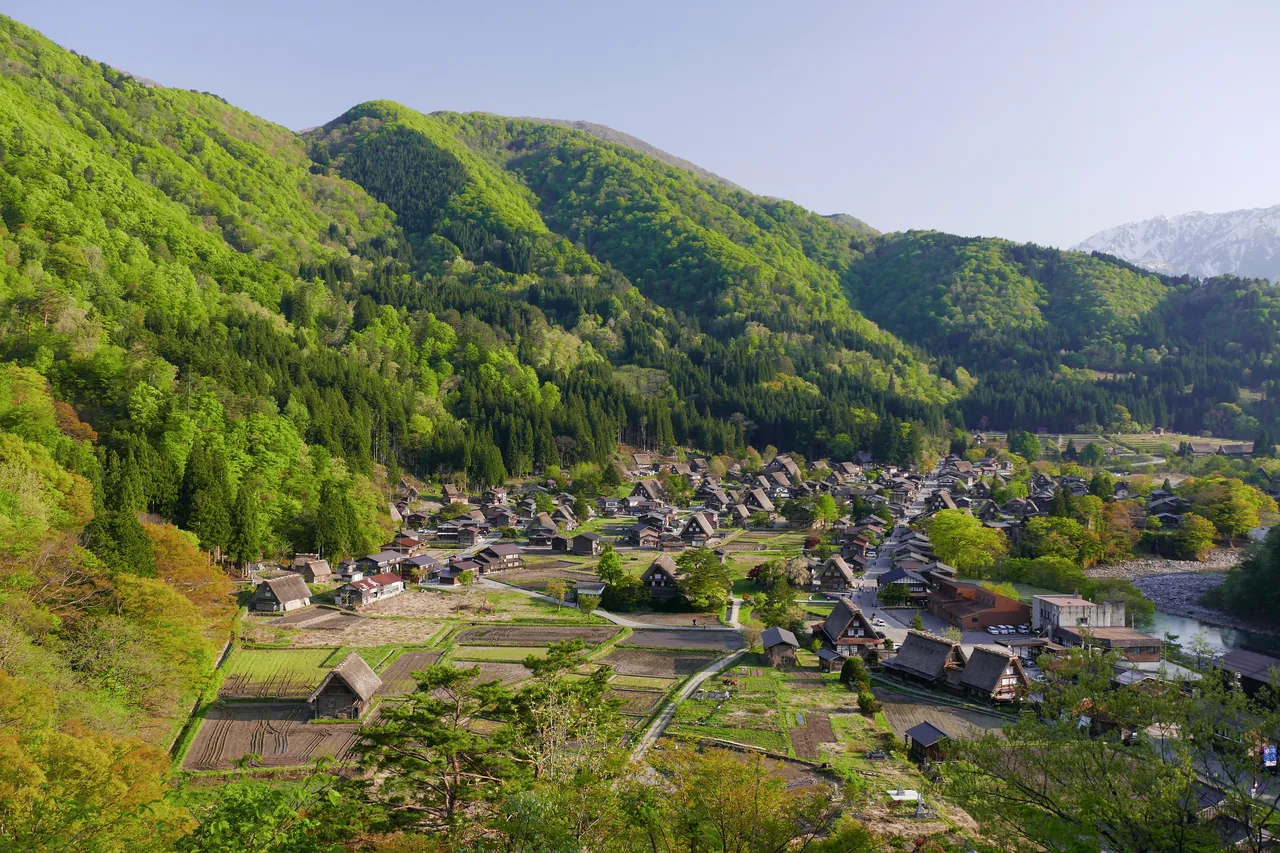
Shirakawa-go, the UNESCO village of thatched gassho-zukuri farmhouses, is a 50 minute bus ride from Takayama, but doing it as a same-day round trip from Nagoya is a rush we do not recommend. Add a night instead. A dedicated Shirakawa-go guide is coming, so here is the essential version.
Shirakawa-go is a World Heritage hamlet of steep-thatched gassho-zukuri farmhouses set in a mountain valley. The main village is Ogimachi, and the Shiroyama observation deck gives the classic panorama of the roofs against the valley. It is one of Japan’s most photographed rural scenes, which is exactly why it tends to appear on everyone’s list.
Getting there from Takayama means the Nohi bus:
- Route: Nohi Bus, from the Takayama Nohi Bus Center (right beside JR Takayama Station) to Shirakawa-go
- Time: about 50 minutes each way
- Fare: ¥2,800 one way for an adult (a round-trip ticket sells at a small discount over two one-ways, so check the current counter price)
- Frequency: around 16 round trips a day
Could you technically do Nagoya to Takayama to Shirakawa-go and back to Nagoya in a day? Yes, but you would bus straight out of Takayama and barely see either place. If Shirakawa-go matters to you, add a night in Takayama, Shirakawa-go or Gero Onsen and give both towns the time they deserve.
Prefer to hand off the logistics entirely? A guided day tour from Nagoya bundles the train and bus and both villages, so you get Shirakawa-go and Takayama in one planned package.
12. When to go: seasons
Takayama is a year-round day trip, but each season has a distinct character, and one winter caveat can quietly derail a plan. The town’s two great festivals also fix a couple of dates worth building around, or avoiding if you dislike crowds.
- Spring: cherry blossoms plus the Spring Festival (Sanno Matsuri) on April 14 to 15, which is spectacular but draws huge crowds. Book train seats well ahead.
- Autumn (Oct to Nov): mountain foliage plus the Autumn Festival (Hachiman Matsuri) on October 9 to 10, peak crowds again. Reserve your train, and your Shirakawa-go bus if you are adding it.
- Winter: the old town under snow is genuinely magical. But note the caveat below about the Shirakawa-go light-up.
- Summer: green and noticeably cooler than the sweltering plains, with fewer festival crowds. A relaxed, easy day trip.
The Takayama Festival
The Takayama Festival (高山祭) is ranked among Japan’s three most beautiful festivals, with elaborate float parades and karakuri, the intricate mechanical marionettes mounted on the floats that perform to music via hidden strings and cams, a craft going back to the Edo period. The spring festival is April 14 to 15 and the autumn one October 9 to 10. Evening float processions are the highlight, crowds are enormous, and train seats need booking far ahead.
For the wider picture of when central Japan is at its best, see our guide to the best time to visit Japan.
13. Practical tips and budget
Two things smooth a Takayama day trip: carry cash, and go hands-free with a station locker. Beyond that, the town is unusually easy for rural Japan, with English help where it counts.
- Coin lockers: at Takayama Station (near the east exit) and the Nohi Bus Center. Drop your bag and explore unencumbered.
- Tourist Information Center: on the ground floor at the station east exit, with English maps and staff. Open 08:30 to 18:30 (April to October) and 08:30 to 17:00 (November to March).
- English: more available than you might expect for a mountain town, with English signage, menus and information across the old town and major sights.
- Cash: carry it. Market stalls and small old-town vendors are often cash-only. ATMs at the station-area post office and konbini (7-Eleven, Lawson) accept foreign cards. Cards and IC payment are increasingly fine at larger places, but not at the markets.
Staying connected
You will want data for maps, train times and translating a menu or two, and mountain Takayama is no place to hunt for Wi-Fi. A travel eSIM set up before you land keeps you online the whole trip, from the Hida platform at Nagoya to the market stalls.
For choosing and installing one, see our Japan eSIM and data guide.
A rough day-trip budget from Nagoya (per person, 2026)
| Item | Estimate |
|---|---|
| Train, round trip (reserved) | ~¥12,280 |
| Sights (Jinya, one or two more) | ~¥1,000 to 2,500 |
| Food (street snacks + a meal) | ~¥2,000 to 3,500 |
| Locker and miscellaneous | ~¥500 |
| Total (without Shirakawa-go) | ~¥16,000 to 19,000 |
Add roughly ¥5,600 for the round-trip Shirakawa-go bus if you tack it on. A nationwide JR Pass or the Takayama-Hokuriku pass changes the train figure dramatically, in which case your on-the-ground spend drops to sights and food.
14. The verdict, and planning the rest of your trip
Takayama is one of the most rewarding day trips in central Japan, and the Nagoya to Takayama Hida ride makes it easy. Take the first train, hit the markets before noon, graze on Hida beef, and let the old town do the rest. Few day trips give you this much genuine, preserved atmosphere for so little planning.
The honest caveats are worth repeating. The morning markets close at noon, so arrive early and go there first. Pick one “extra” sight rather than racing the whole list. And if Shirakawa-go is a must-see, do not try to bolt it onto a same-day round trip from Nagoya. Add a night and enjoy both towns properly.
To recap the essentials:
- The train: Limited Express Hida, about 2h30, ¥5,610 non-reserved one way, free on a nationwide JR Pass. Out on Hida 1 (07:43), back on Hida 18 or 20.
- The core day: Miyagawa Morning Market, Sanmachi Suji old town and sake, Hida beef street food, and Takayama Jinya (¥500).
- The upgrade: add a night for Shirakawa-go, and reserve seats for festival and foliage dates.
Plan the wider journey from our Nagoya travel guide, the hub this day trip belongs to, and the Japan travel guide. If you are flying into central Japan, our Centrair Airport to Nagoya guide covers that first leg, and the Ghibli Park guide makes a natural second Nagoya day. Heading onward by rail, Kyoto is an easy connection from the same network.